

Contents
Overview
| Name | Beijing 北京市 |
| Web address | https://parkofchina.com/en/citybeijing.html |
| Location | Beijing |
| Highlights | Imperial palaces and gardens, altars and temples, Great Wall, hutongs and courtyard houses |
| Top sights | Forbidden City, Temple of Heaven, Summer Palace, Badaling |
| Coordinates | 39.9, 116.4 Google Maps |
| Nearby cities | Langfang ↘︎48km, Tianjin ↘︎114km |
| Nearby airports | Beijing Capital International Airport ↗︎26km, Beijing Daxing International Airport ↓︎44km |
| Nearby sites | The Forbidden City (Palace Museum), Beijing ↑︎2km, The Temple of Heaven, Beijing ↓︎2km, Prince Gong’s Mansion, Beijing ↖︎4km, The Summer Palace, Beijing ↖︎15km, The Great Wall ↖︎60km, Eastern Qing Tombs →︎110km |
| Themes | Big City, Palace, Ancient City, Ancient Building, Culture, Museum, Buddha, Temple, Tower, Garden, Tomb, City Wall, Building, Prehistory, Mountain, Lake, Theme Park, Stamp, Imperial palaces & gardens, Chinese gardens, Passes & fortifications, Food, Confucian academies & temples |
About
Beijing, the capital of China, is a municipality with over 3,000 years of history; five dynasties made it their capital, and it is one of China’s ancient capitals. The 2008 Summer Olympics were held here.
Beijing lies at the northern tip of the North China Plain, with the Western Hills, an outlier of the Taihang Mountains, to the west and the Yanshan Mountains to the north; the two ranges close round it to the north-west, while to the south-east it opens onto the plain. The Yongding River leaves the Western Hills and spreads an alluvial fan across the plain, and the old city stands on that fan. Juyongguan to the north-west and Gubeikou to the north-east are the main passes through the Yanshan to the lands beyond the frontier, which made Beijing the gateway between the Central Plain and the northern steppe and the north-east.
The early Zhou states of Ji and Yan were both here, and Yan later made the city of Ji its capital, near today’s Guang’anmen. The Liao made it a secondary capital, called Nanjing (Southern Capital); the Jin moved their capital here and called it Zhongdu; the Yuan built a new capital, Dadu, north-east of Zhongdu, planned round the Jishuitan lake, which fixed the position of today’s old city. The Ming rebuilt the walls and in the Yongle reign moved the capital here, naming it Beijing, and in the Jiajing reign added the outer city; the Qing kept it. The Beijing Central Axis, running through the old city from Yongding Gate in the south to the Bell and Drum Towers in the north, has the palace city, the imperial city, the Temple of Heaven, the Altar of Agriculture and other buildings laid out symmetrically along it.
Beijing has eight World Heritage sites: the Great Wall, the Imperial Palaces of the Ming and Qing and the Peking Man Site at Zhoukoudian (inscribed 1987), the Summer Palace and the Temple of Heaven (1998), the Ming Tombs as part of the Imperial Tombs of the Ming and Qing Dynasties (2003), the Grand Canal (2014) and the Beijing Central Axis (2024).
In the city

Places on the map: Forbidden City 故宫 E5, Temple of Heaven 天坛 F6, Summer Palace 颐和园 A1, Jingshan 景山 E4/E5, Beihai 北海 E4, Yonghe Temple 雍和宫 F3/F4, Temple of Earth 地坛 F3, Old Summer Palace ruins 圆明园遗址 B1, Beijing Zoo 北京动物园 C4, Beijing Railway Station 北京站 F5/F6, Beijing West Station 北京西站 C6, Beijing South Station 北京南站 E7, Shichahai 什刹海 E4, Peking University 北京大学 B1, Tsinghua University 清华大学 C1, Bird's Nest & Water Cube 鸟巢、水立方 E1, National Museum 国家博物馆 E5/F5, Capital Museum 首都博物馆 C5, National Art Museum 中国美术馆 F4/F5, Military Museum 军事博物馆 C5, National Natural History Museum 国家自然博物馆 E6, Tiananmen 天安门 E5, Prince Gong’s Mansion 恭王府 E4, Dazhong Temple 大钟寺 C2/C3, Guozijian 国子监 F3/F4, Bell and Drum Towers 钟鼓楼 E4, Qianmen 前门 E6, Baita Temple 白塔寺 D4/D5, Baiyun Temple 白云观 C6/D6, Nanluoguxiang 南锣鼓巷 E4/F4, National Centre for the Performing Arts 国家大剧院 E5/E6, Sanlitun 三里屯 G4, CCTV Headquarters 央视大楼 H5, Deshengmen Arrow Tower 德胜门箭楼 E3, Southeast Corner Tower 东南角楼 G6.
Forbidden City: the imperial palace of the Ming and Qing, completed in the Yongle reign and enclosed by walls, corner towers and a moat. The southern half, centred on the three great halls of Supreme Harmony, Central Harmony and Preserving Harmony, is the outer court used for state ceremonies; the northern half is the inner court where the emperor and his consorts lived. It is now the Palace Museum, with collections of old painting and calligraphy, ceramics, bronzes and court objects.

Tiananmen Square: Tiananmen, the Gate of Heavenly Peace, was the main gate of the Ming and Qing imperial city, south of the Forbidden City; at the south end of the square in front of it stand the gate tower and arrow tower of Zhengyangmen (Qianmen). On the west side of the square is the Great Hall of the People, with the National Centre for the Performing Arts, an elliptical dome surrounded by water, beyond it; on the east is the National Museum of China, whose collections run from prehistory to modern times and include the Shang-dynasty Houmuwu bronze ding.
Jingshan, Beihai and Shichahai: Jingshan, due north of the Forbidden City, was piled up in the early Ming from earth dug for the moat; the Wanchun Pavilion on its top sits on the central axis and overlooks the whole palace. Beihai, north-west of the palace, has been an imperial garden since the Liao and Jin, with a White Dagoba built in the early Qing on Qionghua Island; Beihai and the Zhonghai and Nanhai lakes to the south were once called the Taiye Pool. Shichahai, north of Beihai, is what remains of the Yuan lake of Jishuitan, then the terminal harbour of the Grand Canal; along its shores are Prince Gong’s Mansion and whole districts of hutongs. Prince Gong’s Mansion is the best-preserved Qing princely residence: in the Qianlong reign it was the house of Heshen, later passing to Prince Gong, with a garden behind it; and to the north the Bell and Drum Towers mark the northern end of the axis. South-east of them, the hutongs on either side of Nanluoguxiang run out in matching rows, keeping the street plan of Yuan Dadu.
Temple of Heaven: east of the central axis in the southern city, where the Ming and Qing emperors worshipped Heaven and prayed for good harvests. To the north the Hall of Prayer for Good Harvests is a round hall with three tiers of eaves; to the south the Circular Mound is an open-air altar of three stone terraces; the two are linked by the raised Danbi Bridge. The outer wall is round in the north and square in the south, after the old idea of a round heaven and a square earth. Matching it west of the axis is the Altar of Agriculture.

Summer Palace and Old Summer Palace: in the north-western suburbs. The Summer Palace, first called Qingyiyuan, was built in the Qianlong reign around Kunming Lake and Longevity Hill; the Tower of Buddhist Incense on the front of the hill is the centre of the garden, and the Long Corridor runs along the shore. The Old Summer Palace (Yuanmingyuan), east of it, was made up of three gardens, Yuanming, Changchun and Wanchun, and included the European-style Xiyanglou buildings. Both were burned by the Anglo-French force in 1860; the Summer Palace was rebuilt in the Guangxu reign and given its present name, while the Old Summer Palace is now a ruins park. Jade Spring Hill and the Fragrant Hills to the west also held Qing imperial gardens, together known as the Three Hills and Five Gardens. East of the Old Summer Palace is Tsinghua University and to the south-east Peking University, both with the sites of Qing princely gardens on their campuses.
Yonghe Temple, the Confucius Temple and the Imperial Academy: just inside the Second Ring Road in the north-east. Yonghe Temple was the residence of the Yongzheng Emperor before he came to the throne and was turned into a Tibetan Buddhist monastery in the Qianlong reign; the Wanfu Pavilion holds a great Maitreya carved from white sandalwood. Across the street to the west, the Confucius Temple and the Imperial Academy (Guozijian) were where the Yuan, Ming and Qing honoured Confucius and ran the highest school of the empire; the Confucius Temple keeps the steles listing the successful candidates of the palace examinations. The Temple of Earth (Ditan), north of Yonghe Temple, is the square altar where the Ming and Qing worshipped Earth.
Baita Temple and Baiyun Temple: the Baita (White Dagoba) Temple, or Miaoying Temple, in the western city has a Yuan-dynasty Tibetan-style stupa built under the Nepalese craftsman Araniko, the oldest and largest of its kind in Beijing; the Baiyun Temple outside Xibianmen is the ancestral temple of the Quanzhen school of Daoism, where Qiu Chuji is buried.
Museums: besides the National Museum, the Capital Museum, at Fuxingmen on the western extension of Chang’an Avenue, covers Beijing’s history and antiquities; the National Art Museum of China, north of Wangfujing, collects modern and contemporary Chinese art; the National Natural History Museum, west of the Temple of Heaven, shows fossils, animals and plants; the Military Museum is in the western suburbs; the Dazhong Temple on the western Third Ring Road is a museum of ancient bells, holding the Ming-dynasty Yongle Bell. On the northern extension of the central axis is the Olympic Park, with the National Stadium (the Bird’s Nest) and the National Aquatics Center (the Water Cube) of the 2008 Olympics. To the east in Chaoyang, Sanlitun is a shopping district beside the embassy quarter, and on the East Third Ring Road the CCTV Headquarters is made of two leaning towers joined at the top.
Outside the city

Places on the map: Badaling 八达岭 B1, Juyongguan 居庸关 B2, Ming Tombs 十三陵 D2, Fragrant Hills 香山 D6, Marco Polo Bridge 卢沟桥 D8, Tanzhe Temple 潭柘寺 B7, Jietai Temple 戒台寺 C8, Summer Palace 颐和园 E6, Forbidden City 故宫 F7, Capital Airport 首都机场 H5, Mount Miaofeng 1,291m 妙峰山 1,291m B5, Dajue Temple 大觉寺 C5, Fahai Temple 法海寺 C7, Badachu 八大处 D6/D7, Old Summer Palace 圆明园 E6, Temple of Heaven 天坛 F7/F8, Bird's Nest 鸟巢 F6, 798 Art District 798艺术区 G6, Hongluo Temple 红螺寺 H1, Zhoukoudian 周口店 A10, Shihua Cave 石花洞 A9, Temple of the Sleeping Buddha 卧佛寺 D6, Shougang Park 首钢园 C7.
Map © Park of China · © OpenStreetMap contributors · Map credits
Great Wall: most of the wall in Beijing was built in the Ming and follows the ridges of the Yanshan and Jundu mountains. Badaling in Yanqing, guarding the northern end of the Juyongguan pass, was the first section opened to visitors and is the best known; Juyongguan in the Guangou valley to the south has the Yuan-dynasty Cloud Platform, carved with Buddhist incantations in six scripts. Mutianyu in Huairou has closely spaced watchtowers and well-wooded hills; Simatai in Miyun climbs steep ridges, keeps more of its Ming appearance and joins Jinshanling in Luanping, Hebei, to the east.

Ming Tombs: at the southern foot of Tianshou Mountain in Changping, the burial place of thirteen Ming emperors after the move of the capital to Beijing. The tombs share a single Spirit Way lined with stone figures. Changling is the largest, and the underground palace of Dingling has been excavated and is open.
Zhoukoudian: on Longgu Hill in Fangshan in the south-western suburbs, caves that yielded fossils of Peking Man, a Homo erectus of about 700,000 to 200,000 years ago, with traces of the use of fire, and remains of the much later Upper Cave Man. The first Peking Man skull was found by Pei Wenzhong in 1929; the originals were lost during the War of Resistance against Japan.
Marco Polo Bridge: a multi-arched stone bridge over the Yongding River in the south-west, built in the Jin, with stone lions in varied poses on the balustrade posts; Dawn Moon at Marco Polo Bridge is one of the Eight Views of Yanjing. The Marco Polo Bridge Incident of 7 July 1937 broke out here. Up the Yongding River to the north, Shougang Park in Shijingshan has been made out of the old steelworks; the Big Air ramp of the 2022 Winter Olympics stands inside it.
Temples of the Western Hills: the Fragrant Hills are the site of the Qing Jingyi Garden, red with smoke-tree leaves in autumn; nearby are the Sleeping Buddha Temple in the Beijing Botanical Garden, Biyun Temple and Badachu. Tanzhe Temple in Mentougou was founded in the Western Jin, and a saying goes that Tanzhe Temple came before the city of Beijing; the ordination platform of the nearby Jietai Temple dates back to the Liao. Yunju Temple in Fangshan keeps stone sutras carved from the Sui onwards.
Hills and waters: Shidu in Fangshan is a gorge cut by the Juma River through limestone hills, and Stone Flower Cave is a cave on several levels; Longqing Gorge in Yanqing is a gorge lake formed by a dam.
Further afield: the Eastern Qing Tombs at Zunhua, Hebei, the largest imperial burial ground of the Qing, hold the Shunzhi, Kangxi and Qianlong emperors and Empress Dowager Cixi among others; the Western Qing Tombs are at Yixian. To the east, Jizhou in Tianjin has Mount Pan and Dule Temple with its Liao timber Guanyin Pavilion; to the south-west, Laishui in Hebei has Yesanpo; and to the north-east is the Chengde Mountain Resort, where the Qing emperors spent the summer and ran the government.
The Eight Views of Yanjing
The Eight Views of Yanjing were already named in the Jin and varied from age to age; they were fixed in the Qianlong reign, with a stele and poem set up at each:
- Autumn Wind on Taiye Pool: Zhongnanhai (the old Taiye Pool).
- Spring Shade on Qiong Island: Qionghua Island in Beihai.
- Sunset at the Golden Terrace: outside Chaoyangmen, by tradition the Golden Terrace where King Zhao of Yan received men of talent.
- Misty Trees at Jimen: the Yuan Dadu earthen wall in the north-west of the city.
- Clear Snow on the Western Hills: the Fragrant Hills.
- Gushing Jade Spring: Jade Spring Hill.
- Dawn Moon at Lugou: Marco Polo Bridge.
- Layered Green at Juyong: Juyongguan.
Local food
Peking duck is the city’s best-known dish: the duck is roasted until the skin is crisp and the meat tender, sliced, and rolled in thin pancakes with sweet bean sauce, scallion and cucumber. There are two methods, the hung-oven duck, roasted over an open fruit-wood fire, and the closed-oven duck, cooked in the residual heat of a preheated oven wall.

Shuan yangrou (mutton hotpot) is cooked in a charcoal-heated copper pot, with thin slices of mutton swished in plain broth and dipped in sesame sauce, fermented tofu and chive-flower sauce. Zhajiangmian is Old Beijing’s home-style noodle dish: noodles tossed with fried soybean paste and diced pork, topped with shredded cucumber, bean sprouts and other vegetables.
Snacks include douzhi, a sour fermented drink made from the liquid left after mung-bean starch is produced, often served with jiaoquan (fried dough rings) and pickles; wandouhuang, a cake of set pea purée; lüdagun (“rolling donkey”), a glutinous rice roll coated in roasted soybean flour and filled with red bean paste; and baodu, tripe blanched quickly and dipped in sesame sauce.
Travel tips
Getting there: Capital and Daxing airports connect to the city by metro and airport lines. Beijing, Beijing West, Beijing South, Fengtai and Beijing Chaoyang are the main railway stations, and the Beijing-Zhangjiakou high-speed line has a Badaling Great Wall station. Within the city the metro does most of the work, with buses and taxis.
Central area: Tiananmen Square, the Forbidden City, Jingshan, Beihai and Shichahai run north to south and can be linked on foot along the central axis in a day; the Forbidden City alone takes more than half a day.
Temple of Heaven and Summer Palace: the Temple of Heaven is in the south of the city and the Summer Palace in the north-west, each needing half a day. The Old Summer Palace is next to the Summer Palace and can be seen the same day.
Great Wall: Badaling is nearest, with a Badaling Great Wall station on both the Beijing-Zhangjiakou high-speed line and suburban line S2, and can be combined with the Ming Tombs in a day; Mutianyu, Simatai and Jinshanling need a direct shuttle bus or a hired car.
Suburbs: Tanzhe and Jietai temples are in Mentougou to the west, and Zhoukoudian, Yunju Temple and Shidu in Fangshan to the south-west; each group takes a day.
Universal resort: Universal Beijing Resort in Tongzhou, in the eastern suburbs, is a film-themed park reached directly by Metro Lines 1 and 7; allow a full day.
Hutongs: Shichahai, Nanluoguxiang and Dongsi keep many hutongs and courtyard houses, best seen on foot or by pedicab.
Peking opera: Peking opera took shape in the mid and late Qing, after the Anhui troupes came to the capital in the Qianlong reign and absorbed Kunqu, Han opera and other styles, and became Beijing’s representative theatre; it is performed in old theatres such as the Huguang Guild Hall and in theatres around the city.
Local products: cloisonné, carved lacquer and candied fruit.
Time: four to five days gives time for the main city sights plus one section of the Great Wall.
Season: spring and autumn are best, with red leaves in the Fragrant Hills in autumn; summer is hot and rainy, winter dry and cold.
Where to stay: around Tiananmen, Qianmen and Wangfujing for the Forbidden City; elsewhere along the metro lines.
Stamps
Many stamps have featured Beijing since 1949; a few representative sets:
From 1950 seven editions of definitive stamps (R1, R2, R3, R4, R5, R7 and R9) showed the Gate of Heavenly Peace; below is R1.
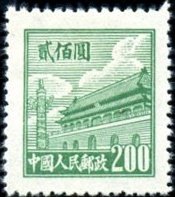
R1
On 15 June 1956 China Post issued S15 “Famous Sights of the Capital”, five stamps: the Summer Palace, Beihai, Tiananmen, the Temple of Heaven and the Hall of Supreme Harmony.
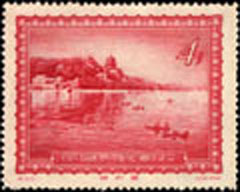
The Summer Palace 
Beihai 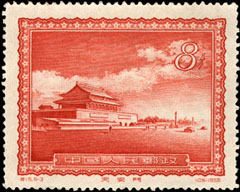
Tiananmen 
The Temple of Heaven 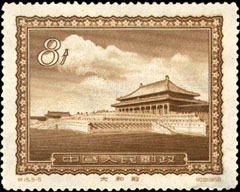
The Hall of Supreme Harmony
In 1958 China Post issued C47 “Monument to the People’s Heroes”, a single stamp.

Monument to the People’s Heroes
On 2 April 1979 the definitive set R20 “Beijing Scenery”, three stamps: Jingshan Park, the Summer Palace and Beihai Park.
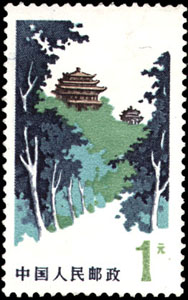
Jingshan Park 
The Summer Palace 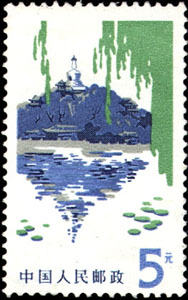
Beihai Park
One of the 14 stamps of the 1986 definitive set R23 “Traditional Dwellings” shows a Beijing dwelling.
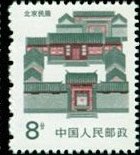
A Beijing dwelling
The third stamp of the 2003 set 2003-5 “Ancient Bridges of China – Arch Bridges” shows the Marco Polo Bridge in Beijing.

The Marco Polo Bridge in Beijing
On 20 December 2007 the set 2007-32 “Games of the XXIX Olympiad – Competition Venues”, six stamps and a souvenir sheet: the China Agricultural University gymnasium, the Laoshan velodrome, the National Indoor Stadium, the Peking University gymnasium, the National Aquatics Center, the Qingdao Olympic Sailing Center, and the National Stadium.
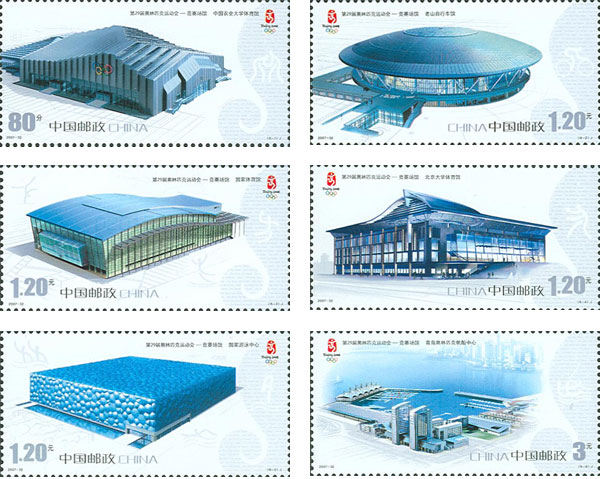
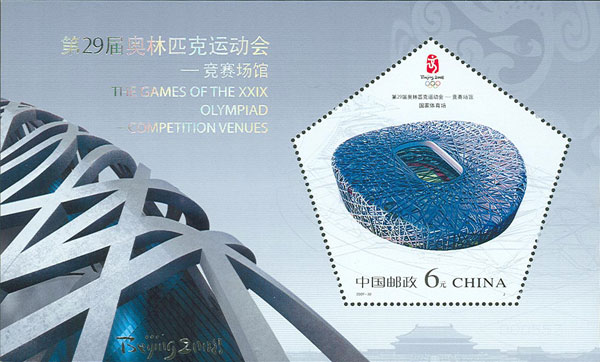
Souvenir sheet: National Stadium
The third stamp of the 2022 set 2022-22 “Famous Pavilions of China (II)” shows the Wanchun Pavilion on Jingshan.
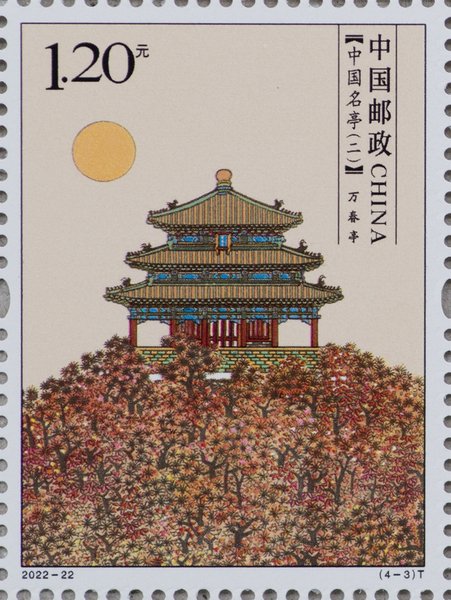
The Wanchun Pavilion on Jingshan
Classical Chinese texts
The texts are in Chinese, in our Library of Chinese Literature.
- 郦道元 Li Daoyuan: 《水经注·㶟水(北京)》(节选)
- 李白 Li Bai: 《北风行》
- 祖咏 Zu Yong: 《望蓟门》
- 马可·波罗: 《马可·波罗游记(节选)》卷二第二十四章《马可·波罗游记(节选)》卷二第三十五章《马可·波罗游记(英文本)》Book II, Chapter VI《马可·波罗游记(英文本)》Book II, Chapter X《马可·波罗游记(英文本)》Book II, Chapter XI《马可·波罗游记(英文本)》Book II, Chapter XXII《马可·波罗游记(英文本)》Book II, Chapter XXXIII
- 袁宏道 Yuan Hongdao: 《满井游记》
- 朱自清 Zhu Ziqing: 《荷塘月色》
- 郁达夫 Yu Dafu: 《故都的秋》
Chinese Culture: A Brief History of Chinese Architecture, Chapter 1, Chapter 6, Chapter 7, Chapter 8, Chapter 9, Chapter 10
Chinese Scenery Stamps: Tiananmen Definitives (Issues 1 to 7: R1, 2, 3, 4, 5, 7, 9) (Pu1-9), Scenic Sites of the Capital (Te15), Monument to the People's Heroes (Ji47), Beijing Scenery Definitives (Pu20), Folk Houses Definitives (Pu23), Ancient Chinese Bridges – Arch Bridges (2003-5), Famous Pavilions of China (II) (2022-22)
Nearby
Photo credits: Peking duck: Mr Wabu (CC BY-SA 2.0, Wikimedia Commons); Forbidden City: xiquinhosilva (CC BY 4.0, Wikimedia Commons)