 Park of China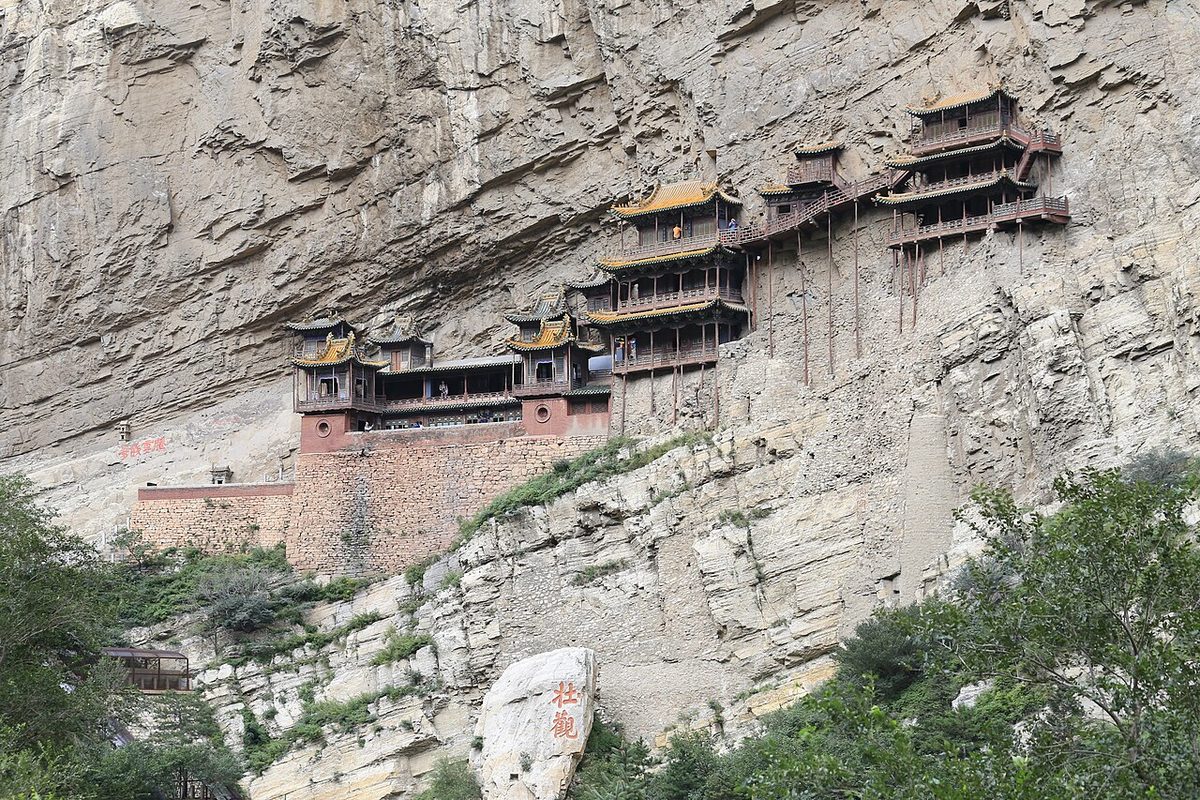
Overview
| Designation | National Park of China (first batch) |
| Province | Shanxi |
| Location | Hunyuan County, Shanxi |
| Mountains | Mountain Ranges of China |
| Latitude, longitude | 39.7, 114.0 Google Maps |
| Highlights | The Northern Sacred Mountain of the Five Sacred Mountains |
| Top sights | The Hanging Temple |
| Highest point | 2,016 m |
| Nearby cities | Datong (Shanxi) |
| Nearby sites | Mount Wutai 86km, Yungang Grottoes 88km, Peking Man Site at Zhoukoudian 172km, The Summer Palace, Beijing 196km Search nearby |
| Themes | Famous Mountain, Mountain, Ancient Building, Stamp, Taoism, Temple, Cliff |
About
Mount Heng, the Northern Sacred Mountain, lies in Hunyuan County, Shanxi; its summit is 2,016 m and it is called “the first mountain beyond the passes”. The famous Hanging Temple clings to the west cliff of Jinlong Gorge outside the mountain gate, first built in the late Northern Wei. The Beiyue Temple on the west peak is dedicated to the god of the Northern Sacred Mountain.
Mount Heng, the Northern Sacred Mountain, rises south of the Hunyuan county seat in Shanxi; its main peak, Tianfeng Ridge, is 2,016 m. The range runs 150 km from north-east to south-west, dividing the Sanggan and Hutuo rivers, and was from ancient times the key pass from the northern frontier to the central plains. Before the Ming the Northern Sacred Mountain was worshipped at Quyang in Hebei; the rites moved to Hunyuan under the Shunzhi Emperor of the Qing. The mountain has Taoist buildings such as the Beiyue Temple and the Huixian Mansion, and the Hanging Temple, a wonder where Buddhism, Taoism and Confucianism share one roof.
Xu Xiake climbed Mount Heng over three days in 1633 and recorded the trip in his “Diary of a Journey to Mount Heng”.
It is in the first batch of national parks of China (national scenic areas) named by the State Council in 1982.
Travel tips
Getting there: go first to Datong (high-speed trains to Datong South), then by bus or hired car to Hunyuan, about an hour and a half. The Hanging Temple is south of Hunyuan town, with the main peak of Mount Heng a short way beyond; cars usually park at the visitor centre, from where shuttle buses run into the scenic area.
Hanging Temple: going up into the temple must be booked in advance under your real name, with a daily limit, and peak-season slots often run out. The walkways and stairs inside are narrow and steep. You can also just look at it from below the cliff.
Main peak: from the gate walk up or take the cable car. More than a hundred stone steps lead up to the Temple of the Northern Peak; Huixian Hall and other sights are along the path.
Time: one day for the Hanging Temple and Mount Heng.
Season: May to October is best; winter is cold.
Nearby: from Datong, combine with the Yingxian Wooden Pagoda and the Yungang Grottoes.
Main sights
Hanging Temple: on the cliff of Cuiping Peak on the west side of the Jinlong gorge, founded in the late Northern Wei, about 50 m above the valley floor, its forty halls carried on wooden beams driven into the rock and linked by walkways. In the Hall of the Three Teachings the Buddha, Laozi and Confucius share one shrine, one of the few such temples in China.
Beiyue Temple (Zhenyuan Hall): the main temple of the mountain, halfway up below the summit, rebuilt in the Qing and reached by 103 stone steps, enshrining the Great Emperor of the Northern Sacred Mountain.
The eighteen views: Guolao Ridge, the Tiger Wind Pass, Sunset Rock, the Flying Stone Grotto, Golden Cock Rock, the Sacrifice Cliff, the Huixian Mansion and others along the climbing path.
Hengshan reservoir and Jinlong gorge: the gorge and reservoir below the Hanging Temple, the entrance to the mountain between facing cliffs.
Yong’an and Yuanjue temples: Old temples in the county town; Yong’an keeps fine Yuan murals.
Stamps
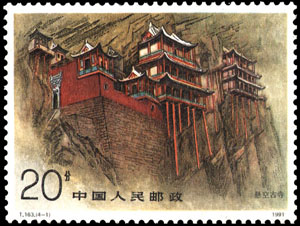
In 1991 China Post issued “Mount Heng”, four stamps: the ancient Hanging Temple, Heng after a thunderstorm, the Northern Sacred Mountain, and the monuments in the clouds.

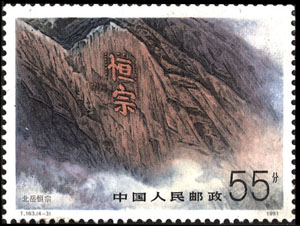

In 2019 China Post issued 2019-16 “The Five Great Mountains”, five stamps: Morning Sun at Riguan Peak (Mount Tai), Clear Autumn on Mount Hua, Rain over Zhurong Peak (Mount Heng in Hunan), Snow on the Heng Frontier (Mount Heng in Shanxi) and The Rival Peaks of Taishi and Shaoshi (Mount Song).


Map

Photo credits: The Hanging Temple, Mount Heng: Zhangzhugang (CC BY-SA 3.0, Wikimedia Commons)
Nearby
| World Heritage | Mount Wutai 86km, Yungang Grottoes 88km, Western Qing Tombs 121km, Peking Man Site at Zhoukoudian 172km |
| National parks | Yesanpo 103km, Xibaipo–Mount Tiangui Scenic Area 157km, Stone Flower Cave 167km, Badaling–Ming Tombs Scenic Area 194km |
| Detailed guides | Shidu 137km |
| AAAAA attractions | Baishishan Scenic Area 81km, Yanmenguan Pass Scenic Area 113km, Western Qing Tombs Scenic Area 121km, Xibaipo 154km |
| AAAA attractions | Lingqiu Pingxingguan Victory Scenic Area 33km, Weizhou Ancient City 51km, Weizhou Museum 52km |
| UNESCO Global Geoparks | Yanqing UNESCO Global Geopark 187km |
| Historic cities | Yu County 52km |
| Cities | Datong 74km |
| Historical sites | Shuishen Hall 25km, Hanging Temple 26km, Tomb of Li Yumei 26km, Hunyuan Yong'an Temple 27km |
| National geoparks | Datong Volcano Cluster National Geopark 50km, Fuping Tianshengqiao National Geopark 88km |
| Nature reserves | Xiaowutaishan National Nature Reserve 83km, Nihewan National Nature Reserve 85km, Tuoliang National Nature Reserve 110km, Baihuashan National Nature Reserve 139km |
| Historic towns | Nuanquan Town 40km |
| Historic villages | Nanliuzhuang Village 42km, Shuixibu Village 47km, Bubeibu Village 49km, Renjiajian Village 49km |