 Park of China
Overview
| Designation | UNESCO World Heritage (cultural, 1994) National Park of China (first batch) AAAAA tourist attraction |
| Province | Hebei |
| Location | Chengde, Hebei |
| Mountains | Yanshan Mountains |
| Latitude, longitude | 41.0, 117.9 Google Maps |
| Nearby cities | Beijing, Tianjin |
| Highlights | Imperial summer palace; Tibetan Buddhist temples |
| Top sights | The Putuo Zongcheng Temple, Club Rock (Bangchui Hill) |
| Nearby sites | Ming Tombs 163km, The Forbidden City (Palace Museum), Beijing 177km, The Temple of Heaven, Beijing 179km, The Summer Palace, Beijing 180km Search nearby |
| Themes | Palace, Garden, Temple, Buddha, Hill, City, Ancient Building, Stamp, Imperial palaces & gardens, Tibetan Buddhism, Chinese gardens |
About
In 1994 UNESCO inscribed the Mountain Resort and its outlying temples on the World Heritage List.

The Kangxi Emperor named 36 scenes with four-character titles and the Qianlong Emperor 36 more with three-character titles, together known as the 72 Scenes of Kangxi and Qianlong.
It is in the first batch of national parks of China (national scenic areas) named by the State Council in 1982.
Main sights
Hall of Frugality and Reverence (Danbo Jingcheng Dian): the main hall of the palace, first built under Kangxi and rebuilt in nanmu wood in 1754, hence its other name, the Nanmu Hall; the emperor held court, ceremonies and audiences here.
Wenjin Pavilion: built in 1774 on the model of the Tianyi Pavilion in Ningbo to house the Siku Quanshu. Its copy went to the Capital Library in 1914 and is now in the National Library of China, the only one of the seven sets kept with its original cases and shelves.
Puning Temple: built in 1755 to mark the defeat of the Dzungars, its rear half modelled on Samye Monastery in Tibet. Known as the Big Buddha Temple, its Mahayana Pavilion holds a wooden thousand-armed Guanyin 22.28 m tall, weighing about 110 tonnes.
The Putuo Zongcheng Temple, modelled on the Potala Palace in Lhasa for the Qianlong Emperor's 60th and the Empress Dowager's 80th birthdays, was finished in 1771 and is the largest of the outlying temples. The Xumi Fushou Temple (1780), modelled on Tashilhunpo Monastery in Shigatse, housed the Sixth Panchen Lama when he came to Chengde for Qianlong's birthday.
Travel tips
Getting there: Chengde South station on the Beijing–Harbin high-speed line is about an hour from Beijing Chaoyang; it lies some way from the city centre, with buses and taxis into town. Regular trains also run to Chengde station. The Mountain Resort is in the north of the city, with the Outlying Temples to its east and north.
Mountain Resort: entry must be booked online in advance under your real name. The palace area at the south end can be seen on foot; the lakes, plain and hills to the north cover a large area, and sightseeing buses and boats run inside.
Outlying Temples: Puning Temple, the Putuo Zongcheng Temple and the Temple of Sumeru Happiness and Longevity are close together and easy to see in one trip; Puren Temple, Anyuan Temple and Pule Temple lie to the east. Each temple is entered separately.
Bangchui Peak: east of the city, reached by an open chairlift, with a view of the peak and the town.
Time: one day for the Mountain Resort and one for the temples.
Season: summer is cool and is the main season; winter is cold and the lakes are bare.
Where to stay: in Chengde city; the area near the resort's south gate is convenient.
The Mountain Resort
The Mountain Resort at Chengde, Hebei, also called the Chengde Detached Palace or the Rehe Travelling Palace, covers 5.6 km². It was the summer palace of the Qing emperors and is the largest imperial garden in China.
It was built between 1703 and 1792 and is divided into a palace area and a garden area, the latter made up of lakes, plains and hills. The hilly west and north are cooler than the city and include Club Rock and Toad Rock.
The Eight Outer Temples
The temples north-east of the resort are known collectively as the Eight Outer Temples. Twelve were built and seven survive, the most famous being the Putuo Zongcheng Temple, nicknamed the Little Potala (see the Potala Palace). The seven are the Puren, Puning, Anyuan, Pule, Putuo Zongcheng, Shuxiang and Xumi Fushou temples; the five lost are the Pushan, Puyou and Guang’an temples, the Arhat Hall and the Kuixing Tower.
Stamps
In 1991 China Post issued T.164 “Chengde Mountain Resort”, three stamps: Pines in Ten Thousand Valleys (15 fen), Water Pavilion among Greenery (20 fen) and Green Maples on the Isle (90 fen), with a 2-yuan souvenir sheet.
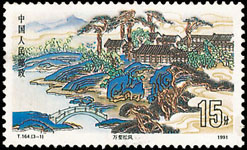

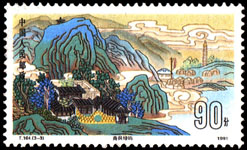

On 20 August 1998 China and Germany jointly issued 1998-19, “Puning Temple and the Würzburg Residence”, two stamps.

The second stamp of the 2022 set 2022-22 “Famous Pavilions of China (II)” shows the Shuiliu Yunzai Pavilion at the Mountain Resort.

Map

Photo credits: The Mountain Resort: xiquinhosilva (CC BY 2.0, Wikimedia Commons); The Putuo Zongcheng Temple (Little Potala): Gisling (CC BY-SA 4.0, Wikimedia Commons)
Nearby
| World Heritage | Eastern Qing Tombs 92km, Ming Tombs 163km, The Great Wall 176km, The Forbidden City (Palace Museum), Beijing 177km |
| National parks | Mount Pan 113km, Badaling–Ming Tombs Scenic Area 170km, Stone Flower Cave 214km, Xingcheng Seaside 244km |
| AAAAA attractions | Jinshanling Great Wall Scenic Area 69km, Eastern Qing Tombs Scenic Area 93km, Tangshan Nanhu Kailuan Tourist Area 156km, Olympic Park 171km |
| AAAA attractions | Qingchuifeng Forest Park 4km, Shuangtashan Scenic Area 10km, Xinglong Xinglongshan Scenic Area 58km, Mazhen Scenic Area 58km |
| UNESCO Global Geoparks | Yanqing UNESCO Global Geopark 176km |
| Historic cities | Chengde 1km |
| Historical sites | Chengde Mountain Resort 1km, Puren Temple 1km, Chengde City God Temple 2km, Anyuan Temple 2km |
| National geoparks | Xinglong National Geopark 59km, Ningcheng National Geopark 102km, Jizhou National Geopark 114km, Qian'an National Geopark 127km |
| Nature reserves | Wulingshan National Nature Reserve 59km, Maojingba National Nature Reserve 62km, Heilihe National Nature Reserve 79km, Baxianshan National Nature Reserve 93km |