
Chinese Food
“Food is the first necessity of the people.” China is vast, with very different products and climates, and its food varies just as widely: rice is the staple in the south, wheat noodles and bread in the north. A popular saying holds that the south likes sweet, the north salty, the east sour and the west spicy. It is crude, but it roughly maps the regions of taste. Chinese cooking prizes knife work and heat control, and has dozens of techniques, including stir-frying, flash-frying, braising, deep-frying, pan-frying, simmering and steaming. Quick stir-frying over a fierce flame is the most characteristic.
Over the centuries, regions developed distinctive local cuisines, known as caixi. The best known are the “Eight Great Cuisines”: Lu, Chuan, Yue, Su, Min, Zhe, Xiang and Hui. Beijing cuisine, Northeastern food, the Muslim (halal) food and wheat dishes of the northwest, Yunnan food and Xinjiang food also have their own character.
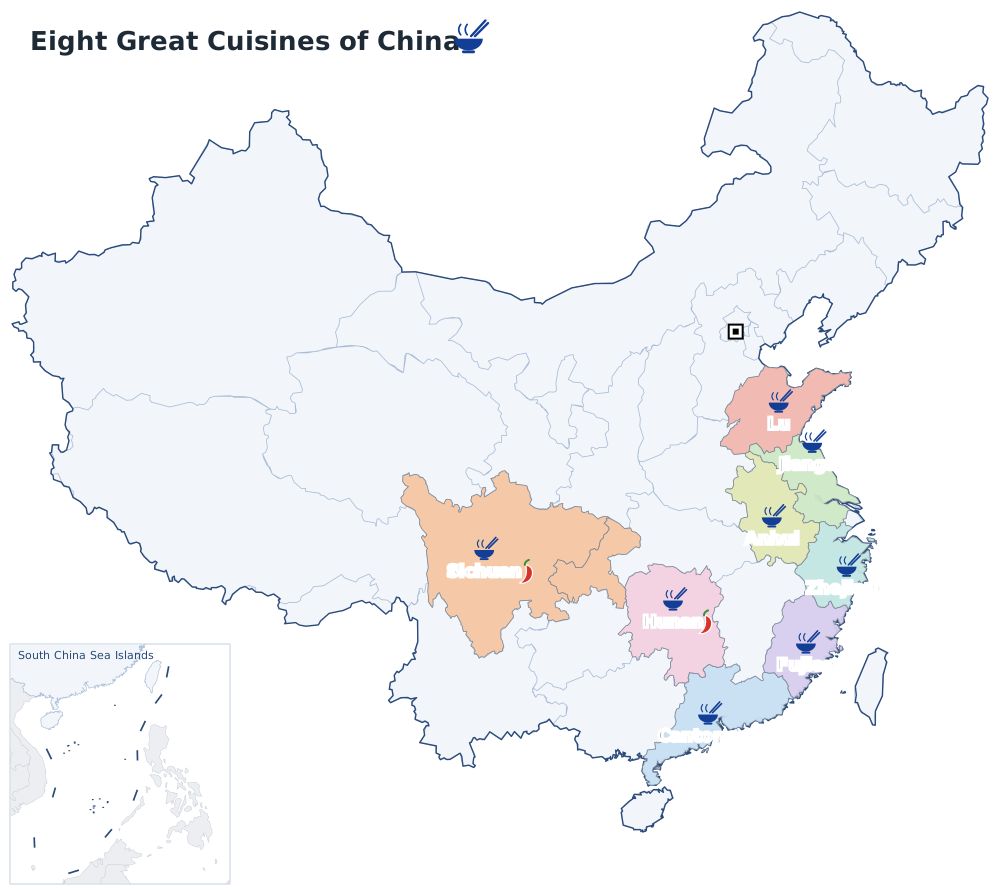
The Eight Great Cuisines
Lu cuisine (Shandong) The oldest of the eight. In the Ming and Qing it formed the core of imperial cooking, and dishes across the north bear its influence. It makes much use of scallions and is good at soups. It has two branches: Jinan cooking excels at quick-fried, stir-fried and braised dishes, while Jiaodong cooking is strong on seafood. Signature dishes include braised sea cucumber with scallions (cong shao haishen), Jiuzhuan dachang (braised pork intestine) and sweet-and-sour carp. See Jinan and Qingdao.
Chuan cuisine (Sichuan) Famous for its numbing heat (mala), using Sichuan pepper and chili together. It is not only hot: the saying goes “one dish, one style; a hundred dishes, a hundred flavors”, and flavor types such as fish-fragrant, strange-flavor and home-style all originated in Sichuan. Signature dishes include Mapo tofu, Kung Pao chicken, twice-cooked pork (huiguorou) and boiled fish in chili oil (shuizhu yu). Hot pot also comes from Sichuan and Chongqing. See Chengdu and Chongqing.
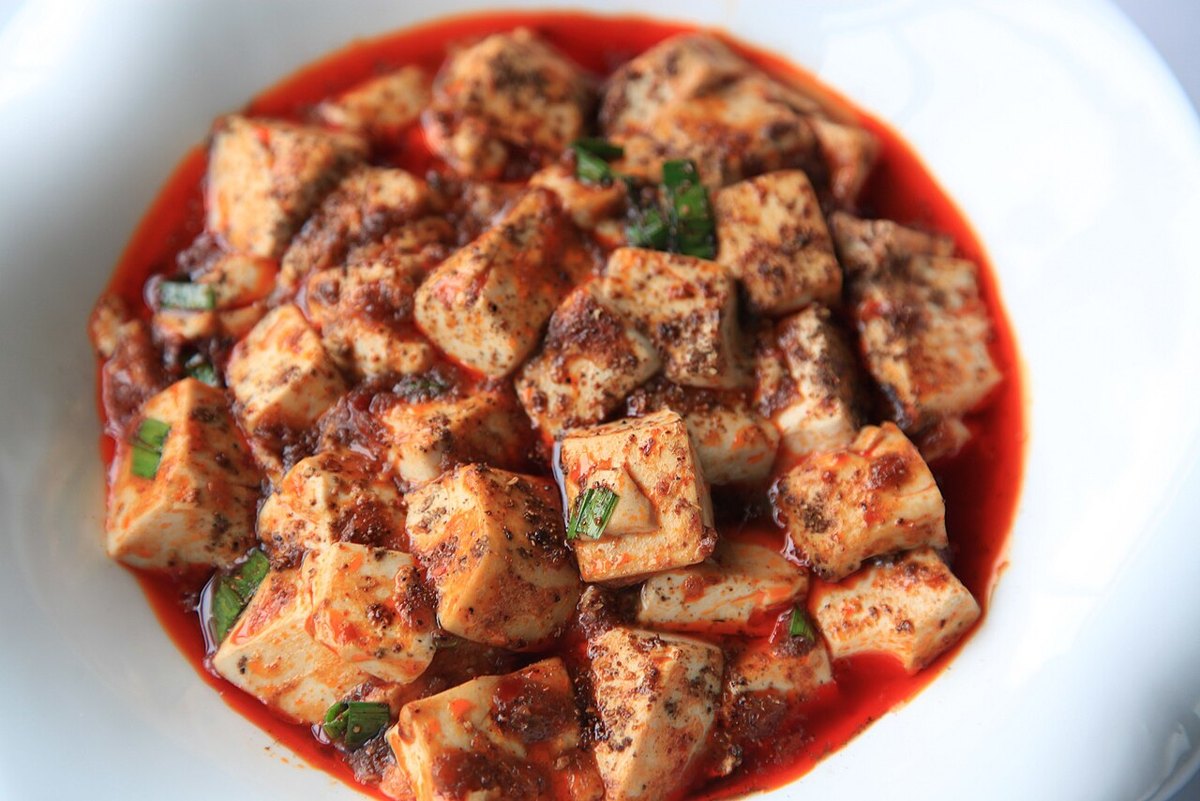
Sichuanfoodlover, CC BY-SA 4.0, Wikimedia Commons
Yue cuisine (Guangdong, Cantonese) Uses a very wide range of ingredients, with a light, fresh taste that preserves natural flavor. It has three branches: Guangfu, Chaoshan and Hakka. Guangzhou’s morning tea and dim sum, white-cut chicken, roast goose and slow-simmered soups are famous, as are Chaoshan’s braised meats and beef balls. See Guangzhou and Hong Kong.
Su cuisine (Jiangsu) Best represented by Huaiyang cuisine: fine knife work, light and slightly sweet flavors, and careful control of heat. Signature dishes include stewed crab-meat lion’s head meatballs (shizitou), shredded tofu in broth (dazhu gansi), squirrel-shaped mandarin fish (songshu guiyu) and salted duck. See Yangzhou, Nanjing and Suzhou.
Min cuisine (Fujian) Good at soups, often seasoned with red yeast rice lees, with plenty of seafood. The most famous dish is Buddha Jumps Over the Wall (fotiaoqiang), made by slowly simmering abalone, sea cucumber, shark fin and a dozen or so other ingredients. See Fuzhou and Xiamen.
Zhe cuisine (Zhejiang) Made up of the local cooking of Hangzhou, Ningbo, Shaoxing and other places; fresh, light and tender. Signature dishes include West Lake fish in vinegar sauce (xihu cuyu), Dongpo pork and Longjing tea shrimp (Longjing xiaren). Shaoxing cooking often uses yellow rice wine and preserved dried greens (meigancai). See Hangzhou, Ningbo and Shaoxing.
Xiang cuisine (Hunan) Oily, richly colored, mostly hot or sour-hot, with frequent use of cured meats and chopped pickled chilies. Signature dishes include fish head with chopped chilies (duojiao yutou), stir-fried pork with chili peppers (lajiao chao rou) and steamed assorted cured meats (layue hezheng). See Changsha.
Hui cuisine (Anhui) Comes from the mountains of southern Anhui; rich in oil, color and fire, and fond of wild mountain ingredients. Signature dishes include stinky mandarin fish (chou guiyu), fuzzy (moldy) tofu (mao doufu) and daobanxiang (cured pork). See Ancient Villages in Southern Anhui and Huangshan.
Regional Flavors
Beijing cuisine Combines Lu cuisine, imperial cooking and Muslim cooking. Its most famous dishes are Peking duck and instant-boiled mutton hot pot (shuan yangrou). See Beijing.
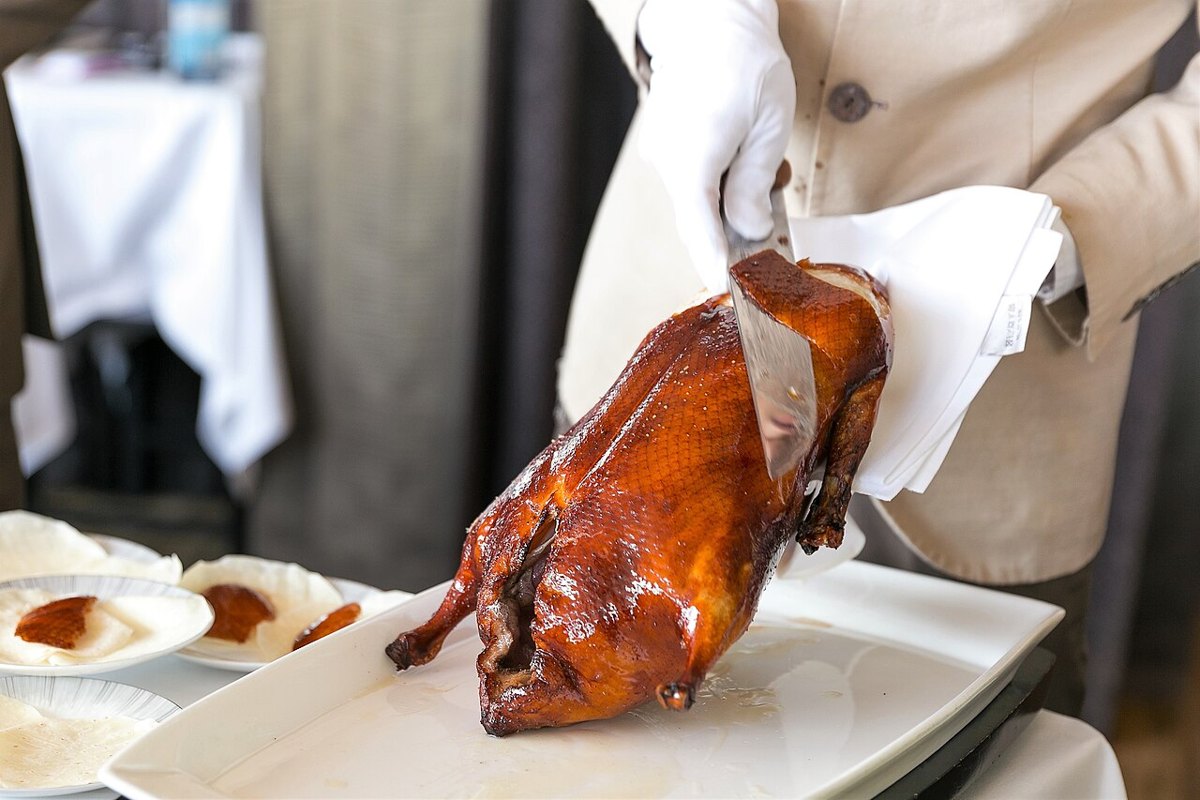
City Foodsters, CC BY 2.0, Wikimedia Commons
Northeastern cuisine Big portions and strong flavors; guobaorou (sweet-and-sour crispy pork), pork stewed with glass noodles and di sanxian (stir-fried potato, eggplant and green pepper) are well-known home dishes. See Harbin and Shenyang.
Northwestern flavors Built on wheat foods, beef and lamb. Lanzhou beef noodles, Xi’an yangrou paomo (lamb soup with crumbled flatbread) and shouzhua yangrou (hand-grabbed lamb) are the most representative. See Lanzhou and Xi’an.
Yunnan, Xinjiang and Tibet Yunnan has crossing-the-bridge rice noodles (guoqiao mixian) and many wild mushrooms; Xinjiang has big-plate chicken (da pan ji), pilaf (zhua fan) and baked meat buns (kao baozi); Tibet has zanba (roasted barley flour) and butter tea. See Kunming, Urumqi and Lhasa.
Famous Snacks
The most common breakfast nationwide is youtiao (fried dough sticks) with soy milk or doufunao (silky tofu pudding). Youtiao is made by stretching a strip of dough and deep-frying it until crisp outside and airy inside. Doufunao is freshly set soft tofu, served in the north with a savory sauce and in the south often with sugar syrup; in Sichuan some versions add chili oil and pickled mustard stem. Breakfasts vary endlessly from place to place, but most are variations on these basics.
Every region has its own snacks, found at breakfast stalls, on the street and in night markets. The north favors wheat foods: Beijing has zhajiangmian (noodles with fried bean sauce), douzhi (fermented mung bean drink) and lüdagun (glutinous rice rolls with sweet bean flour); Tianjin has jianbing guozi (savory crepe with a crisp cracker) and Goubuli baozi (steamed buns); Xi’an has roujiamo (meat in flatbread, the “Chinese hamburger”), liangpi (cold skin noodles) and yangrou paomo; Lanzhou has beef noodles; Shanxi has daoxiaomian (knife-shaved noodles); Kaifeng has guantang baozi (soup buns); and Henan has hulatang (spicy peppery soup).
The south excels at rice products and dim sum: Shanghai has shengjian (pan-fried pork buns) and xiaolongbao (soup dumplings); Nanjing has yaxue fensitang (duck blood and vermicelli soup); Wuhan has reganmian (hot dry noodles); Changsha has chou doufu (stinky tofu) and tangyou baba (fried sugar-oil rice cakes); Guangzhou’s morning tea offers xiajiao (shrimp dumplings) and changfen (rice noodle rolls); Guilin and Nanning have rice noodles (mifen); Kunming has guoqiao mixian; Chengdu has dandanmian (dan dan noodles) and long chaoshou (wontons in chili oil); Chongqing has xiaomian (spicy noodles); Xiamen has shacha mian (satay noodles) and haili jian (oyster omelet); and Macao has Portuguese egg tarts. The “Local Food” section of each city page gives more detail.
Festival Foods
Most traditional Chinese festivals have their own special foods, carrying wishes for reunion, safety and a good harvest.
Jiaozi (dumplings) In the north, jiaozi are eaten on Chinese New Year’s Eve. Shaped like gold ingots, they recall the phrase gengsui jiaozi (“the old year gives way to the new”); some are filled with a coin for luck. In the south, niangao (sticky rice cake) is more common at the Spring Festival; its name sounds like “year after year higher”.
Yuanxiao and tangyuan (glutinous rice balls) Eaten at the Lantern Festival on the fifteenth day of the first month. In the north they are called yuanxiao and are made by rolling filling in glutinous rice flour; in the south they are called tangyuan and are made by wrapping filling in glutinous rice dough. The round shape stands for reunion.
Chunjuan (spring rolls) A thin wrapper rolled around a filling and deep-fried. In the old days they were eaten at the Beginning of Spring, a custom called “biting the spring”.
Qingtuan (green rice balls) Eaten around Qingming in the Jiangnan region. Mugwort or barley-grass juice is mixed into glutinous rice flour, and the balls are filled with sweet red bean paste, giving them a deep green color.
Zongzi (sticky rice dumplings) Eaten at the Dragon Boat Festival, wrapped in bamboo or reed leaves. In the north they often contain red dates and bean paste; in the south, fresh pork and salted egg yolk. Tradition says they commemorate Qu Yuan, who drowned himself in the Miluo River.
Mooncakes Eaten at the Mid-Autumn Festival; the round shape stands for the full moon and for reunion. Cantonese mooncakes have a thin skin and plenty of filling, Suzhou-style mooncakes have a flaky pastry crust, and there are also Beijing and Yunnan styles (the latter with Yunnan ham).
Chongyang cake Eaten at the Double Ninth Festival on the ninth day of the ninth month. The word for “cake” (gao) sounds like “high”, matching the custom of climbing a height. It is usually steamed from rice flour and topped with small colored flags.
Laba porridge Eaten on the eighth day of the twelfth month (Laba Festival), cooked from rice, beans, red dates, lotus seeds, longan and more. It began as a Buddhist temple custom marking the Buddha’s enlightenment, and later became a folk food custom before the New Year.