 Park of China
Overview
| Designation | UNESCO World Heritage (cultural, 2009) National Park of China (first batch) AAAAA tourist attraction |
| Province | Shanxi |
| Location | Shanxi |
| Mountains | Mountain Ranges of China |
| Latitude, longitude | 39.0, 113.6 Google Maps |
| Highlights | One of the four sacred Buddhist mountains |
| Area | 250 km² |
| Highest point | 3,061 m |
| Nearby cities | Shahe, Datong, Baoding |
| Nearby sites | Mount Tiangui 84km, Xibaipo 85km, Mount Heng (Northern Sacred Mountain) 86km, Yungang Grottoes 130km, Yesanpo 154km Search nearby |
| Themes | Famous Mountain, Mountain, Buddha, Temple, Stamp, Ancient Building, Tower, Tibetan Buddhism |
About
Mount Wutai, north-east of Wutai County in Shanxi, is the seat of the bodhisattva Manjushri and one of the four sacred Buddhist mountains. Centred on the town of Taihuai, it consists of five flat-topped peaks: the North Terrace (Yedou Peak), South Terrace (Jinxiu), East Terrace (Wanghai), West Terrace (Guayue) and Central Terrace (Cuiyan). The North Terrace, 3,061 m, is the “roof of north China”.
Wutai is a holy place of both Chinese and Tibetan Buddhism. The five great monasteries around Taihuai are Xiantong, Tayuan, Shuxiang, Luohou and Pusading; the famous temples outside the town are Foguang and Nanchan.
Buddhism flourished here in the Northern Wei, when temple building reached its first peak with more than 200 temples; after a thousand years of change some 50 complete temples remain in and around the mountain.
The five summits are broad, flat and treeless, like earthen terraces, which gave Wutai (“Five Terraces”) its name.
It was inscribed on the UNESCO World Heritage List in 2009, as a cultural site. It is in the first batch of national parks of China (national scenic areas) named by the State Council in 1982.
Main sights
Xiantong Temple: formerly Dafu Lingjiu Temple, traditionally founded in AD 68, the largest and oldest temple at Wutai, with over 400 rooms; its bronze hall was cast in 1610.
Pusading: on Lingjiu Peak above Taihuai, also called Zhenrong Yuan or Da Wenshu Si, traditionally founded in the Northern Wei. Converted to Tibetan Buddhism under Shunzhi, it is the largest Tibetan Buddhist temple at Wutai and lodged Qing emperors on pilgrimage; 108 steps lead up to it.
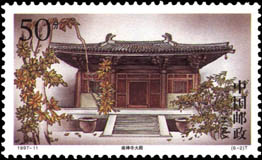
Foguang Temple: at Foguang Village, Doucun Town, Wutai County, founded in the Northern Wei. Its East Hall was built in 857 and was identified by Liang Sicheng, Lin Huiyin and colleagues in 1937; its Tang architecture, sculpture, murals and ink inscriptions are called the “four treasures”.
Travel tips
Getting there: the visitor centre and most temples are in Taihuai town. Long-distance buses run from Taiyuan and Datong, a drive of several hours either way; Xinzhou Wutaishan Airport is over 100 km from Taihuai.
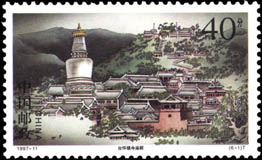
Taihuai temples: Xiantong Temple, Tayuan Temple, Pusading, Shuxiang Temple and Luohou Temple are close together and can be visited on foot. The large white stupa of Tayuan Temple is the symbol of Wutaishan.
Dailuoding: on the hill east of Taihuai, reached by more than a thousand steps or by cable car.
The five terraces: the five summits are 2,000 to 3,000 m high and far apart, so you need a vehicle; visiting all five usually takes a full day. It is cold on top even in summer; bring a jacket.
Foguang Temple and Nanchan Temple: these two Tang-dynasty timber halls are in the south of Wutai County, a long way from Taihuai; allow half a day to a day.
Time: one or two days for the Taihuai temples; three or four days with the terraces or Foguang and Nanchan.
Season: May to October is best. Winter is cold, and roads to the summits may close for snow and ice.
Note: photography is not allowed in most temple halls; behave respectfully inside.
Stamps
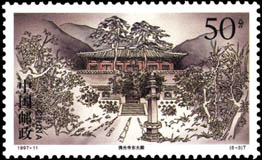
On 26 July 1997 China Post issued 1997-11 “Mount Wutai”, six stamps: the temples of Taihuai, the main hall of Nanchan Temple, the east hall of Foguang Temple, the bronze hall of Xiantong Temple, Pusading and Zhenhai Temple.



Map

Photo credits: The temples of Taihuai and the white stupa of Tayuan Temple: G41rn8 (CC BY-SA 4.0, Wikimedia Commons)
Nearby
| World Heritage | Yungang Grottoes 130km, Western Qing Tombs 157km, Peking Man Site at Zhoukoudian 218km, Ancient City of Pingyao 234km |
| National parks | Xibaipo–Mount Tiangui Scenic Area 83km, Mount Heng (Northern Sacred Mountain) 86km, Mount Cangyan 139km, Yesanpo 154km |
| Detailed guides | Mount Tiangui 84km, Shidu 186km |
| AAAAA attractions | Yanmenguan Pass Scenic Area 65km, Xibaipo 85km, Baishishan Scenic Area 100km, Western Qing Tombs Scenic Area 157km |
| AAAA attractions | Fuping Tianshengqiao Scenic Area 41km, Manshan Huaxi Valley 41km, Jinxiu Damingchuan Scenic Area 59km |
| Historic cities | Dai County 54km |
| Cities | Datong 125km, Shijiazhuang 137km, Taiyuan 149km |
| Historical sites | Xiantong Temple 1km, Nanshan Temple on Mount Wutai 2km, Fanshi Glazed Pagoda 7km, Former Jin-Cha-Ji Military Region Headquarters at Jingangku Village 14km |
| National geoparks | Fuping Tianshengqiao National Geopark 41km, Datong Volcano Cluster National Geopark 125km |
| Nature reserves | Tuoliang National Nature Reserve 36km, Luyashan National Nature Reserve 146km |