

Overview
| Name | The Grand Canal 大运河 |
| Web address | https://parkofchina.com/en/dayunhe.html |
| Designation | UNESCO World Heritage (cultural, 2014) |
| Location | Beijing, Tianjin, Hebei, Shandong, Jiangsu, Zhejiang, Anhui and Henan |
| Rivers and lakes | Grand Canal |
| Highlights | Ancient canal, locks and waterworks, canal towns, old bridges |
| Top sights | Yangzhou, Qingkou Water Hub Site, Gongchen Bridge in Hangzhou, Suzhou |
| Coordinates | 29.87, 121.56 Google Maps |
| Nearby cities | Ningbo in town, Hangzhou ←︎141km, Shanghai ↑︎147km |
| Nearby airports | Ningbo Lishe International Airport ↙︎11km |
| Nearby sites | Tianyi Pavilion and Moon Lake, Ningbo, Zhejiang ←︎2km, Mount Putuo →︎81km, Mount Tiantai (Zhejiang) ↙︎93km, West Lake, Hangzhou ←︎142km, Archaeological Ruins of Liangzhu City ←︎161km, Classical Gardens of Suzhou ↖︎183km |
| Themes | River, Culture, Canals |
About
The Grand Canal, the man-made waterway linking north and south China through Beijing, Tianjin, Hebei, Shandong, Jiangsu, Zhejiang, Henan and Anhui, was inscribed as a UNESCO World Cultural Heritage site in 2014. The largest engineering work in the world before the Industrial Revolution, it carried southern grain and goods to the capital for more than two thousand years; towns along it prospered, and the cultures of north and south met through it.
The Grand Canal runs from Beijing in the north to Ningbo in Zhejiang, with Sui–Tang branches to Luoyang, about 3,200 km in all. The earliest sections were dug in the 5th century BC; in the 7th century the Sui linked them into a national waterway, rebuilt by later dynasties, mainly to carry grain from the south to the capital. Its 27 canal sections and 58 sites include locks, dams, bridges, wharves, granaries and historic quarters of canal towns.

Travel tips
What to see: the Grand Canal is a serial site made of many sections and related remains; the Beijing-Hangzhou Canal alone is about 1,794 km long, so visitors normally choose a few cities along it rather than the whole route.
Hangzhou: the southern end of the Beijing-Hangzhou Canal is near Gongchen Bridge, a stone arch bridge. The China Grand Canal Museum and a waterside promenade are close by, and boat trips run on the canal.
Suzhou: Pan Gate, Baodai Bridge and the Shantang and Pingjiang historic districts are part of the heritage site. Boats run on the water in the evening, and the classical gardens can be visited by day.
Yangzhou: a canal city whose heritage sites include the Slender West Lake, Yucheng post station and the old Shaobo embankment; boat rides are available in town.
Northern sections: Beijing lies at the northern end, Huai'an has the Qingkou water-control complex, and the Nanwang water-control hub lies near Jining in Shandong. Many stretches are laid out as canal parks.
Getting there: Suzhou, Hangzhou and Yangzhou all have high-speed rail; from Shanghai, Suzhou and Hangzhou are about half an hour to an hour away, so day trips are easy, and several cities can be linked.
Time: two or three days are enough for Hangzhou and Suzhou; following the canal through more cities needs a week or more.
Season: spring and autumn are best; summer is hot and wet, and in winter the northern channels freeze and boats may not run.
Stamps
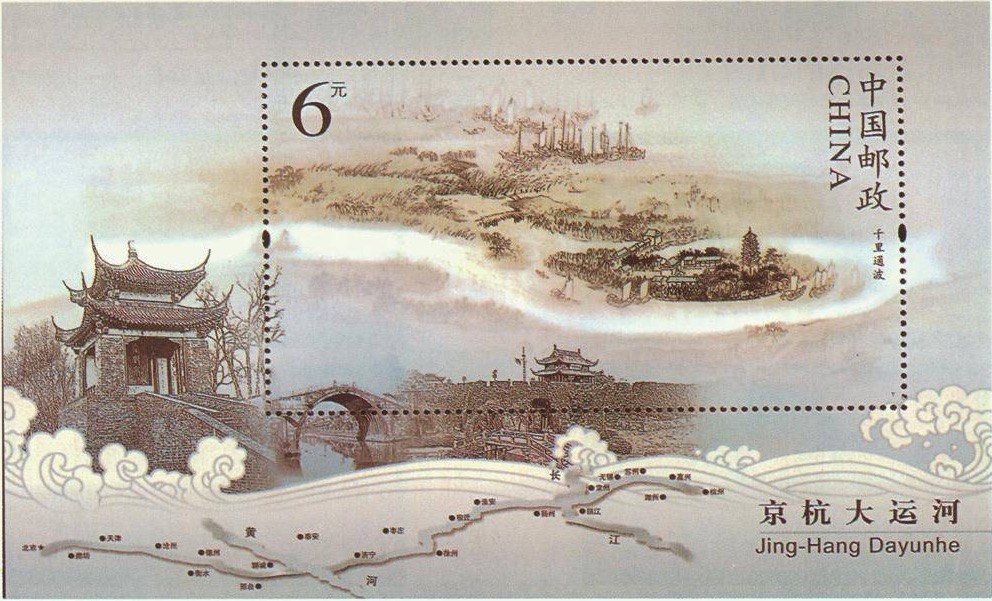
In 2009 China Post issued 2009-23 “Beijing–Hangzhou Grand Canal”, six stamps: the Randeng Pagoda (Tongzhou), the Tianhou Temple (Tianjin), the Shanxi-Shaanxi Guild Hall (Liaocheng), the Qingjiang Lock (Huai’an), the Wenfeng Pagoda (Yangzhou) and the Gongchen Bridge (Hangzhou). A souvenir sheet, “A Thousand Li of Flowing Water”, was issued with them.


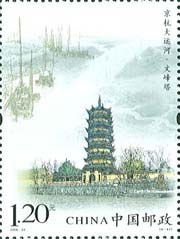
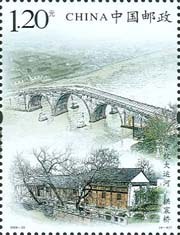
From north to south: the Randeng Pagoda stamp shows Tongyun Bridge behind the pagoda; the Tianhou Temple stamp shows the temple and Wanghailou Church in Tianjin, with the Sancha River mouth behind and boats on the canal in front; the guild hall stamp has the Linqing Sarira Pagoda behind the hall; the Qingjiang Lock stamp shows the Office of the Grand Canal Governor-General in Huai’an and Hongze Lake behind; the Wenfeng Pagoda stamp has the Yangzhou stretch of the canal behind; the Gongchen Bridge stamp has the Fuyi Granary of Hangzhou in front. The souvenir sheet, “A Thousand Li of Flowing Water”, shows the Zhenguo Temple Pagoda and Gaoyou Lake, with Pan Gate in Suzhou, Yucheng post station in Gaoyou and Qingming Bridge in Wuxi in the margins. The Randeng Pagoda, the Linqing Sarira Pagoda, the Wenfeng Pagoda and the Liuhe Pagoda in Hangzhou are known as the four great pagodas of the canal; the first three appear on these stamps.

Classical Chinese texts
The texts are in Chinese, in our Library of Chinese Literature.
Photo credits: The Grand Canal seen from Gongchen Bridge, Hangzhou: Windmemories (CC BY-SA 4.0, Wikimedia Commons)