
← Chapter 4: Wei, Jin and the Northern and Southern DynastiesContentsChapter 6: Five Dynasties →
Chapter 5: Sui and Tang
The Sui dynasty was short-lived; during the nearly three centuries of the Tang, Chang'an (present-day Xi'an) and Luoyang were the cultural centers of the country. Figure painting reached its peak; landscape left its role as background to figure stories and became a genre in its own right; horses and birds and flowers also had their specialists. Buddhist art was at its most flourishing, with cave murals and statues on a grand scale.
Zhan Ziqian. Zhan Ziqian served the Northern Qi and Northern Zhou before entering the Sui, and was known for painting buildings, carriages and horses, and landscapes. Spring Outing, attributed to him, shows gentlemen enjoying a spring day among mountains and water. Landscape fills most of the picture, people and horses are small, and the proportions of near and far are broadly correct; the old fault of "people larger than mountains and water that cannot float a boat" has gone. Rocks are only outlined and filled with azurite and malachite, without texture strokes; distant trees are rendered as clusters of dots. The painting is often called the earliest surviving landscape scroll, though some consider it a Northern Song copy or a Northern Song work.

Full scroll; Palace Museum, Beijing
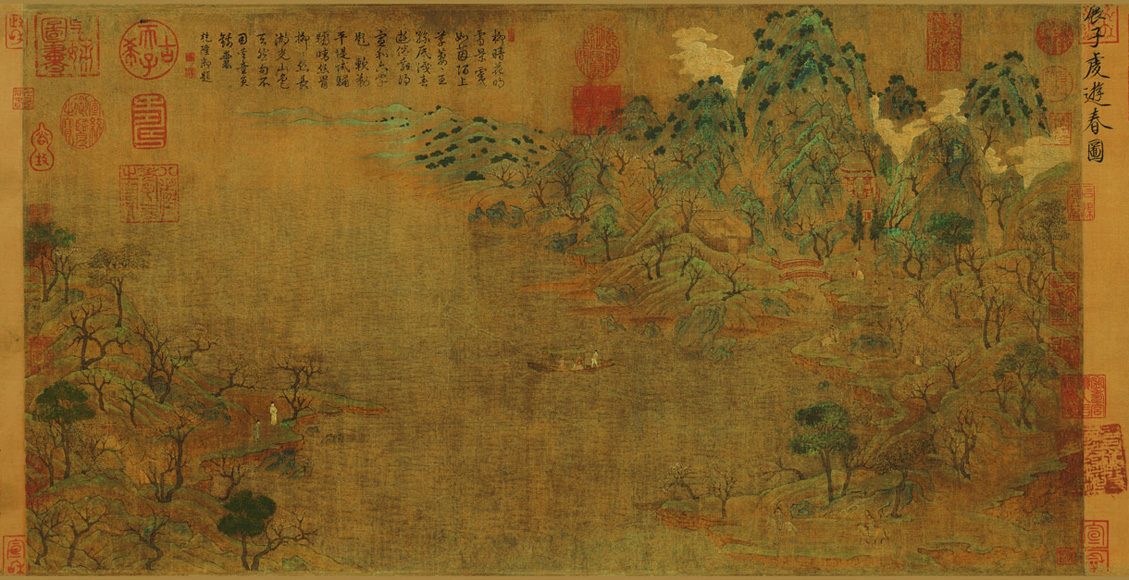
Main painting
Li Sixun and Li Zhaodao. Father and son were members of the Tang imperial clan. Li Sixun rose to General of the Left Militant Guard and was called "General Li the Elder", and Li Zhaodao "General Li the Younger". They developed Zhan Ziqian's blue-green manner, using azurite and malachite as the main colors and sometimes outlining rocks in gold, a style called "gold-and-blue-green landscape": precise and sumptuous, well suited to palaces and pavilions. Sailboats and Pavilions, attributed to Li Sixun, and Emperor Minghuang's Journey to Shu, attributed to Li Zhaodao, are in this manner. Zhang Yanyuan said that "the transformation of landscape began with Wu and was completed by the two Lis." In the late Ming, Dong Qichang made Li Sixun the founder of the "Northern School" of landscape painting.

Attributed to Li Sixun; National Palace Museum, Taipei
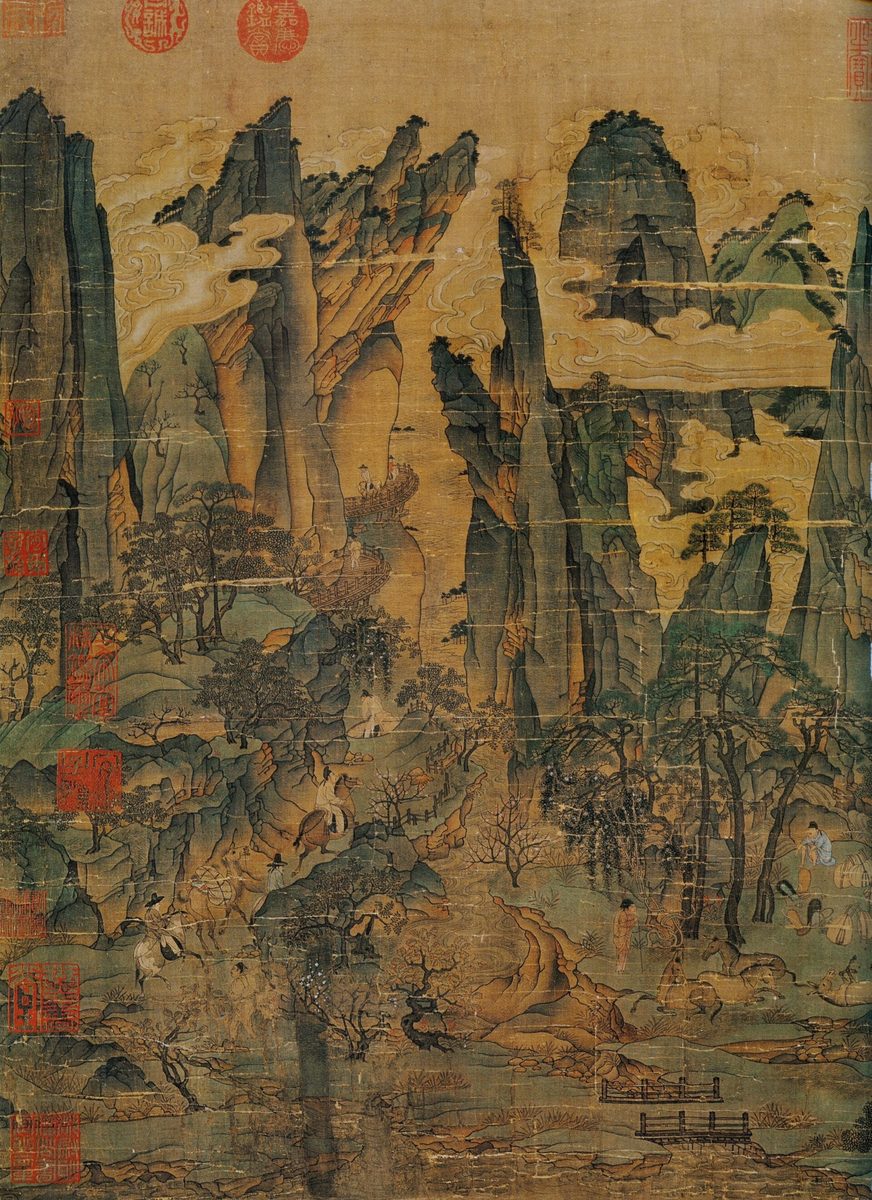
Attributed to Li Zhaodao; National Palace Museum, Taipei
Wu Daozi. Wu Daozi, a native of Yangdi (present-day Yuzhou, Henan), studied calligraphy as a youth under Zhang Xu and He Zhizhang without success, and turned to painting. Emperor Xuanzong summoned him to court, and later ages honored him as the "Sage of Painting". He painted murals in more than three hundred bays of temples in Chang'an and Luoyang, mainly Daoist and Buddhist figures. His lines swell and taper with strong movement, and his figures' sashes fly up, a manner called "Wu's sashes in the wind", paired with Cao Zhongda's "Cao's robes emerging from water"; his colors were light, with only slight washes, called the "Wu manner". It is said that when the butchers and fishermen of Chang'an saw his painting of hell, they changed their trades. No original survives; The Heavenly King Presenting a Son, attributed to him, is a Song copy. Su Shi wrote: "With Wu Daozi, painting completed all the changes of past and present and all that could be achieved under heaven." It is also said that Xuanzong ordered him and Li Sixun to paint the scenery of the Jialing River in the Datong Hall; Wu finished in a day, Li took several months, and the emperor declared both "supremely marvelous". The two men's dates do not quite match and the story may not be true, but it shows that two manners already existed: Wu's free and loose, the Lis' fine and detailed.

Full scroll (Song copy); Osaka City Museum of Fine Arts

Eighty-seven Immortals, attributed to Wu Daozi; Xu Beihong Memorial Museum
Calligraphy. Tang regular script was the most strictly disciplined. In the early Tang, Ouyang Xun, Yu Shinan and Chu Suiliang each created a style of his own; in the middle Tang, Yan Zhenqing wrote with dignity and power; in the late Tang, Liu Gongquan was known for strength of bone, and later ages spoke of "Yan's sinew and Liu's bone". Famous steles by Ouyang, Yan, Liu and others are mostly in the Forest of Steles in Xi'an; Chu Suiliang's Preface to the Sacred Teachings is still set into the ground floor of the Big Wild Goose Pagoda; and Xuanzong's Inscription Commemorating Mount Tai, in clerical script, is carved on the cliff at the summit of Mount Tai. Yan Zhenqing's Draft of a Requiem to My Nephew, written during the An Lushan Rebellion to mourn a nephew killed in the fighting, is full of corrections, its grief and anger visible in the brushwork; it is called "the second finest running script under heaven". Zhang Xu and Huaisu were famous for wild cursive, with strokes linked and unrestrained; Huaisu's Autobiography is the classic of wild cursive. Wu Daozi studied calligraphy with Zhang Xu, and the flying lines of his painting share their source with wild cursive.

National Palace Museum, Taipei
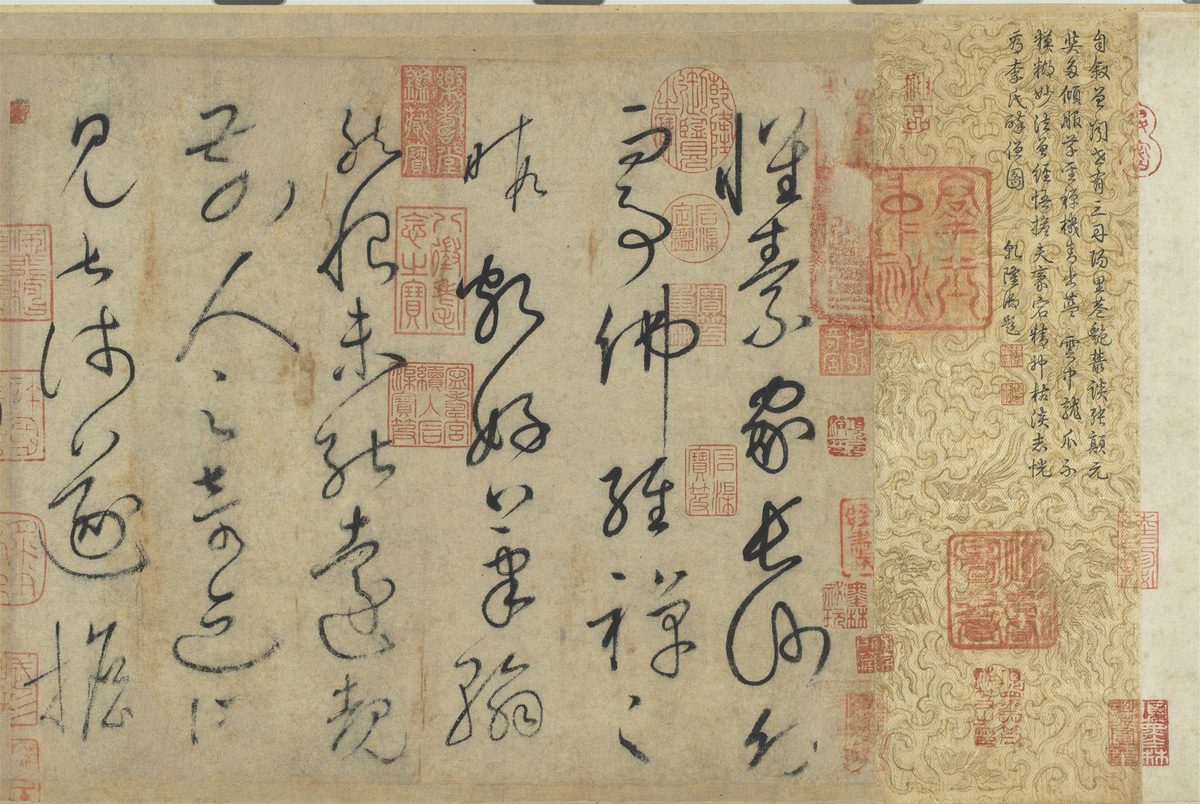
Wild cursive
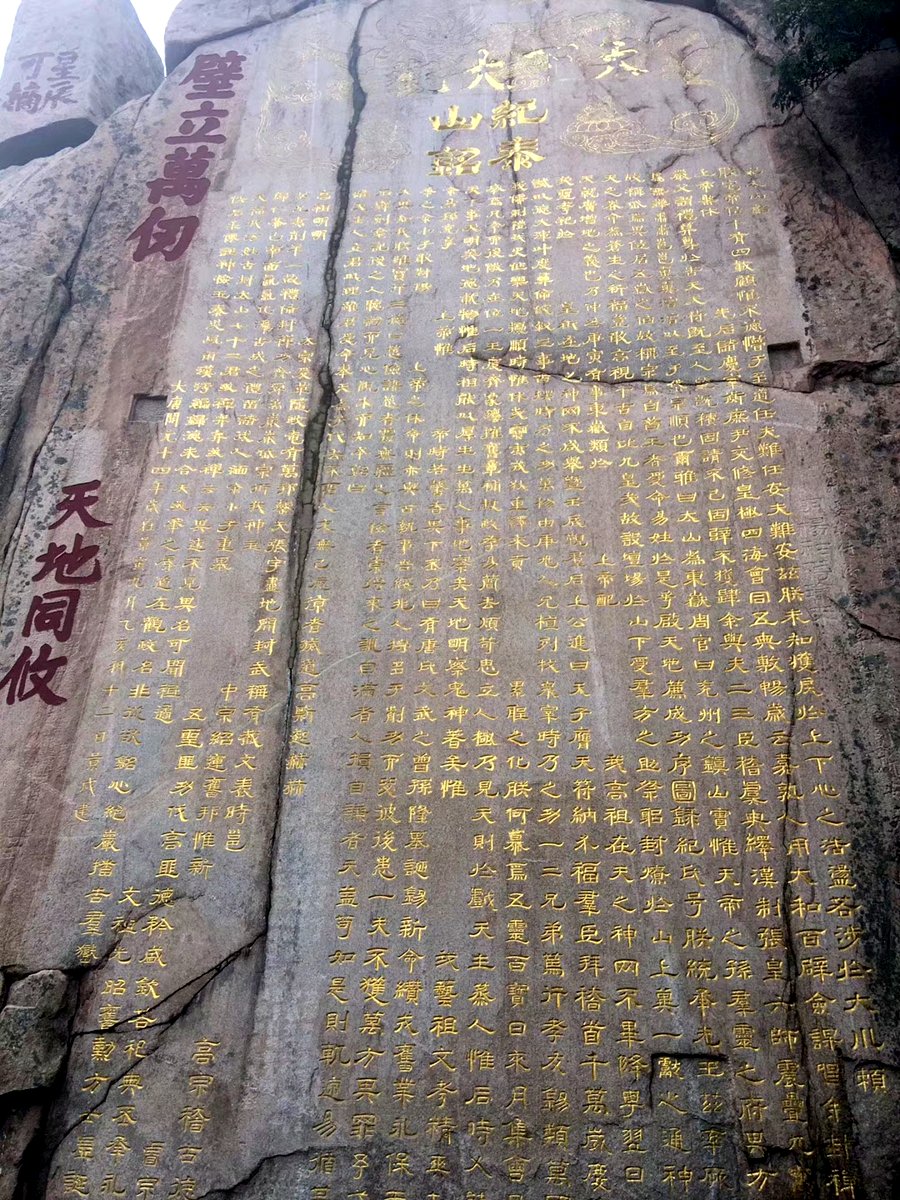
Composed and written by Emperor Xuanzong of Tang; Daguan Peak, summit of Mount Tai
Wang Wei. Wang Wei was both poet and painter. In his later years he kept a country estate at Wangchuan in Lantian, where he and Pei Di exchanged the poems of the Wangchuan Collection, and he painted the Wangchuan Villa; the original is long lost, surviving only in later copies and stone engravings. Zhang Yanyuan records that his "broken-ink landscapes have vigorous, crisp brushwork". The manner later attributed to him replaces blue-green with ink washes, often depicting snow scenes and rivers and mountains with a clear, distant mood. Su Shi wrote: "Savor Mojie's poems and there are paintings in them; look at Mojie's paintings and there are poems in them", and ranked him above Wu Daozi. Genuine works were already rare in the Song, and none of the paintings now attributed to Wang Wei is reliable. His place in the history of painting was mainly established by later writers: in the late Ming Dong Qichang made him the founder of the "Southern School" and of literati painting. The Zhongnan Mountains, which he often visited, are a section of the Qinling, and his poem Zhongnan Mountains conveys their height and expanse.

Full scroll of the copy attributed to Guo Zhongshu; National Palace Museum, Taipei

Anonymous copy; Art Institute of Chicago

Wang Shimin's Clearing after Snow on Rivers and Mountains, after Wang Wei (no genuine Wang Wei survives)
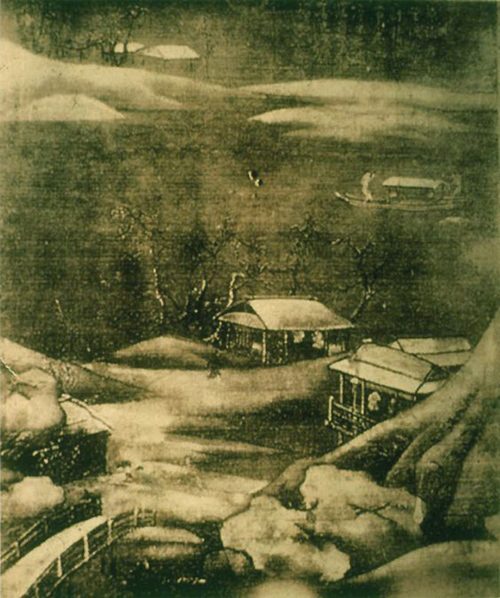
Snowy Stream, attributed to Wang Wei
The rise of ink landscape. Ink landscape spread after the High Tang. Zhang Zao excelled at pines and rocks, and is said to have painted with a brush in each hand at once, one for living branches and one for dead. He said: "Outwardly learn from nature; inwardly find the source in the mind": take nature as teacher, then recast it within. This became one of the most quoted sayings in later theory. Wang Qia first splashed ink on the silk, then turned the shapes of the ink into rocks, clouds and water; he was called "Ink Wang". These experiments prepared the way for the maturity of ink landscape in the Five Dynasties.
Yan Liben. Yan Liben came from a family of craftsmen: his father Yan Pi and elder brother Yan Lide were both skilled in architecture and painting, and he himself rose to Chancellor of the Right. Emperor Taizong Receiving the Tibetan Envoy shows Taizong receiving Gar Tongtsen, envoy of the Tibetan kingdom. The emperor sits on a sedan carried by palace women and is drawn larger than those around him; the envoy stands with hands clasped, respectful in manner. The Thirteen Emperors depicts thirteen rulers from the Han to the Sui, distinguishing the wise from the foolish by their bearing. Both are attributed to him, and the surviving versions may be copies. He also painted portraits of meritorious officials for the Lingyan Pavilion (lost). Some say the reliefs of the Six Steeds of Zhaoling were based on drawings by him or Yan Lide; the six horses originally stood at Taizong's Zhaoling mausoleum, and four of them are now in the Forest of Steles in Xi'an.

Full scroll; Palace Museum, Beijing
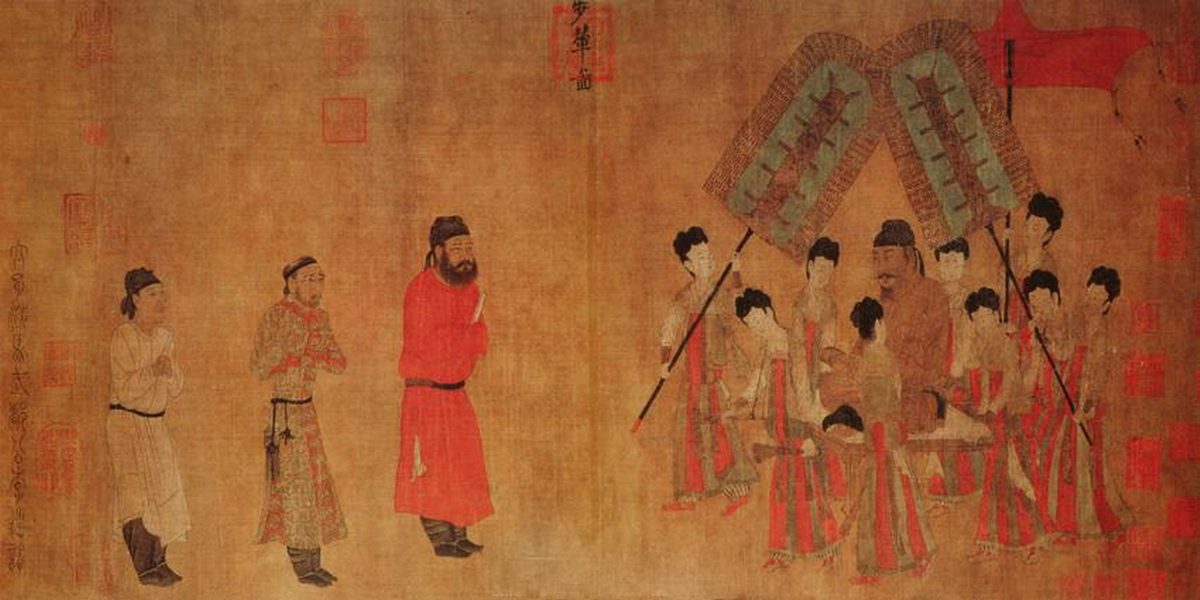
Main painting

Full scroll; Museum of Fine Arts, Boston
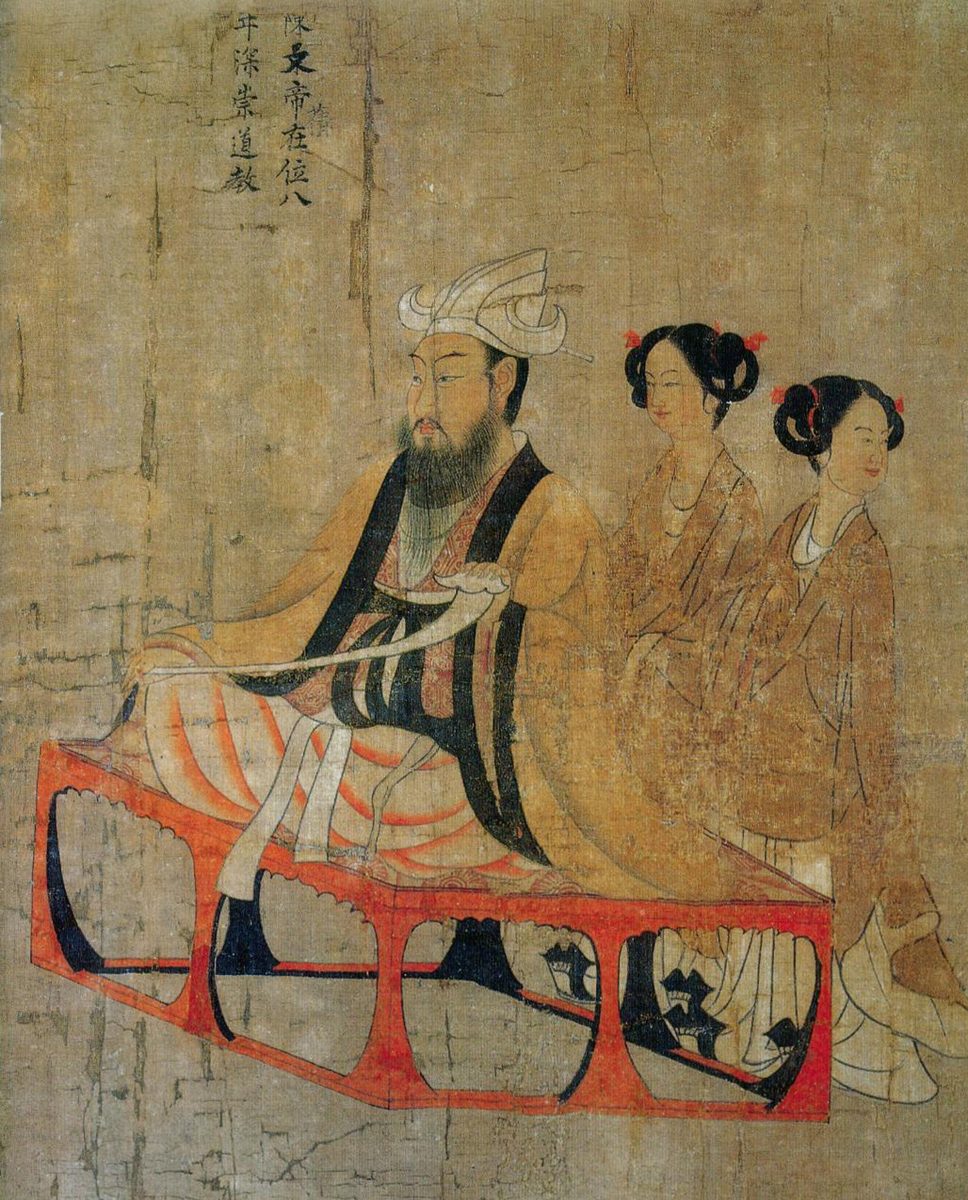
Detail (Emperor Wen of Chen)

Xi'an Beilin Museum

Xi'an Beilin Museum

Xi'an Beilin Museum
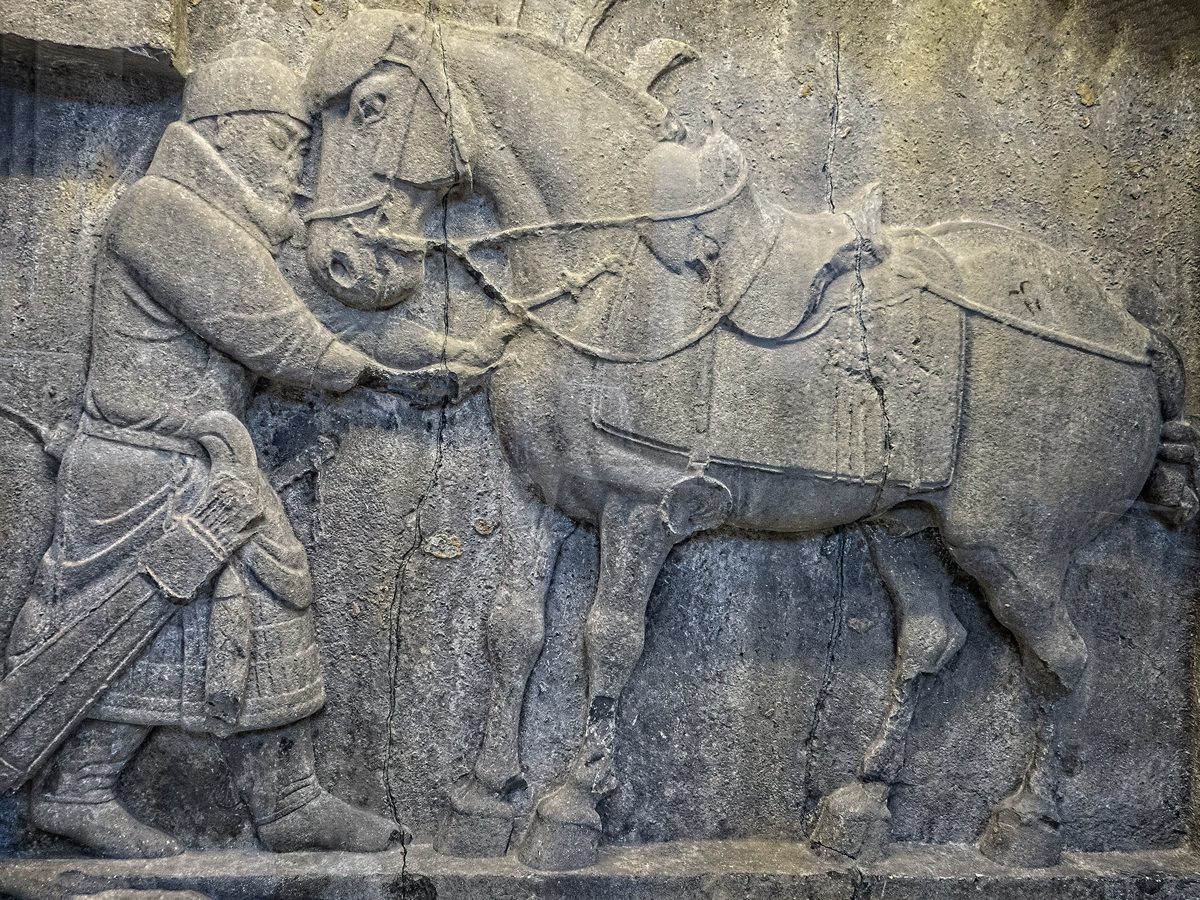
Penn Museum, University of Pennsylvania
Gary Todd, CC BY-SA 4.0, Wikimedia Commons
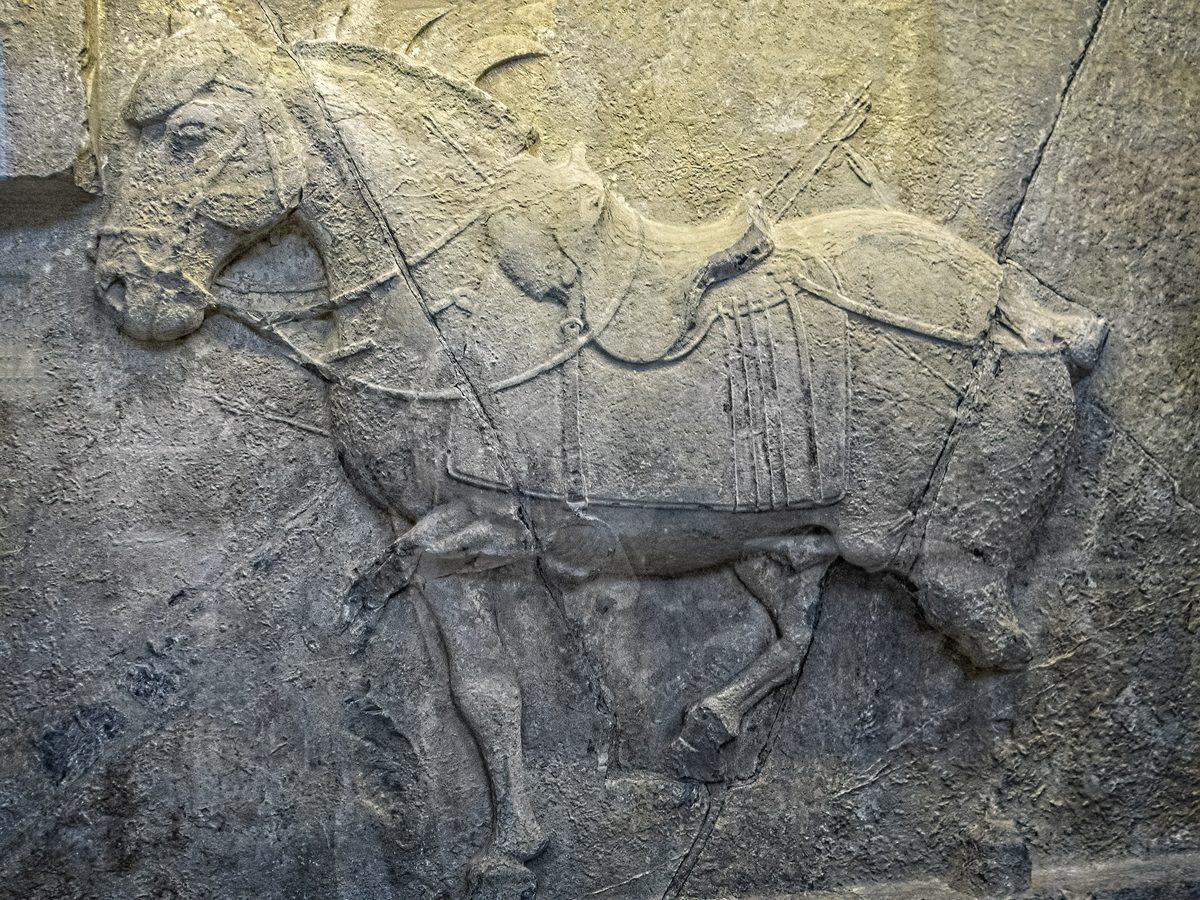
Penn Museum, University of Pennsylvania
Gary Todd, CC BY-SA 4.0, Wikimedia Commons

Xi'an Beilin Museum
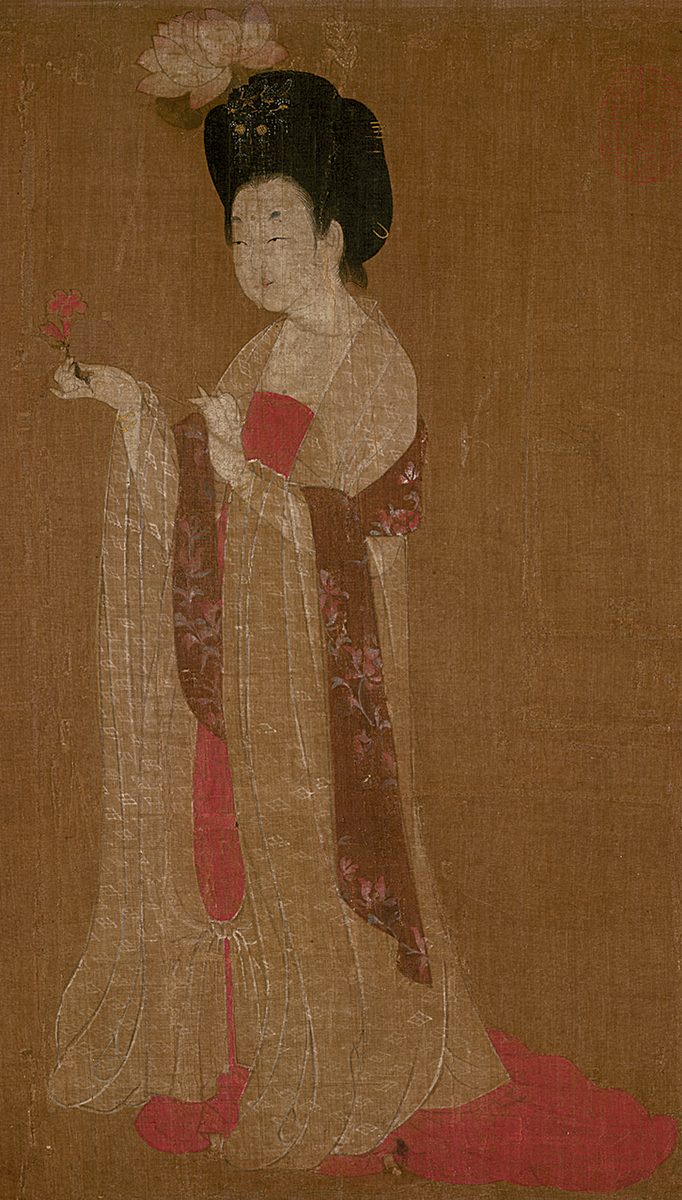
Zhang Xuan and Zhou Fang. From the High to the middle Tang, Zhang Xuan and Zhou Fang were known for paintings of aristocratic women. The Tang admired plumpness, and the ladies in these paintings are full-figured, richly dressed and at ease. Zhang Xuan's Lady Guoguo's Spring Outing shows Lady Guoguo, sister of Consort Yang, riding out with her retinue. The figures are well spaced and there is no background; spring is felt only in the lightness of riders and horses. The original is lost; the surviving Song copy is attributed to Emperor Huizong. Court Ladies Preparing Newly Woven Silk, showing women pounding, spinning and ironing silk, is also a Song copy. Zhou Fang came after Zhang Xuan; Court Ladies Wearing Flowered Headdresses, attributed to him, shows palace women admiring flowers and playing with dogs, their hair piled high and decorated with flowers, their skin visible through gauze robes; its date is disputed. Zhou Fang also created the "Water-Moon Guanyin" type, followed by later painters.
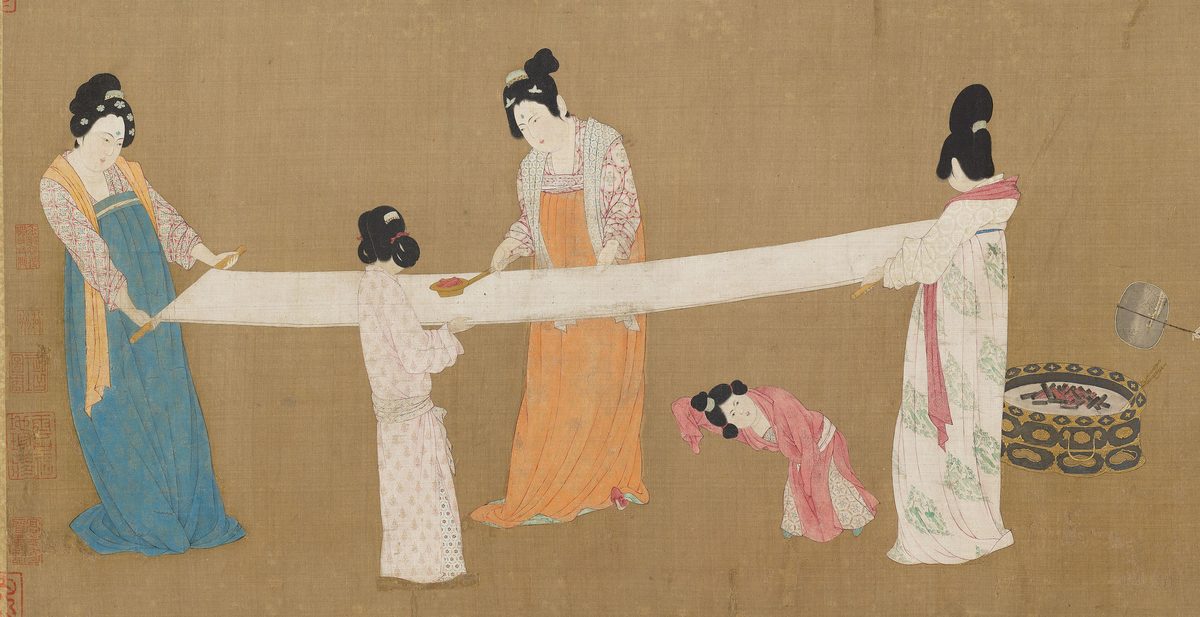
Detail
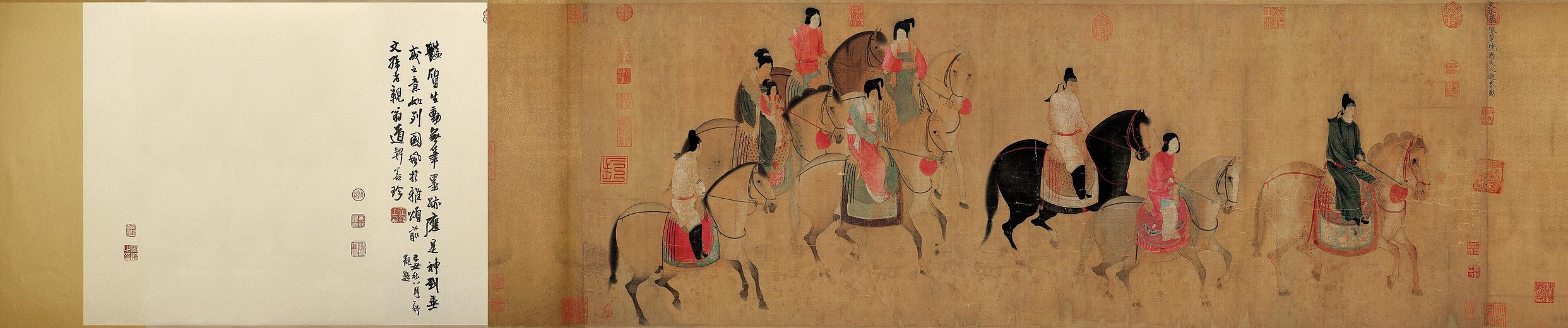
Song copy; Liaoning Provincial Museum

Full scroll (copy by Emperor Huizong); Museum of Fine Arts, Boston
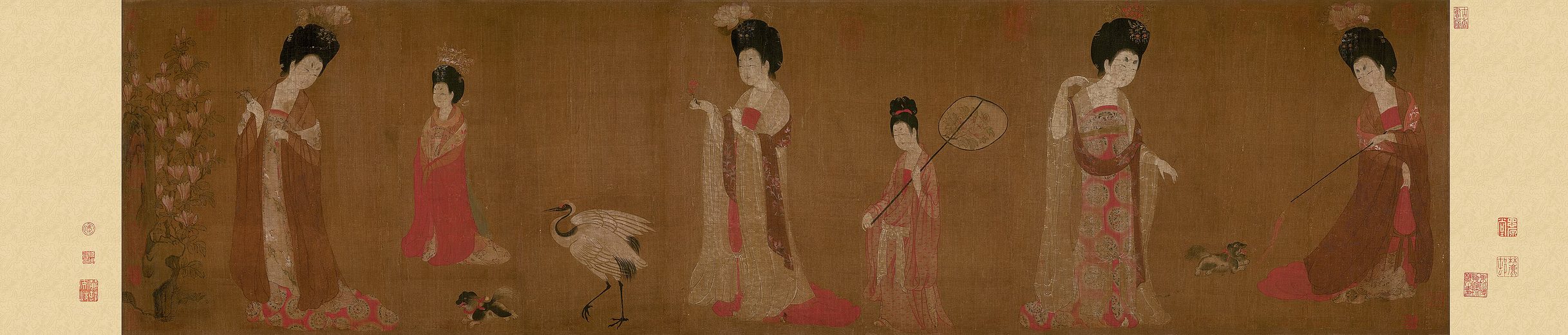
Full scroll; Liaoning Provincial Museum
Detail
Horses and oxen. The Tang loved horses. Han Gan was the great horse painter of Xuanzong's reign; Night-Shining White shows the emperor's horse tethered to a post, head raised and neighing, sturdy and fleshy. Du Fu wrote that he "painted the flesh and not the bone", a remark later readers have taken both as praise and as criticism. Five Oxen by Han Huang of the middle Tang shows five oxen in different poses and is one of the earliest surviving paintings on paper. Dai Song also painted oxen; Su Shi's On Dai Song's Painting of Oxen tells of a herdboy laughing at his fighting oxen with raised tails, since oxen fight with their tails clamped between their legs.
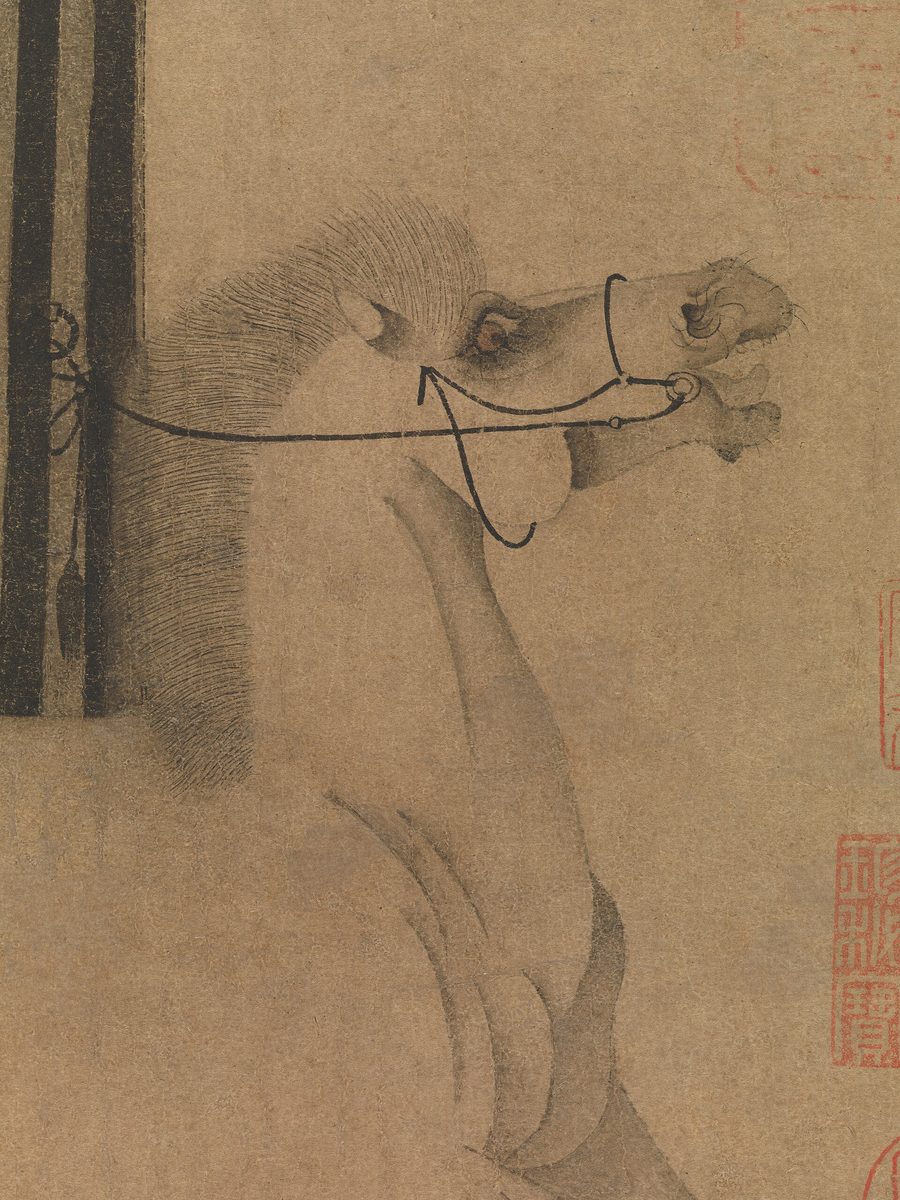

Full scroll; Palace Museum, Beijing

Detail
History and theory of painting. In the late Tang, Zhang Yanyuan wrote the Record of Famous Painters of All the Dynasties in ten chapters, the first systematic general history of painting. The first three chapters discuss the origins of painting, the Six Principles, brushwork, landscape, trees and rocks, connoisseurship and mounting; the last seven give short biographies of more than three hundred painters from antiquity to the Tang. He held that "calligraphy and painting use the brush in the same way" and that "the idea must precede the brush", opposing the pursuit of mere likeness and color. Slightly earlier, Zhu Jingxuan's Record of Famous Tang Painters ranked Tang painters as inspired, marvelous and capable, and set up an "untrammeled" class outside the three; this classification shaped criticism from the Song onward.
Dunhuang murals. The Tang was the golden age of the Mogao Caves. The murals are mainly sutra illustrations, each turning the content of a Buddhist scripture into one large composition. The most common is the Western Pure Land: the Buddha sits on a lotus throne in the center, surrounded by pavilions, pools, music and dance, in a symmetrical and grand composition. Cave 220 has an inscription dated to the early Tang; the emperor in the Vimalakirti illustration on its east wall resembles those in The Thirteen Emperors. In Cave 217 of the High Tang, the "Parable of the Phantom City" in the Lotus Sutra illustration has blue-green landscape, giving an idea of landscape scrolls of the time. In Cave 156 of the late Tang, Zhang Yichao's Army on the March shows Zhang Yichao, who recovered the Hexi Corridor, leading his troops.
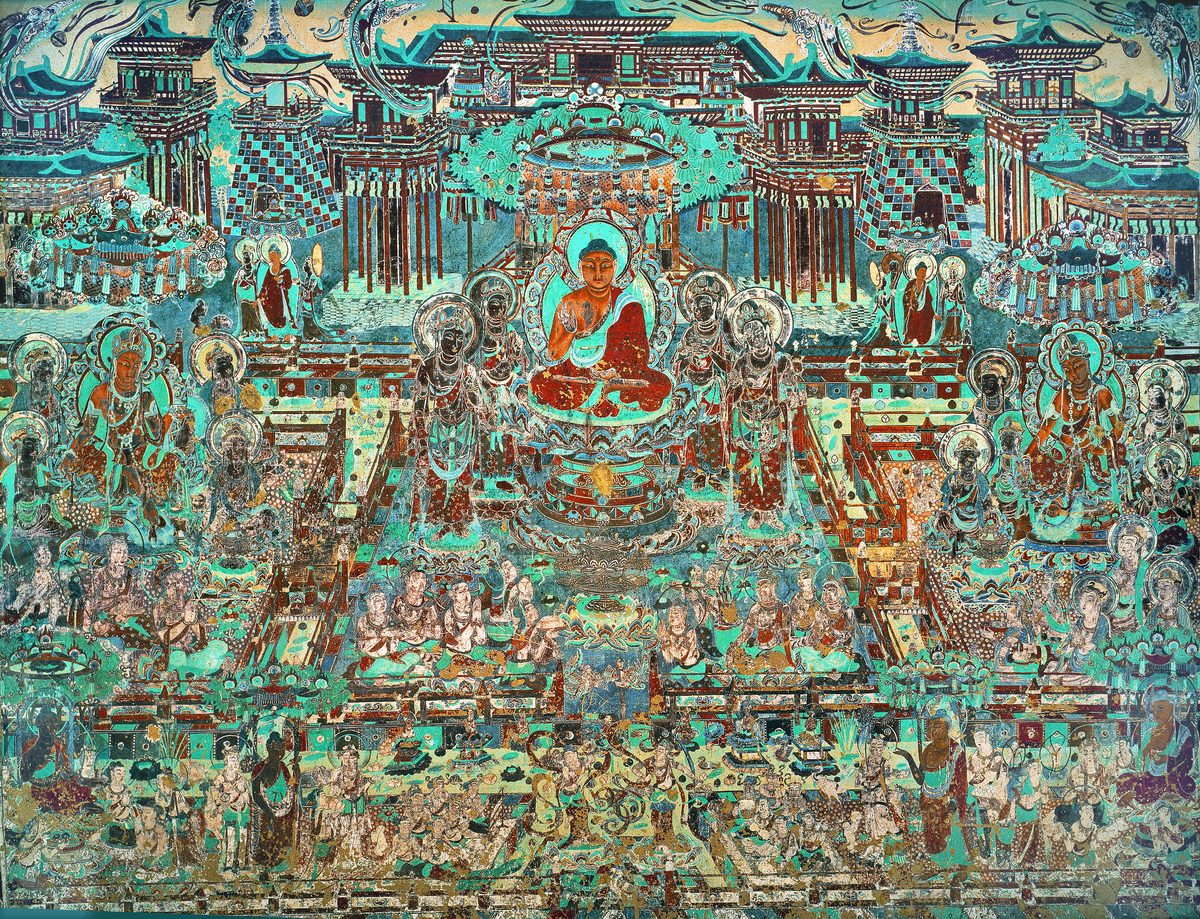
Contemplation Sutra illustration, Cave 217
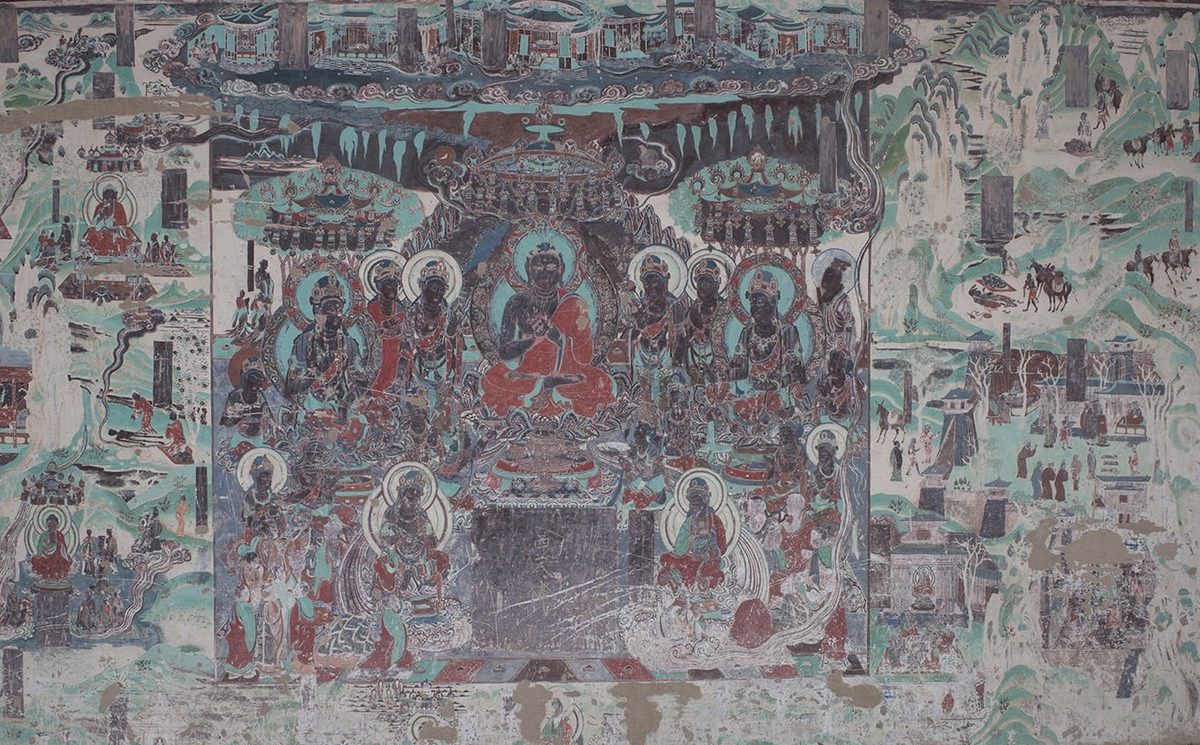
Lotus Sutra illustration, Cave 217

Dunhuang Murals, Set 5 (1994-8), 1994

Dunhuang Murals, Set 5 (1994-8), 1994
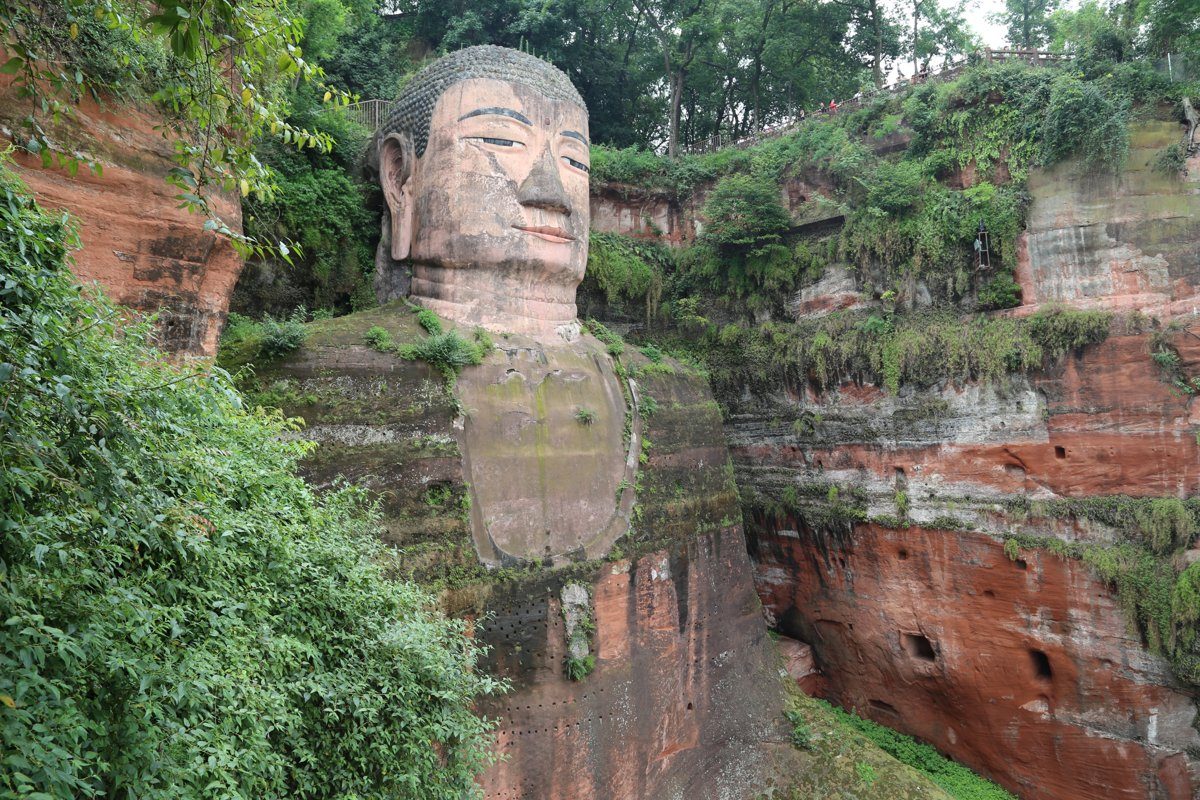
Tomb murals, sculpture and crafts. Many satellite tombs around Tang imperial mausoleums have murals. Those of Prince Zhanghuai, Prince Yide and Princess Yongtai, buried near the Qianling mausoleum, show polo, processions with honor guards and palace women in flowing line; most have been removed from the walls and are in the Shaanxi History Museum. The Vairocana Buddha of the Fengxian Temple at the Longmen Grottoes, completed under Emperor Gaozong with funds from Empress Wu, has a full and dignified face; the Leshan Giant Buddha was cut from the mountain over about ninety years. The East Hall of the Foguang Temple on Mount Wutai preserves Tang painted sculptures and murals, rare Tang originals in a temple. Tang sancai (three-color ware) is low-fired lead-glazed pottery whose yellow, green, white or brown glazes run together in firing; it was mostly made as tomb figures of horses, camels and people, with most finds from Chang'an and Luoyang. The best-known gold and silver come from the Hejiacun hoard in Xi'an and the crypt of the Famen Temple, their shapes and patterns often influenced by West and Central Asia. In carved brick, the Xiuding Temple Pagoda at Anyang, Henan, a single-story square Tang pagoda, is faced with more than three thousand carved bricks showing guardians, flying apsaras, dragons, tigers and floral patterns, covering it entirely in relief; it is unique among ancient pagodas.
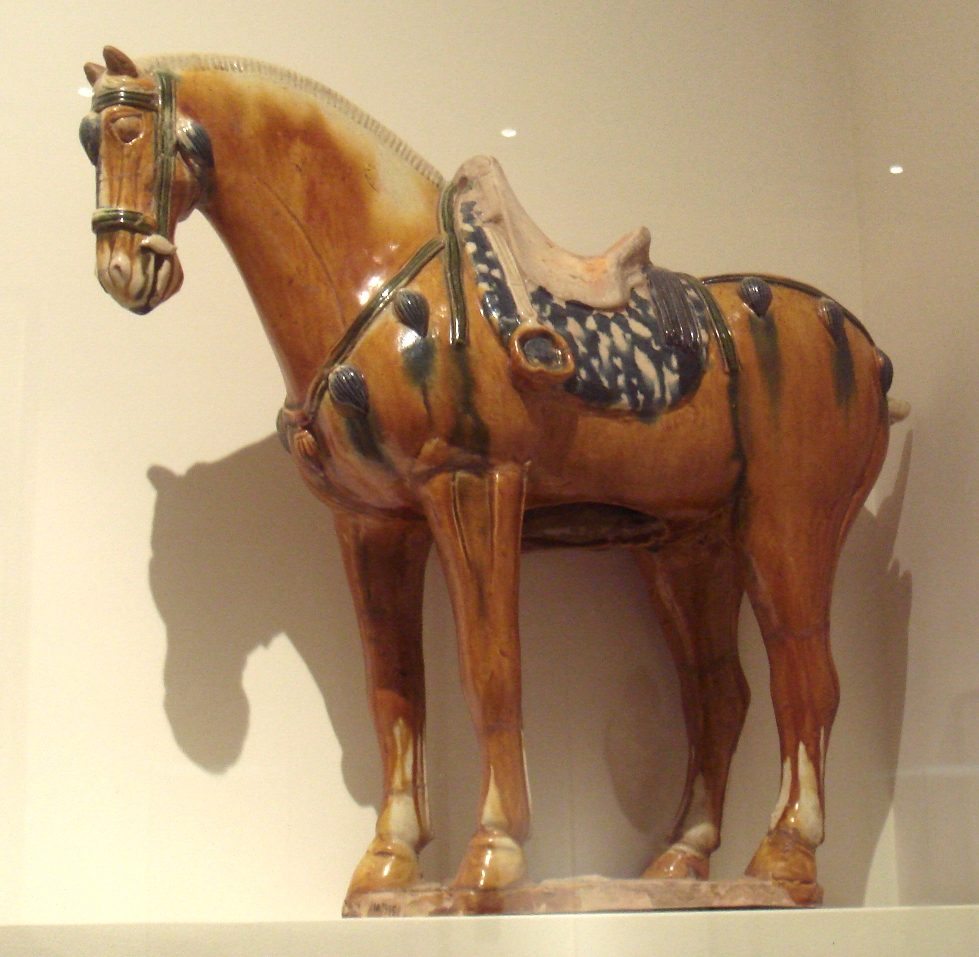
Sancai horse
PHGCOM / self-made, photographed at the Musée Guimet, CC BY-SA 3.0, Wikimedia Commons
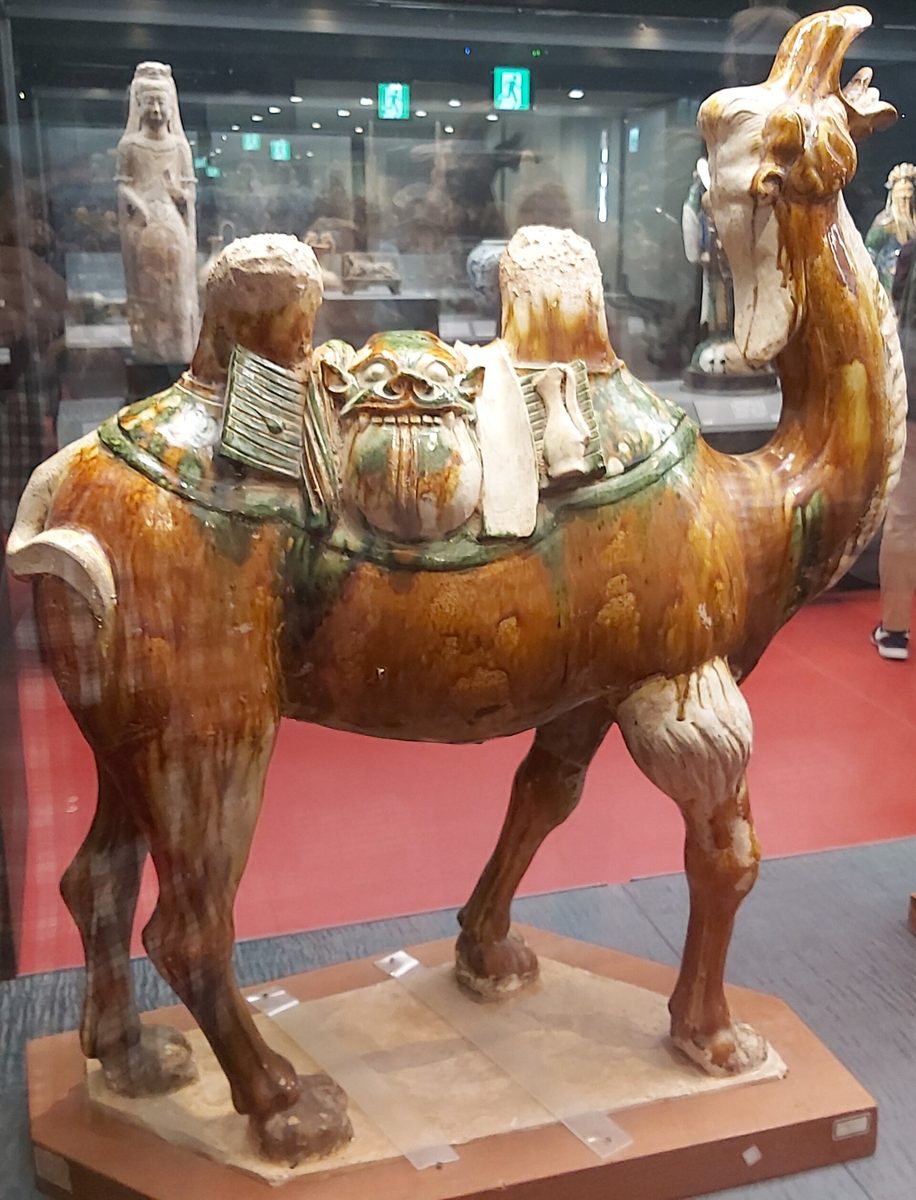
Sancai camel
阿道 / Own work, CC BY-SA 4.0, Wikimedia Commons
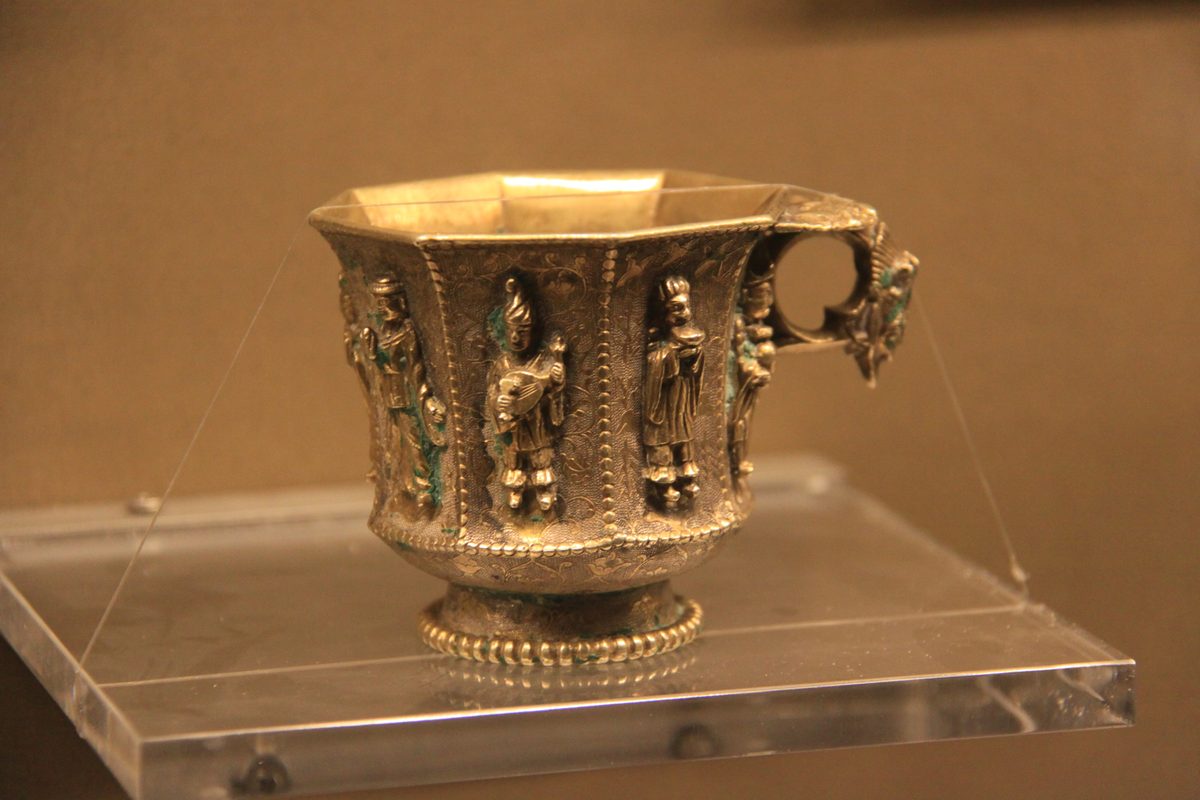
Gilded octagonal silver cup with musicians; Shaanxi History Museum
Byrnzie500 / https://www.flickr.com/photos/byrnzie28/3869044863, CC BY-SA 2.0, Wikimedia Commons
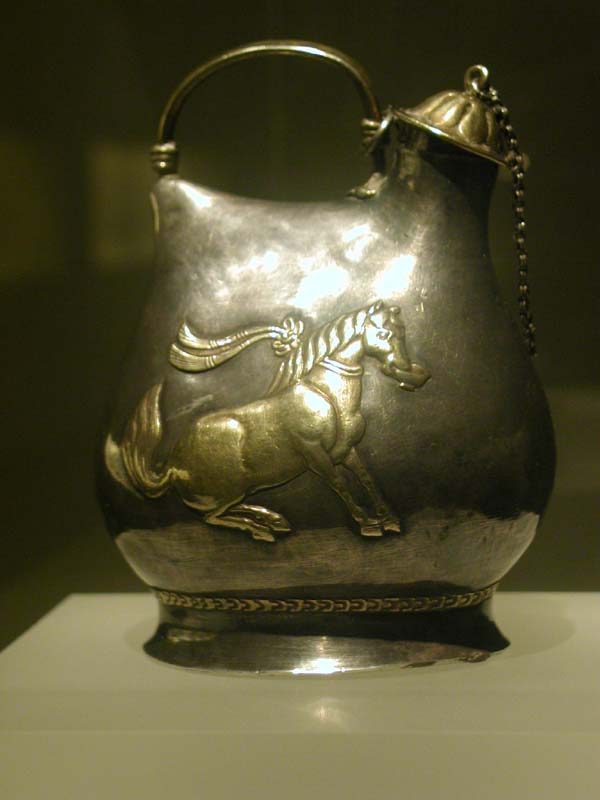
Silver flask with dancing horse holding a cup

Cultural Relics Unearthed during the Cultural Revolution (Nos. 66–77), 1973
Representative works
| Work | Period | Type | Collection | Notes | |
|---|---|---|---|---|---|
| Spring Outing↑ | Sui | Handscroll, ink and color on silk, attributed to Zhan Ziqian | Palace Museum | Often called the earliest surviving landscape scroll; some consider it a Northern Song copy. |
| Sailboats and Pavilions↑ | Tang | Hanging scroll, ink and color on silk, attributed to Li Sixun | National Palace Museum, Taipei | Blue-green landscape. |
| Emperor Minghuang's Journey to Shu↑ | Tang | Hanging scroll, ink and color on silk, attributed to Li Zhaodao | National Palace Museum, Taipei | Xuanzong fleeing to Shu; the surviving version is a later copy. |
| Wangchuan Villa↑ | Tang | Wang Wei | The original is lost; later copies and stone engravings survive. | |
| Emperor Taizong Receiving the Tibetan Envoy↑ | Tang | Handscroll, ink and color on silk, attributed to Yan Liben | Palace Museum | Taizong receives the Tibetan envoy Gar Tongtsen; some consider it a Song copy. |
| The Thirteen Emperors↑ | Tang | Handscroll, ink and color on silk, attributed to Yan Liben | Museum of Fine Arts, Boston | Thirteen rulers from the Han to the Sui. |
| The Heavenly King Presenting a Son↑ | Tang | Handscroll, ink on paper, attributed to Wu Daozi, Song copy | Osaka City Museum of Fine Arts, Japan | Shows the line drawing of Wu Daozi's school. |
| Eighty-seven Immortals | Tang | Handscroll, ink outline on silk | Xu Beihong Memorial Museum | Formerly owned by Xu Beihong; its author and date are disputed. | |
| Lady Guoguo's Spring Outing↑ | Tang | Handscroll, ink and color on silk, after Zhang Xuan, Song copy | Liaoning Provincial Museum | The copy is attributed to Emperor Huizong. |
| Court Ladies Preparing Newly Woven Silk↑ | Tang | Handscroll, ink and color on silk, after Zhang Xuan, Song copy | Museum of Fine Arts, Boston | Women pounding, spinning and ironing silk. |
| Court Ladies Wearing Flowered Headdresses↑ | Tang | Handscroll, ink and color on silk, attributed to Zhou Fang | Liaoning Provincial Museum | Its date is disputed. |
| Night-Shining White↑ | Tang | Handscroll on paper, Han Gan | Metropolitan Museum of Art | Emperor Xuanzong's horse. |
| Five Oxen↑ | Tang | Handscroll, ink and color on paper, Han Huang | Palace Museum | One of the earliest surviving paintings on paper. |
| Western Pure Land | Early Tang | Mural | Cave 220, Mogao Caves, Dunhuang | The cave bears an inscription dated to the early Tang. | |
| Lotus Sutra: Parable of the Phantom City↑ | High Tang | Mural | Cave 217, Mogao Caves, Dunhuang | Blue-green landscape in a mural. |
| Zhang Yichao's Army on the March↑ | Late Tang | Mural | Cave 156, Mogao Caves, Dunhuang | A large procession scene. |
| Polo Players | Tang | Tomb mural | Shaanxi History Museum | From the tomb of Prince Zhanghuai, a satellite tomb of Qianling. | |
| Six Steeds of Zhaoling↑ | Tang | Stone relief | Xi'an Beilin Museum (four), Penn Museum, University of Pennsylvania (two) | Carvings from Emperor Taizong's Zhaoling mausoleum; some say designed by Yan Liben or Yan Lide. |
| Vairocana Buddha of the Fengxian Temple | Tang | Cave sculpture | In situ, Longmen Grottoes, Luoyang | Completed under Emperor Gaozong. | |
| Sancai Camel Carrying Musicians | Tang | Tang sancai | National Museum of China | From the tomb of Xianyu Tinghui in Xi'an; musicians and a dancer ride on the camel's back. | |
| Gilded Silver Flask with Dancing Horse Holding a Cup↑ | Tang | Gold and silver | Shaanxi History Museum | From the Hejiacun hoard, Xi'an. |
| Gold and Silver Tea Set from the Famen Temple Crypt | Tang | Gold and silver | Famen Temple Museum | Late Tang imperial tea utensils, found with secret-color celadon. | |
| Carved Bricks of the Xiuding Temple Pagoda | Tang | Carved brick | In situ, Xiuding Temple, Anyang County, Henan | More than three thousand carved bricks form a relief covering the pagoda's walls. |
← Chapter 4: Wei, Jin and the Northern and Southern DynastiesContentsChapter 6: Five Dynasties →