 Park of China
Overview
| Designation | UNESCO World Heritage (mixed, 1987) National Park of China (first batch) AAAAA tourist attraction |
| Province | Shandong |
| Location | Shandong |
| Mountains | Taiyi Mountains |
| Latitude, longitude | 36.3, 117.1 Google Maps |
| Highlights | First of the Five Sacred Mountains; stone inscriptions, sea of clouds, sunrise |
| Top sights | The Eighteen Bends, South Heavenly Gate, Jade Emperor Peak, Dai Temple |
| Highest point | 1,533 m |
| Nearby cities | Tai'an, Jinan |
| Nearby sites | Lingyan Temple 17km, Temple, Mansion and Cemetery of Confucius, Qufu 73km, Qingzhou Scenic Area 129km Search nearby |
| Themes | Famous Mountain, Mountain, Inscription, Temple, Taoism, Forest, Small Waterfall, Stamp, Banknote, Cable Car, Culture, Sea of clouds & sunrise, Hiking & climbing, Ancient trees |
About
Mount Tai, the Eastern Sacred Mountain, also called Daizong, is the first of the Five Sacred Mountains. It rises on the northern edge of Tai’an in Shandong, about 70 km south of Jinan. Emperors of many dynasties held the Fengshan sacrifices here. The summit, Jade Emperor Peak, is 1,533 m above sea level, the highest point in Shandong.
Inscriptions and stelae left by famous figures of every age are found all over the mountain, together with more than 20 groups of ancient buildings. The main sights are the Dai Temple, Puzhao Temple, Black Dragon Pool, the Sutra Stone Valley, the Doumu Palace, the Middle and South Heavenly Gates, the Bixia Temple and Jade Emperor Peak. The four wonders of the summit are sunrise over the east, the glow of sunset, the “golden belt” of the Yellow River and the “jade plate” sea of clouds.

A road climbs as far as the Middle Heavenly Gate, and a cable car runs from there to the top; the cable car has been much criticised by experts.
The Dai Temple in the city of Tai’an, also called the Temple of the Eastern Sacred Mountain, is where emperors sacrificed to the mountain and held their grand ceremonies.
It is in the first batch of national parks of China (national scenic areas) named by the State Council in 1982.
Main sights
Dai Temple: in Tai'an city. Its main hall, Tiankuang Hall, dates from the Song dynasty and is counted among the three great ancient halls of China. The wall paintings inside show the god of Mount Tai on procession. The temple has old cypresses and many steles.
Red Gate and Wanxian Tower: the Red Gate is the start of the traditional climb, a short way north of Dai Temple. Wanxian Tower stands above it, with a number of inscriptions and memorial arches around.
Sutra Stone Valley (Jingshiyu): in a valley north of Doumu Palace, where a broad stream-washed rock slab carries a large-character carving of the Diamond Sutra, from the Northern Dynasties. Part of it survives.
Five Pines (Wudafu Pine): beside the path above Midway Gate. Tradition says the First Emperor of Qin sheltered under a pine here in a rainstorm and gave it a title. The trees now standing were planted later.
Eighteen Bends (Shibapan): the steepest stretch of the climb, a long, steep flight of stone steps up to the South Gate to Heaven, and the hardest part of the walk.
South Gate to Heaven and the Heavenly Street: at the top of the Eighteen Bends is the South Gate to Heaven, and inside it a short street with shops and guesthouses leading to the Bixia Temple area.
Bixia Temple: a temple at the summit to Bixia Yuanjun, a goddess widely worshipped in northern China. Many of its roofs are covered in bronze and iron tiles. Pilgrims came in large numbers in the past.
Jade Emperor Peak (Yuhuangding): the highest point, with the Jade Emperor Temple. In front of it stands a stele without inscription, usually thought to date from the Qin or Han period, though its date is disputed.
Tang cliff inscription at Daguan Peak: on a cliff east of the summit is the Tang dynasty Record of Mount Tai, the largest of the cliff inscriptions on the mountain.
Sun-viewing Peak (Riguanfeng): the traditional place on the eastern side of the summit to watch the sunrise, beside the Gongbei and Tanhai rocks.
Eighteen Bends: from Kaishan, north of Duisong Shan, to the South Gate of Heaven, over 1,630 stone steps in three sections, the slow eighteen, the neither-slow-nor-fast eighteen and the steep eighteen; the last is the steepest.
South Gate of Heaven: founded in 1264 under the Yuan by the Taoist Zhang Zhichun; also called the Third Gate of Heaven, it marks the top of the Eighteen Bends.
Bixia Temple: founded in 1008 under the Northern Song and called Zhaozhen Shrine, it was Zhaozhen Temple under the Jin and Bixia Lingyou Palace under the Ming, and took its present name in the Qing.
History and culture
Before the Qin, Mount Tai was already regarded as a sacred peak that touched heaven. Emperors came to report to heaven and earth in rites known as Feng and Shan. Records mention the First Emperor of Qin, Emperor Wu of Han, Emperor Guangwu of Han, and later Emperors Gaozong and Xuanzong of Tang and Emperor Zhenzong of Song.
Confucius is said to have climbed Mount Tai, and the Mencius records that when he climbed it he found the world small. Scholars of every period climbed to write poems and have them carved, from the Han to modern times. The number of inscriptions makes the mountain an open-air museum of calligraphy.
Belief on the mountain is layered. The Great Emperor of the Eastern Peak was the official mountain god, Bixia Yuanjun is the most influential goddess in popular belief, and Buddhist monasteries and Daoist temples are scattered over the slopes. The custom of setting up a stone inscribed with the words 'Shi Gandang of Mount Tai' at the door to ward off evil is also associated with the mountain.
The traditional route from Dai Temple north has several thousand steps, lined with inscriptions, memorial arches and pavilions. The route itself is treated as part of the cultural landscape and was a key point in the World Heritage listing.
Travel tips
Getting there: take the Beijing–Shanghai high-speed train to Tai'an station, or a regular train to Tai'an, then a bus or taxi to the trailheads. Jinan airport is about an hour's drive from Tai'an.
Booking: every visitor needs a real-name booking; tickets are checked at the time slot and entrance you booked, so bring your ID or passport. Book ahead on holidays.
Hongmen route: north from the Dai Temple through Hongmen, Doumu Palace and Zhongtianmen, then up the Eighteen Bends to the South Gate of Heaven. This is the traditional route, with the most inscriptions. Walking from Hongmen to the top takes about four to six hours.
By bus and cable car: from Tianwaicun, park buses go to Zhongtianmen, and a cable car goes on to near the South Gate of Heaven. The western Taohuayu route has a cable car to the summit, and on the north side of the summit the Houshiwu cable car serves the Tianzhufeng area.
The summit area: above the South Gate of Heaven are Heavenly Street, the Temple of the Azure Clouds (Bixia Temple) and the Jade Emperor Peak, all on foot.
Dai Temple: in Tai'an city, where emperors made sacrifices to the mountain; visit separately from the climb, allowing one to two hours.
Sunrise: many people climb at night or stay on the summit to see the sunrise. Early morning on top is cold, even in summer, so bring warm clothes. In cloud or fog there is no sunrise to see.
Time: one day for the mountain and half a day for the Dai Temple.
Caution: the Eighteen Bends are long and steep. On holidays there are very many climbers, with long queues on the summit and at the cable cars. When paths ice over in winter, some routes close temporarily.
Nearby: Lingyan Temple, north of the mountain in Changqing District of Jinan, takes another half day.
Stamps and banknotes
In 1988 China Post issued “Mount Tai”, four stamps: the Dai Temple in clear snow, the winding path to heaven, the grand peaks and sunrise over a sea of clouds.


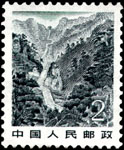
The third stamp of the 1981 definitive set R21 “Scenery of the Motherland” shows Mount Tai.
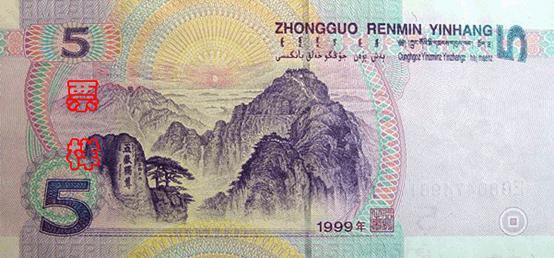
The back of the five-yuan note of the fifth series of renminbi shows Mount Tai.
In 2019 China Post issued 2019-16 “The Five Great Mountains”, five stamps: Morning Sun at Riguan Peak (Mount Tai), Clear Autumn on Mount Hua, Rain over Zhurong Peak (Mount Heng in Hunan), Snow on the Heng Frontier (Mount Heng in Shanxi) and The Rival Peaks of Taishi and Shaoshi (Mount Song).


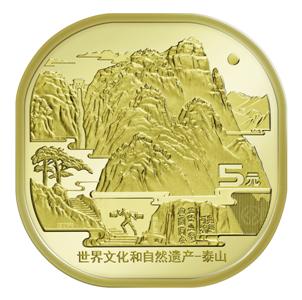
The 5-yuan coin “World Cultural and Natural Heritage: Mount Tai”, issued by the People’s Bank of China in 2019, shows the South Gate of Heaven, the Eighteen Bends, the Jade Emperor Summit and Mount Tai inscriptions on the reverse.
In literature
Du Fu’s “Gazing at the Sacred Mountain” describes the green of the mountain stretching over Qi and Lu and ends with his wish to stand on the summit and see all other mountains small.
Lingyan Temple
Lingyan Temple lies north of Mount Tai in Changqing District of Jinan and is counted among the four great temples of China; as the saying goes, a visit to Mount Tai is not complete without Lingyan. The temple is famous for its painted clay arhats, called “the finest sculptures in the land”, and also has an ancient pagoda and a forest of memorial pagodas.
Map
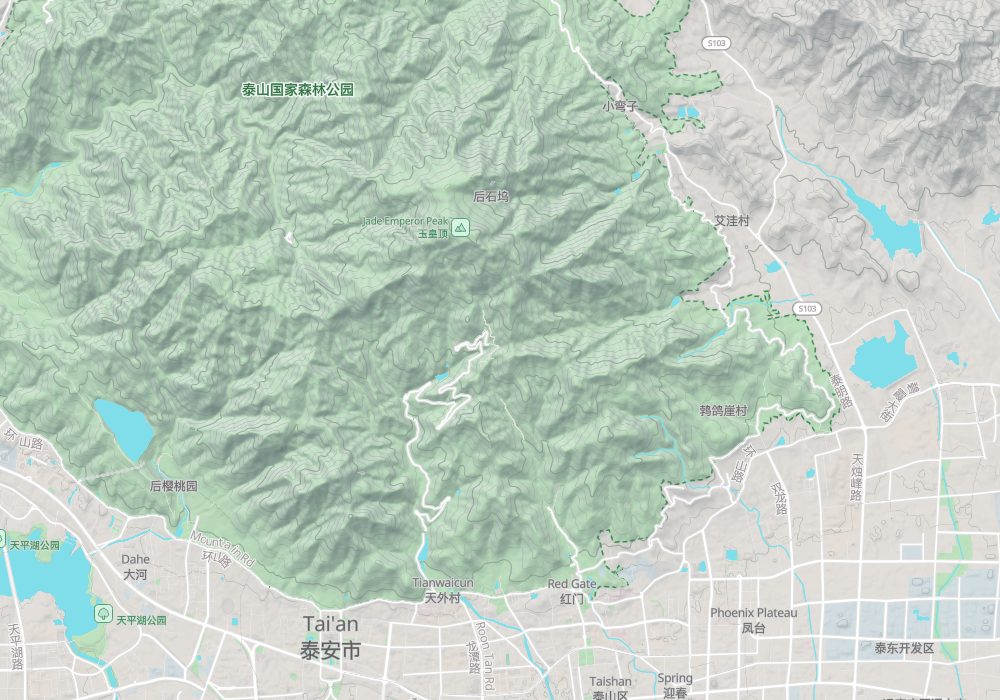
Photo credits: The Dai Temple: Zhangzhugang (CC BY-SA 4.0, Wikimedia Commons); Mount Tai: Jari Kirma (CC BY-SA 4.0, Wikimedia Commons)
Nearby
| World Heritage | Temple, Mansion and Cemetery of Confucius, Qufu 73km, Yin Xu, Anyang 261km |
| National parks | Thousand Buddha Mountain 43km, Boshan Scenic Area 72km, Qingzhou Scenic Area 129km |
| Detailed guides | Lingyan Temple 17km |
| AAAAA attractions | Jinan Springs 46km, Yimeng Mountain Scenic Area 89km, Zhoucun Ancient Commercial City Scenic Area 90km, Firefly Water Cave and Underground Grand Canyon Tourist Area 135km |
| AAAA attractions | Taishan Baotailong Scenic Area 7km, Taishan Fantawild Joyland 8km, Lingyanshan 17km, Jiudingta Chinese Ethnic Happy Amusement Park 19km |
| UNESCO Global Geoparks | Yimengshan UNESCO Global Geopark 89km |
| Historic cities | Tai'an 7km, Jinan 48km, Qufu 74km, Zoucheng 95km |
| Cities | Jinan 40km |
| Historical sites | Taishan Ancient Building Complex <1km, Taishan Stone Inscriptions 3km, Tomb of Feng Yuxiang 5km, Dai Temple 7km |
| National geoparks | Yiyuan Lushan National Geopark 95km, Shanwang National Geopark 149km |
| Nature reserves | Shanwang Paleontological Fossils National Nature Reserve 149km |
| Historic towns | Dawenkou Town 33km |