
← Chapter 5: Sui and TangA History of Chinese ArtChapter 7: Northern Song →
Chapter 6: Five Dynasties
In the half century and more after the fall of the Tang, five dynasties succeeded one another in the Central Plains, while ten kingdoms stood side by side in the south and in Sichuan. The Western Shu at Chengdu and the Southern Tang at Jinling (present-day Nanjing) were relatively stable, and both courts set up painting academies that gathered many painters. The greatest achievement of the period was in landscape: in the north Jing Hao and Guan Tong, in the south Dong Yuan and Juran, known together as "Jing, Guan, Dong and Ju". Ink landscape replaced blue-green as the mainstream, and cun (texture strokes), used to render the grain of rocks and mountains, matured. Bird-and-flower painting also developed two styles.
Jing Hao. Jing Hao lived in the late Tang and Five Dynasties. To escape the wars he withdrew to Honggu in the Taihang Mountains and called himself Master of Honggu. In the mountains he sketched old pines "tens of thousands of times before they were true to life". His contribution was to unite the brush and ink that had developed separately in the Tang. He said: "Wu Daozi's landscapes have brush but no ink; Xiang Rong's have ink but no brush. I shall take the strengths of both and create a style of my own." Mount Kuanglu, attributed to him, is named after Kuanglu, that is, Mount Lu, but its mountains are massive and steep, more like those of the north, and whether it depicts Mount Lu is disputed. The main peak stands in the center and recedes layer by layer; from bottom to top come a stream, cottages, a plank path, a waterfall and peaks. It is the classic northern "monumental" landscape.
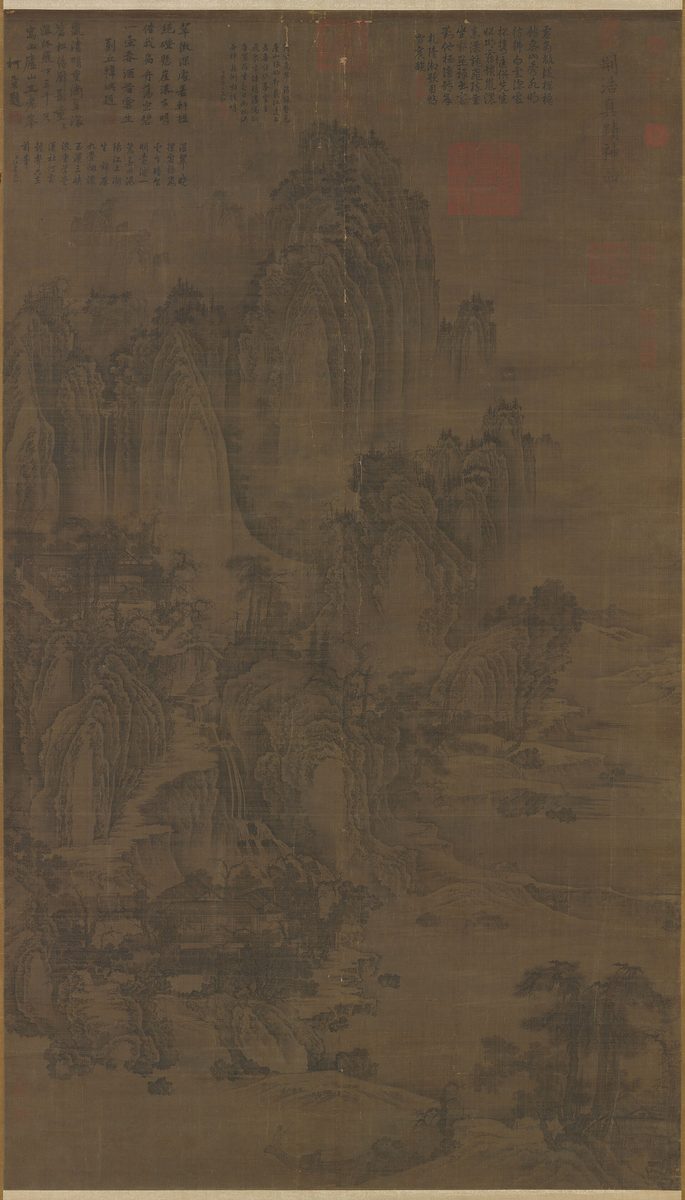
Attributed to Jing Hao; National Palace Museum, Taipei
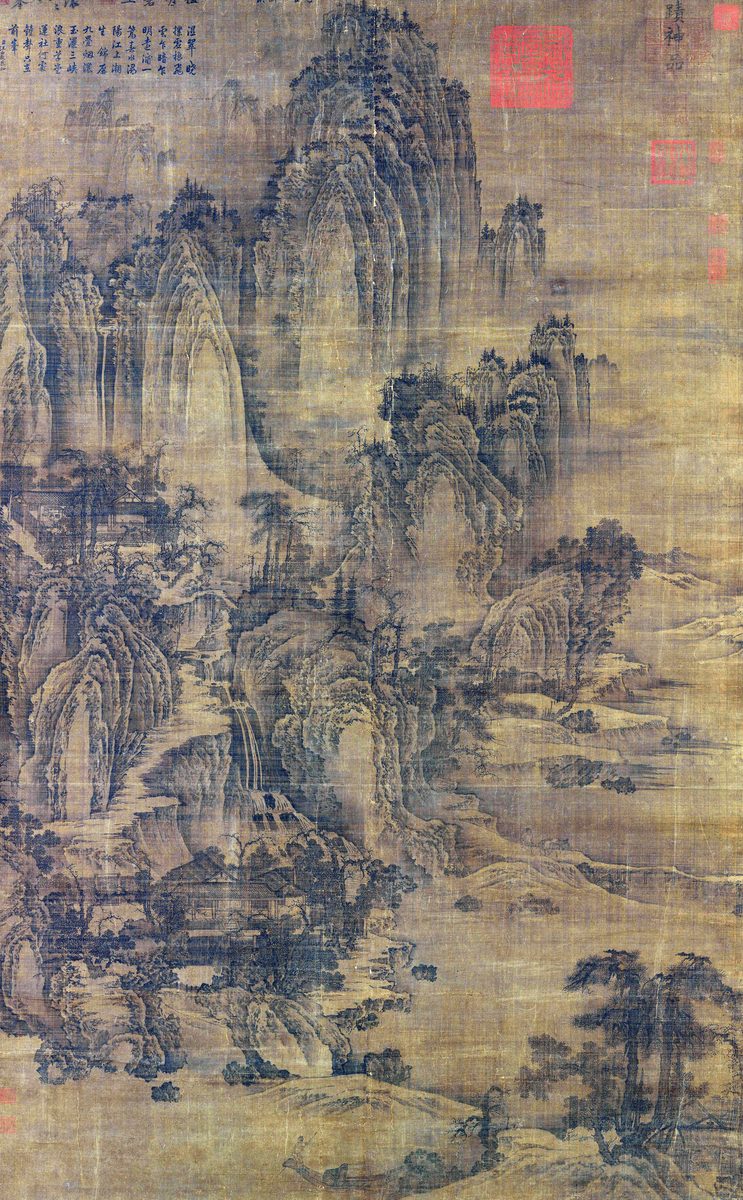
Colour-adjusted from the original by Park of China
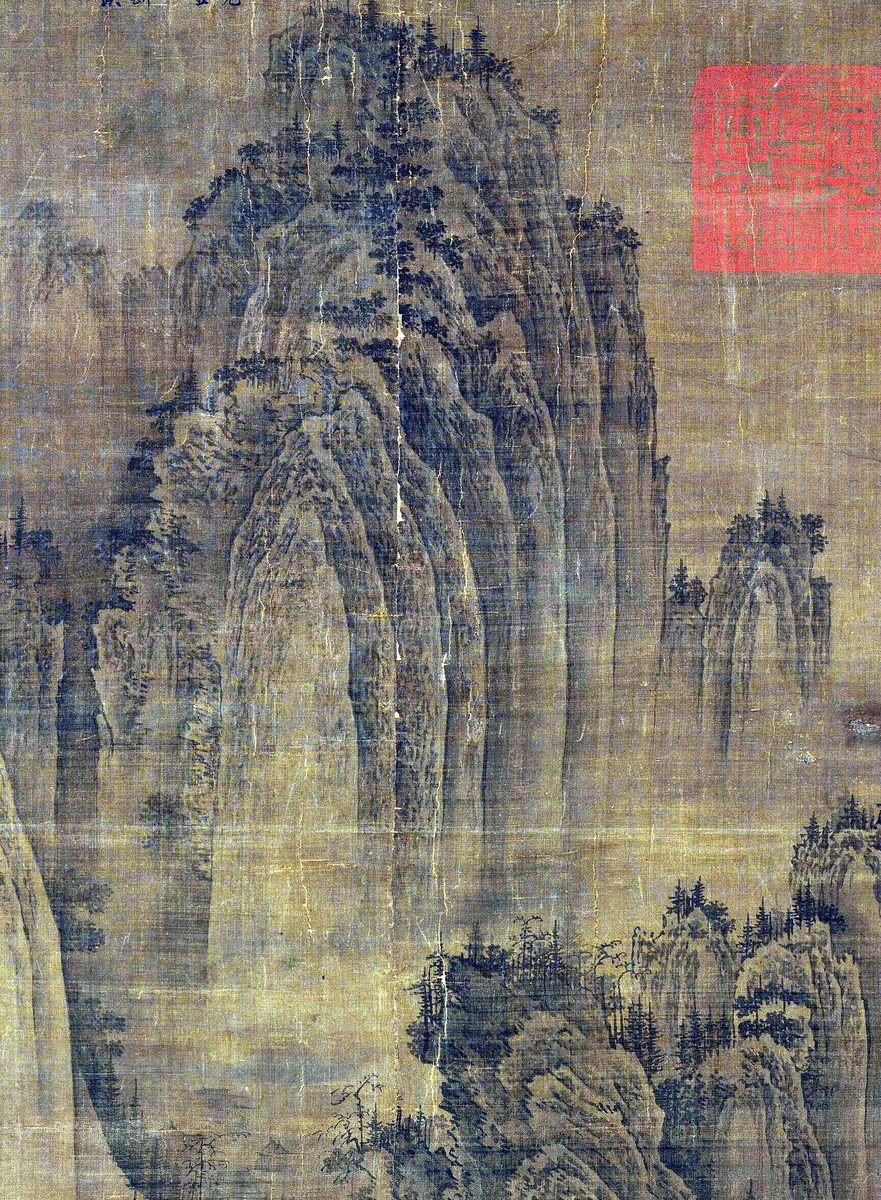
Colour-adjusted from the original by Park of China
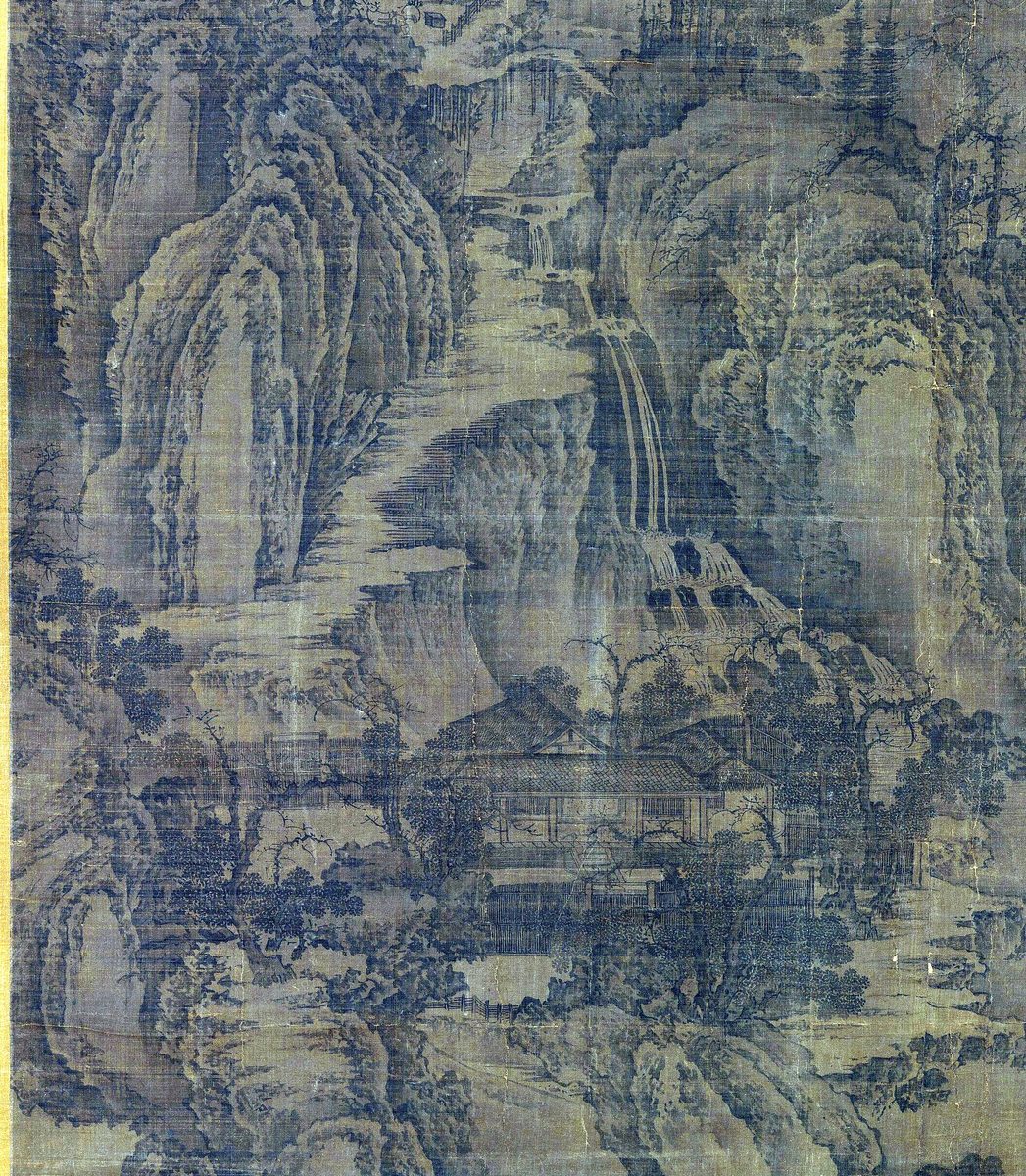
Colour-adjusted from the original by Park of China
Notes on the Art of the Brush. Jing Hao's Notes on the Art of the Brush is framed as a dialogue with an old man met in the Taihang Mountains. It sets out the "Six Essentials" of landscape painting: spirit, resonance, thought, scene, brush and ink. "Spirit" is the mind moving with the brush, choosing images without hesitation; "resonance" is hiding the traces of effort without vulgarity; "thought" is paring away the superfluous and concentrating on forms; "scene" is choosing views according to the season and seeking out their wonders; "brush" and "ink" treat the use of each. He also said that painting must "measure the forms of things and grasp their truth", distinguishing likeness from truth: "Likeness captures the form but loses the spirit; truth is full in both spirit and substance." Compared with Xie He's Six Principles, the Six Essentials are designed for landscape and raise ink to equal standing with the brush, a sign that ink landscape had matured.
Guan Tong. Guan Tong, a native of Chang'an, studied with Jing Hao as a young man and was later said to have surpassed his teacher. He mostly painted the mountains and rivers of the Guanzhong and Shaanxi region, with solid rocks and steep peaks, spare brushwork and strong spirit; Song writers called it "Guan-style landscape". Travelers at a Mountain Pass, attributed to him, shows a village inn and travelers deep in the mountains; Waiting for the Ferry by a Mountain Stream shows people waiting at a crossing below high peaks. The Northern Song writer Guo Ruoxu ranked Guan Tong with Li Cheng and Fan Kuan as the three masters of landscape.
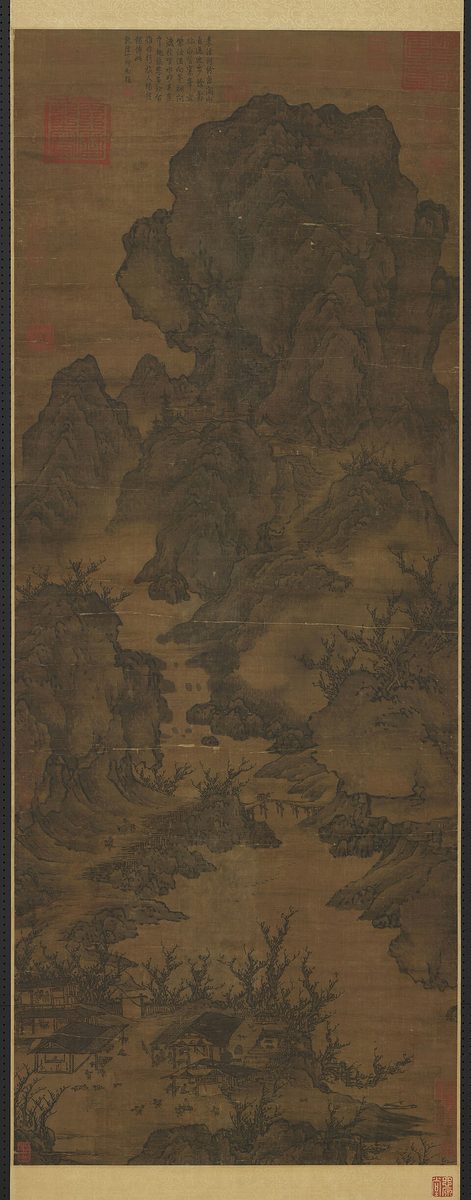
National Palace Museum, Taipei
Dong Yuan. Dong Yuan was a Southern Tang painter who served as Deputy Commissioner of the Northern Park, and later ages called him "Dong Beiyuan". He painted the hills and waterways of the south: rounded mountains with slopes reaching into the water, lush vegetation and light mist, without strange peaks or sheer cliffs. He rendered the grain of earthen hills with long, soft lines, later called "hemp-fiber texture strokes", and added moss dots in ink. Shen Kuo, in his Dream Pool Essays, said that he "mostly painted the real mountains of the south, without strange or precipitous strokes", and that the paintings of Dong Yuan and Juran "are best seen from a distance; the brushwork is very rough, and close up it hardly resembles anything, but from afar the scenery is brilliantly clear". Mi Fu called his paintings "plain, natural and genuine", saying "the Tang had nothing of this kind". His major works, The Xiao and Xiang Rivers, Summer Mountains and Waiting for the Ferry at the Foot of Summer Mountains, share one style; the title of The Xiao and Xiang Rivers was given by Dong Qichang in the Ming. In the Northern Song, Dong Yuan was less famous than Li Cheng and Fan Kuan; from the Yuan onward literati painters revered him as a master, and Dong Qichang made him the orthodox heir of the Southern School.

Full scroll; Palace Museum, Beijing

Detail
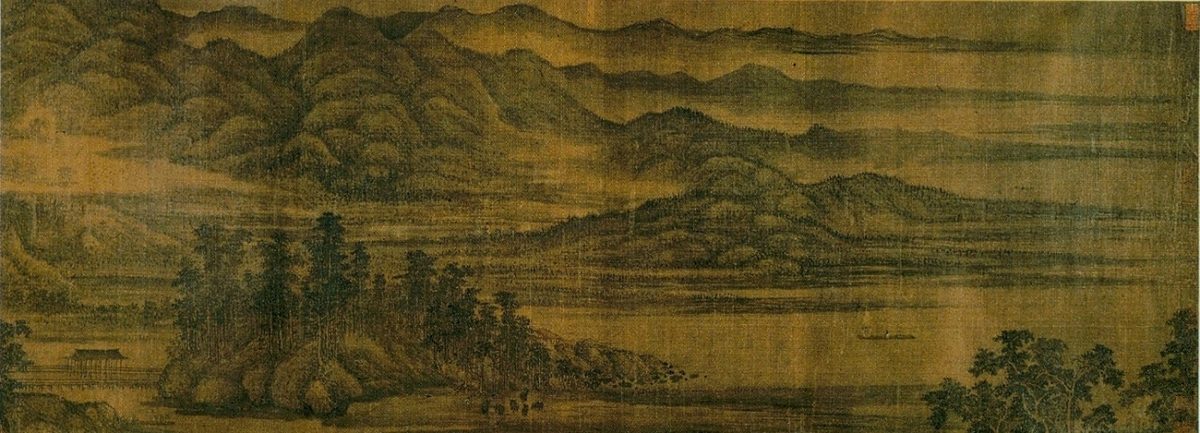
Detail; Shanghai Museum
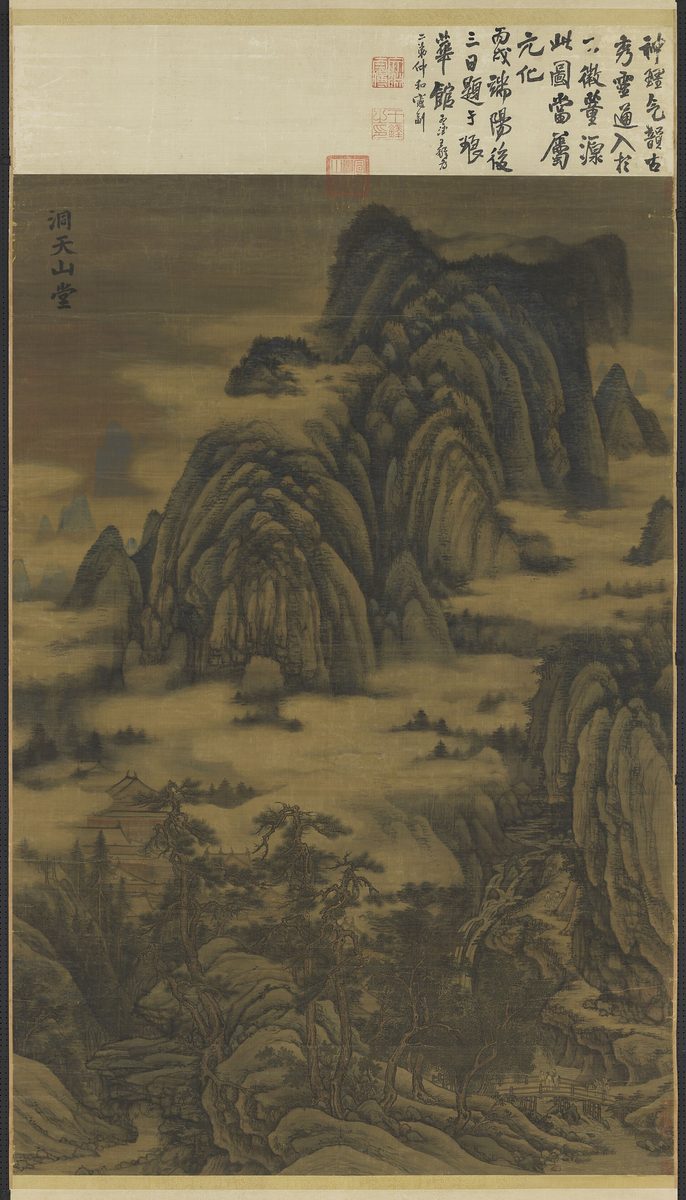
Another work by Dong Yuan
Juran. Juran was a monk of the Kaiyuan Temple in Jinling who followed Dong Yuan. After the fall of the Southern Tang he went with the last ruler, Li Yu, to Bianjing (present-day Kaifeng) and lived in the Kaibao Temple. He painted mountains with long hemp-fiber strokes, often with egg-shaped boulders called "alum heads" on the summits and dense woods, more massive in feeling than Dong Yuan. Seeking the Dao in the Autumn Mountains shows two men seated in a thatched hut deep in the mountains discussing the Way; Myriad Valleys with Wind in the Pines and Layered Cliffs and Dense Woods are also attributed to him. "Dong and Ju" together came to represent the southern school of landscape.
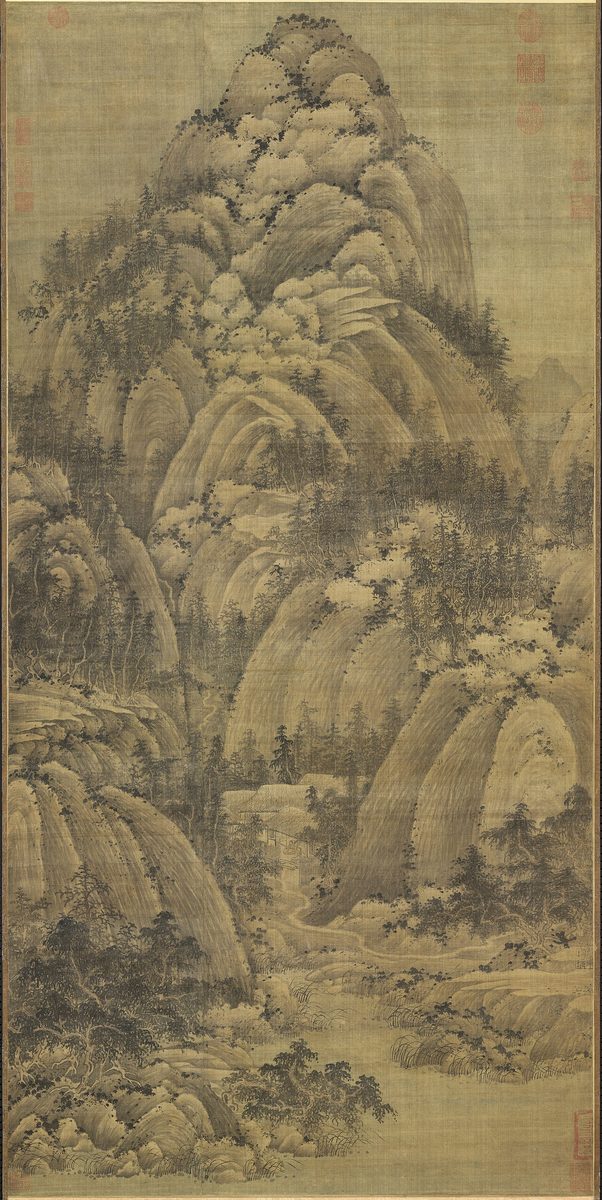
National Palace Museum, Taipei
Gu Hongzhong and Zhou Wenju. Figure painting at the Southern Tang academy is represented by Gu Hongzhong and Zhou Wenju. The Night Revels of Han Xizai shows a night banquet at the home of the Southern Tang minister Han Xizai, in five sections divided by screens: listening to music, watching a dance, resting, playing wind instruments, and the party breaking up. Han Xizai appears in each section, always melancholy. It is said that the last ruler, Li Yu, hearing that Han indulged in pleasure, sent Gu Hongzhong to watch at night, and Gu painted the scene from memory. The surviving version is attributed to Gu Hongzhong; some consider it a Song copy. Zhou Wenju drew drapery with trembling lines, called "quivering brush". The Double Screen shows the Southern Tang ruler Li Jing playing weiqi with his brothers; on the screen behind them a man reclines on a couch, and behind the couch stands another screen painted with a landscape, a painting within a painting, hence the title.

Palace Museum, Beijing

Detail
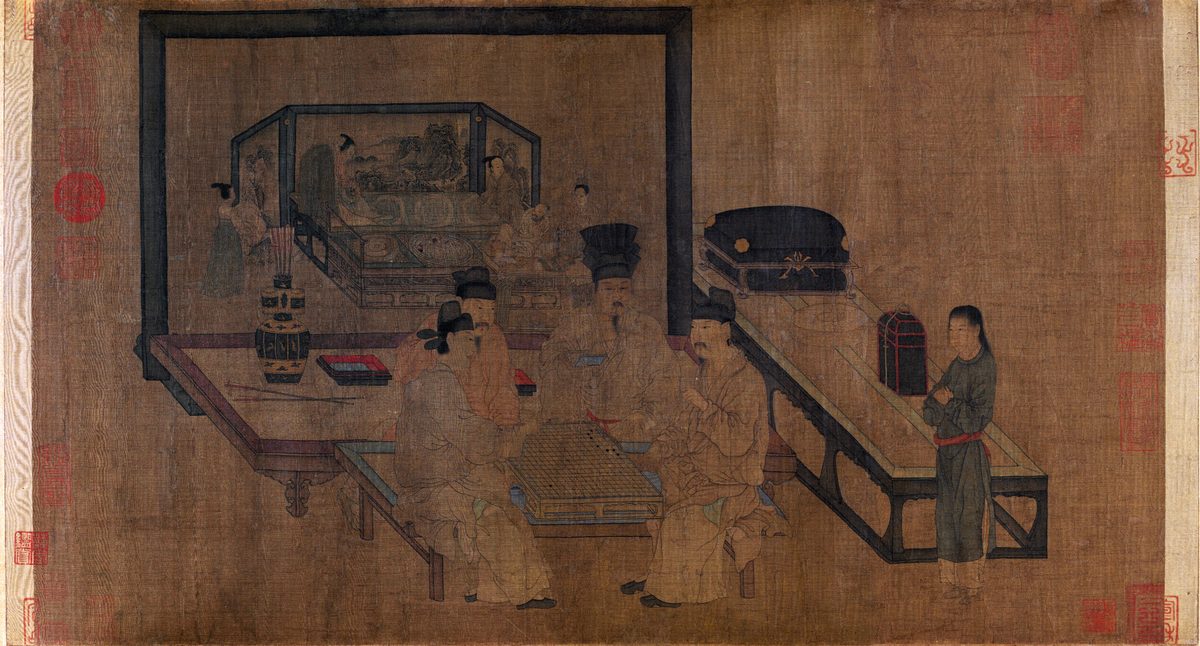
Palace Museum, Beijing

A Palace Concert, attributed to Zhou Wenju
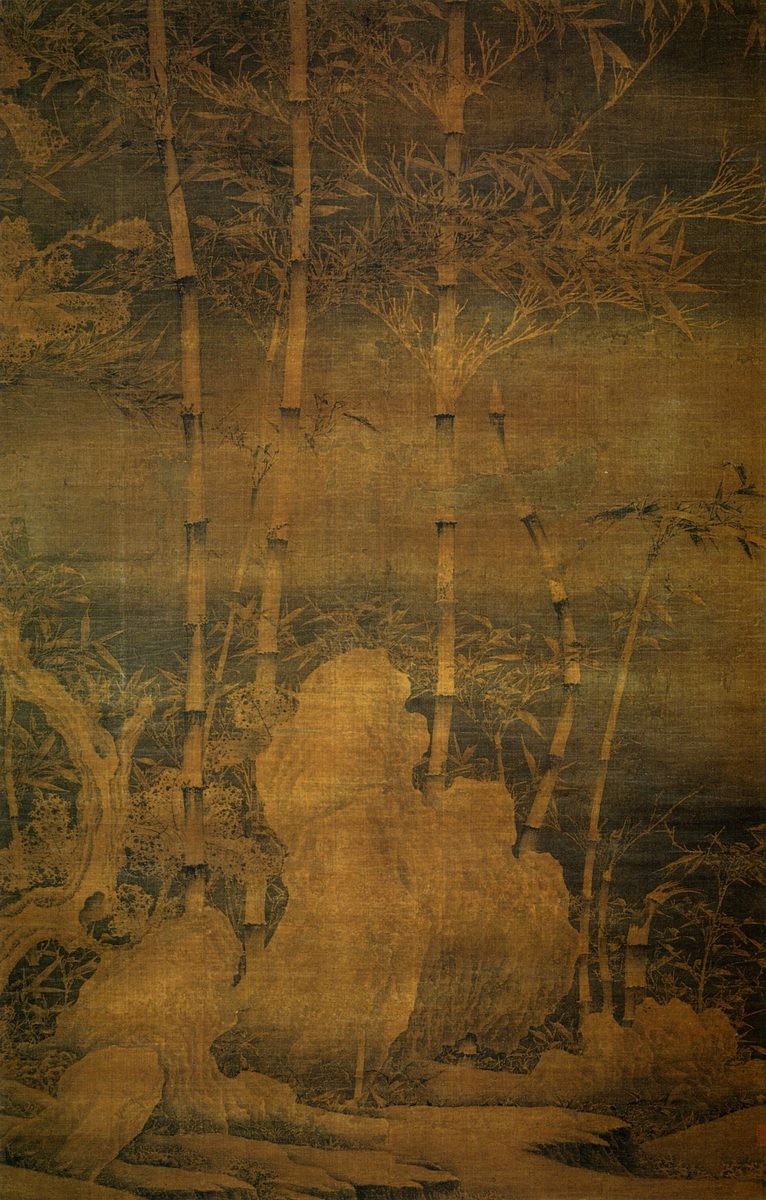
Shanghai Museum
Huang Quan and Xu Xi. Bird-and-flower painting in the Five Dynasties developed two styles, which the Northern Song writer Guo Ruoxu summed up as "the Huang family's opulence, Xu Xi's untrammeled wildness". Huang Quan, a court painter of the Western Shu, painted rare birds and exotic plants of the palace gardens, first outlining them in extremely fine ink lines and then filling in color layer by layer, so that the brush is barely visible, a method called "outline and fill". His Sketches of Rare Birds shows more than twenty birds, tortoises and insects, a model sheet for his son's practice. After the fall of the Western Shu, Huang Quan and his son Huang Jucai entered the Song, and the Huang manner became the standard for bird-and-flower painting at the Northern Song academy. Xu Xi of the Southern Tang was a gentleman of the south who never held office. He painted wild birds on sandbars, vegetables, fruit, grasses and insects, mainly in ink with light color, a method called "laying down ink", with a free brush. No reliable work by Xu Xi survives, but his emphasis on brush and ink was later admired by literati painters.
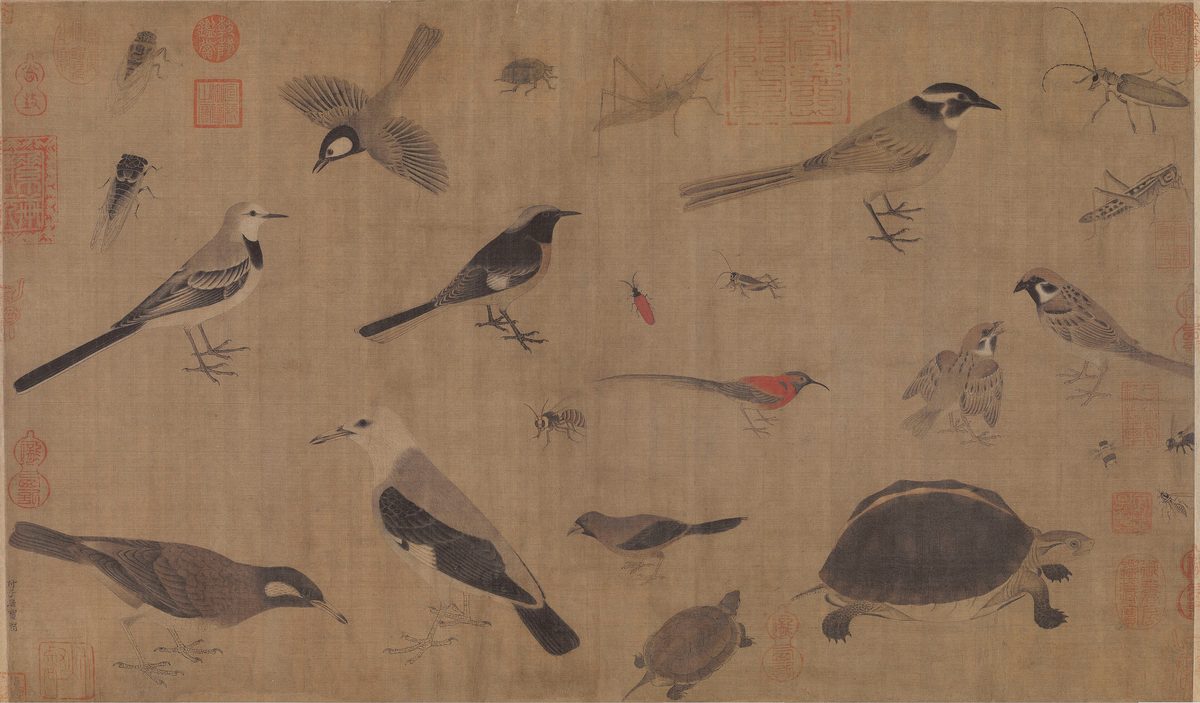
Palace Museum, Beijing

Others. Zhao Gan of the Southern Tang painted Early Snow along the River, showing fishermen at work in the snow. Wei Xian excelled at ruled-line painting. The Khitan painter Hu Gui depicted nomadic life in the north; Resting Riders, attributed to him, shows a mounted party resting and feasting. The monk Guanxiu went to Shu in his later years and painted arhats with strange, archaic faces, described as having "foreign looks and Indian features". The reliefs of twenty-four musicians around the coffin platform in the tomb of Wang Jian of the Former Shu (Yongling) in Chengdu are physical evidence of Tang and Five Dynasties music and dance.
Representative works
| Work | Period | Type | Collection | Notes | |
|---|---|---|---|---|---|
| Mount Kuanglu↑ | Five Dynasties | Hanging scroll, ink on silk, attributed to Jing Hao | National Palace Museum, Taipei | Northern monumental landscape; whether it depicts Mount Lu is disputed. |
| Travelers at a Mountain Pass↑ | Five Dynasties | Hanging scroll, ink on silk, attributed to Guan Tong | National Palace Museum, Taipei | A village inn and travelers deep in the mountains. |
| Waiting for the Ferry by a Mountain Stream | Five Dynasties | Hanging scroll, ink on silk, attributed to Guan Tong | National Palace Museum, Taipei | A ferry crossing below high peaks. | |
| The Xiao and Xiang Rivers↑ | Five Dynasties, Southern Tang | Handscroll, ink and color on silk, Dong Yuan | Palace Museum | The title was given by Dong Qichang. |
| Summer Mountains↑ | Five Dynasties, Southern Tang | Handscroll, ink and light color on silk, Dong Yuan | Shanghai Museum | Southern hills in hemp-fiber texture strokes. |
| Waiting for the Ferry at the Foot of Summer Mountains | Five Dynasties, Southern Tang | Handscroll, ink and color on silk, Dong Yuan | Liaoning Provincial Museum | In the same style as The Xiao and Xiang Rivers and Summer Mountains. | |
| Festival for Evoking Rain | Five Dynasties, Southern Tang | Hanging scroll, ink and color on silk, attributed to Dong Yuan | National Palace Museum, Taipei | Villagers by a river welcoming the gods. | |
| Seeking the Dao in the Autumn Mountains↑ | Five Dynasties | Hanging scroll, ink on silk, attributed to Juran | National Palace Museum, Taipei | Alum-head boulders on the summits; long hemp-fiber strokes. |
| Myriad Valleys with Wind in the Pines | Five Dynasties | Hanging scroll, ink on silk, Juran | Shanghai Museum | Pine forest and flowing springs. | |
| Layered Cliffs and Dense Woods | Five Dynasties | Hanging scroll, ink on silk, attributed to Juran | National Palace Museum, Taipei | Woods among the mountains. | |
| The Night Revels of Han Xizai↑ | Five Dynasties, Southern Tang | Handscroll, ink and color on silk, attributed to Gu Hongzhong | Palace Museum | Five sections divided by screens; some consider it a Song copy. |
| The Double Screen↑ | Five Dynasties, Southern Tang | Handscroll, ink and color on silk, attributed to Zhou Wenju, Song copy | Palace Museum | The Southern Tang ruler Li Jing playing weiqi with his brothers. |
| Sketches of Rare Birds↑ | Five Dynasties, Western Shu | Ink and color on silk, Huang Quan | Palace Museum | A model sheet for his son's practice. |
| Bamboo in Snow↑ | Five Dynasties, Southern Tang | Hanging scroll, ink on silk, attributed to Xu Xi | Shanghai Museum | Its authorship is disputed. |
| Early Snow along the River | Five Dynasties, Southern Tang | Handscroll, ink and color on silk, Zhao Gan | National Palace Museum, Taipei | Fishermen working in the snow by the river. | |
| The Lofty Recluse | Five Dynasties, Southern Tang | Hanging scroll, ink and color on silk, Wei Xian | Palace Museum | The story of Liang Hong and Meng Guang, the devoted couple; buildings in ruled-line painting. | |
| Resting Riders | Five Dynasties | Handscroll, ink and color on silk, attributed to Hu Gui | Palace Museum | A Khitan mounted party resting and feasting. | |
| Reliefs of Twenty-four Musicians, Tomb of Wang Jian | Five Dynasties, Former Shu | Stone relief | In situ, Yongling, Chengdu | Music and dance figures around the coffin platform. |