 Park of China
Overview
| Designation | UNESCO World Heritage (cultural, 2000) National Park of China (first batch) AAAAA tourist attraction |
| Province | Henan |
| Location | On the Yi River south of Luoyang, Henan |
| Latitude, longitude | 34.6, 112.5 Google Maps |
| Highlights | Buddhist sculpture, calligraphy inscriptions |
| Top sights | The great Vairocana Buddha |
| Nearby cities | Luoyang |
| Nearby sites | Shaolin Temple 43km, Mount Song 46km, Mount Wangwu 71km, Mount Yuntai (Henan) 127km, Baligou Scenic Area 151km Search nearby |
| Themes | Grotto, Statue, Buddha, Culture, Inscription, Stamp |
About
The Longmen Grottoes, one of China’s three great grotto complexes, are cut into Longmen Mountain on the banks of the Yi River 12 km south of Luoyang, Henan. A spur of the Xiong’er range, the mountain splits into two facing hills with the river between, a natural gateway called the “Yi Gate”. The west bank is steep; over more than 400 years of carving from the Northern Wei to the Northern Song, a stretch 1 km long came to hold 2,345 caves and niches, nearly 110,000 figures, more than 2,800 inscriptions and over 40 pagodas, the largest number at any Chinese grotto site.
Fengxian Temple is the largest cave, over 30 m on each side; its statue of the Vairocana Buddha, 17.14 m high, is a masterpiece. Other caves include the middle Binyang Cave, the Guyang Cave and the Prescription Cave. The “Twenty Longmen Inscriptions” are the finest of Northern Wei calligraphy, and the Yique Buddhist Niche Stele in the hand of the Tang calligrapher Chu Suiliang is a model of early Tang regular script.
The east hill is called Xiangshan (Fragrant Hill); its temple is said to be where the Tang poet Bai Juyi lived in retirement, and his tomb, the Bai Garden, lies at the northern foot.
Carving began around the time Emperor Xiaowen of the Northern Wei moved the capital to Luoyang in 494, and peaked under the Tang.
The Central Binyang Cave was an imperial Northern Wei commission that took 24 years; its relief processions of the emperor and empress were hacked out in the 1930s and are now in the Metropolitan Museum of Art, New York, and the Nelson-Atkins Museum, Kansas City.
It was inscribed on the UNESCO World Heritage List in 2000, as a cultural site. It is in the first batch of national parks of China (national scenic areas) named by the State Council in 1982.
Travel tips
Getting there: the nearest high-speed station is Luoyang Longmen; buses and taxis go from the city or the station to the site.
Booking: tickets must be booked in advance under your real name for a time slot; holidays often book out.
West Hill: the main caves are on the west bank of the Yi River. Along the riverside path from north to south are Qianxi Temple, Binyang Caves, Ten Thousand Buddha Cave, Lotus Cave, Fengxian Temple, Guyang Cave and Prescription Cave.
Fengxian Temple: the great Vairocana Buddha faces east, so the light is better in the morning. Reaching it involves a flight of steps.
East Hill: cross the bridge at the south end of West Hill to the east bank, with Kanjing Temple and Leigutai caves and a view back across the river to West Hill.
Xiangshan Temple and Bai Garden: both on East Hill and on the way.
Time: West Hill plus East Hill, Xiangshan Temple and Bai Garden take about half a day.
Night visits: for part of spring and summer the site opens in the evening, but only West Hill and Xiangshan Temple; East Hill and Bai Garden are closed at night.
Season: spring and autumn are best; during Luoyang's peony festival in April there are more visitors. Summer is hot, with little shade on the paths.
Caution: many statues have lost their heads or hands, mostly to theft in the early twentieth century. Touching the statues is generally not allowed.
Stamps
On 5 September 1993 China Post issued 1993-13 “Longmen Grottoes”, four stamps and a souvenir sheet: the Vairocana Buddha of Fengxian Temple (Tang), the Shakyamuni of the middle Binyang Cave (Northern Wei), a heavenly king treading a yaksha at Fengxian Temple (Tang), the left attendant bodhisattva of the Guyang Cave (Northern Wei), and Fengxian Temple.

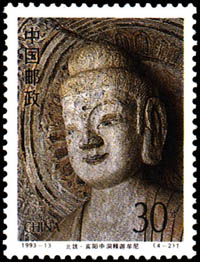
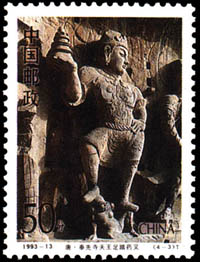
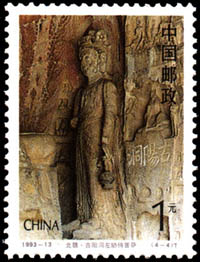
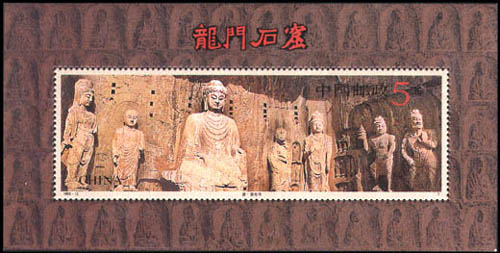
The second stamp of the 1988 definitive set R24 “Chinese Grotto Art” shows a Tang guardian from Longmen.

Map

Photo credits: The Vairocana Buddha at Longmen: Gisling (CC BY-SA 3.0, Wikimedia Commons)
Nearby
| World Heritage | The Old City of Luoyang in Han and Wei Dynasties 23km, Hangu Pass 33km, Shaolin Temple 43km, Mount Song 46km |
| National parks | Mount Shennong 76km, Mount Shiren (Stone Men) 96km, Qingtian River 97km, Zhengzhou Yellow River 105km |
| Detailed guides | Mount Wangwu 71km |
| AAAAA attractions | Longtan Grand Canyon Scenic Area 63km, Yaoshan Mountain and Central Plains Buddha Scenic Area 95km, Huangcheng Xiangfu Ecological and Cultural Tourist Area 107km, Baiyunshan Scenic Area 113km |
| AAAA attractions | Guanlin 6km, Sui-Tang City Site Botanical Garden 9km, China National Flower Garden 11km, Wananshan Summit Park 14km |
| UNESCO Global Geoparks | Wangwushan-Daimeishan UNESCO Global Geopark 71km, Funiushan UNESCO Global Geopark 157km |
| Historic cities | Luoyang 12km |
| Cities | Luoyang 17km, Zhengzhou 107km |
| Historical sites | Tomb of Fan Zhongyan 10km, Luoyang Xigong Barracks 13km, Luoyang Shaanxi-Shanxi Guildhall 13km, Luoyang Duke of Zhou Temple 13km |
| National geoparks | Songshan Stratigraphic Structure National Geopark 46km, Yaoshan National Geopark 95km, Guanshan National Geopark 150km |
| Nature reserves | Yangcheng Manghe Macaque National Nature Reserve 78km, Danjiang Wetland National Nature Reserve 80km, Lishan National Nature Reserve 96km, Yellow River Wetland National Nature Reserve 107km |