
← Chapter 3: Qin and HanA History of Chinese ArtChapter 5: Sui and Tang →
Chapter 4: Wei, Jin and the Northern and Southern Dynasties
In the three centuries and more between the end of the Han and the Sui reunification, regimes rose and fell in quick succession, yet art changed profoundly. First, painting became an independent art, with painters famous for their work and the first treatises on painting. Second, Buddhism flourished; the carving of cave temples and statues brought foreign methods of representing form, which gradually merged with native traditions.
Gu Kaizhi. Gu Kaizhi of the Eastern Jin is the earliest painter whose works survive in copies, and he was famed for figure painting. According to the Shishuo Xinyu, he sometimes left the eyes of a portrait unpainted for years, saying that "conveying the spirit and capturing the likeness lies right in these", meaning that expression depends entirely on the eyes. The Admonitions of the Instructress to the Court Ladies, attributed to him, illustrates the Admonitions of the Instructress, a text by Zhang Hua of the Western Jin admonishing palace women, pairing each passage with a scene; it survives in a Tang copy in the British Museum. Nymph of the Luo River illustrates Cao Zhi's Rhapsody on the Nymph of the Luo River in a continuous handscroll and survives in several Song copies. His lines are even, fine and unbroken; earlier writers likened them to "silk spun by a spring silkworm", and later critics called them "gossamer lines of high antiquity".

Full scroll (Tang copy); British Museum
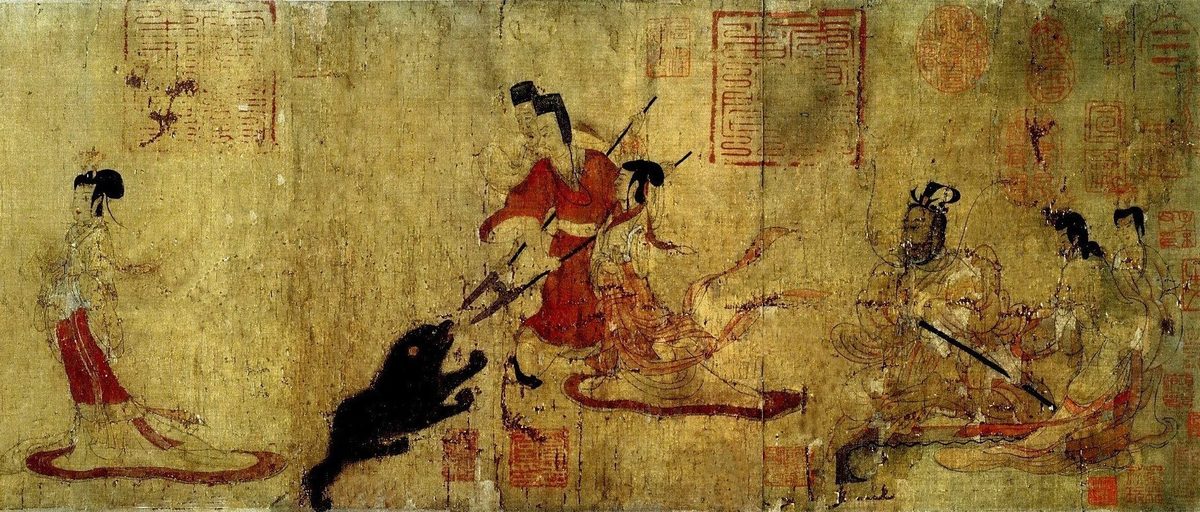
Detail

Full scroll (Song copy); Palace Museum, Beijing
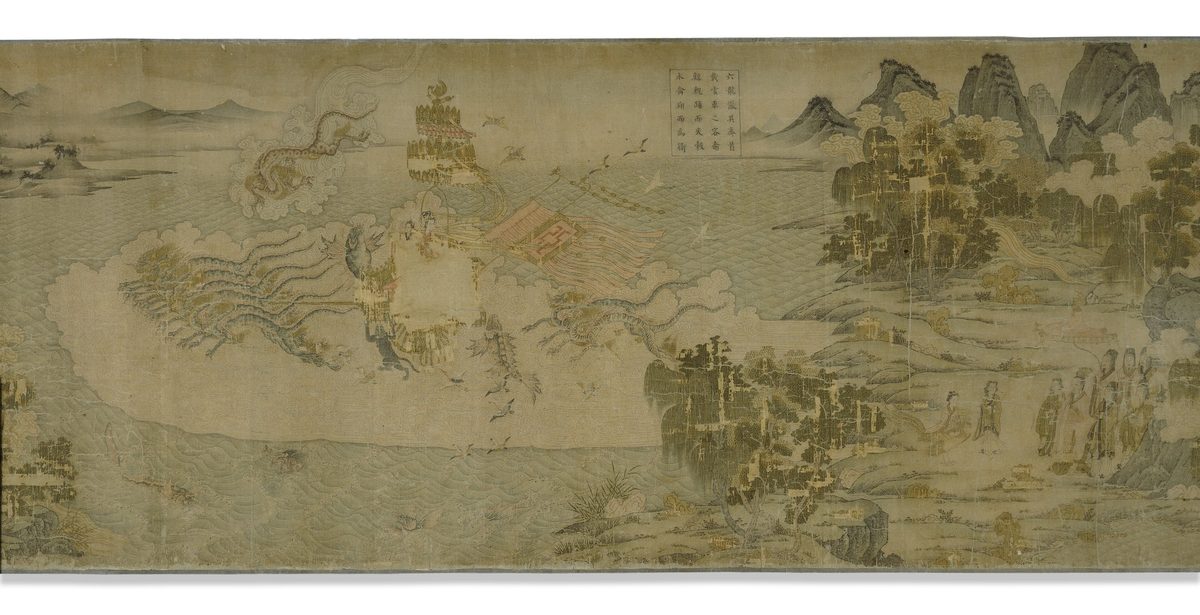
Detail, clearer
Lu Tanwei, Zhang Sengyou, Cao Zhongda and Yang Zihua. Lu Tanwei of the Liu Song and Zhang Sengyou of the Liang are ranked with Gu Kaizhi. The Tang critic Zhang Huaiguan wrote that "Zhang captured the flesh, Lu the bone, and Gu the spirit." Zhang Sengyou painted many murals in Buddhist temples; he is said to have painted flowers on the gate of the Yicheng Temple in Jiankang that seemed to stand out in relief from a distance, using a shading technique brought from India. The story of "dotting the eyes of the dragon" is also attached to him, but it is legend. Cao Zhongda of the Northern Qi came from the Central Asian state of Cao; in his Buddhist figures the drapery clings to the body as if just emerging from water, called "Cao's robes emerging from water", later paired with Wu Daozi's "Wu's sashes in the wind". Yang Zihua of the Northern Qi excelled at figures and horses; Collating Texts, attributed to him, survives in a Song copy.
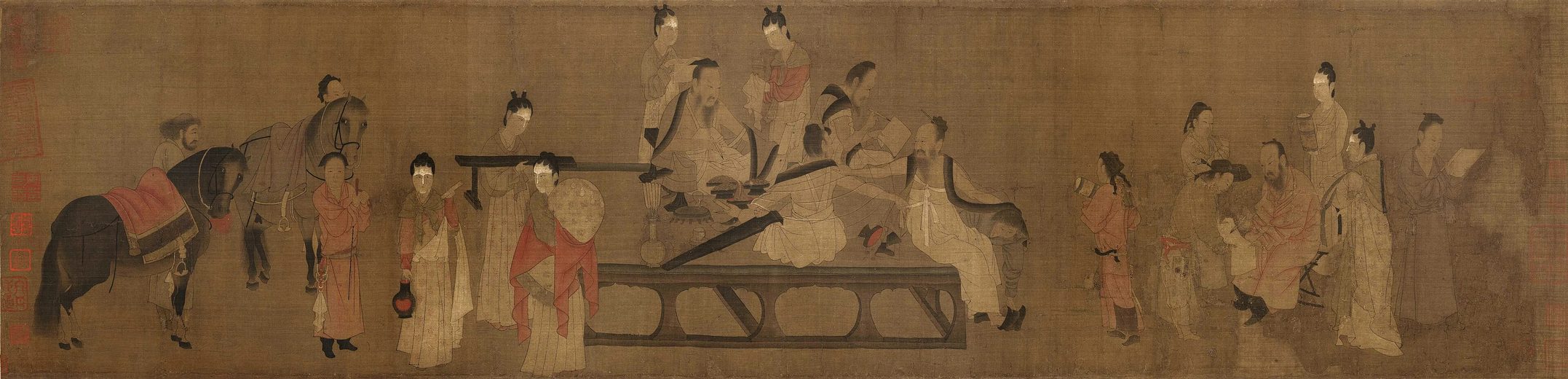
Full scroll (Song copy); Museum of Fine Arts, Boston
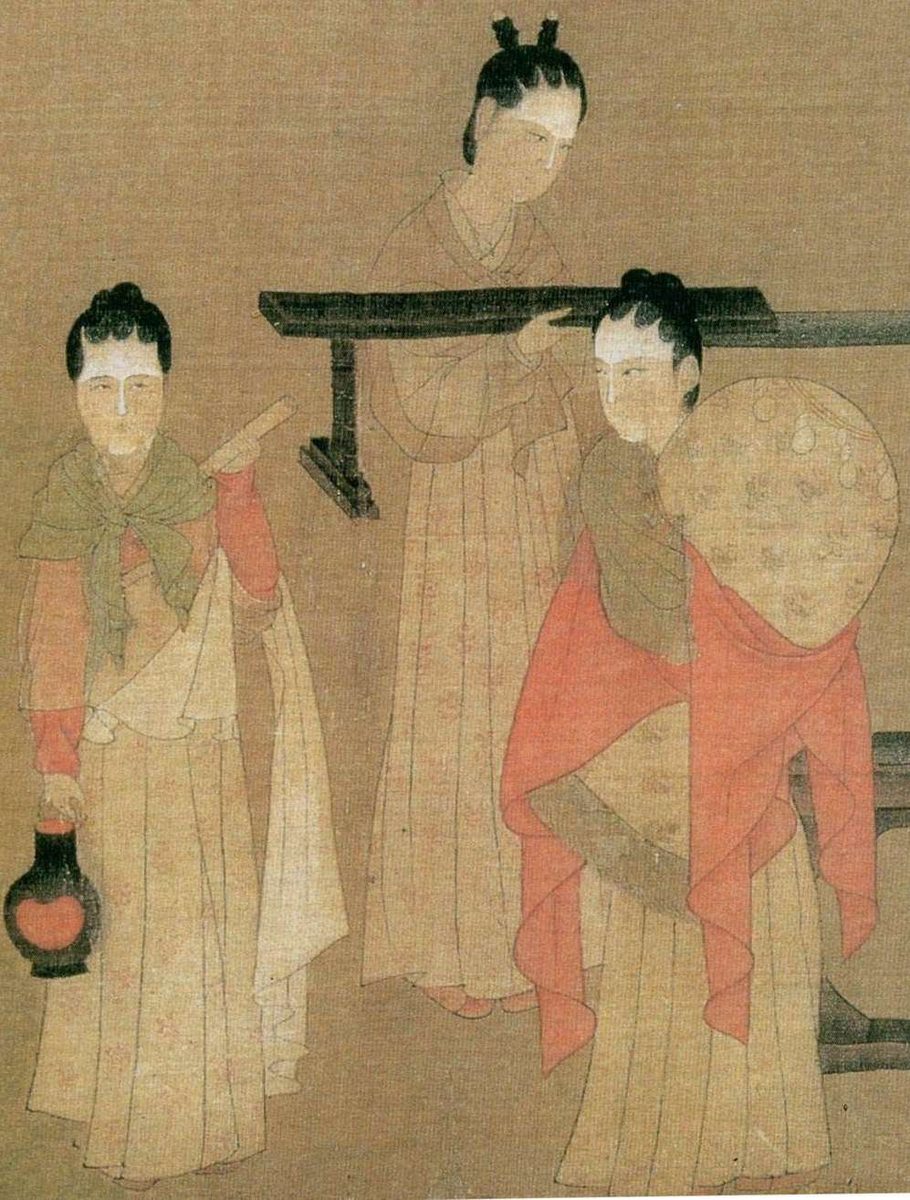
Detail
Theory. This period produced the first systematic writings on painting. Gu Kaizhi wrote On Painting, Notes on Painting Yuntai Mountain and others, proposing "using form to convey spirit". Zong Bing of the Liu Song loved travelling among mountains and rivers; when old and ill he painted the landscapes he had visited on the walls of his room, so he could "travel while lying down". His Preface on Landscape Painting says that landscape "through its forms delights the Dao", and explains that distant things look small and near things large: "A vertical stroke of three inches can stand for a height of a thousand ren; a few feet of horizontal ink can embody a distance of a hundred li." His contemporary Wang Wei (not the Tang poet) wrote in On Painting that painting landscape differs from drawing maps and must capture the feeling of the scenery. Xie He of the Southern Qi, in his Classified Record of Ancient Painters, set out the "Six Principles": spirit resonance and lifelike vitality; bone method in the use of the brush; fidelity to the object in depicting form; conformity to kind in applying color; proper planning in composition; and transmission by copying. They concern, in turn, spirit, brushwork, form, color, composition and copying, and became the basic framework for judging painting.
The beginnings of landscape painting. Landscape at this time mostly served as a background to figure paintings. In Nymph of the Luo River the trees look like outspread hands, the mountains stand in rows like screens, and the figures are larger than the hills. The Tang writer Zhang Yanyuan, in his Record of Famous Painters of All the Dynasties, criticized landscapes since the Wei and Jin: "the water cannot float a boat, or the people are larger than the mountains", and the trees are "like outstretched arms with spread fingers". The faulty proportions show that landscape was not yet a genre of its own. The theories of Zong Bing and Wang Wei ran ahead of practice; landscape painting truly became independent only in the Sui and Tang.
Tomb art. The stamped-brick picture The Seven Sages of the Bamboo Grove and Rong Qiqi from large Southern Dynasties tombs near Nanjing is assembled from several hundred bricks on two walls. Eight men each sit under a tree, drawn in flowing lines, giving an idea of figure painting on scrolls at the time. The stone beasts before Southern Dynasties imperial tombs around Nanjing and Danyang, generally called tianlu, qilin and bixie, have long bodies, raised heads and thrust-out chests, and are the representative sculpture of the period.
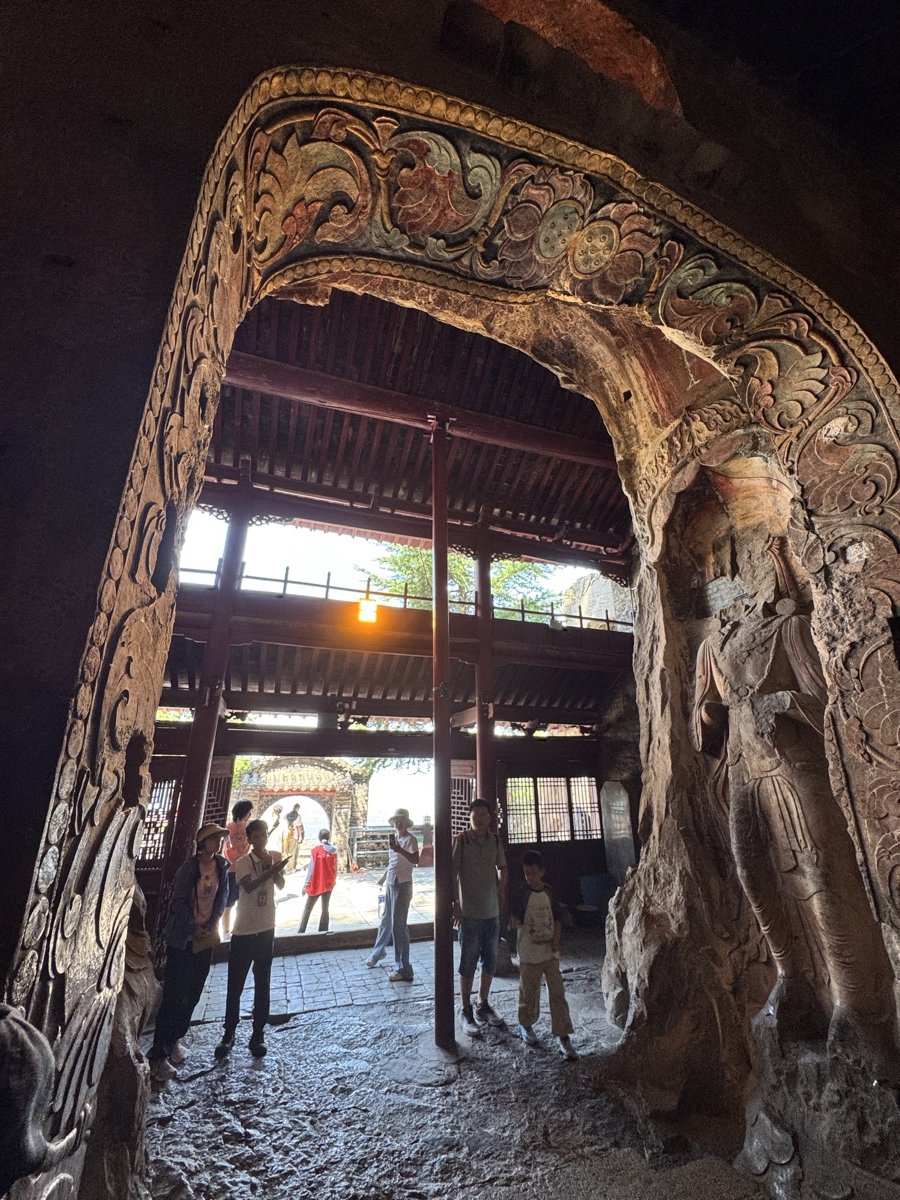
Buddhist cave temples. Buddhism reached China in the Eastern Han, and during the Northern and Southern Dynasties caves and statues were made on a vast scale. The Mogao Caves at Dunhuang, Gansu, were begun in the Sixteen Kingdoms period. Murals in the Northern Dynasties caves mostly show jataka tales (stories of the Buddha's former lives), such as the Deer King Jataka in Cave 257, told continuously in a long horizontal band, with figures modeled by shading in the style of the Western Regions. The Bingling Temple Grottoes at Yongjing, Gansu, have an inscription dated to the Western Qin, making them one of the earliest precisely dated cave temples. Maijishan at Tianshui is known for clay sculpture; its Northern Dynasties figures have delicate faces, many of them smiling. At Pingcheng (present-day Datong) the Northern Wei carved the Yungang Grottoes; the Buddhas of the early "Five Caves of Tanyao" are huge, with full round faces and broad, powerful shoulders, showing the influence of Gandhara and Gupta art. After Emperor Xiaowen moved the capital to Luoyang, the Longmen Grottoes were begun. Northern Wei figures such as those in the Central Binyang Cave have slender faces and loose robes with broad sashes; later writers borrowed a phrase first used of Lu Tanwei, "elegant bones and lean forms", to describe them, a taste shared with the scholar-officials of the south. The Gongyi Cave Temple east of Luoyang preserves reliefs of the Northern Wei emperor and empress worshipping the Buddha. In the Northern Qi caves at Xiangtangshan the figures turn full and solid, with drapery clinging to the body, anticipating the Sui and Tang. The Xumishan Grottoes at Guyuan, Ningxia, were begun in the late Northern Wei; the Tianlongshan Grottoes at Taiyuan were carved in the Eastern Wei and Northern Qi, and many of their statues are now dispersed abroad. Many Northern Dynasties statues excavated at the site of the Longxing Temple in Qingzhou, Shandong, still retain paint and gilding.
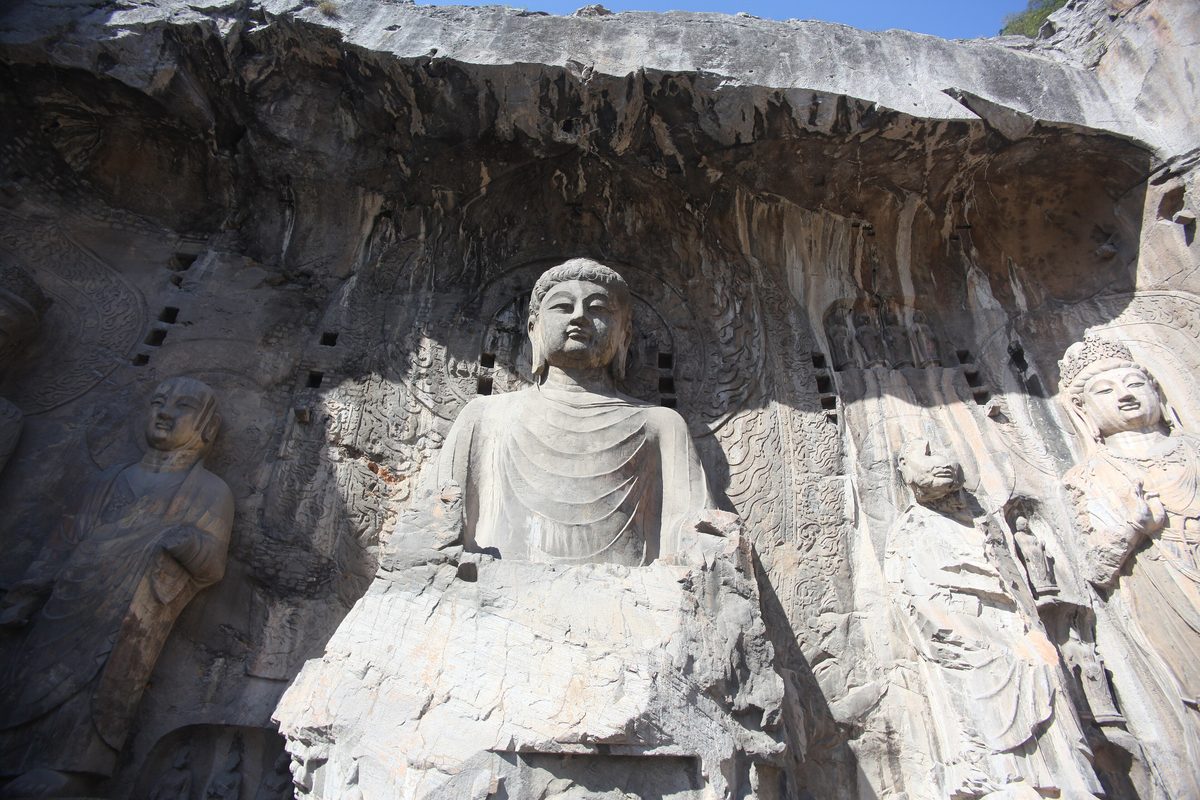
Vairocana Buddha, Fengxian Temple
Gisling / Own work, CC BY-SA 3.0, Wikimedia Commons

Exterior of the Nine-story Pavilion
Zhangzhugang / Own work, CC BY-SA 4.0, Wikimedia Commons

Map of Mount Wutai, Cave 61
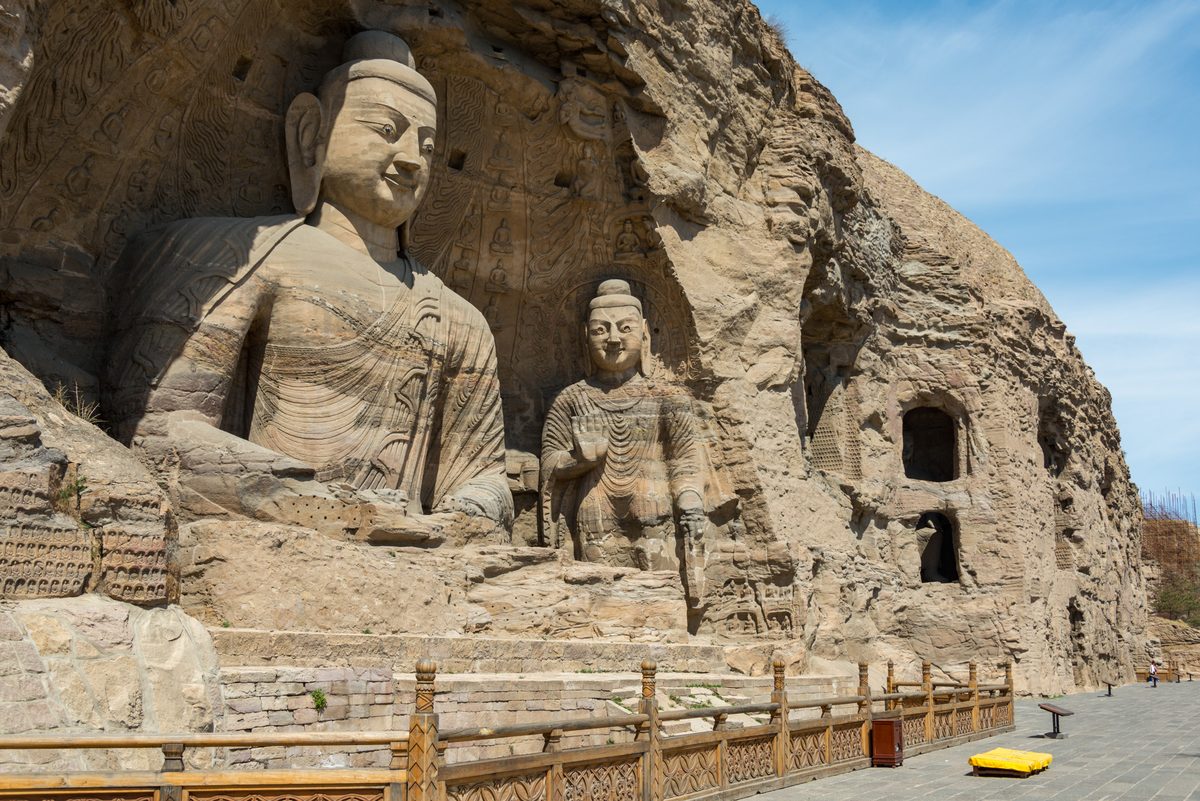
Open-air Great Buddha, Cave 20
xiquinhosilva / 61292-Yungang-Grottoes, CC BY 2.0, Wikimedia Commons
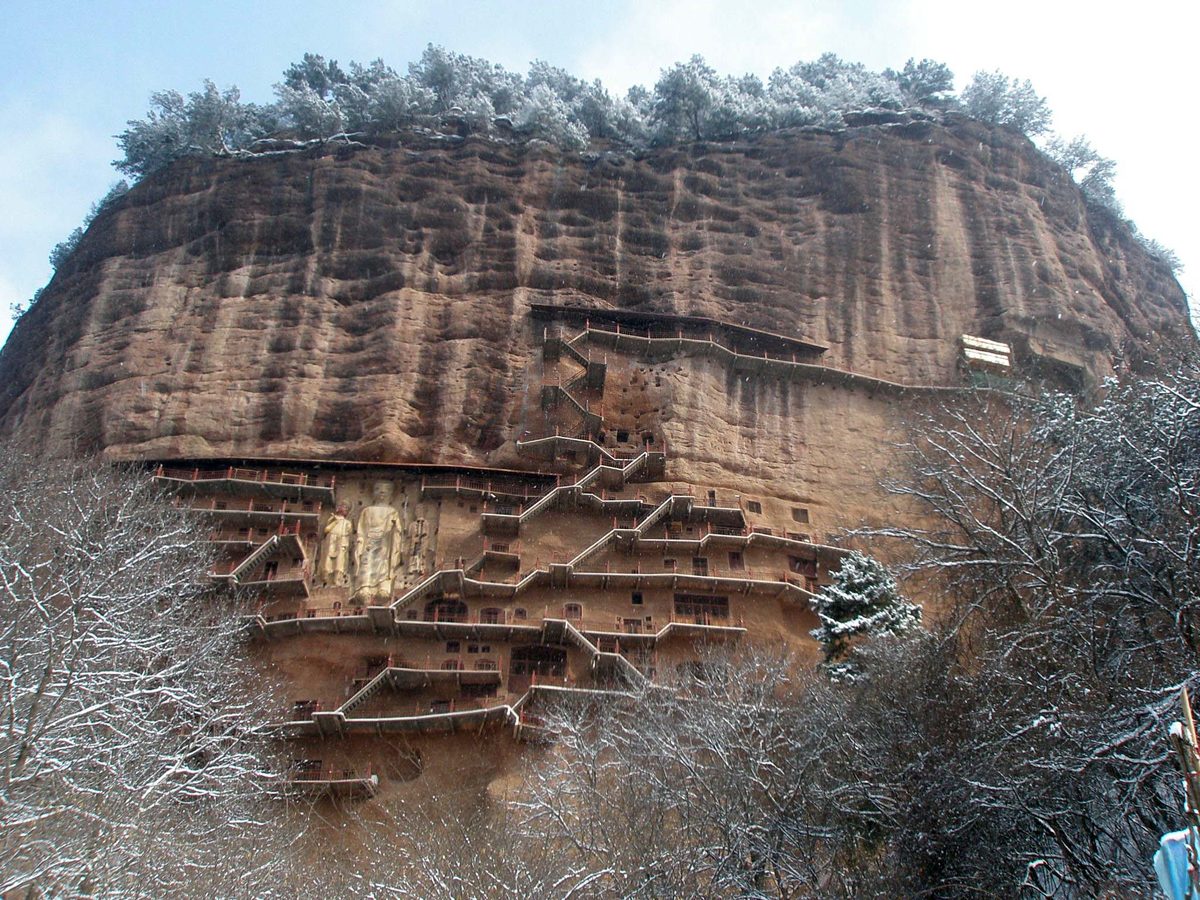
Panorama
MarsmanRom / Own work, CC BY-SA 3.0, Wikimedia Commons
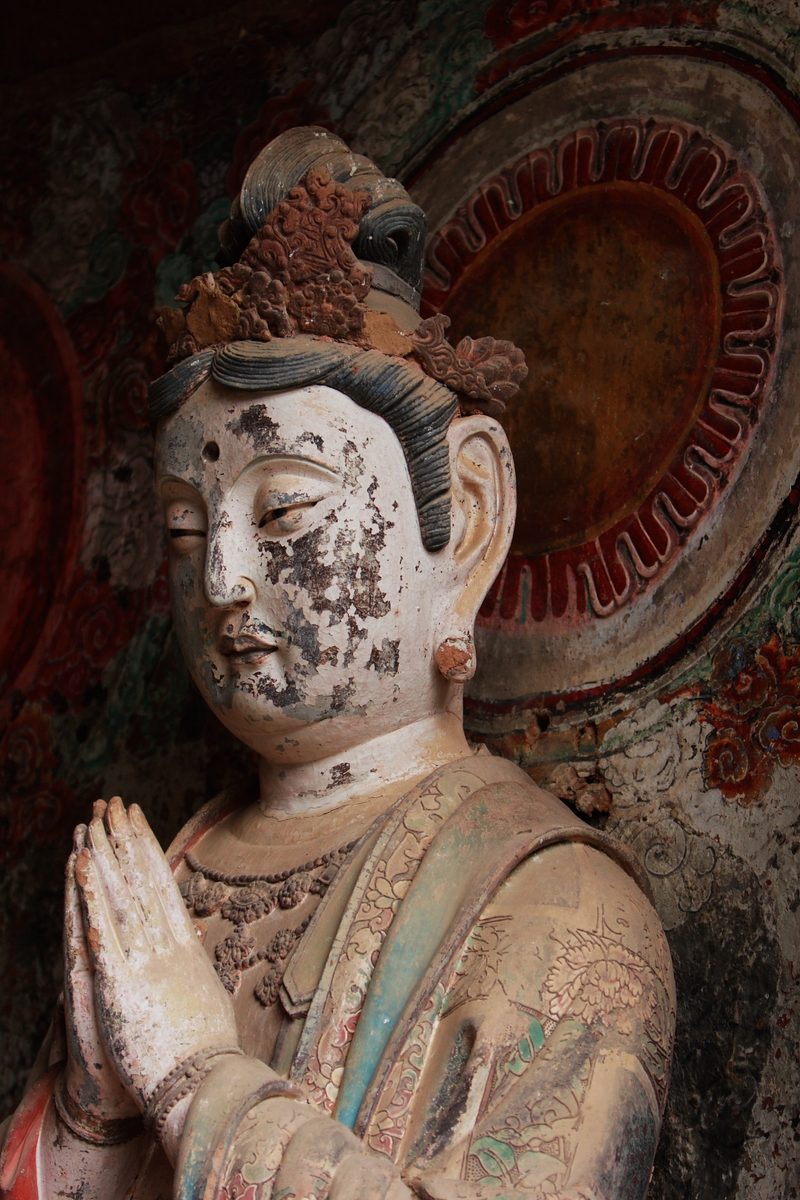
Bodhisattva
Farm / Own work, CC BY-SA 3.0, Wikimedia Commons
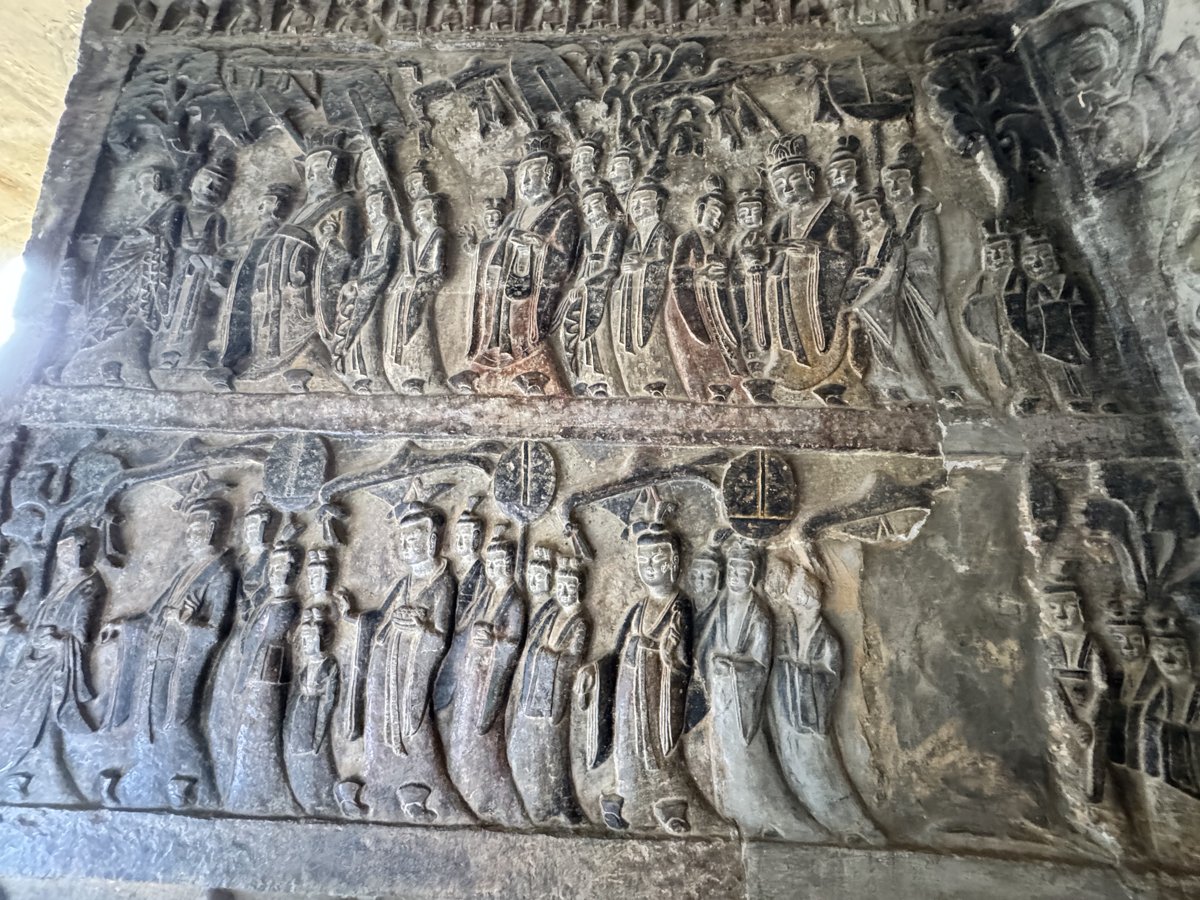
Gongyi Cave Temple
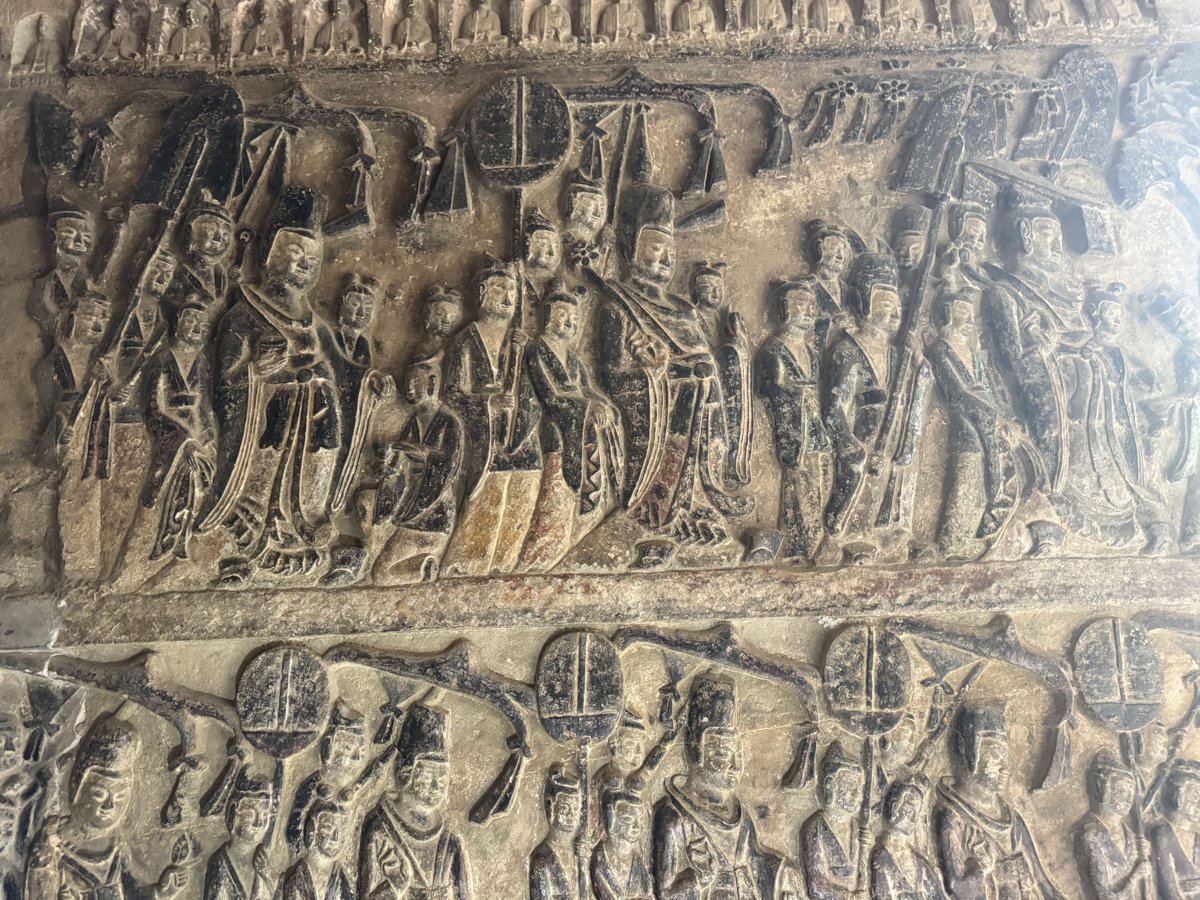
Attendants holding canopies; Gongyi Cave Temple
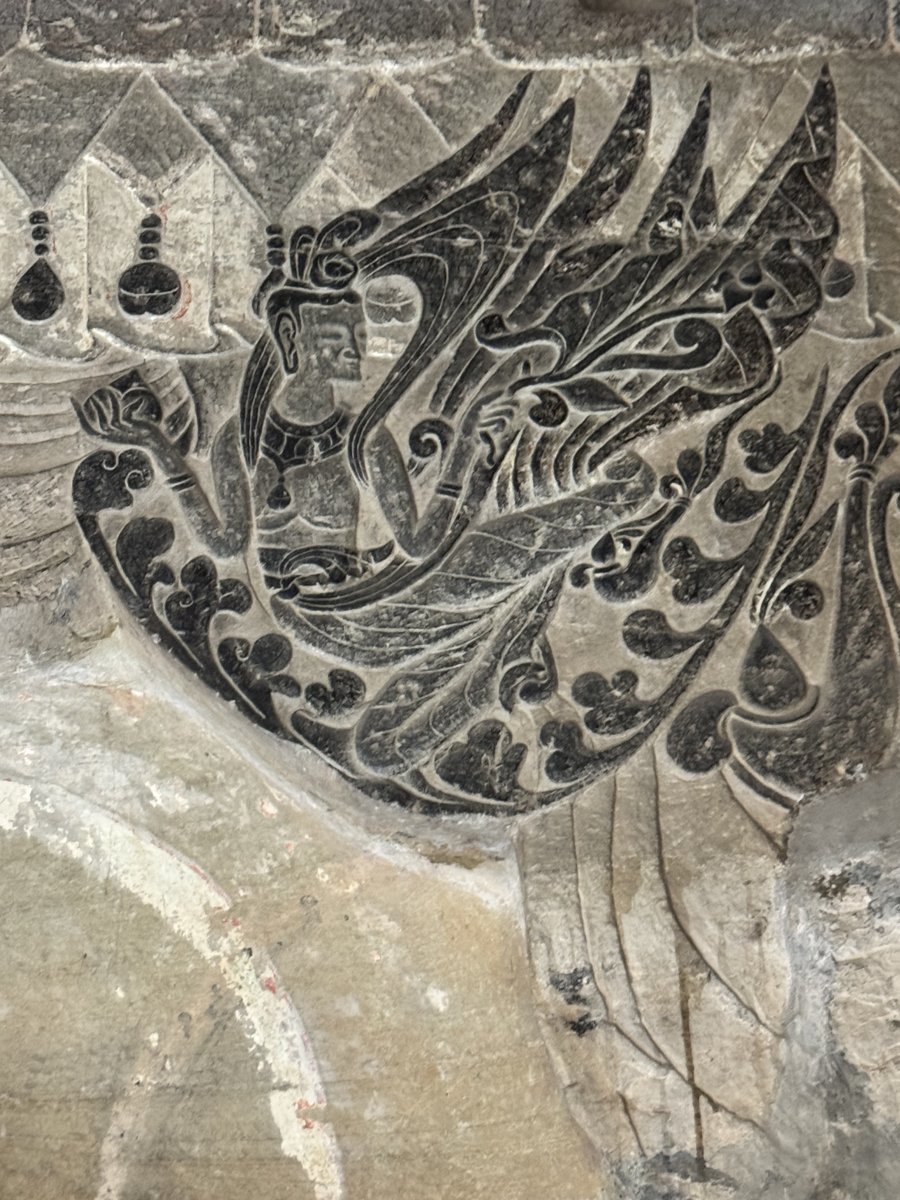
Gongyi Cave Temple
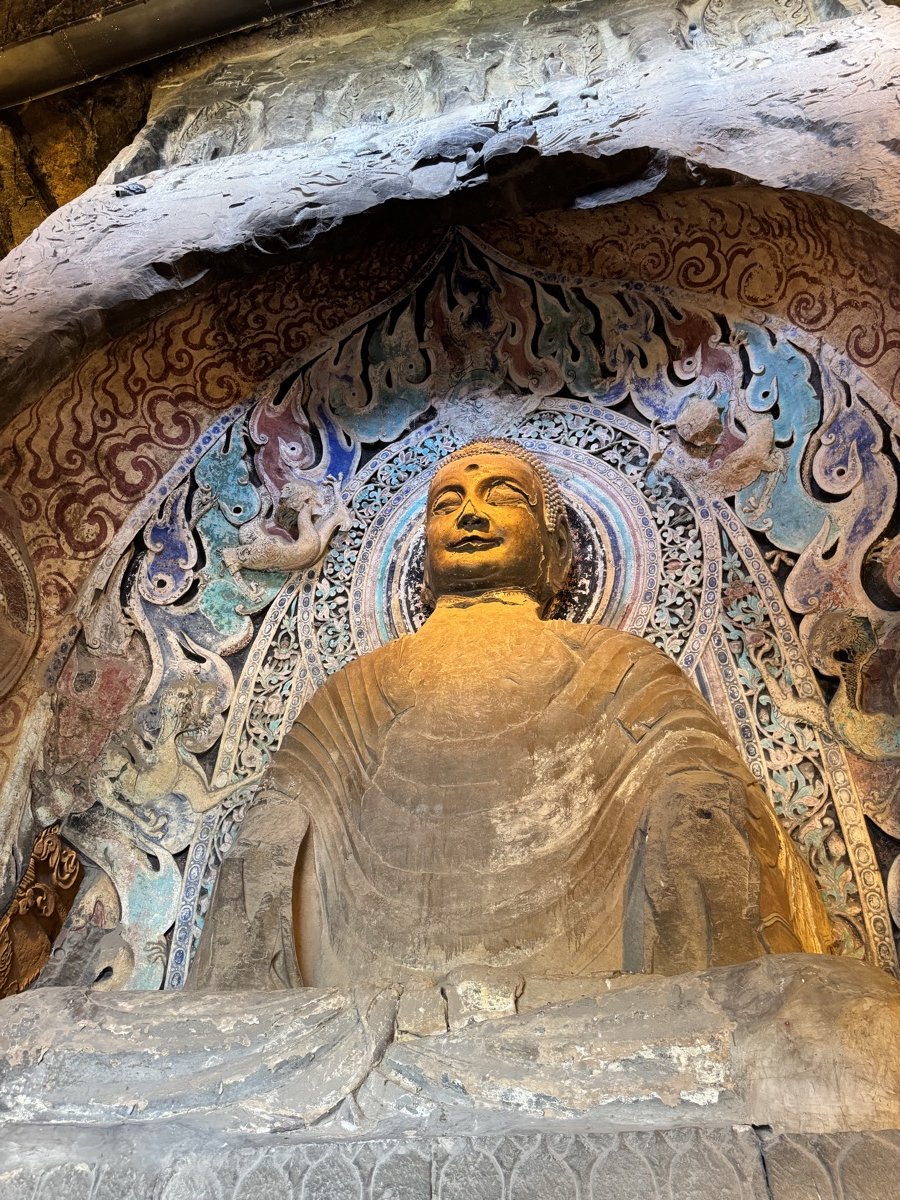
Xiangtangshan Grottoes, Handan
Northern Qi
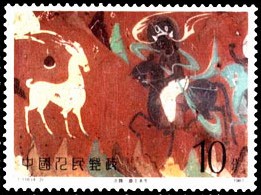
Dunhuang Murals, Set 1 (T116), 1987
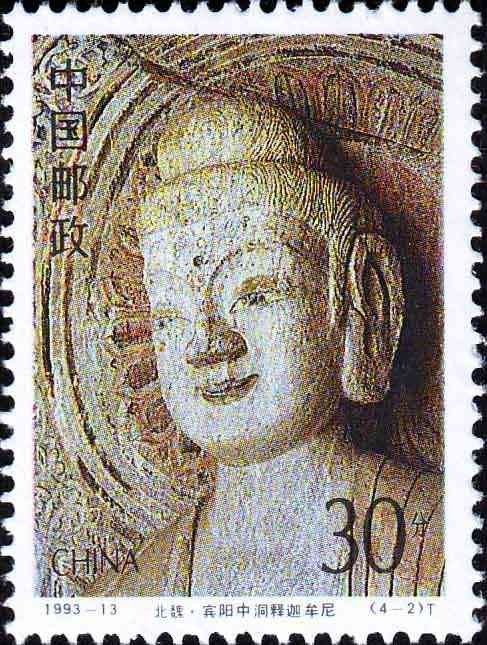
Longmen Grottoes (1993-13), 1993
Calligraphy. Wang Xizhi of the Eastern Jin transformed the plain style of the Han and Wei into one of grace and fluency. His Preface to the Orchid Pavilion Collection, written at a gathering at the Orchid Pavilion in Shanyin, Kuaiji, is called "the finest running script under heaven". The original is lost; the surviving versions are mostly Tang copies. The cliff inscription Eulogy on Burying a Crane at Jiaoshan in Zhenjiang is generally thought to have been carved in the Liang dynasty, though its calligrapher is disputed. Wang Xizhi and his son Wang Xianzhi are known together as the "Two Wangs". The refinements of calligraphic brushwork later deeply shaped Chinese painting.
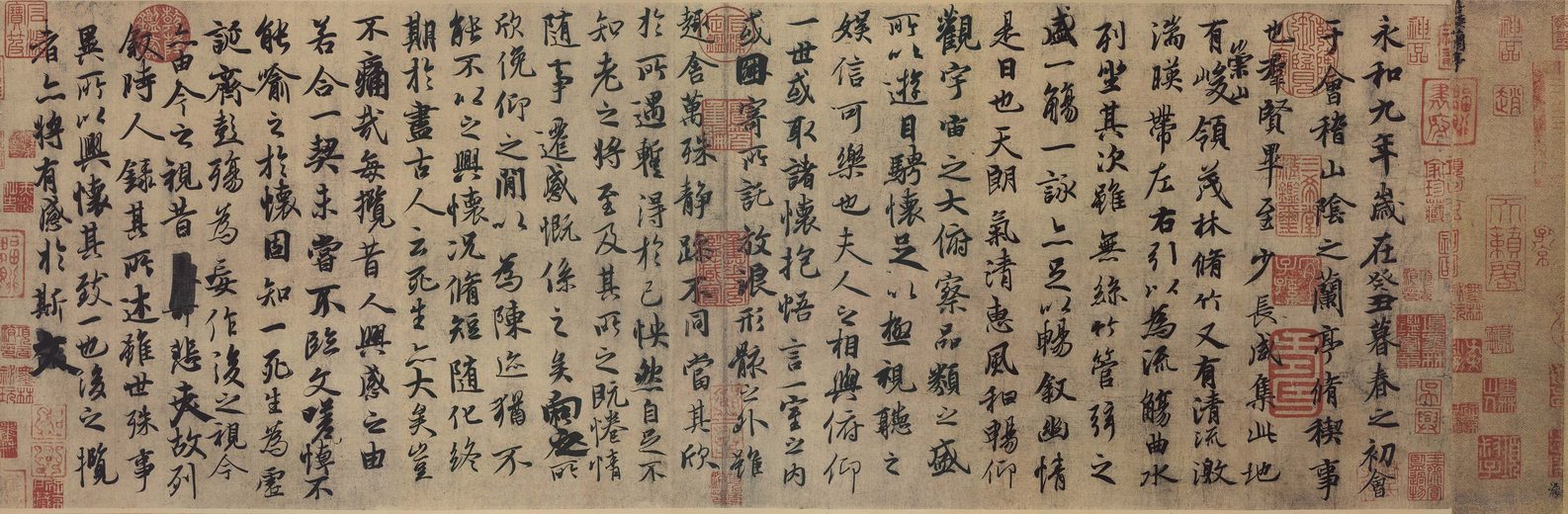
Copy by Feng Chengsu; Palace Museum, Beijing

Tang copy of Wang Xizhi's Preface to the Orchid Pavilion Collection; Palace Museum, Beijing
Representative works
| Work | Period | Type | Collection | Notes | |
|---|---|---|---|---|---|
| Admonitions of the Instructress to the Court Ladies↑ | Eastern Jin | Handscroll, ink and color on silk, attributed to Gu Kaizhi, Tang copy | British Museum | Illustrates Zhang Hua's Admonitions of the Instructress. |
| Nymph of the Luo River↑ | Eastern Jin | Handscroll, ink and color on silk, attributed to Gu Kaizhi, Song copy | Palace Museum | Other copies are in the Liaoning Provincial Museum and the Freer Gallery of Art, Washington. |
| Wise and Benevolent Women | Eastern Jin | Handscroll, ink and color on silk, attributed to Gu Kaizhi, Song copy | Palace Museum | Stories of wise women of antiquity. | |
| The Seven Sages of the Bamboo Grove and Rong Qiqi | Southern Dynasties | Stamped-brick picture | Nanjing Museum | From a Southern Dynasties tomb at Xishanqiao, Nanjing. | |
| Lacquer Screen from the Tomb of Sima Jinlong | Northern Wei | Lacquer painting | Found at Datong; stories of exemplary women in a style close to Gu Kaizhi. | ||
| Collating Texts↑ | Northern Qi | Handscroll, ink and color on silk, attributed to Yang Zihua, Song copy | Museum of Fine Arts, Boston | Scholars collating texts. |
| Deer King Jataka↑ | Northern Wei | Mural | Cave 257, Mogao Caves, Dunhuang | A jataka tale in a long horizontal band. |
| Bingling Temple Cave 169 | Western Qin | Cave sculpture and murals | In situ, Yongjing, Gansu | Bears an inscription dated to the Western Qin. | |
| Five Caves of Tanyao | Northern Wei | Cave sculpture | Caves 16–20, Yungang Grottoes, Datong | The open-air Great Buddha of Cave 20 is the best known. | |
| Central Binyang Cave↑ | Northern Wei | Cave sculpture | Longmen Grottoes, Luoyang | The classic example of elegant, lean figures in loose robes. |
| Emperor and Empress Worshipping the Buddha↑ | Northern Wei | Relief | In situ, Gongyi Cave Temple | Processions of the emperor and empress with attendants. |
| Northern Dynasties Clay Sculpture at Maijishan↑ | Northern Wei to Northern Zhou | Clay sculpture | In situ, Maijishan Grottoes, Tianshui | Delicate faces, many of them smiling. |
| North Xiangtangshan Caves↑ | Northern Qi | Cave sculpture | In situ, Xiangtangshan, Handan | Full figures with clinging drapery. |
| Southern Dynasties Tomb Sculpture | Southern Dynasties | Stone sculpture | In situ, Nanjing and Danyang | Tianlu, qilin and bixie with long bodies. | |
| Preface to the Orchid Pavilion (Shenlong version)↑ | Eastern Jin | Running script, Wang Xizhi, Tang copy by Feng Chengsu | Palace Museum | The most famous surviving copy of the Orchid Pavilion Preface. |