 Park of China
Overview
| Designation | UNESCO World Heritage (cultural, 1987) |
| Province | Gansu |
| Location | North-west Gansu |
| Latitude, longitude | 40.0, 94.8 Google Maps |
| Highlights | Buddhist cave temples; desert oasis |
| Top sights | The Mogao Caves |
| Highest point | 1,715 m |
| Nearby cities | Dunhuang (Gansu) |
| Nearby sites | Mingsha Dunes and Crescent Spring 13km, Jiayuguan Pass 292km Search nearby |
| Themes | Grotto, Buddha, Statue, Desert, Sand Dune, Spring, Culture, Stamp, Rock art & murals |
The Mogao Caves
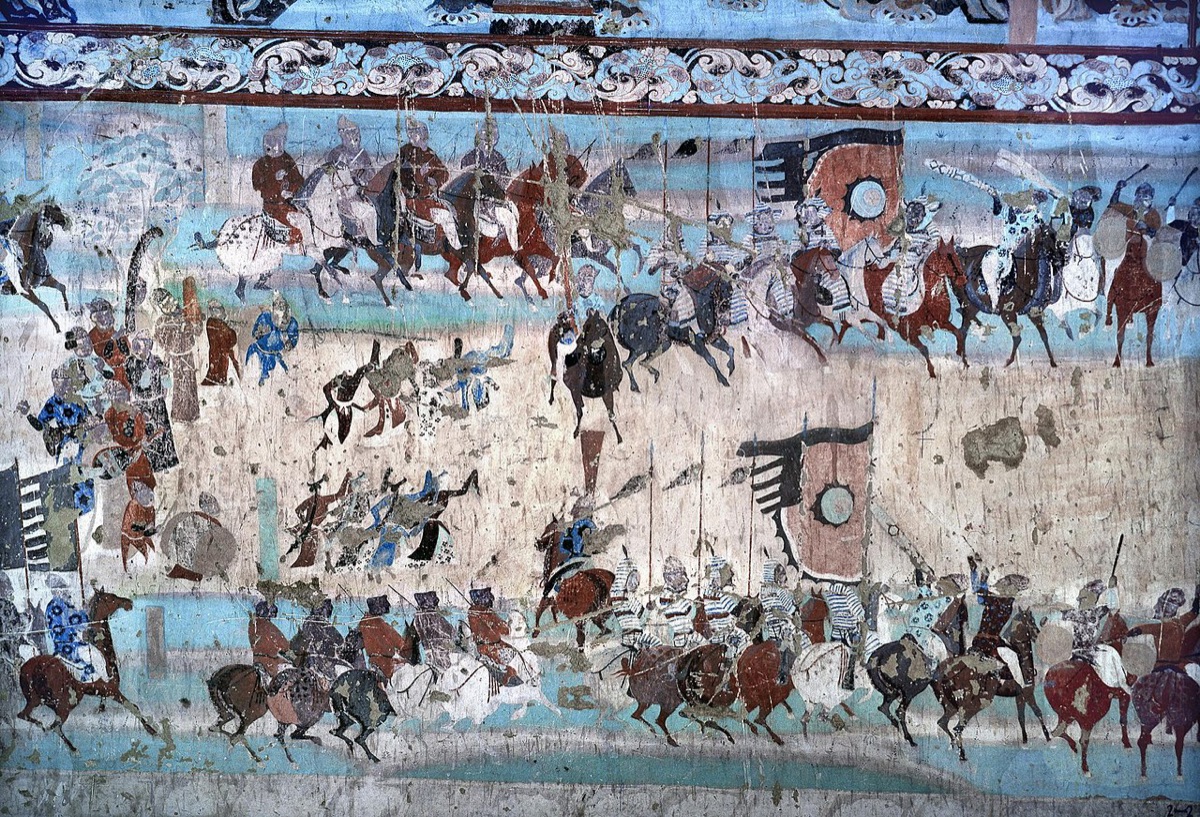
The Mogao Caves, also called the Caves of the Thousand Buddhas, are cut into a cliff at the eastern foot of the Mingsha Dunes 25 km south-east of Dunhuang, at the western end of the Hexi Corridor in Gansu. The cliff face runs 1,680 m north to south and is 50 m high. Work began in AD 366 and the site is the most famous Buddhist cave complex in China: 735 caves survive from the Northern Wei to the Yuan dynasty, 487 in the southern section and 248 in the northern. The main caves, in the southern section, hold a vast number of Buddhist wall paintings and statues: 45,000 m² of murals and more than 2,000 painted sculptures in all.
In 1900 the Library Cave was discovered, holding more than 50,000 manuscripts from the Sixteen Kingdoms to the Northern Song; from it grew Dunhuang studies, the discipline devoted to these documents and to Dunhuang art.
It was inscribed on the UNESCO World Heritage List in 1987, as a cultural site.
Main sights
Nine-Storey Building (Cave 96): the best-known structure at Mogao, a nine-tier timber facade over a seated Maitreya Buddha made in the Tang dynasty. The statue is about 35 m high and is the largest at the site.
Library Cave (Cave 17): a small chamber off the corridor of Cave 16, found in 1900. The manuscripts are mostly Buddhist texts, but also include official papers, contracts and literature, in Chinese, Tibetan and several ancient languages of Central Asia.
Cave 45: a High Tang cave. The main Buddha is flanked by disciples, bodhisattvas and guardian kings. The painted clay figures are well preserved and naturalistic, and are a standard example of Tang sculpture at Mogao.
Cave 158: a Middle Tang cave dominated by a reclining Buddha about 16 m long, with wall paintings of princes and disciples in mourning.
Cave 257: a Northern Wei cave. Its mural of the Nine-Coloured Deer is among the best-known early Buddhist narrative paintings.
Cave 285: a Western Wei cave with dated inscriptions. The ceiling shows Fuxi, Nüwa and flying apsaras, so Buddhist and traditional Chinese mythological themes appear together.
Cave 112: a Middle Tang cave whose murals include the musician playing a pipa behind her back, an image often used to introduce Dunhuang art.
Cave 61: a large Five Dynasties cave. Its west wall carries a very large map-like painting of Mount Wutai in Shanxi with its monasteries and towns.
Mount Mingsha and Crescent Spring: the dune ridge lies south of Dunhuang, and the spring sits at its northern foot. The spring has stayed clear of drifting sand for a very long time. Visitors usually look down on it from the dune crest.
Digital Exhibition Centre: on the outskirts of Dunhuang, where films introduce the murals before visitors go to the cave area.
History and culture
Dunhuang became a commandery under the Han and lies at the western end of the Hexi Corridor, the gateway from China to Central Asia on the Silk Road. Merchants, monks and envoys passed through, and the Buddhist art here absorbed styles from both the Central Plains and the west.
According to tradition, a monk named Lezun cut the first cave on the eastern face of Mount Mingsha in 366. Work continued through the Sixteen Kingdoms, Northern Dynasties, Sui, Tang, Five Dynasties, Song, Western Xia and Yuan periods, a span of about a thousand years.
The murals cover Buddhas, preaching scenes, illustrations of sutras, Jataka tales and portraits of donors, together with landscapes, buildings, costume, music and dance. Changing taste is visible: Northern Dynasties work is bold in form and strong in colour, while Tang compositions are large and the line is fluent.
In the early twentieth century foreign explorers bought or carried away many of the Library Cave manuscripts, which are now held in libraries and museums around the world. The Dunhuang Art Institute was founded in 1944 and became the Dunhuang Academy, which handles conservation, research and digitisation of the caves.
Travel tips
Getting there: Dunhuang has an airport and a railway station. The Mogao Caves are about 25 km south-east of town and Mingsha Shan and Crescent Spring about 5 km south; buses and taxis go to both.
Booking: the Mogao Caves need advance booking under your real name, with a daily limit; in high season tickets are often gone well ahead. In high season there is also an emergency ticket that covers only a few caves and no films.
Visiting the caves: the visit starts at the Digital Exhibition Centre on the edge of Dunhuang with films, then a shuttle bus takes you to the cliff, where guides lead groups through a selection of caves. The open caves rotate and cannot be chosen.
Caution: no photography inside the caves, and the light is dim.
Mingsha Shan and Crescent Spring: walk or ride a camel up the dunes and look down on the spring. Go early in the morning or late in the day; at midday in summer the sand is very hot.
Time: about half a day for the caves and half a day for the dunes and spring, a full day in all.
Season: May to October is the busy season; summer days are hot and dry, so protect against the sun and drink plenty. Winter is cold and quiet.
The modern Dunhuang grottoes
The Dunhuang Modern Grotto Art Centre lies in the Danghe gorge 33 km west of the town. Begun in 1996, it fulfils the wish to “continue Dunhuang” of Chang Shuhong, founder of the Dunhuang Academy and “guardian of Dunhuang”, and was cut with their own funds by his widow, the Dunhuang scholar Li Chengxian, and his son, the Japan-based artist Chang Jiahuang.
On 24 July 2007 the centre announced that one of its modern murals, the Medicine Buddha, had been stripped from the wall and stolen.
Stamps
On 1 July 1952 China Post issued S3, “Our Great Motherland (1st series): Dunhuang Murals”, four stamps of 800 yuan (old currency): a hunt (Western Wei), donors (Northern Zhou), flying apsaras (Tang) and a celestial riding a tiger (Tang).
On 1 September 1953 followed S6, “Our Great Motherland (3rd series): Dunhuang Murals”, four stamps: a groom and horse (Western Wei), musicians (Western Wei), a battle (Northern Zhou) and an ox cart (Tang).

On 20 May 1987 T116 “Dunhuang Murals (1st series)” was issued, four stamps and a souvenir sheet: an offering bodhisattva, the Deer King jataka, heavenly musicians, flying apsaras, and Prince Sattva giving his body to the tigress.


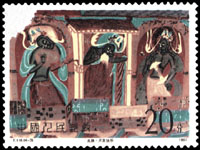


On 25 May 1988 T126 “Dunhuang Murals (2nd series)”, four stamps: a hunt and a battle (Western Wei), ploughing and building a pagoda (Northern Zhou).


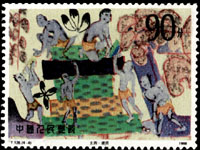
On 10 July 1990 T150 “Dunhuang Murals (3rd series)”, four stamps from the Sui dynasty: flying apsaras, an offering bodhisattva, Guanyin saving the afflicted, and Indra.
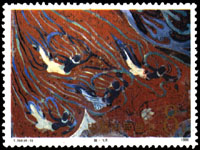
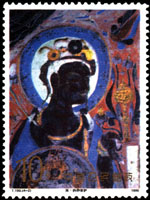

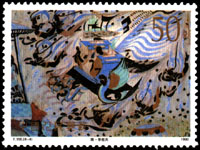
On 15 September 1992 1992-11 “Dunhuang Murals (4th series)”, four stamps and a sheet, all Tang: a bodhisattva, musicians, ascending to heaven on a dragon, an envoy to the Western Regions, and Guanyin.


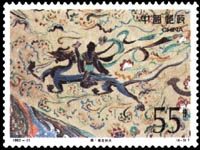
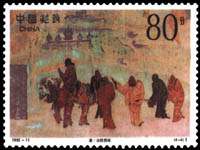

On 16 July 1994 1994-8 “Dunhuang Murals (5th series)”, four Tang subjects: flying apsaras, Vimalakirti, the procession of Zhang Yichao, and the demon’s daughters.
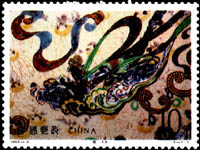


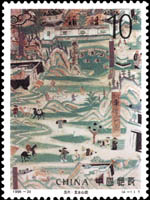
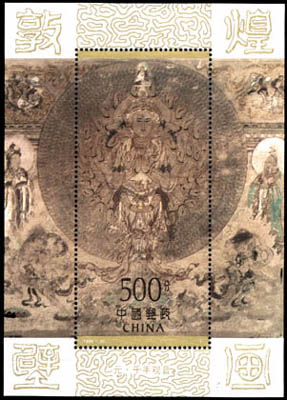
On 15 August 1996 1996-20 “Dunhuang Murals (6th series)”, four stamps and a sheet: the map of Mount Wutai (Five Dynasties), the King of Khotan (Five Dynasties), Guanyin saving the afflicted (Song), an offering bodhisattva (Western Xia) and the thousand-armed Guanyin (Yuan).


More photos
Map
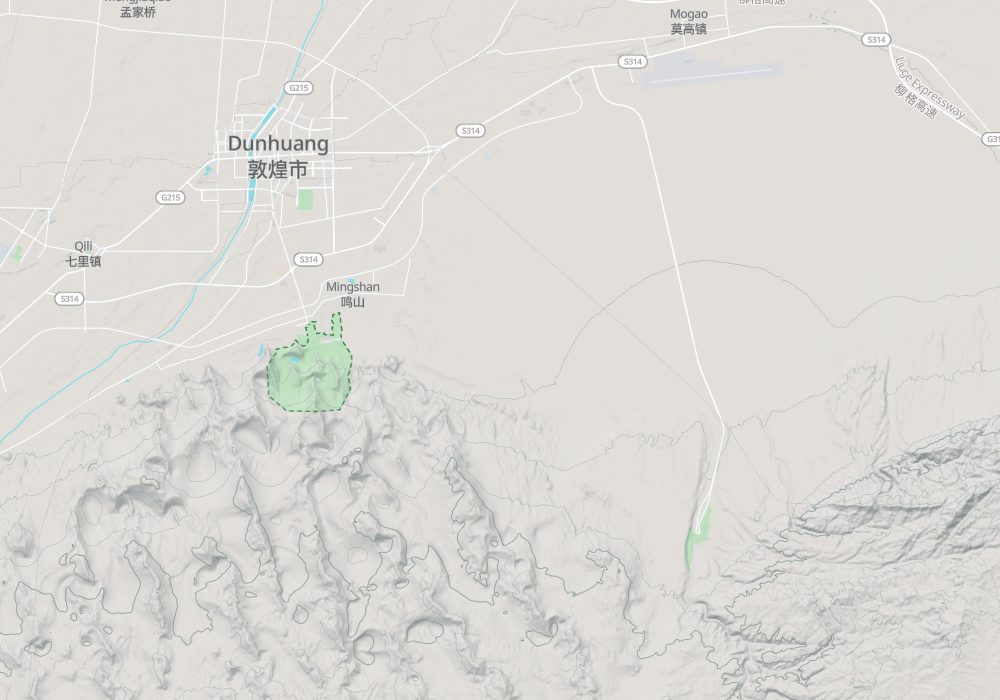
Photo credits: The Mogao Caves: Zhangzhugang (CC BY-SA 4.0, Wikimedia Commons)
Nearby
| World Heritage | Xuanquanzhi 51km, Yumen Pass 87km, Suoyang City 121km |
| National parks | Mingsha Dunes and Crescent Spring 13km |
| UNESCO Global Geoparks | Dunhuang UNESCO Global Geopark 17km |
| Historic cities | Dunhuang 17km |
| National geoparks | Dunhuang Yardang National Geopark 143km |
| Nature reserves | Yanchiwan National Nature Reserve 96km, Dunhuang Yangguan National Nature Reserve 143km |