

Overview
| Name | Mausoleum of the First Qin Emperor and the Terracotta Army 秦始皇陵及兵马俑 |
| Web address | https://parkofchina.com/en/bingmayong.html |
| Designation | UNESCO World Heritage (cultural, 1987) Part of the first-batch National Park of China “Lintong Mount Li–Terracotta Army” AAAAA tourist attraction |
| Province | Shaanxi |
| Location | Lintong, Xi’an, Shaanxi |
| Mountains | Qinling Mountains |
| Coordinates | 34.4, 109.2 Google Maps |
| Highlights | Imperial mausoleum, the Terracotta Army |
| Top sights | The Terracotta Army |
| Nearby cities | Xi’an |
| Nearby sites | Lintong Mount Li–Terracotta Army Scenic Area, Mount Hua, Qianling Mausoleum, Wulao Peak, Mausoleum of the Yellow Emperor |
| Themes | Tomb, Museum, Statue, Culture, Stamp, Archaeological sites |
About
The Mausoleum of the First Qin Emperor and the Terracotta Army pits are at Lintong, east of Xi'an, Shaanxi. Inscribed by UNESCO as a World Cultural Heritage site in 1987, the site comprises the mausoleum at the northern foot of Mount Li and the Terracotta Army pits about 2 km east of it. It is part of the Lintong Mount Li–Terracotta Army scenic area, which also includes Huaqing Pool and Mount Li.
Qin Shihuang began building his tomb when he came to the throne at 13, and after unifying the six states conscripted more than 700,000 men from across the country to work on it; it was still unfinished when he died. The mausoleum park was laid out like the capital, and more than 500 accompanying tombs and pits have been found in the protected zone; the Terracotta Army pits are only some of them.
The Terracotta Army
In 1974 local farmers digging a well found Pit 1; Pits 2 and 3 were found later. The three pits are arranged in a triangle, and the Emperor Qinshihuang's Mausoleum Site Museum has been built over them. The Terracotta Army is regarded as one of the most important archaeological finds of the twentieth century.

Pit 1, the largest, is a rectangular formation of infantry and chariots. It is thought to hold about 6,000 figures and horses, of which a little over 1,000 have been excavated; most of the pit remains undug. The three pits together hold about 8,000. Pit 2, L-shaped, is the finest of the pits, made up of four smaller formations: kneeling and standing crossbowmen, four-horse chariots, mixed chariots, infantry and cavalry, and cavalry. Pit 3, the smallest, is believed to be the command post of the army.
The figures are life-size, mostly 1.75 to 1.85 m tall, and by dress, bearing and hairstyle include generals, warriors and charioteers, each face different. Bronze weapons were also found in the pits: swords, spears, halberds and crossbow triggers.


The Mausoleum of the First Qin Emperor
The mausoleum lies at the northern foot of Mount Li and is the largest imperial tomb in China. The surviving mound is about 50 m high, enclosed by inner and outer walls. The tomb has never been excavated. According to the Annals of Qin Shihuang in Sima Qian's Records of the Grand Historian, the tomb was dug through three layers of groundwater and lined with bronze, guarded by crossbow traps, with rivers and seas of mercury, the heavens above and the land below, and lamps of whale oil; the workmen were sealed inside, and childless concubines were buried with the emperor. The Wei River chapter of Li Daoyuan's Commentary on the Water Classic gives a similar account. Modern surveys have found a marked mercury anomaly beneath the mound, consistent with this record.

In 1980 two painted bronze chariots were unearthed from a pit on the west side of the mausoleum, one behind the other: a standing carriage in front and a covered carriage behind, each two-wheeled with a single shaft, drawn by four bronze horses and driven by a charioteer. Chariots, horses and figures are about half life size, cast mainly in bronze with gold and silver fittings; the parts were cast separately and joined by inlay casting, welding, riveting, interlocking clasps, pins and other techniques, and the whole was painted, the horses white. Badly broken when found, they have been restored. A miniature of the First Emperor's processional carriages, the bronze chariots have been hailed as “the crown of bronzes”.

Places on the map: Mausoleum of the First Qin Emperor 秦始皇陵 E3/F3, Terracotta Army 兵马俑 G2, Huaqing Pool 华清池 A5, Mount Li cable car 骊山索道 A5, Jiulong Peak 1,302m 九龙顶 1,302m H8/H9.
Travel tips
- Getting there: tourist buses from the east square of Xi'an railway station take about an hour; or take Metro Line 9 to Lintong and change to a bus.
- Visiting: at the Terracotta Army see Pits 1, 3 and 2 and then the exhibition hall of artefacts. Pit 1 is the largest and the most crowded.
- Mausoleum: the mausoleum park is about 2 km from the Terracotta Army, linked by shuttle bus; above ground you see mainly the mound and site remains.
- Time: half a day to a day for the Terracotta Army and the mausoleum; Huaqing Pool and Mount Li, in the same scenic area, can be fitted into the same day.
Stamps
“Terracotta Figures of the Qin Mausoleum” (T.88, 1983): four stamps and a souvenir sheet showing a figure leading a horse.

A group of figures 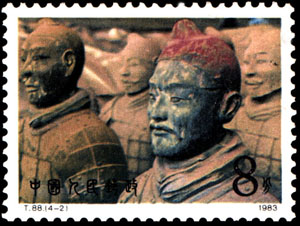
A figure 
Warriors and horses 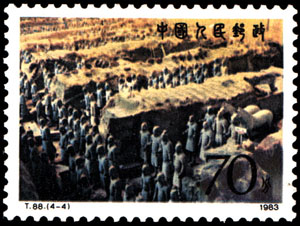
A pit 
Souvenir sheet: Figure Leading a Horse
Chinese Scenery Stamps: Terracotta Army of the First Qin Emperor's Mausoleum (T88), Bronze Chariots and Horses of the First Qin Emperor's Mausoleum (T151)
“Bronze Chariots of the Qin Mausoleum” (T.151, 1990): two stamps and a souvenir sheet.
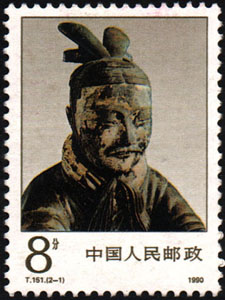
The head of a charioteer 
A bronze horse’s head 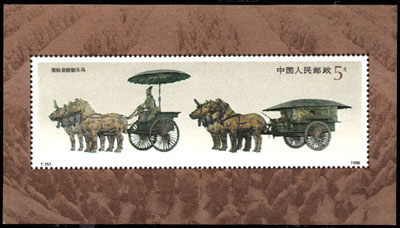
Souvenir sheet: Bronze Chariots of the Qin Mausoleum
Chinese Scenery Stamps: Terracotta Army of the First Qin Emperor's Mausoleum (T88), Bronze Chariots and Horses of the First Qin Emperor's Mausoleum (T151)
Banknotes and coins
The 5-yuan coin “World Cultural Heritage: the Mausoleum of the First Qin Emperor and the Terracotta Army pits”, issued by the People’s Bank of China in 2002, shows a general figure and the pits of the Terracotta Army on the reverse.
Related sites
Imperial tombs: Qianling Mausoleum, Northern Song Imperial Tombs, Western Xia Imperial Tombs, Zhongshan (Purple Mountain), Nanjing, Ming Tombs, Eastern Qing Tombs
Classical Chinese texts
The texts are in Chinese, in our Library of Chinese Literature.
- 郦道元 Li Daoyuan: 《水经注·渭水(秦始皇陵)》(节选)
- 司马迁 Sima Qian: 《秦始皇本纪》
Nearby
| World Heritage | Great Wild Goose Pagoda 34km, Mount Wudang 273km, Longmen Grottoes, Luoyang 294km |
| National parks | Lintong Mount Li–Terracotta Army Scenic Area 6km, Mount Hua 74km, Wulao Peak 124km, Mausoleum of the Yellow Emperor 133km |
| Short guides | Forest of Steles Museum, Xi’an 33km, Bell Tower of Xi'an 33km, Shaanxi History Museum 35km, Qin and Han Branch, Shaanxi History Museum 38km |
| AAAAA attractions | Mount Li and Huaqing Pool 6km, Daming Palace Scenic Area 31km, City Wall and Forest of Steles Historical and Cultural Scenic Area 34km, Giant Wild Goose Pagoda and Tang Paradise Scenic Area 34km |
| AAAA attractions | Chanba National Wetland Park 20km, Weinan Museum 23km, Banpo Museum 24km, Qujiang Ocean Polar Park 33km |
| UNESCO Global Geoparks | Qinling Zhongnanshan UNESCO Global Geopark 56km |
| Historic cities | Xi'an 33km, Xianyang 52km |
| Cities | Xi’an 36km |
| Historical sites | Mausoleum of Qin Shi Huang 2km, Jiangzhai Site 6km, Eastern Qin Mausoleums 11km, East Wei Bridge Site 16km |
| National geoparks | Zhashui Karst Cave National Geopark 92km |
| Nature reserves | Niubeiliang National Nature Reserve 63km, Sangyuan National Nature Reserve 88km, Zhouzhi National Nature Reserve 101km, Heihe Rare Aquatic Wildlife National Nature Reserve 110km |