 Park of China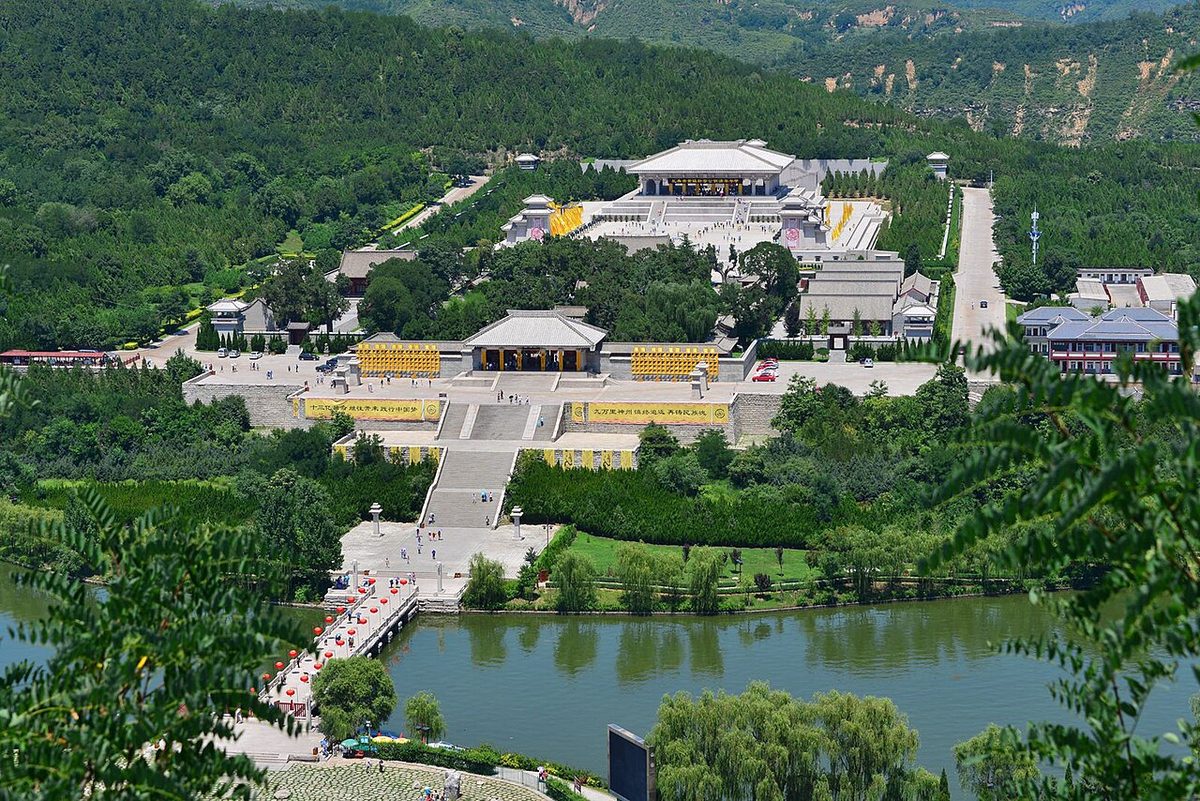
Overview
| Designation | National Park of China (fourth batch) AAAAA tourist attraction |
| Province | Shaanxi |
| Location | North of the Huangling county seat, Shaanxi |
| Latitude, longitude | 35.6, 109.3 Google Maps |
| Highlights | The first mausoleum of China |
| Area | 3.3 km² |
| Nearby cities | Huangling (Shaanxi), Tongchuan, Xi’an |
| Nearby sites | Hukou Waterfall of the Yellow River 123km, Mausoleum of the First Qin Emperor and the Terracotta Army 133km, Lintong Mount Li–Terracotta Army Scenic Area 134km, Mount Li and Huaqing Pool 135km, Mount Hua 143km Search nearby |
| Themes | Culture, Tomb, Taoism, Ancient Building, Forest, Stamp, Ancient trees |
About
The Mausoleum of the Yellow Emperor stands on the summit of Qiao Hill north of the Huangling county seat, south of Yan’an in Shaanxi. By tradition it is the tomb of Xuanyuan, the Yellow Emperor, ancestor of the Chinese people, “the first mausoleum of China”; anciently called Qiaoling, it is where emperors of every dynasty sacrificed to him.
Qiao Hill lies 1 km north of the town, ringed by the Ju River and by hills and towering ancient cypresses, with a road to the summit. The tomb mound in the centre faces south, about 4 m high and 50 m round, deep in cypress forest. A stone on the summit, the Dismounting Stone, reads “civil and military officials dismount here”; before the tomb is a terrace, the Han Wudi Immortal Terrace, said to have been raised when Emperor Wu of Han sacrificed here. All who came to sacrifice dismounted and walked to the tomb, where a pavilion holds a tall stele with “Mausoleum of the Yellow Emperor” in the hand of Guo Moruo; a stele behind reads “the dragon ascended from Qiao Hill”. Governments of the Song, Yuan, Ming and Qing all issued orders to protect the cypresses.
The scenic area, 3.3 km², has two parts, the tomb and the Xuanyuan Temple. There are more than 80,000 ancient cypresses, over 30,000 of them more than a thousand years old, one said to have been planted by the Yellow Emperor himself.
It is in the fourth batch of national parks of China (national scenic areas) named by the State Council in 2002.
Travel tips
Getting there: the mausoleum is about 1 km north of Huangling county town in Shaanxi. From Xi'an, coaches or trains reach Huangling in roughly three to four hours, and buses also run from Yan'an.
Layout: the park has two parts, the mausoleum area and the Xuanyuan Temple. The temple is at the foot of Qiao Hill, and the tomb is on its summit.
Route: start at the Xuanyuan Temple, with its main hall, the Hall of the Primal Ancestor and the cypress said to have been planted by the Yellow Emperor. Then follow the main path up Qiao Hill to the tomb mound, the Immortal Terrace of Emperor Wu of Han and the sacrificial pavilion. Most of it is on foot.
Old cypresses: the hill has about 82,000 ancient cypresses, the distinctive feature of the site, and many along the path are over a thousand years old.
Time: half a day is enough. Going up the hill and coming back takes about two hours.
Season: spring and autumn are comfortable. Around the Qingming festival the public memorial ceremony draws large crowds, and access can be controlled.
Where to stay: Huangling town is close to the site and has hotels, where most visitors stay.
Nearby: Hukou Waterfall lies to the east, Yan'an to the north, and Xi'an has more sights to return to.
The Yellow Emperor
The Yellow Emperor, surnamed Ji (or Gongsun), personal name Xuanyuan, took his title from the virtue of earth, whose colour is yellow. He and the Yan Emperor are regarded as the ancestors of the Chinese, who call themselves “descendants of Yan and Huang”; he is also honoured as the founder of Taoism.
According to the Records of the Grand Historian, the Yellow Emperor was the son of Shaodian, surnamed Gongsun and named Xuanyuan, and lived on the hill of Xuanyuan. Other histories record that after the Yan Emperor he united the tribes of China, set his capital at Zhuolu, reckoned the calendar and civilised the people; the rulers of the Xia, Shang and Zhou were his descendants.
Legend says he was born at Shouqiu in Shandong, died at Jingshan in Henan and was buried at Qiao Hill in Shaanxi.
Events
A public ceremony in honour of the Yellow Emperor is held at the mausoleum at the Qingming festival.
Stamps
On 5 April 1983 China Post issued T84 “Mausoleum of the Yellow Emperor”, three stamps: the mausoleum, the Hall of the Founder of Civilisation and the Xuanyuan Cypress.


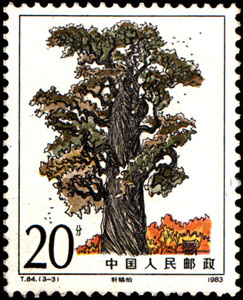
Photo credits: Xuanyuan Temple at the Mausoleum of the Yellow Emperor: Xue Siyang (CC BY-SA 3.0, Wikimedia Commons)
Nearby
| World Heritage | Dafosi Grottoes 129km, Mausoleum of the First Qin Emperor and the Terracotta Army 133km, Daming Palace 146km, Xingjiao Temple Pagoda 167km |
| National parks | Qiachuan, Heyang 109km, Hukou Waterfall of the Yellow River 123km, Lintong Mount Li–Terracotta Army Scenic Area 134km, Mount Hua 143km |
| AAAAA attractions | Yan'an Revolutionary Sites Scenic Area 114km, Mount Li and Huaqing Pool 135km, Daming Palace Scenic Area 147km, Qianling Mausoleum Scenic Area 148km |
| AAAA attractions | Yuhua Palace 43km, Cangjie Temple 45km, Jinsuoguan Stone Forest 45km, Huanglong Mountain 46km |
| UNESCO Global Geoparks | Qinling Zhongnanshan UNESCO Global Geopark 185km |
| Cities | Xi’an 147km |
| Historical sites | Yijun Grottoes 23km |
| National geoparks | Yellow River Hukou Waterfall (Shaanxi) National Geopark 123km |
| Nature reserves | Sangyuan National Nature Reserve 49km, Ziwuling National Nature Reserve 70km |