 Park of China
Overview
| Designation | National Park of China (first batch) AAAAA tourist attraction |
| Province | Jiangsu |
| Location | East of Nanjing, Jiangsu |
| Latitude, longitude | 32.1, 118.8 Google Maps |
| Nearby cities | Nanjing |
| Top sights | The Sun Yat-sen Mausoleum, the Ming Xiaoling Mausoleum |
| Area | 20 km² |
| Highest point | about 448 m |
| Nearby sites | Caishi 59km, Mount Langya 61km, Shugang and Slender West Lake, Yangzhou 66km, Lake Tai 161km, Classical Gardens of Suzhou 187km Search nearby |
| Themes | Hill, Forest, Tomb, Big City, Temple, Culture, Homes & tombs of notable people |
About
Zhongshan (Bell Mountain), also called Purple Mountain, rises east of Nanjing; its summit, Toutuo Ridge, is about 448 m. The main sights are the Sun Yat-sen Mausoleum, the Ming Xiaoling Mausoleum and the Purple Mountain Observatory.
The Sun Yat-sen Mausoleum, built from 1926 to 1929, is the tomb of Dr Sun Yat-sen; the text of his Outline of National Reconstruction is carved in the memorial hall. The Xiaoling Mausoleum is the tomb of the Hongwu Emperor Zhu Yuanzhang, founder of the Ming, with twelve pairs of stone figures along its Sacred Way; nearby Plum Blossom Hill holds the tomb of Sun Quan. Linggu Temple is famous for its Beamless Hall, the Xuanzang memorial hall and the memorial pagoda to the war dead.
Zhongshan rises east of Nanjing, about 7 km from west to east and thickly wooded; its purple shale glows purple-gold in sunlight, hence its other name, Purple Mountain. Sun Quan of the Three Kingdoms was buried here, and from the Eastern Jin on every dynasty built temples and tombs on it, so the remains of the Six Dynasties, the Ming and the Republic lie along its foot from west to east: the finest sights of the “ancient capital of six dynasties”.
It is in the first batch of national parks of China (national scenic areas) named by the State Council in 1982.
Travel tips
Getting there: Nanjing Metro Line 2 stations Muxuyuan, Xiamafang, Xiaolingwei and Zhonglingjie all give access to the scenic area; walk or change to the park shuttle buses, which link the Sun Yat-sen Mausoleum, the Ming Xiaoling Mausoleum, Linggu Temple and other sights. Lingyuan Road is closed to vehicles at weekends and on holidays.
Booking: the Sun Yat-sen Mausoleum is free but must be booked in advance under your real name. The tomb hall is closed on Mondays.
Sun Yat-sen Mausoleum: nearly 400 steps lead from the Bo'ai Arch to the memorial hall; the slope is gentle. It is very crowded on holidays.
Ming Xiaoling Mausoleum: walk from the Sacred Way with its stone animals and figures to the Square Tower; part of the Sacred Way runs beside Plum Blossom Hill.
Linggu Temple: the Beamless Hall, Linggu Pagoda and the temple itself are close together and easy to see in one visit.
Other sights: Meiling Palace, the Music Stage and the Purple Mountain Observatory, as time allows; the observatory is up the mountain and needs a separate trip.
Time: one day covers the Sun Yat-sen Mausoleum, Ming Xiaoling and Linggu Temple.
Season: plum blossoms on Plum Blossom Hill in February and March; autumn leaves along Lingyuan Road around November; summer is hot.
Main sights
Sun Yat-sen Mausoleum: begun in 1926 and completed in 1929 to Lü Yanzhi’s design. From the Bo’ai archway the way climbs through the gate and stele pavilion to the memorial hall by 392 steps; inside is a seated statue of Sun Yat-sen, with the tomb chamber behind.
Ming Xiaoling Mausoleum: the tomb of the Hongwu Emperor, founder of the Ming, and Empress Ma, begun in 1381. The sacred way winds round Plum Blossom Hill between twelve pairs of stone animals (lions, xiezhi, camels, elephants, qilin and horses) and four pairs of officials; the tomb precinct has the gate, the site of the sacrificial hall and the Square City with its Soul Tower. Inscribed in 2003 as part of the Imperial Tombs of the Ming and Qing Dynasties World Heritage Site.
Linggu Temple: moved here from Dulongfu in the early Ming; the Beamless Hall is a Ming brick-vaulted building, and behind it are the Republican cemetery of fallen soldiers and the nine-storey Linggu pagoda.
Purple Mountain Observatory: China’s first modern observatory, completed in 1934 on the third peak, keeping Ming and Qing armillary spheres and other ancient instruments.
Meiling Palace: a Republican residence of 1931 on the south slope, a palace-style building with glazed tiles.
Plum Blossom Hill: the small hill encircled by the Xiaoling sacred way, site of Sun Quan’s tomb, at its best in early spring.
Xuanwu Lake and the Ming city wall: the lake west of the mountain and the wall along it; the stretch from Taiping Gate to Jiefang Gate can be walked.
Map
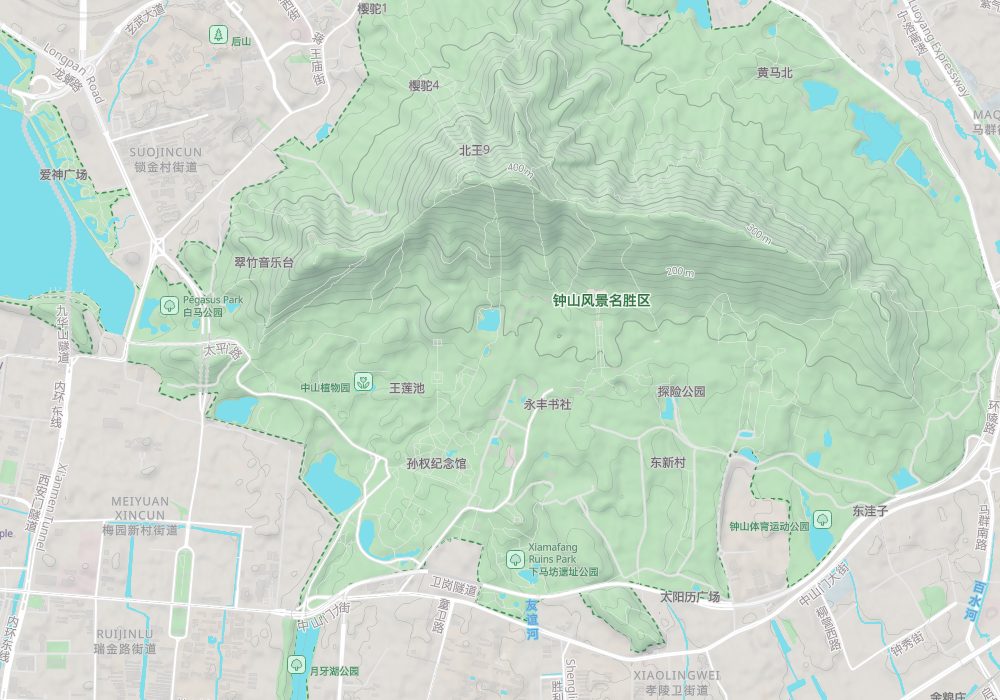
Photo credits: Zhongshan, Nanjing: xiquinhosilva (CC BY 2.0, Wikimedia Commons)
Nearby
| World Heritage | Shugang and Slender West Lake, Yangzhou 66km, Classical Gardens of Suzhou 187km, Archaeological Ruins of Liangzhu City 216km, Huangshan (Yellow Mountains) 225km |
| National parks | The Three Hills of Zhenjiang 57km, Caishi 59km, Mount Langya 61km, Lake Chao 133km |
| AAAAA attractions | Confucius Temple - Qinhuai Scenic Belt 8km, Jurong Maoshan Scenic Area 53km, Jinshan (Jinshan-Jiaoshan-Beigushan Tourist Area) 56km, Beigushan (Jinshan-Jiaoshan-Beigushan Tourist Area) 60km |
| AAAA attractions | Nanjing Museum 4km, Xuanwu Lake 4km, Hongshan Forest Zoo 4km, Meiyuan New Village Memorial Hall 5km |
| Historic cities | Nanjing 8km, Zhenjiang 59km, Yangzhou 65km, Gaoyou 97km |
| National key parks | Xuanwuhu Park 4km |
| Cities | Nanjing 5km, Hefei 147km |
| Historical sites | Zhongshan Architectural Site <1km, Sun Yat-sen Mausoleum 1km, Site of the National Purple Mountain Observatory 1km, Site of the Former National Government 3km |
| National geoparks | Jiangning Tangshan-Fangshan National Geopark 12km, Luhe National Geopark 28km, Yashan National Geopark 99km, Fengyangshan National Geopark 134km |
| Nature reserves | Chinese Alligator National Nature Reserve 130km, Sihong Hongze Lake Wetland National Nature Reserve 139km |
| Historic villages | Yangliu Village 25km |