 Park of China
Overview
| Designation | UNESCO World Heritage (cultural, 2025) National Park of China (second batch) |
| Province | Ningxia |
| Location | About 25 km west of Yinchuan, Ningxia |
| Mountains | Helan Mountains |
| Latitude, longitude | 38.4, 106.0 Google Maps |
| Nearby sites | Xumishan Grottoes 242km, Mount Kongtong 324km, Badain Jaran Desert - Towers of Sand and Lakes 357km Search nearby |
| Area | 40 km² |
| Nearby cities | Yinchuan |
| Themes | Tomb, Tower, Ancient Building, Culture, Museum, Stamp, Archaeological sites, Rock art & murals |
The Western Xia tombs
The Western Xia Imperial Tombs lie about 25 km west of Yinchuan, Ningxia, at the eastern foot of the Helan Mountains on the western edge of the Yinchuan plain, the densest surviving imperial cemetery in China. The Western Xia dynasty lasted from 1038 to 1227 with its capital at Yinchuan. The scenic area has four parts, Gunzhongkou, the tombs, Baisikou and the old Great Wall at Sanguan, 40 km² in all, with nine imperial tombs and 271 satellite tombs. Each imperial tomb is a complete complex facing south: from south to north the que towers, spirit walls, stele pavilions, corner towers, outer and inner cities, offering hall and tomb mound.
Gunzhongkou has the Laojun Hall, the Doumu Palace, Xiaodongtian and a mosque, and rocks in the valley shaped like a roaring lion, a crouching tiger, an immortal pointing the way and a leaping goat.
Baisikou has a square pagoda and twin pagodas. The square pagoda is about 30 m, solid, with eleven tiers of eaves, plastered white and painted; the twin pagodas stand over 100 m apart and are about 45 m high.
The tomb town in the north of the cemetery covers about 60,000 m² inside rammed-earth walls, with remains of squares, roads, courtyards, wells and houses. The octagonal earthen tomb mounds, over 20 m high, have been called China’s pyramids.
The Western Xia Museum on the east side of the cemetery, 5,300 m², is the first museum devoted to the rise and fall of the Western Xia kingdom against the background of its imperial cemetery.
The tombs are the largest and highest-ranking surviving remains of the Western Xia and are among China’s 100 major archaeological discoveries of the 20th century. Of the ten Western Xia emperors, the last three had no time to build tombs before the fall of the state, so there are nine imperial tombs.
Tomb No. 3 is the largest of the nine imperial tombs; in 2001 green-glazed kalavinka figures (human-headed birds) used as roof ornaments were excavated there.
It is in the second batch of national parks of China (national scenic areas) named by the State Council in 1988.
Travel tips
Getting there: fly or take the high-speed train to Yinchuan, then go by road from the city to the Western Xia Tombs, within about an hour.
Visiting: enter through the visitor centre, see the Western Xia Museum first, then take the park bus to the tombs. The main tomb open to visitors is Tomb No. 3, where you can walk close to the earthen mound and the ruins around it.
Time: about half a day for the museum and Tomb No. 3. Visitor numbers have risen sharply since the 2025 World Heritage listing; go early on holidays.
Season: spring and autumn are best. The site is open, with almost no shade, so the summer sun is strong; winter is cold and windy.
Caution: the ground is gravel and sand; wear good walking shoes and bring water and sun protection.
Nearby: along the eastern foot of the Helan Mountains are the Twin Pagodas of Baisikou, the Helan Mountain rock art and the Zhenbeibu Western Film Studio; they can be combined into a day.
The Western Xia
The Western Xia was a dynasty founded in the 11th century chiefly by the Tangut people. At its height its territory reached the Yellow River in the east, Yumen in the west, Xiaoguan in the south and the desert in the north, more than ten thousand li, covering today’s Ningxia, Gansu, western Inner Mongolia, northern Shaanxi and eastern Qinghai, about 830,000 km². A military power of the north-west, it stood on equal terms with the Song and Liao. Founded in 1038, it was destroyed by the Mongols in 1227 after 189 years and ten emperors.
Stamps
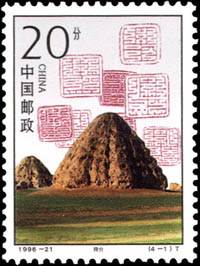
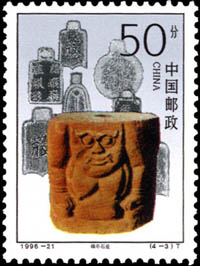
On 22 August 1996 China Post issued 1996-21 “Western Xia Tombs”, four stamps: a tomb mound, a chiwen roof ornament from a spirit gate, a stele base and a broken stele from the Shouling tomb. The mound is 20 m high, like a seven-storey pagoda; the chiwen is a roof decoration; the stele base is a kneeling female figure; the broken stele was unearthed at the west stele pavilion of tomb no. 5.


Map
Nearby
| National parks | Xumishan Grottoes 242km |
| AAAAA attractions | Zhenbeibu Western Film Studio 21km, Lingwu Shuidonggou Tourist Area 47km, Sand Lake (Shahu) 52km, Yellow River Grand Canyon Tourist Area 62km |
| AAAA attractions | Western Xia Imperial Tombs <1km, Nansi Ecological Tourism Area 30km, Mingcui Lake National Wetland Park 34km, Helan Mountain Rock Carvings 34km |
| UNESCO Global Geoparks | Alxa Desert UNESCO Global Geopark 146km |
| Historic cities | Yinchuan 26km |
| Cities | Yinchuan 28km |
| Historical sites | Chengtian Temple Pagoda 24km, Yinchuan Yuhuang Pavilion 26km, Haibao Pagoda 26km, Twin Pagodas at Baisikou 27km |
| National geoparks | Lingwu National Geopark 71km |
| Nature reserves | Helanshan National Nature Reserve 52km, Haba Lake National Nature Reserve 123km, Luoshan National Nature Reserve 128km |