 Park of China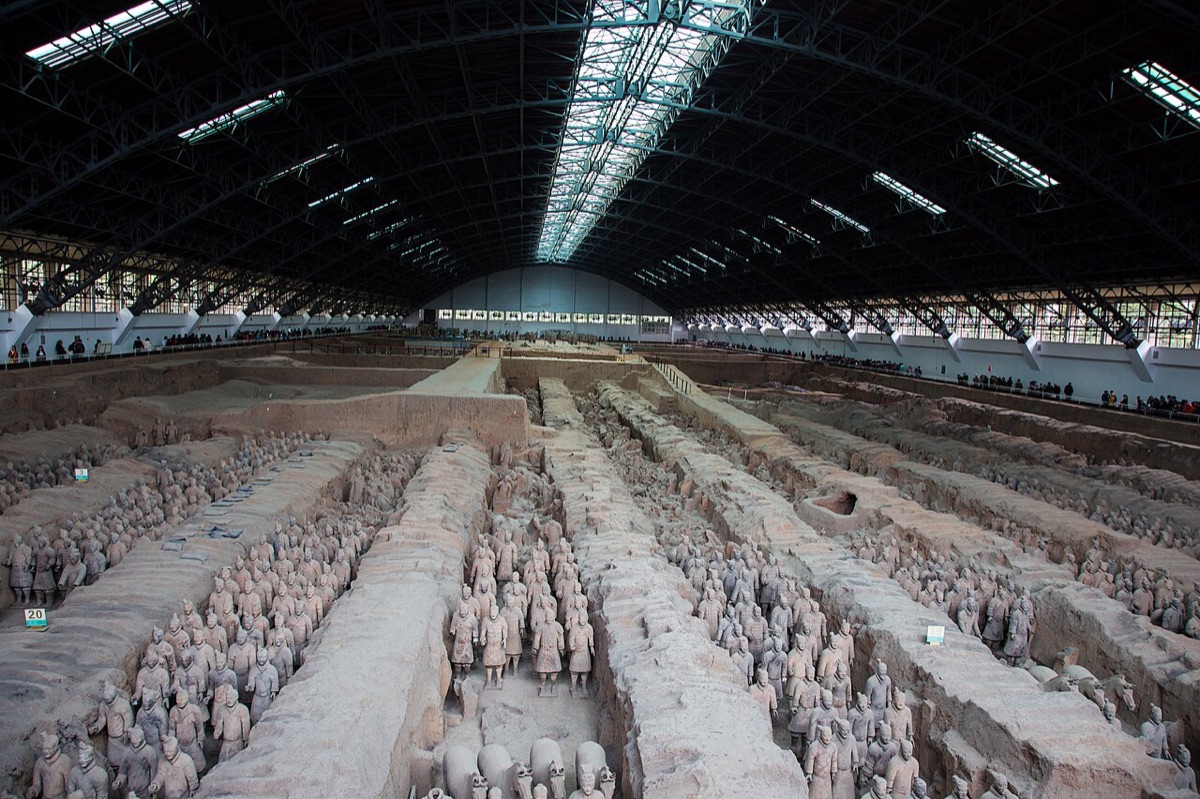
Overview
| Designation | UNESCO World Heritage (cultural, 1987) Part of the first-batch National Park of China “Lintong Mount Li–Terracotta Army” AAAAA tourist attraction |
| Province | Shaanxi |
| Location | Lintong, Xi’an, Shaanxi |
| Mountains | Qinling Mountains |
| Latitude, longitude | 34.4, 109.2 Google Maps |
| Highlights | Imperial mausoleum, hot springs |
| Top sights | The Terracotta Army |
| Nearby cities | Xi’an |
| Nearby sites | Lintong Mount Li–Terracotta Army Scenic Area 4km, Mount Li and Huaqing Pool 7km, Mount Hua 74km, Wulao Peak 123km, Mausoleum of the Yellow Emperor 133km Search nearby |
| Themes | Tomb, Museum, Statue, Mountain, Famous Mountain, Geothermal, Spring, Ancient Building, Culture, Stamp, Archaeological sites |
About
Mount Li at Lintong, Xi’an, Shaanxi, is a first-batch national park of China. The Mausoleum of the First Qin Emperor and its Terracotta Army at the northern foot of the mountain were inscribed on the World Heritage List in 1987.
According to Sima Qian's Records of the Grand Historian, the tomb was dug through three layers of groundwater and lined with bronze, guarded by crossbow traps, with rivers and seas of mercury, the heavens above and the land below, and lamps of whale oil; the workmen were sealed inside, and childless concubines were buried with the emperor.
Modern surveys have found a marked mercury anomaly beneath the mound, consistent with the record of mercury rivers; the tomb itself has not been excavated.
The three pits are arranged in a triangle covering over 20,000 m². Pit 1 alone covers 14,260 m² and is estimated from the density of the rows to hold about 6,000 figures and horses; the three pits together, about 8,000.
Travel tips
Getting there: the Terracotta Army is in Lintong, about 40 km from central Xi'an. A tourist bus from the east square of Xi'an railway station runs via Huaqing Palace to the Terracotta Army in about an hour; or take Metro Line 9 to Lintong and change to a local bus.
Booking: the Emperor Qinshihuang's Mausoleum Site Museum (the Terracotta Army and the mausoleum) requires advance booking under your real name; book early for holidays.
Terracotta Army: see Pits 1, 3 and 2 and then the exhibition hall. Pit 1 is the largest and the most crowded.
Mausoleum of the First Emperor: the mausoleum park (Lishan Garden) is about 2 km from the pits, linked by a free shuttle bus. The tomb itself has not been excavated; above ground you see the mound and site remains.
Huaqing Palace and Mount Li: Huaqing Palace lies at the northern foot of Mount Li, with the Tang imperial bath ruins and the Five-Room Hall; from the palace you can go up Mount Li.
Time: half a day to a day for the Terracotta Army and the mausoleum; a full day with Huaqing Palace and Mount Li.
Caution: touts around Xi'an railway station sell day tours that often add shopping stops; the public tourist bus or travelling on your own is simpler.
The Mausoleum of the First Qin Emperor
The mausoleum lies at the northern foot of Mount Li and was built between 246 and 208 BC, a labour of 39 years. The surviving mound is about 51 m high; the inner wall is 2.5 km round, the outer 6.3 km. It is the largest imperial tomb in China. Qin Shihuang began building it when he came to the throne at 13, and after unifying the six states conscripted 700,000 men from all over the country; it was still unfinished when he died. Decades of survey and trial excavation have found more than 500 accompanying tombs and pits in the 56.25 km² protected zone and over 50,000 important objects. The discovery of the Terracotta Army has been called “the most important archaeological find of the twentieth century” and “the eighth wonder of the world”.
The Terracotta Army
The Museum of the Terracotta Warriors and Horses stands 1.5 km east of the mausoleum on its burial pits. On 29 March 1974 local farmers digging a well chanced on Pit 1; Pits 2 and 3 followed, and a large site museum was built over them. The warriors stand 1.75 to 1.85 m tall and, by dress, bearing and hairstyle, include generals, infantry and charioteers; bronze swords, spears, halberds and curved knives were found with them.
Pit 1, the main sight, is 210 m by 62 m; more than 1,000 life-size figures, 8 chariots, 32 horses and nearly 10,000 bronze objects have been excavated. It is thought to hold over 6,000 figures in all; only about 1,000 have been excavated, and most of the pit remains undug.
Pit 2, the finest of the three, is L-shaped, 96 m at its longest and 84 m at its widest, about 5 m deep and 6,000 m² in area, with kneeling and standing crossbowmen, a square of four-horse chariots, a mixed formation of chariots, infantry and cavalry, and a formation of cavalry.
Pit 3, the smallest, is believed to be the command post; no bronze chariots were found there.
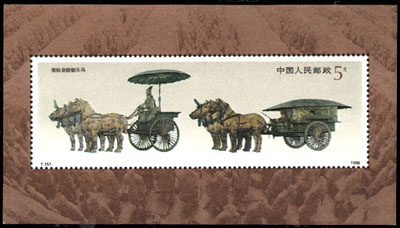
In December 1980 two bronze chariots with horses were unearthed, hailed as “the crown of bronzes” and “national treasures”. They represent the emperor’s processional carriages: a standing carriage and a covered carriage, each two-wheeled with a single shaft, drawn by four bronze horses and driven by a senior charioteer. Cast mainly in bronze with gold and silver fittings, the parts were cast separately and joined by inlay casting, welding, gluing, riveting, mortise joints, ring fastenings and pins. They are painted all over, the horses white, in mineral pigments bound with glue, the glue’s thickness used to raise lines in relief. Chariots, horses and figures are about half life size, faithfully reproducing the emperor’s equipage. They were found 20 m west of the mound in a wooden chamber, one behind the other, badly broken, and have been restored.
Stamps
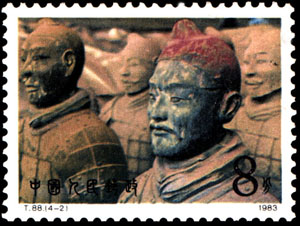
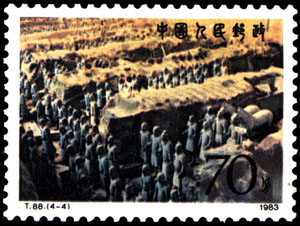
In 1983 China Post issued T.88 “Terracotta Figures of the Qin Mausoleum”, four stamps: a group of figures (8 fen), a figure (8 fen), warriors and horses (10 fen) and a pit (70 fen), with a 2-yuan souvenir sheet of a groom.



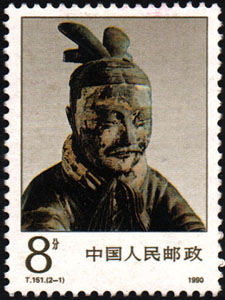
In 1990 T.151 “Bronze Chariots of the Qin Mausoleum”, two stamps: the head of a charioteer (8 fen) and a bronze horse’s head (50 fen), with a souvenir sheet.

Banknotes and coins
The 5-yuan coin “World Cultural Heritage: the Mausoleum of the First Qin Emperor and the Terracotta Army pits”, issued by the People’s Bank of China in 2002, shows a general figure and the pits of the Terracotta Army on the reverse.
Map
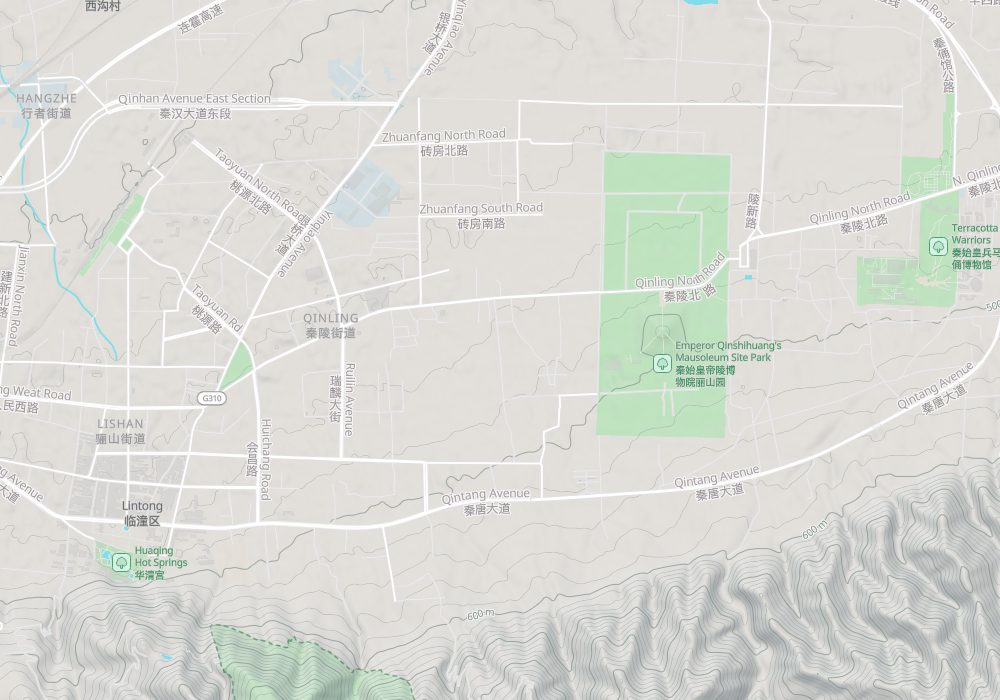
Photo credits: The Terracotta Army: Jmhullot (CC BY 3.0, Wikimedia Commons)
Nearby
| World Heritage | Daming Palace 31km, Xingjiao Temple Pagoda 40km, Dafosi Grottoes 140km, Shihao Section of Xiaohan Ancient Route 208km |
| National parks | Lintong Mount Li–Terracotta Army Scenic Area 4km, Mount Hua 74km, Wulao Peak 123km, Qiachuan, Heyang 133km |
| AAAAA attractions | Mount Li and Huaqing Pool 7km, Daming Palace Scenic Area 31km, City Wall and Forest of Steles Historical and Cultural Scenic Area 34km, Giant Wild Goose Pagoda and Tang Paradise Scenic Area 35km |
| AAAA attractions | Weinan Museum 22km, Banpo Museum 24km, Qujiang Ocean Polar Park 34km, Bailuyuan Film and Television City 34km |
| UNESCO Global Geoparks | Qinling Zhongnanshan UNESCO Global Geopark 56km |
| Historic cities | Xi'an 33km, Xianyang 53km |
| Cities | Xi’an 36km |
| Historical sites | Mausoleum of Qin Shi Huang 2km, Jiangzhai Site 7km, Huaqing Palace Site 7km, Eastern Qin Mausoleums 12km |
| National geoparks | Zhashui Karst Cave National Geopark 92km |
| Nature reserves | Niubeiliang National Nature Reserve 64km, Sangyuan National Nature Reserve 88km, Zhouzhi National Nature Reserve 102km, Heihe Rare Aquatic Wildlife National Nature Reserve 111km |