 Park of China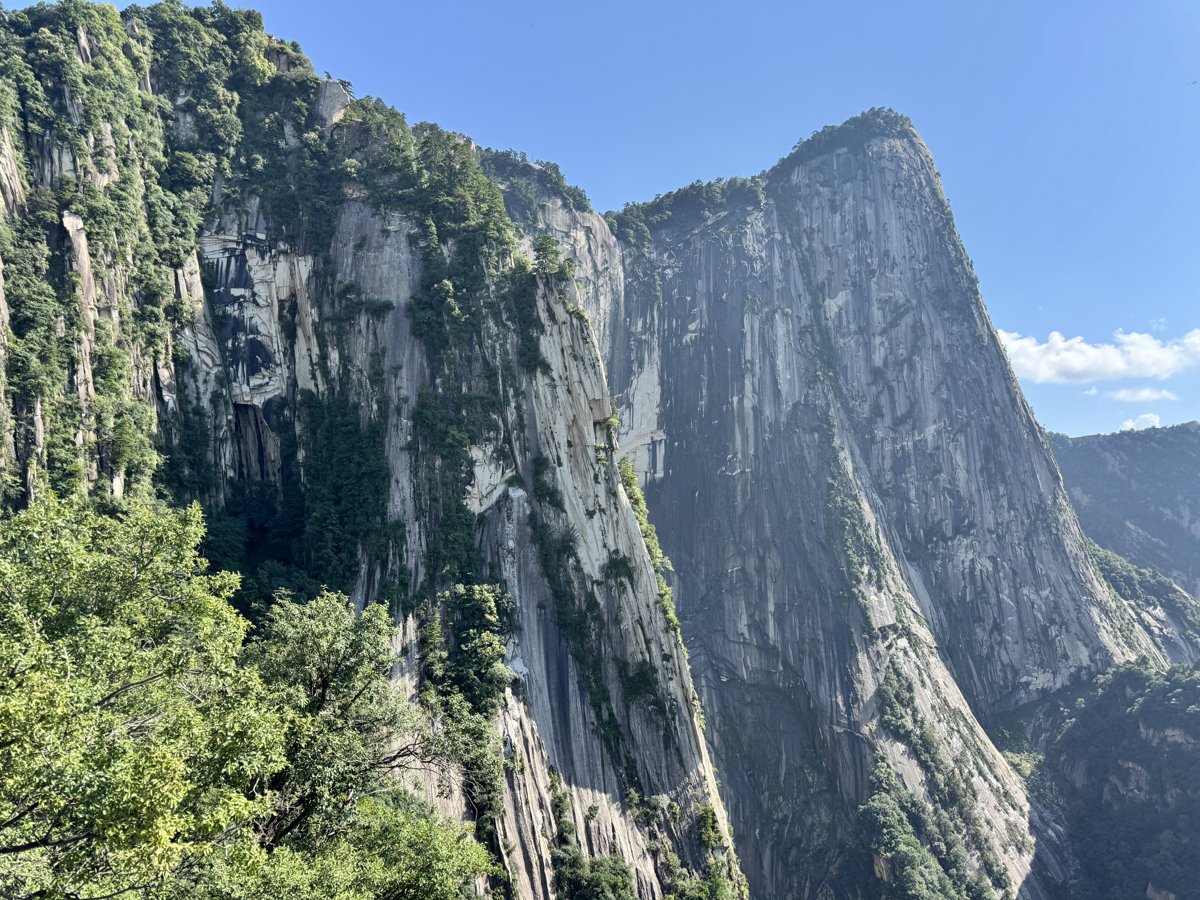
Overview
| Designation | National Park of China (first batch) |
| Province | Shaanxi |
| Location | Shaanxi, northern foot of the Qinling Mountains |
| Mountains | Qinling Mountains |
| Latitude, longitude | 34.5, 110.1 Google Maps |
| Highlights | The Western Sacred Mountain of the Five Sacred Mountains |
| Top sights | East Peak, Blue Dragon Ridge, the Plank Walk in the Sky |
| Highest point | 2,155 m |
| Nearby cities | Tongguan, Xi’an |
| Nearby sites | Mausoleum of the First Qin Emperor and the Terracotta Army 74km, Lintong Mount Li–Terracotta Army Scenic Area 78km, Mount Li and Huaqing Pool 81km, Mausoleum of the Yellow Emperor 143km, Hukou Waterfall of the Yellow River 188km Search nearby |
| Themes | Mountain, Famous Mountain, Cliff, Peak, Taoism, Stamp, Cable Car, Hiking & climbing, Sea of clouds & sunrise |
About
Mount Hua, the western of the Five Great Mountains, rises to about 2,155 m in Huayin, Shaanxi, about 100 km east of Xi’an at the northern foot of the Qinling range. A Taoist mountain famed for its precipitous grandeur, “since ancient times there has been only one path up Mount Hua”. It has five peaks, East, South, West, North and Central, the East, West and South being the highest. The East Peak is the place to watch the sunrise; the West Peak, shaped like a lotus, is the most beautiful; the South Peak, Luoyan, is the summit.
Famous sights: Yuquan Temple, Qingkeping, the Thousand-Foot Precipice, the Hundred-Foot Gorge, Blue Dragon Ridge, the East Peak, the Sparrowhawk’s Somersault and the Plank Walk in the Sky.
It is in the first batch of national parks of China (national scenic areas) named by the State Council in 1982.
Map

Main sights
Yuquan Temple: at the north foot of the mountain and the usual start of the climb, traditionally linked with the Daoist Chen Tuan, with an old garden and a stone boat.
Qingke Ping: about 6 km above Yuquan Temple, a flat stretch with a temple and lodging, after which the path becomes steep.
Thousand-Foot Precipice and Hundred-Foot Gorge: above Qingke Ping, very steep stairs cut into the rock. The first is almost vertical, and the second is a narrow cleft between two walls.
North Peak (Yuntai Peak): about 1,614 m, with sheer sides and a fairly flat top, with the upper station of the North Peak cable car; from here the path follows Canglong Ridge to the other peaks.
Canglong Ridge: a narrow spine beyond North Peak with deep drops on either side, where the Tang writer Han Yu is said to have been so frightened that he wept.

East Peak (Chaoyang Peak): known for sunrise, with the neighbouring Shilou Peak and the Bo Terrace, which has a chess pavilion.
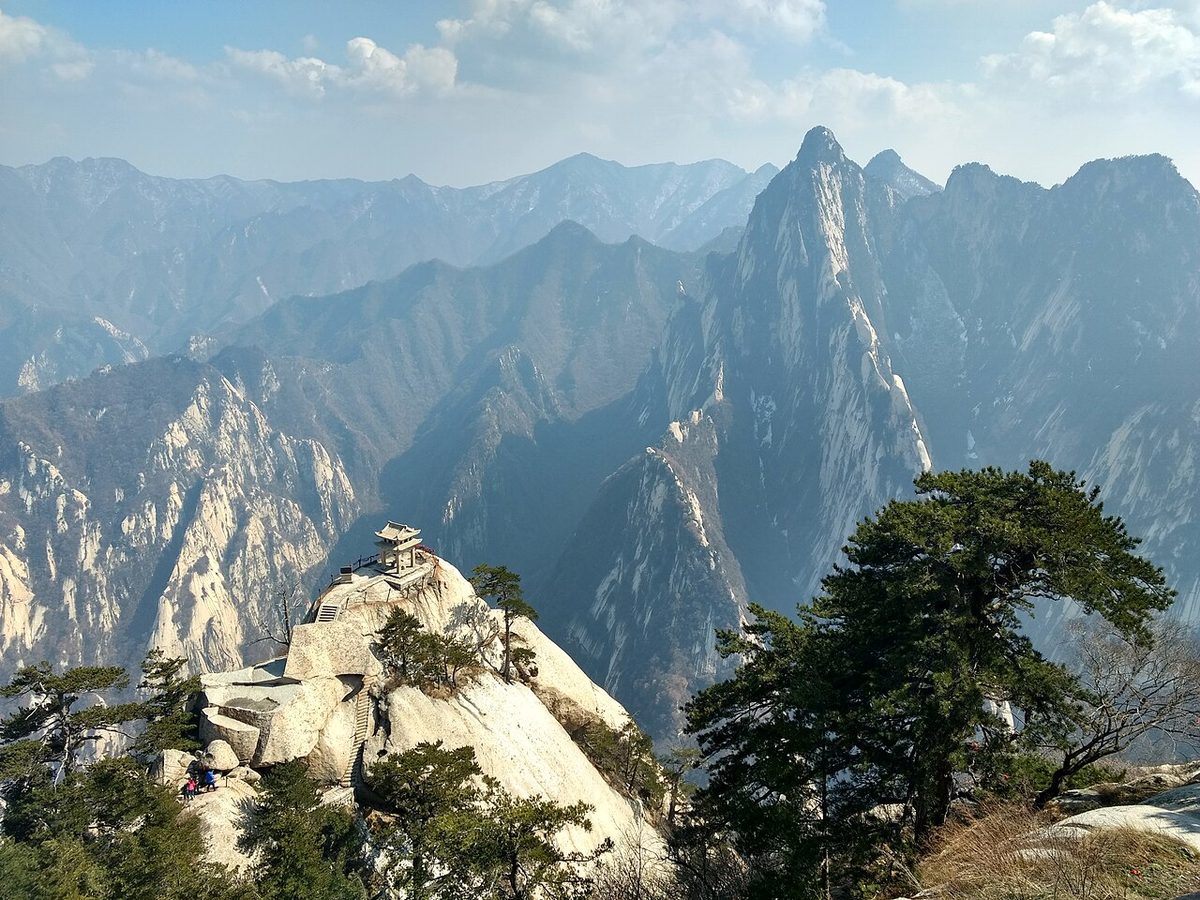
South Peak (Luoyan Peak): the highest peak at about 2,155 m, with a small pool on the summit and many inscriptions.

West Peak (Lotus Peak): a huge split boulder on top is associated with the legend of Chenxiang splitting the mountain to free his mother.
Middle Peak (Yunü Peak): between the East, South and West peaks, with a shrine to the Jade Maiden, traditionally linked with Nongyu, daughter of Duke Mu of Qin.
Huayue Immortal's Palm: natural streaks on a cliff beside the East Peak resembling a giant handprint, said in legend to be left by the giant Juling as he split the mountain for the Yellow River; it heads the Eight Views of Guanzhong on a Qing-dynasty stele of 1680.

On the summit of the West Peak is the Cuiyun Temple, with Lotus Cave, the Giant's Footprint and Sheshen Cliff nearby.
Temple of the Western Peak: in Huayin town, founded under Emperor Wu of Han and moved to its present site in the Eastern Han, where emperors sacrificed to Mount Hua. The walled compound is 525 m long; the main Haoling Hall, seven bays wide, stands on a raised terrace.
History and culture
Huashan is the Western Mountain of the Five Great Mountains, and offering sacrifice to sacred mountains is an ancient practice. The Xiyue Temple in Huayin town was where the mountain god was worshipped, and with the Daoist temples on the mountain it makes up Huashan's cultural landscape.
In old usage hua (华) and hua (花, flower) were interchangeable, and one explanation is that the mountain was named for its flower-like outline. The Daoist temples on the mountain mostly belong to the Quanzhen school, among them Yuquan, Dulong and Zhenyue.
The Daoist Chen Tuan of the Five Dynasties and early Song period lived as a hermit on Huashan, and many legends and sites are tied to him.
For centuries there was one path up the mountain, with the steep sections made passable by rock-cut steps, chains and plank walkways, hence the saying 'since ancient times only one way up Huashan'. Cliff walkways such as the Changkong Plank Road are planks laid on iron pegs set into the rock face.
Jin Yong's martial-arts novels made the mountain still more famous: in The Legend of the Condor Heroes the five greatest masters meet on Huashan to contest the title of the best swordsman, and The Smiling, Proud Wanderer tells of the Huashan Sect and its leader Yue Buqun, the “Gentleman Sword”.
Travel tips
Getting there: Huashan North station is on the Zhengzhou–Xi'an high-speed line, about half an hour from Xi'an North. From the station a bus or shuttle goes to the Huashan visitor centre.
Booking: tickets are sold under your real name for timed entry; holiday slots go fast, so book ahead.
Going up: either take a park bus from the visitor centre to the North Peak or West Peak cable car, or walk from the Yuquan Temple past Qingke Ping, the Thousand-Foot Precipice and the Hundred-Foot Gorge to the North Peak, which takes four to five hours or more.
The five peaks: from the North Peak the path follows Canglong Ridge and Golden Lock Pass to the East, South, West and Central peaks.
Plank Walk in the Sky: on the east side of the South Peak, a narrow plank path on the cliff face. A safety harness is required, and queues can be long.
Sunrise: the East Peak is the place for sunrise. Many people climb overnight from the Yuquan Temple to reach it before dawn; others stay on the mountain.
Time: with the cable cars, one day covers the main peaks; on foot, allow more than a day.
Caution: the paths are steep stone steps with chain handrails and are tiring. Some sections close in ice, rain or snow. Cable cars and paths are very crowded on holidays.
Where to stay: in Huayin town or near the Yuquan Temple below, or at the few guesthouses on the peaks.
Stamps
In 1989 China Post issued T140 “Mount Hua”, four stamps: the Western Sacred Mountain, Mount Hua from afar, the Thousand-Foot Precipice and Blue Dragon Ridge.


The second stamp of the 1981 definitive set R21 “Scenery of the Motherland” shows Mount Hua.

Photo credits: Chess Pavilion, East Peak: May Wung (CC BY-SA 4.0, Wikimedia Commons)
Nearby
| World Heritage | Mausoleum of the First Qin Emperor and the Terracotta Army 74km, Daming Palace 105km, Xingjiao Temple Pagoda 105km, Shihao Section of Xiaohan Ancient Route 134km |
| National parks | Wulao Peak 54km, Lintong Mount Li–Terracotta Army Scenic Area 78km, Qiachuan, Heyang 82km, Mausoleum of the Yellow Emperor 143km |
| AAAAA attractions | Mount Li and Huaqing Pool 81km, Daming Palace Scenic Area 105km, Giant Wild Goose Pagoda and Tang Paradise Scenic Area 107km, City Wall and Forest of Steles Historical and Cultural Scenic Area 107km |
| AAAA attractions | Tongguan Ancient City 24km, Fengtu Righteous Granary 34km, Yongji Guanque Tower Scenic Area 45km, Yongji Pujiu Temple Scenic Area 48km |
| UNESCO Global Geoparks | Qinling Zhongnanshan UNESCO Global Geopark 115km |
| Cities | Xi’an 110km |
| Historical sites | Wei Great Wall Site 8km, Hongnong Yang Family Cemetery 9km, Xiyue Temple 11km, Hengzhen Site 14km |
| National geoparks | Zhashui Karst Cave National Geopark 132km |
| Nature reserves | Sangyuan National Nature Reserve 95km, Taikuanhe National Nature Reserve 113km, Yellow River Wetland National Nature Reserve 119km, Niubeiliang National Nature Reserve 122km |