
How to Read an Old Chinese Bridge
By structure, old Chinese bridges fall into beam bridges, arch bridges, suspension bridges and pontoon bridges, plus covered bridges with galleries built on top. This chapter explains how to tell them apart and what to look for on a bridge, with a few examples of each that can be visited.
Start with the structure
When looking at a bridge, first ask what holds the deck up. A beam bridge lays stone or timber beams flat across piers, and the beams carry the load directly, like a bench. An arch bridge uses stones laid in a curved vault that pushes the weight of the deck out to the banks. A suspension bridge stretches bamboo or iron cables from one bank to the other and hangs the deck from them. A pontoon bridge links boats together and lays planks over them. A covered bridge is not a separate structure but a beam or arch bridge with a gallery built over it. Most of China’s timber bridges are gone; the old bridges that survive are mainly of stone, while timber covered bridges are found mostly in the mountains of the south.
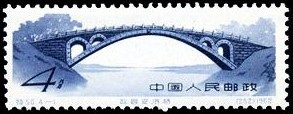
The Zhaozhou Bridge, an open-spandrel stone arch
Stamp
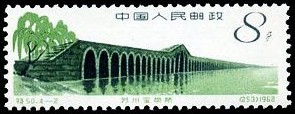
Suzhou, 53 arches in a row
Stamp
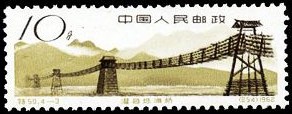
The suspension bridge at Dujiangyan
Stamp
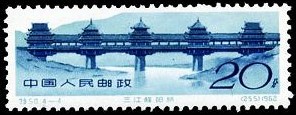
Sanjiang, Guangxi, a Dong covered bridge
Stamp
The four-stamp set Ancient Chinese Architecture: Bridges happens to show one of each kind: the Zhaozhou Bridge is an arch bridge, the Baodai Bridge a multi-arch bridge, the Zhupu Bridge at Dujiangyan a suspension bridge and the Chengyang Bridge a covered bridge. Chapter 9 of A Brief History of Chinese Architecture also outlines these types, following Liang Sicheng’s classification.
Beam bridges
The beam bridge is the simplest type and also the oldest. The span of a stone beam bridge is limited by the length of the stone, so spans are usually short and the bridge relies on many piers instead. Coastal Fujian has the greatest concentration of stone beam bridges; a group of long bridges was built there in the Song, and the two in Quanzhou are the most famous. Both are component sites of the World Heritage site “Quanzhou: Emporium of the World in Song-Yuan China”. The Luoyang Bridge, also called the Wan’an Bridge, was built under the direction of Cai Xiang in the Northern Song and spans the mouth of the Luoyang River. The current there is fast and the riverbed soft, so the builders first dumped large quantities of stone along the line of the bridge to form an underwater stone bank as a foundation, then raised the piers on it; they also cultivated oysters on the stone base so that the shells would cement the stones together. Both ends of each pier were built as pointed wedges to part the water. The Anping Bridge, south of Quanzhou, links the towns of Anhai and Shuitou. Completed in the Southern Song and about five li long, it is popularly called the Five-Li Bridge, and a saying goes that “no bridge under heaven is as long as this one”. It is the longest surviving ancient stone beam bridge.
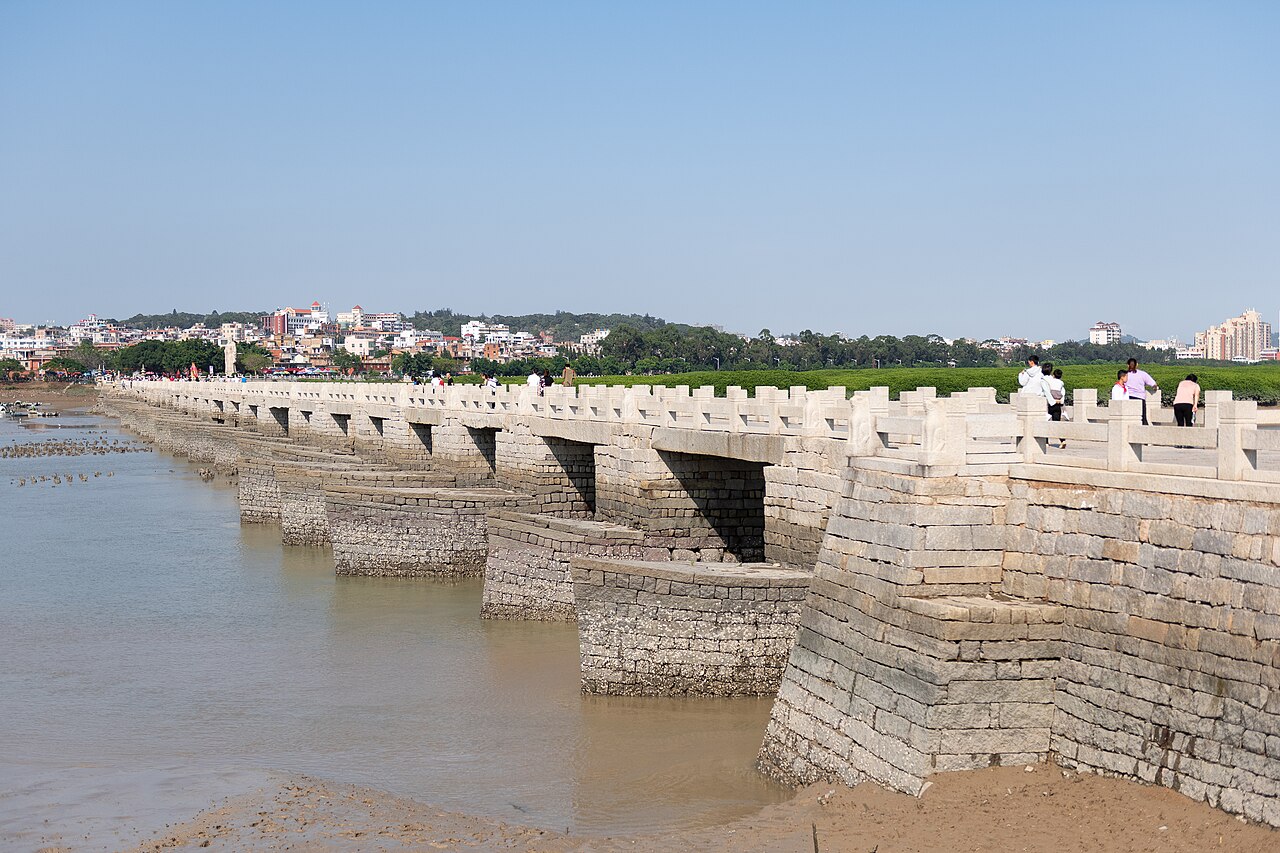
Luoyang Bridge, Quanzhou: stone beams laid flat on wedge-shaped piers
N509FZ, CC BY-SA 4.0, Wikimedia Commons
There is also a rare form of beam bridge. In front of the Hall of the Holy Mother at Jinci Temple in Taiyuan is a square pool called the Fish Pond. Stone columns stand in the pool, carrying bracket sets and beams that support a cross-shaped deck, known as the Flying Bridge. Liang Sicheng noted that this kind of stone-column bridge, occasionally mentioned in old texts, survives in this single example (see Chapter 6).
Arch bridges
Arch bridges are the most numerous and most varied of old Chinese bridges. With an arch bridge, first count the arches, then look at the shape of the arch and at the spandrels.
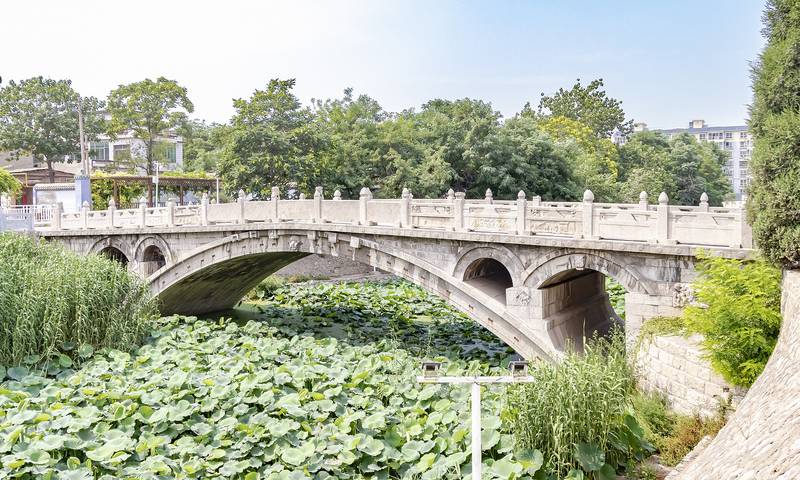
Yongtong Bridge, Zhao County, Hebei, with small arches in both spandrels of the main arch
ScareCriterion12, CC BY-SA 4.0, Wikimedia Commons
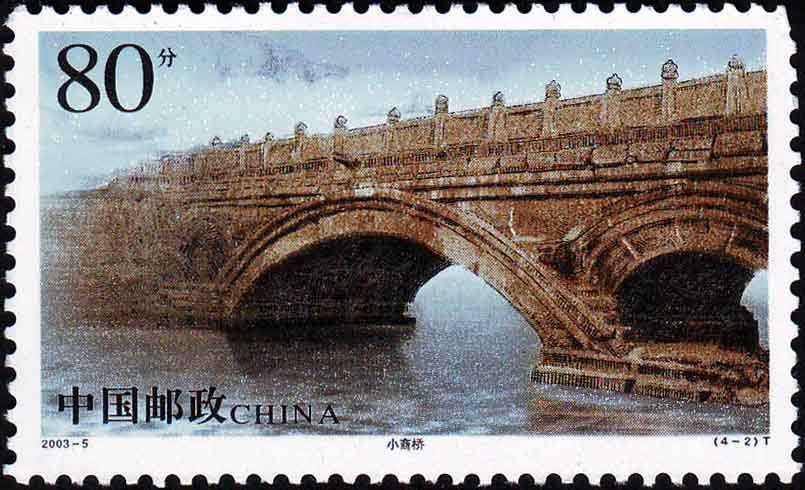
Linying, Henan
Stamp
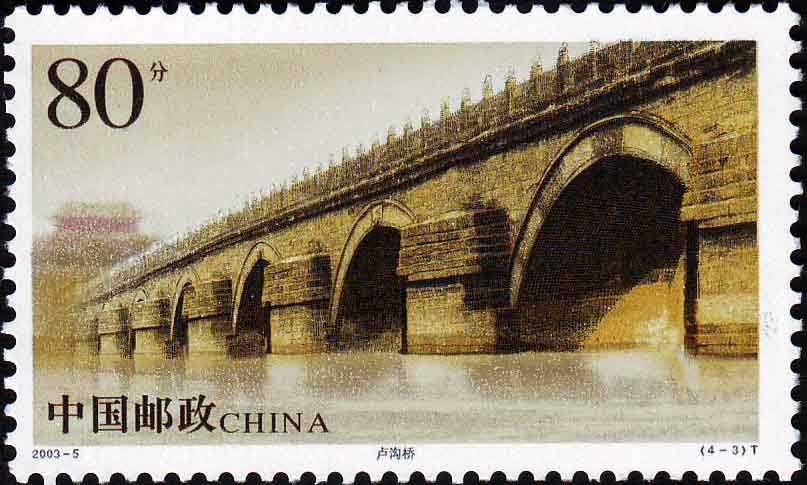
Multi-arch stone bridge over the Yongding River, Beijing
Stamp
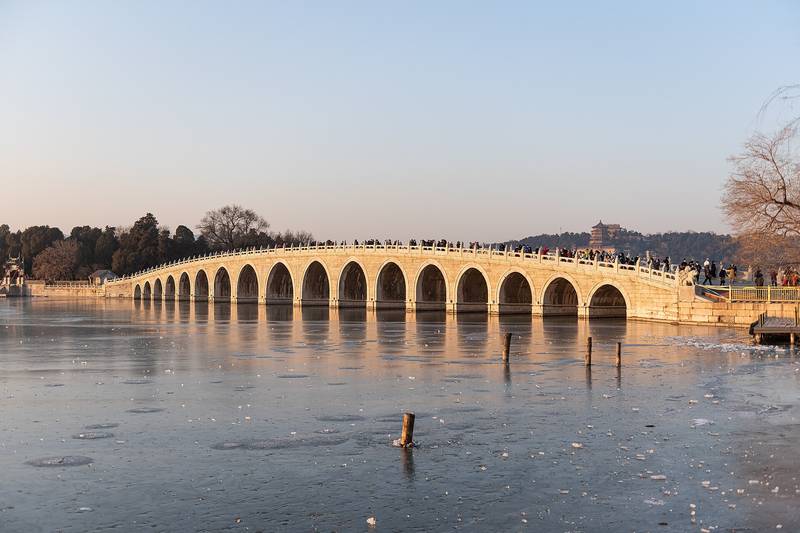
Seventeen-Arch Bridge, Summer Palace
N509FZ, CC BY-SA 4.0, Wikimedia Commons
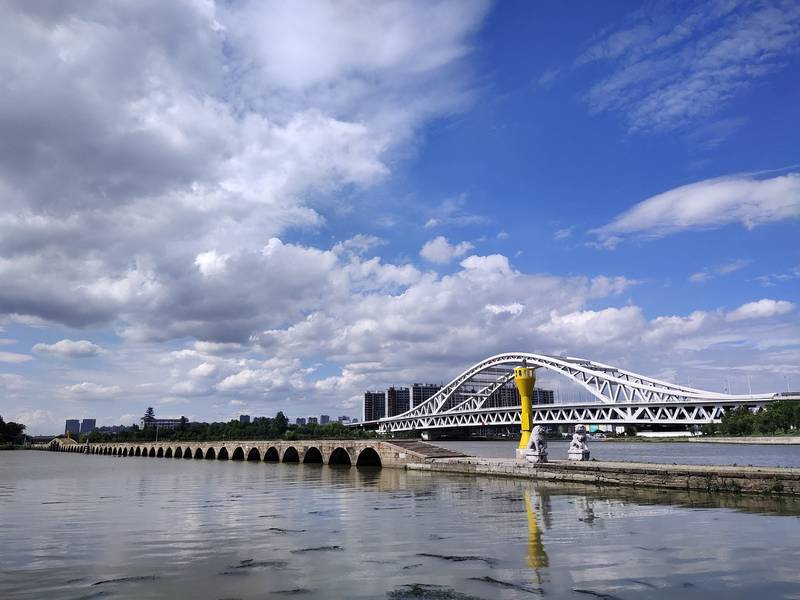
Baodai Bridge, Suzhou, 53 arches in a row
云在动, CC BY-SA 4.0, Wikimedia Commons
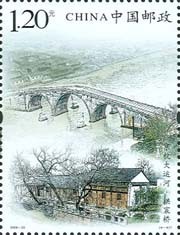
Hangzhou, southern end of the Grand Canal
Stamp
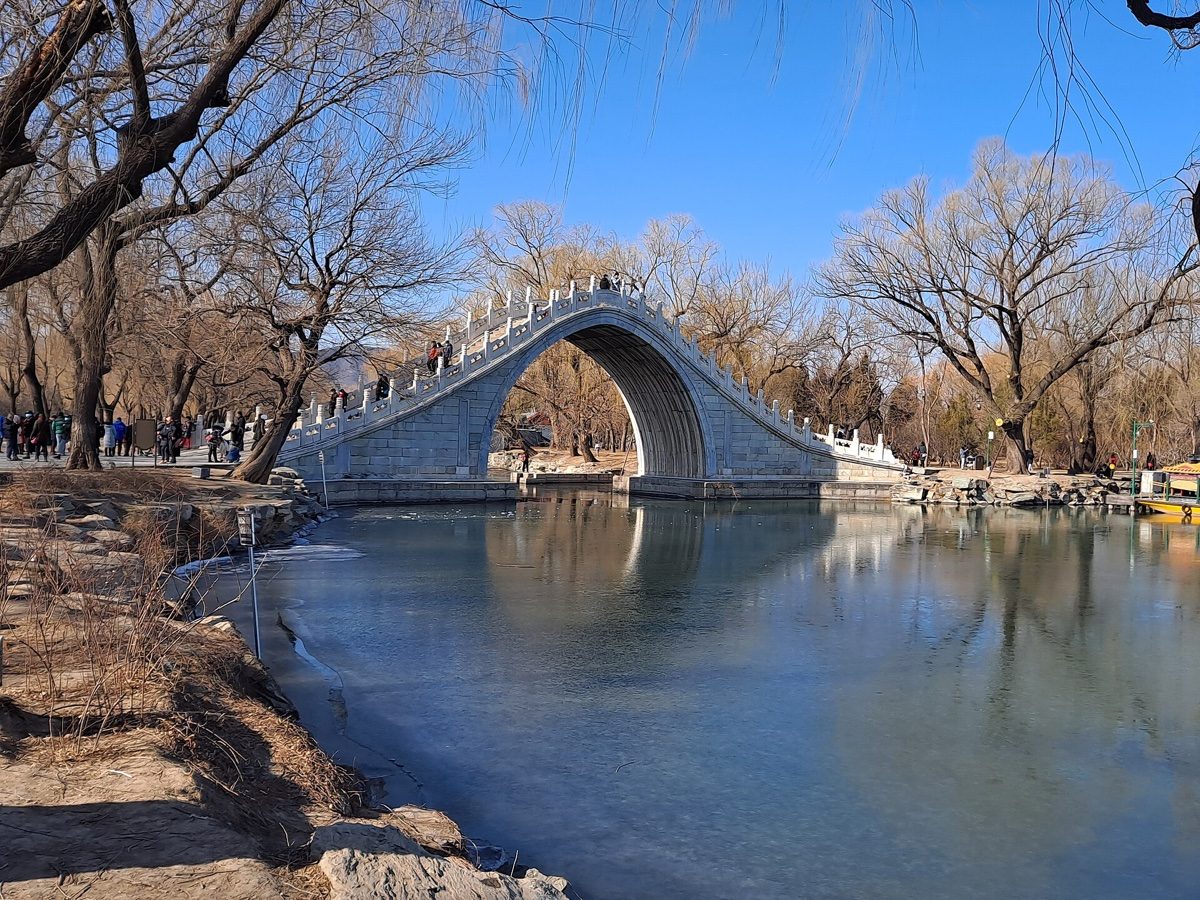
Jade Belt Bridge, Summer Palace
钉钉, CC BY-SA 4.0, Wikimedia Commons
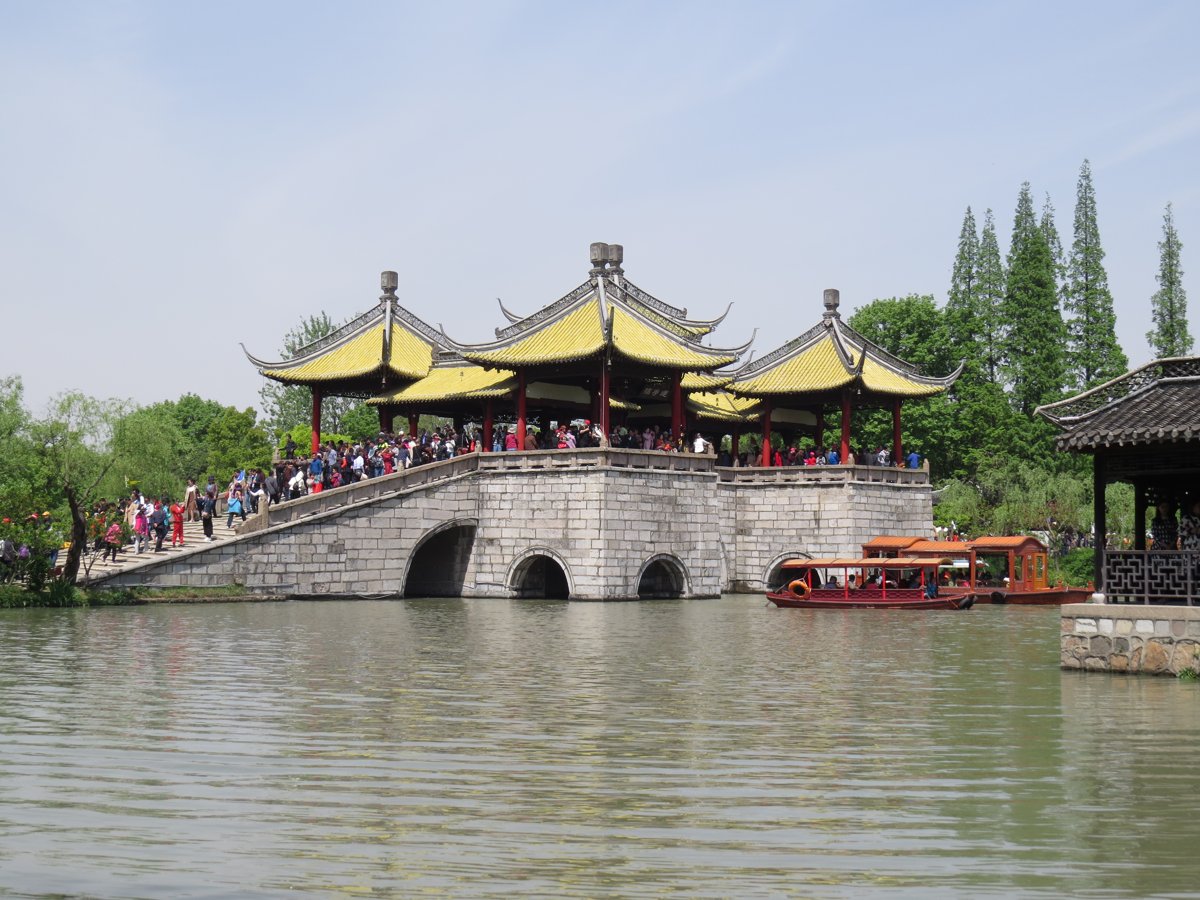
Five-Pavilion Bridge, Slender West Lake, Yangzhou
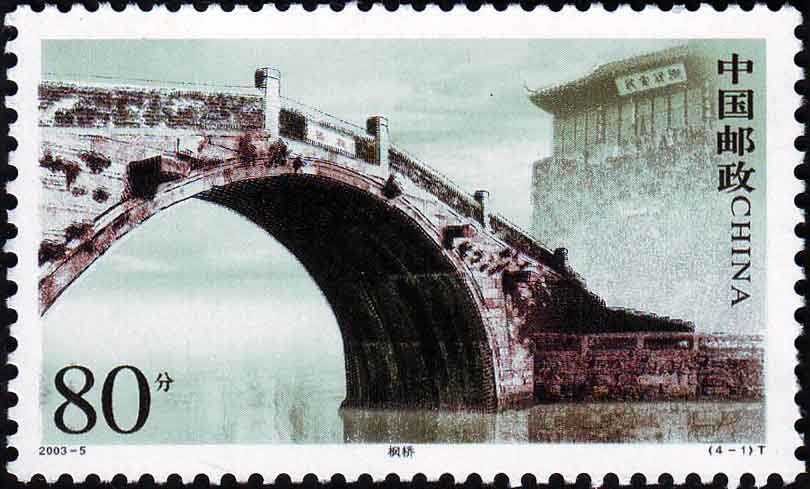
Maple Bridge, Suzhou
Stamp
Single open-spandrel arch. The Zhaozhou Bridge in Zhao County, Hebei, also called the Anji Bridge, was built under the direction of the Sui craftsman Li Chun. A single stone arch of about 37 metres crosses the Xiao River. The arch is not a semicircle but a flat segment of a circle, so the deck rises gently and is easy for carts and horses. Cleverer still are the spandrels: two small arches are opened in each shoulder of the main arch, lightening the bridge and letting more floodwater through when the river rises. This is called an open-spandrel arch. It is the oldest surviving bridge in China; a similar method did not appear in Europe until the 14th century (see Chapter 5). West of the Zhao County town stands the Jin-dynasty Yongtong Bridge, popularly called the Little Stone Bridge, modelled on the Zhaozhou Bridge and only half its length; the Xiaoshang Bridge in Linying, Henan, is also a single open-spandrel arch of similar structure.
Multiple arches. Where the river is wide, several arches are joined together. The Marco Polo Bridge (Lugou Bridge) in Beijing crosses the Yongding River. First built in the Jin and rebuilt in the Qing, it has eleven arches, and “Dawn Moon over Lugou” is one of the Eight Views of Yanjing. Qing official stone bridges usually have an odd number of arches, the central one highest and the others stepping down towards each end, so that the deck rises slightly in the middle. The Seventeen-Arch Bridge on Kunming Lake in the Summer Palace, the largest stone bridge in the garden, is of this type. The Gongchen Bridge in Hangzhou, a three-arch stone bridge across the Grand Canal, is regarded as the landmark of the canal’s southern end.
The Baodai Bridge in Suzhou is a different kind of multi-arch bridge: fifty-three arches in a straight line, the bridge low, flat and long. It was originally a towpath for the trackers who hauled boats along the canal, so it needed to be long and level, not high. It and the Gongchen Bridge are both component sites of the Grand Canal World Heritage site.
Humpback bridges. In the water towns south of the Yangtze, canals are narrow and boats many. Bridges have to let boats pass beneath, so the arch rises high and steps climb up either side, giving the bridge the shape of a camel’s hump. The Maple Bridge west of Suzhou is a single-arch stone bridge, famous everywhere through the line “The moon sets, crows caw, frost fills the sky” in Zhang Ji’s “Night Mooring by Maple Bridge”. The Jade Belt Bridge on the West Causeway of the Summer Palace is built of white marble, its arch soaring and its deck curving like a belt: a humpback bridge in an imperial garden. The Five-Pavilion Bridge on Yangzhou’s Slender West Lake carries five pavilions on a stone arch bridge, with fifteen interconnected arched openings beneath; Du Mu’s line “On the Twenty-Four Bridges, a moonlit night” (“To Han Chuo, Magistrate of Yangzhou”) added to the fame of Yangzhou’s bridges.
Suspension and pontoon bridges
In the mountains of the southwest, rivers run deep in steep gorges where piers cannot be built, so suspension bridges were used, of bamboo cables or iron chains (see Chapter 9). The Luding Bridge in Sichuan crosses the Dadu River. Completed in the Kangxi reign of the Qing, it has thirteen iron chains anchored on both banks: nine below carry the wooden deck planks and four at the sides serve as handrails. The bridge sways underfoot as people walk across. This was a main route from Sichuan into Tibet in the past. The Anlan Suspension Bridge at Dujiangyan, known in the past as the Zhupu Bridge, crosses the Min River; it was originally made of bamboo cables, later replaced with steel cables.
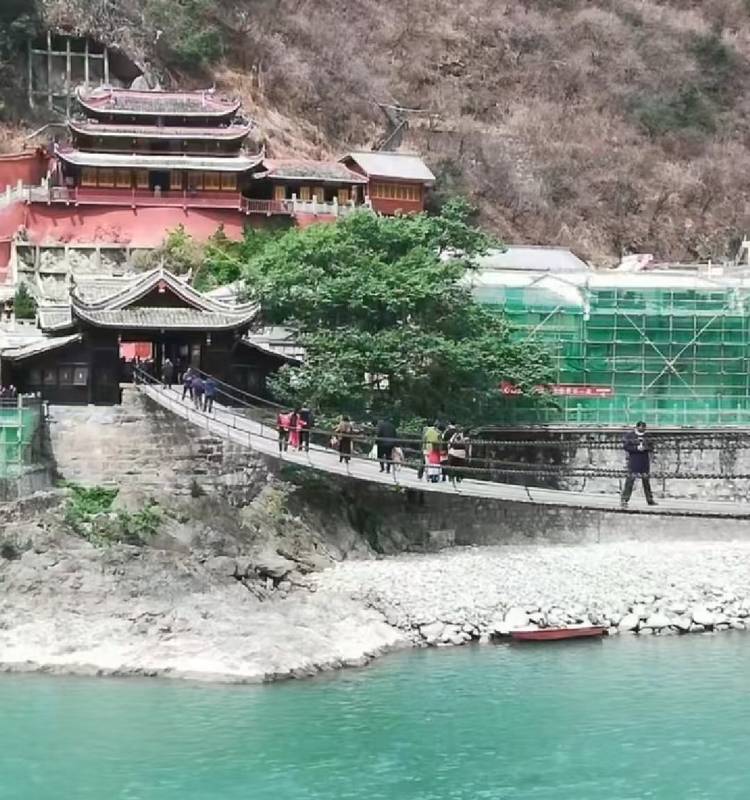
Luding Bridge, Sichuan: iron chains carry the deck and the handrails
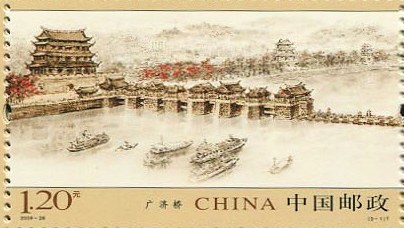
Guangji Bridge, Chaozhou
Stamp
A pontoon bridge lines boats up side by side and lays planks over them. It is quick to build and rises with the water, but cannot withstand fast currents or strong winds, so it was mostly a temporary or makeshift solution. The Guangji Bridge in Chaozhou, popularly called the Xiangzi Bridge, crosses the Han River and combines two methods in one bridge: the eastern and western sections are beam bridges on stone piers, while in the middle of the river, where the water is deepest and fastest, no piers were built and eighteen wooden boats are linked into a pontoon section that can be opened to let large ships through. Together with the Zhaozhou, Luoyang and Marco Polo bridges it is counted among China’s Four Great Ancient Bridges.
Covered bridges and wind-and-rain bridges
A gallery built on a bridge keeps rain off the timber structure and stops it rotting, gives passers-by a place to rest and shelter, and served villagers as a place to gather, set up stalls and keep shrines. In the Dong areas where Guangxi, Guizhou and Hunan meet, covered bridges are called wind-and-rain bridges. The Chengyang Wind and Rain Bridge in Sanjiang, also called the Yongji Bridge, crosses the Linxi River. On its stone piers, logs are cantilevered outward layer upon layer to carry the timber beams; a long gallery runs along the deck, topped by five tower-like pavilions, all joined with mortise and tenon, without iron nails. The Diping Wind-and-Rain Bridge in the Dong villages of Liping, Guizhou, is of the same kind. Two stamps in the set Dong Architecture show wind-and-rain bridges, one spanning a river and one standing among fields.
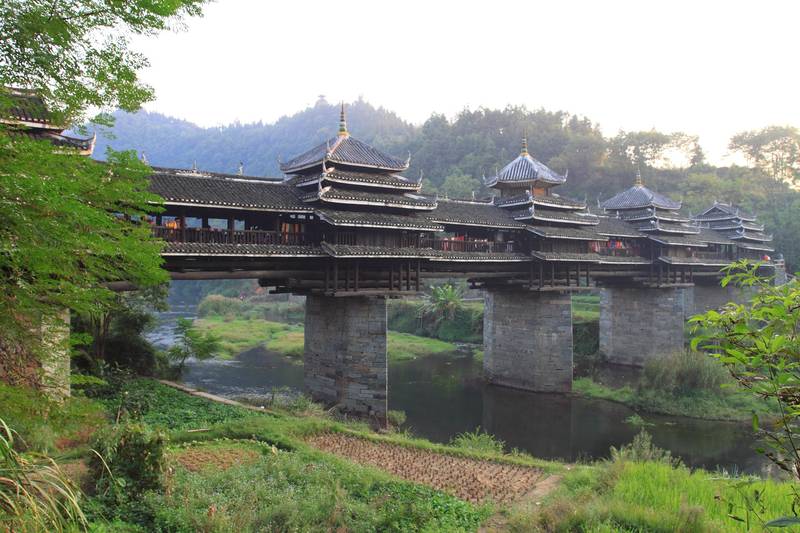
Chengyang Wind and Rain Bridge, Sanjiang, Guangxi, with five pavilions on the roof of the gallery
Zhangzhugang, CC BY-SA 3.0, Wikimedia Commons
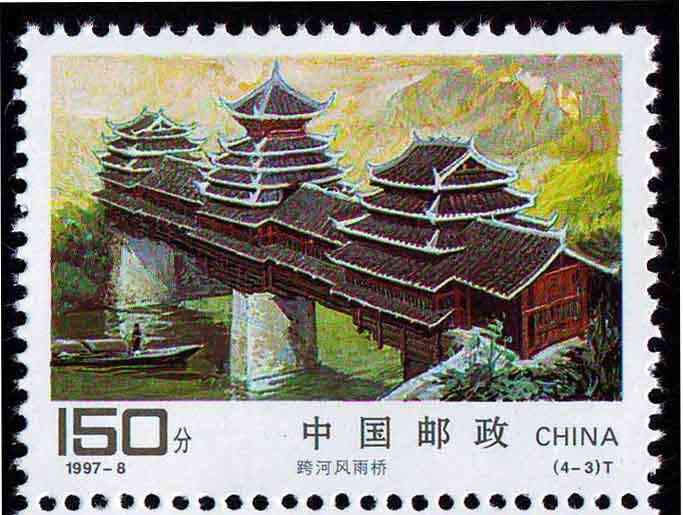
Dong wind-and-rain bridge
Stamp
Gardens have covered bridges too: the Small Flying Rainbow in Suzhou’s Humble Administrator’s Garden is a small bridge with a gallery roof, gallery and bridge forming one.
What to look for on a bridge
Balustrades and posts. The balustrades on either side of a stone bridge are made of panels and posts; the posts are short columns standing between the panels, their tops often carved with lions or lotuses. The stone lions of the Marco Polo Bridge are the most famous: on the posts, small lions hide on the bodies of the large ones, and a Beijing saying goes, “the lions of the Marco Polo Bridge: too many to count”. The posts of the Seventeen-Arch Bridge are also carved with more than five hundred stone lions. The balustrade panels of the Zhaozhou Bridge are carved with dragons in the style of Sui and Tang stone carving.
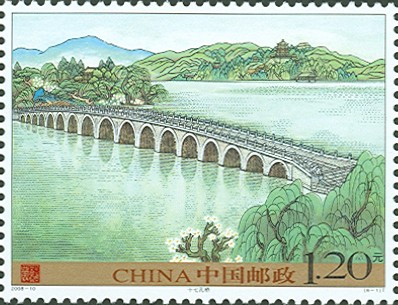
Seventeen-Arch Bridge, Summer Palace
Stamp
Water-guarding beasts. Fearing that floods would wash bridges away, builders often placed stone beasts or iron oxen at the crown of the arch, on the piers or at the ends of the bridge to guard against the water. On some bridges the keystone is carved as a beast’s face looking down on the water.
Names and inscriptions. A bridge’s name is usually carved on the stone at the crown of the arch, once on each side. Stone arch bridges south of the Yangtze often have couplets carved on the stone pillars either side of the opening, describing the river or travel; reading them tells you what the bridge means to the place. Some bridges also have steles at their ends recording how the bridge was built and repaired.
Bridges and legends. Some bridges are famous for their stories. The Broken Bridge on the Bai Causeway of West Lake in Hangzhou is where Xu Xian meets Lady White in the Legend of the White Snake; after winter snow, “Lingering Snow on the Broken Bridge” is one of the Ten Views of West Lake.
Bridges of the old water towns
In the water towns south of the Yangtze, the canals are the streets and the bridges are the town’s crossroads. The town of Tongli is divided by canals into several small islands linked by stone bridges. The Double Bridge in Zhouzhuang is a stone arch bridge and a stone beam bridge meeting at a bend in the canal; the painter Chen Yifei made it the subject of an oil painting, and through it Zhouzhuang became known to the outside world. When visiting a water town, notice how bridges are combined: where canals meet, two or three bridges are often linked, the arch bridge for boats and the beam bridge for people, and at their ends lie streets, landings and steps down to the water. The stamp set Ancient Water Towns shows six towns, Zhouzhuang, Tongli, Wuzhen, Nanxun, Luzhi and Xitang, and almost every stamp has a bridge.
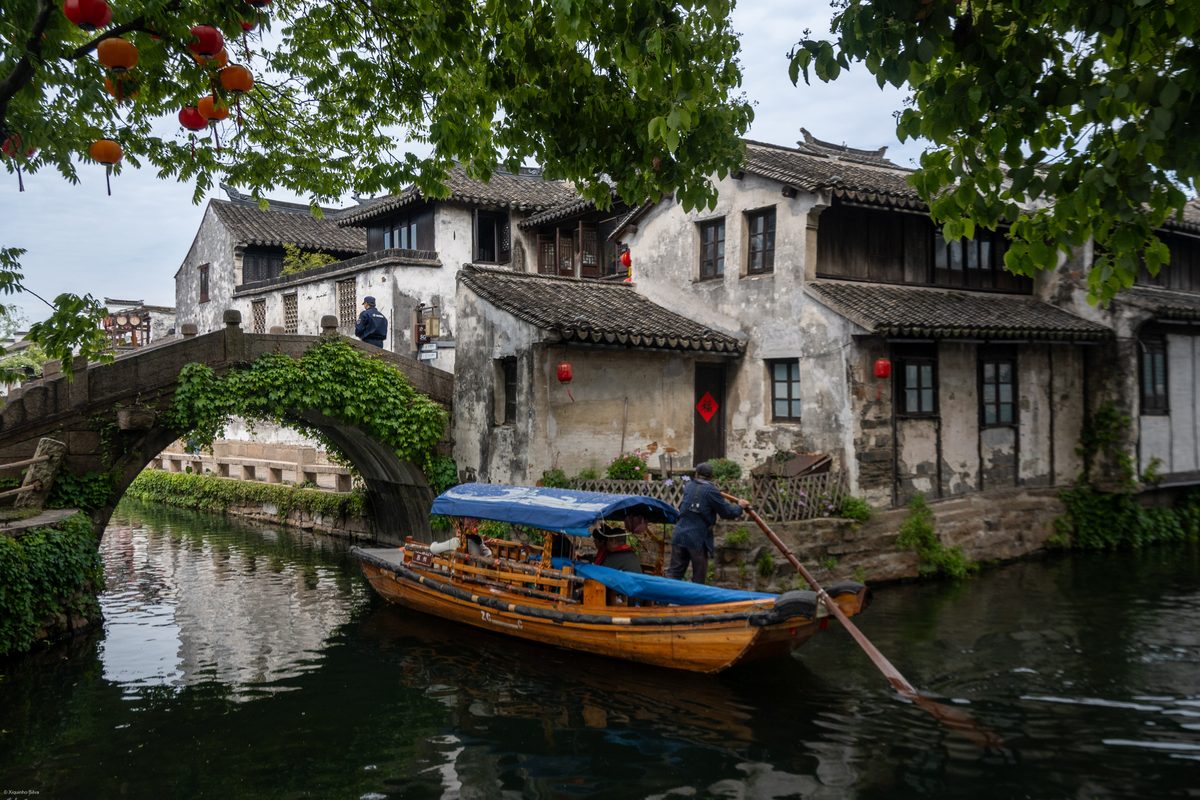
Canals and stone bridges of Zhouzhuang
xiquinhosilva, CC BY 4.0, Wikimedia Commons
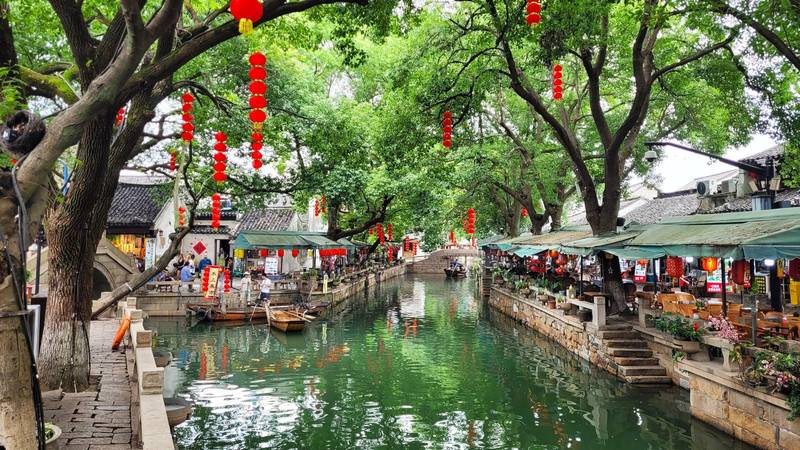
Where canals meet in Tongli
Piotr Latasiewicz, CC BY-SA 4.0, Wikimedia Commons
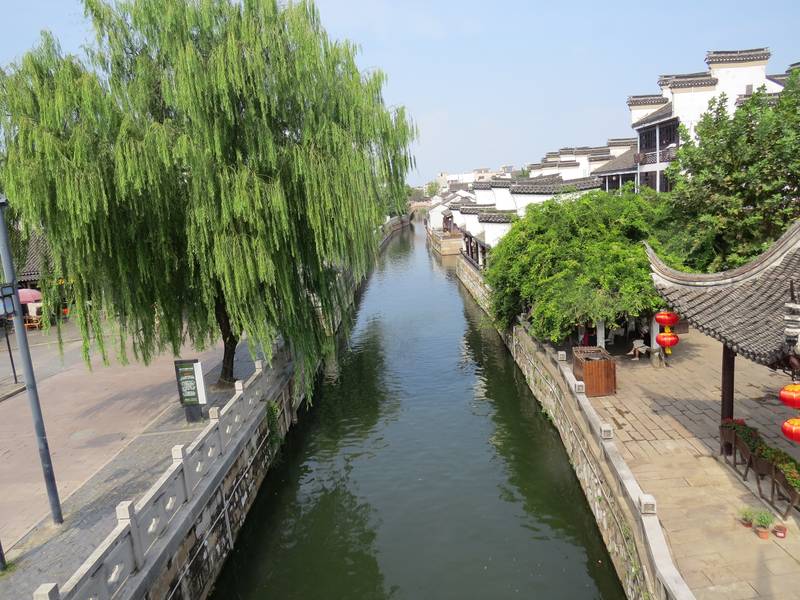
Nanxun, Huzhou
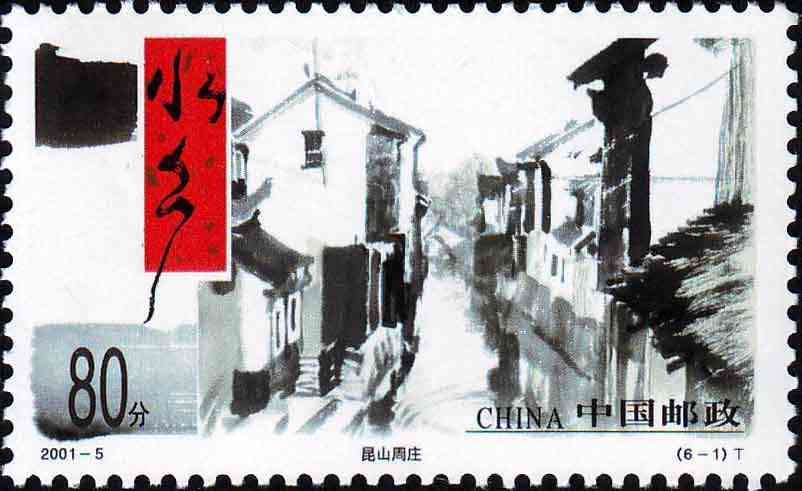
Stamp