
← Chapter 6: Five DynastiesA History of Chinese ArtChapter 8: Southern Song →
Chapter 7: Northern Song
The Northern Song made its capital at Bianjing (present-day Kaifeng). The court established the Hanlin Painting Academy, where painters held official ranks and were selected and promoted by examination in their art. Society was stable, cities prospered, and collecting and connoisseurship flourished. The Northern Song was the high point of landscape painting: painters studied real mountains and rivers over long periods and painted towering, complete mountains. At the same time scholar-officials began to write about painting and to paint, setting standards different from those of professional painters. Guo Ruoxu, in his Experiences in Painting, compared past and present: "In Buddhist and Daoist figures, ladies, oxen and horses, the moderns fall short of the ancients; in landscapes, woods and rocks, flowers, bamboo, birds and fish, the ancients fall short of the moderns."
Li Cheng. Li Cheng lived at the end of the Five Dynasties and the beginning of the Northern Song. His ancestors were of the Tang imperial clan; the family later lived at Yingqiu (in present-day Shandong), and he was called Li Yingqiu. He excelled at level-distance views of wintry forests in the Shandong region, using pale ink, and was said to "treasure ink like gold". He textured rocks with light ink, their outlines rolling like clouds, and the drooping twigs of his winter trees were shaped like crab claws. Guo Ruoxu said that Li Cheng, Guan Tong and Fan Kuan "stood like the three legs of a tripod, a model for a hundred generations", and Li Cheng had the most followers in the early Northern Song. Few genuine works survive. Reading a Stele, attributed to him, shows an old man on a donkey looking at an ancient stele in open country, the dead trees with branches like iron; some say the figures were added by Wang Xiao.
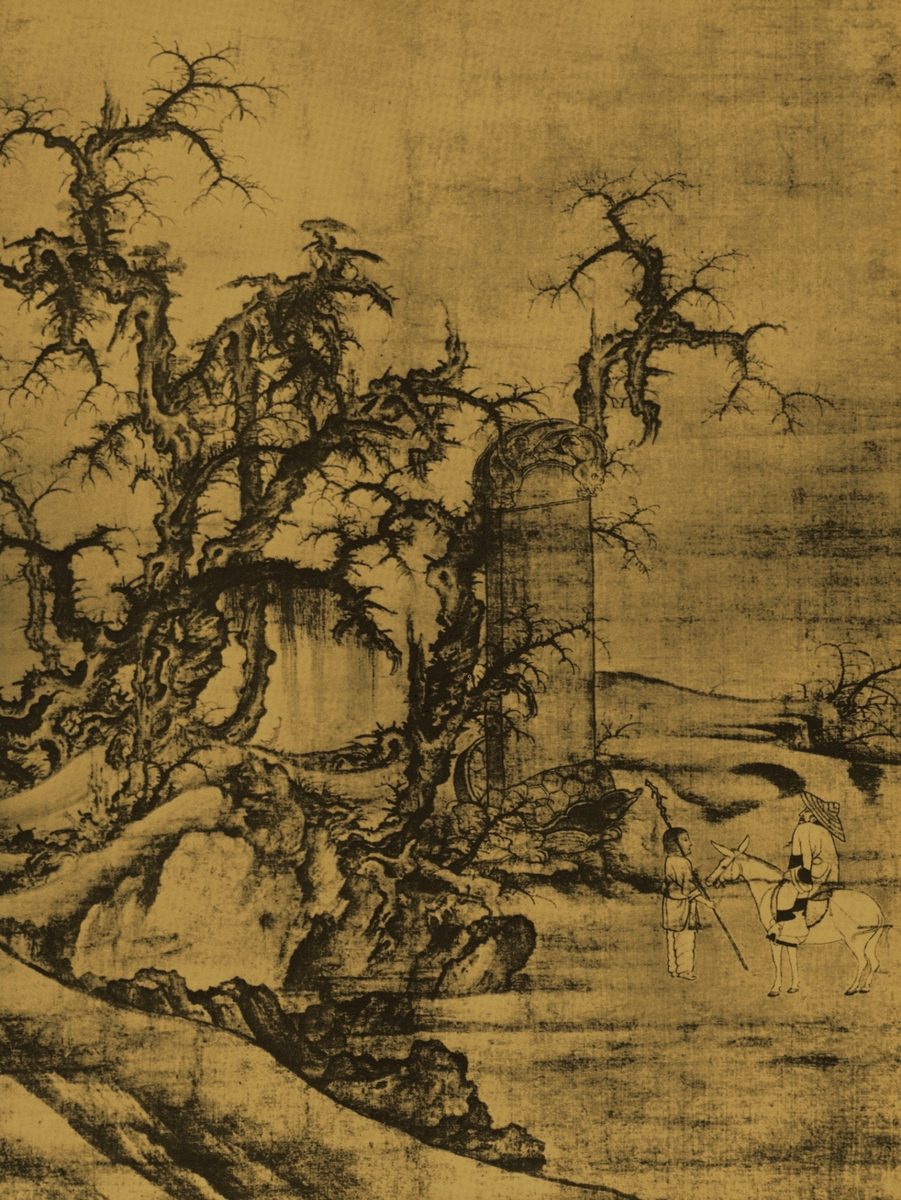
By Li Cheng and Wang Xiao; Osaka City Museum of Fine Arts

Attributed to Li Cheng; Nelson-Atkins Museum of Art
Fan Kuan. Fan Kuan came from Huayuan (present-day Yaozhou District, Tongchuan, Shaanxi); because of his easygoing (kuan) nature he was called Fan Kuan. He first studied Li Cheng and Jing Hao, then realized: "Rather than learn from men, better to learn from things; rather than learn from things, better to learn from the mind." He moved to the Zhongnan Mountains (a section of the Qinling) and the Mount Hua area and spent his days watching the changing clouds and mists. Travelers among Mountains and Streams is the masterpiece of Northern Song landscape. A huge peak rises frontally, filling more than half the picture, its top thick with shrubs, and a thin waterfall drops on the right. By the stream at the foot a train of travelers with pack donkeys, tiny as ants, makes the mountain seem even greater. The rocks are textured with dense short dabs, called "raindrop texture strokes", giving them hardness and weight. The signature "Fan Kuan" hidden among the leaves was discovered only in the mid-twentieth century.
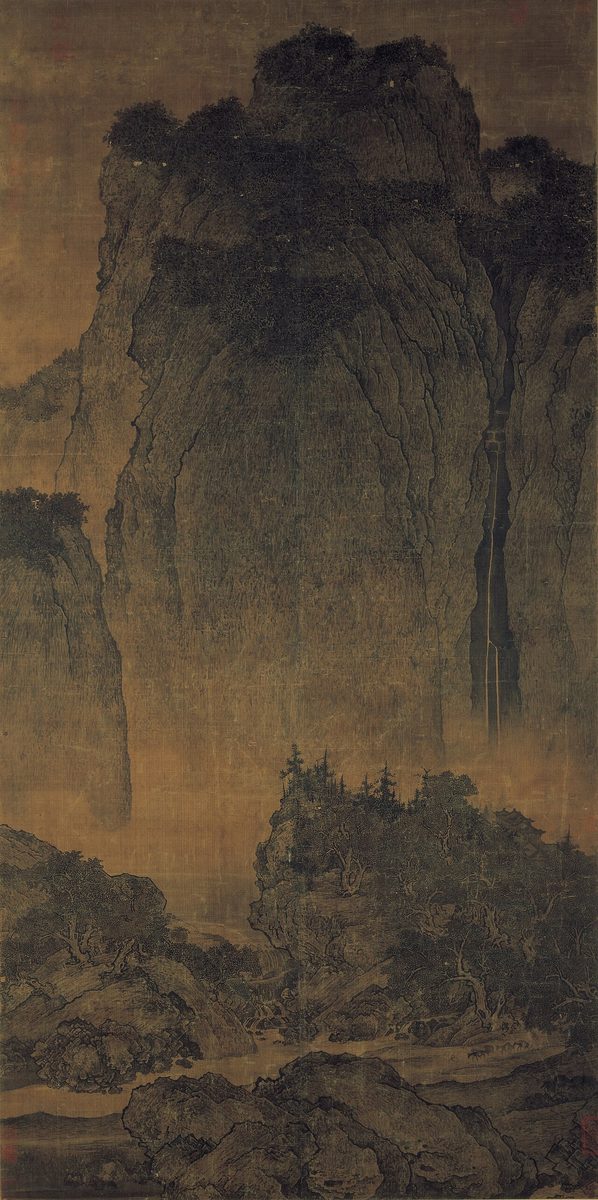
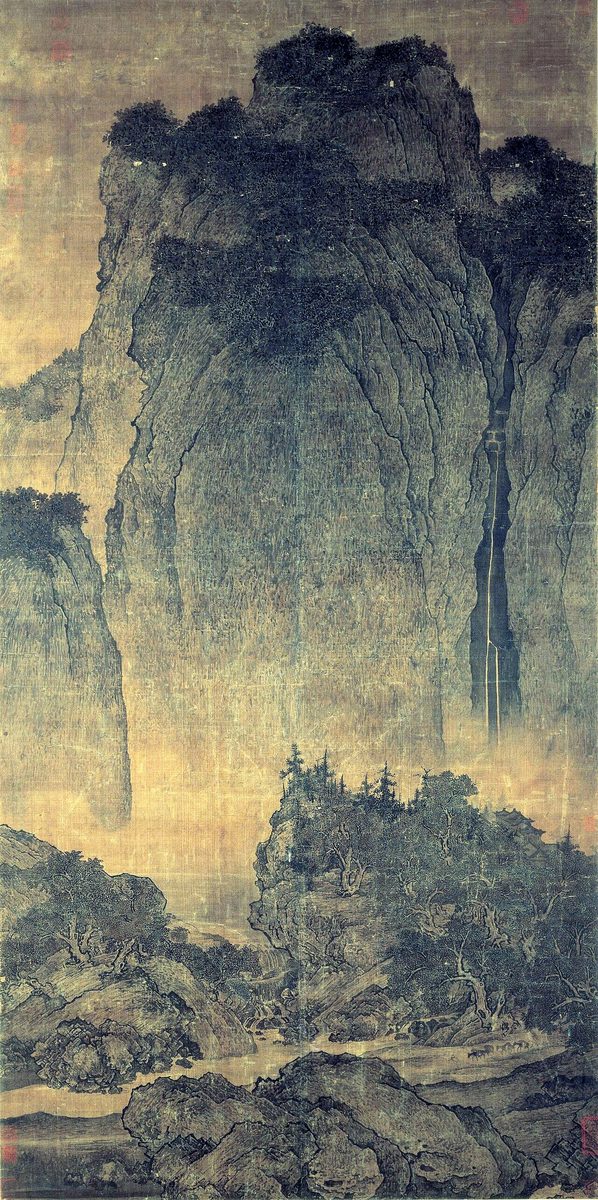
Colour-adjusted from the original by Park of China
Guo Xi. Guo Xi, from Wenxian in Heyang (in present-day Henan), served in the academy under Emperor Shenzong, and many of the palace screens and walls were painted by him. Following Li Cheng, he textured rocks with "curling-cloud strokes", painted branches like crab claws, and excelled at rendering distance, season and weather through mist. Early Spring bears a date from Shenzong's reign: the ice and snow are just melting, mist rises among the mountains, the mountain masses roll like clouds, plants are just budding, with fishermen and travelers in the foreground and temples in the distance. His writings on painting were compiled by his son Guo Si as The Lofty Message of Forests and Streams.
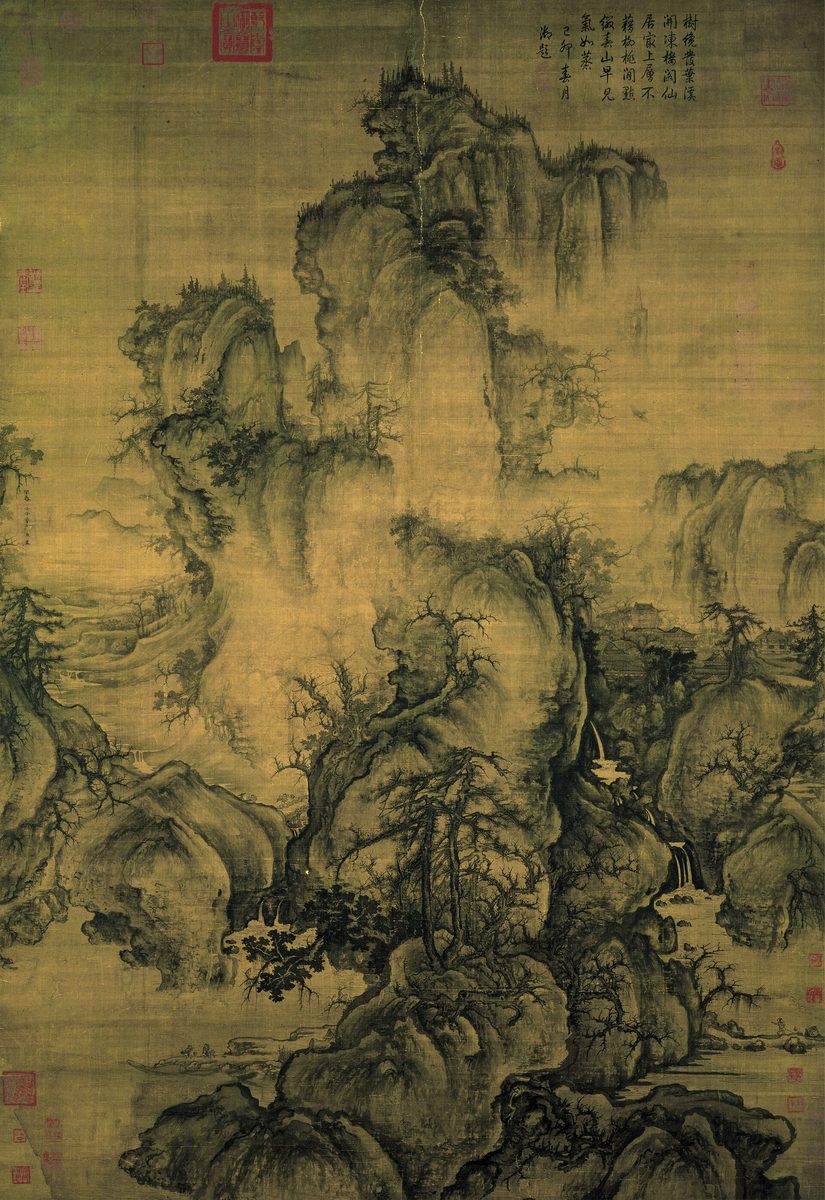
National Palace Museum, Taipei
The Lofty Message of Forests and Streams. The book begins by explaining why gentlemen love landscape: living in the world, they cannot often go to the forests and streams, and a good landscape painting lets them "without leaving the hall, sit and roam to the end of springs and valleys". Landscapes may be "walked in, gazed at, wandered through, or lived in", and paintings that can be wandered through and lived in are the best. The painter must look at real mountains, "traveling fully and gazing to satiety", and see how their appearance changes with the seasons: "Spring mountains are gentle and seem to smile; summer mountains are deep green and seem to drip; autumn mountains are bright and clear and seem adorned; winter mountains are bleak and seem asleep." Most famous are the "Three Distances": "Looking up from the foot of the mountain to its summit is called high distance; looking from the front of the mountain into the back is called deep distance; looking from a near mountain to far mountains is called level distance." High distance shows the abruptness of the mountain, deep distance its layered ridges, level distance a vast, hazy expanse. Chinese landscape painting does not use a fixed viewpoint; a single painting can combine looking up, looking across and looking down, and the Three Distances are the earliest summary of this way of seeing.
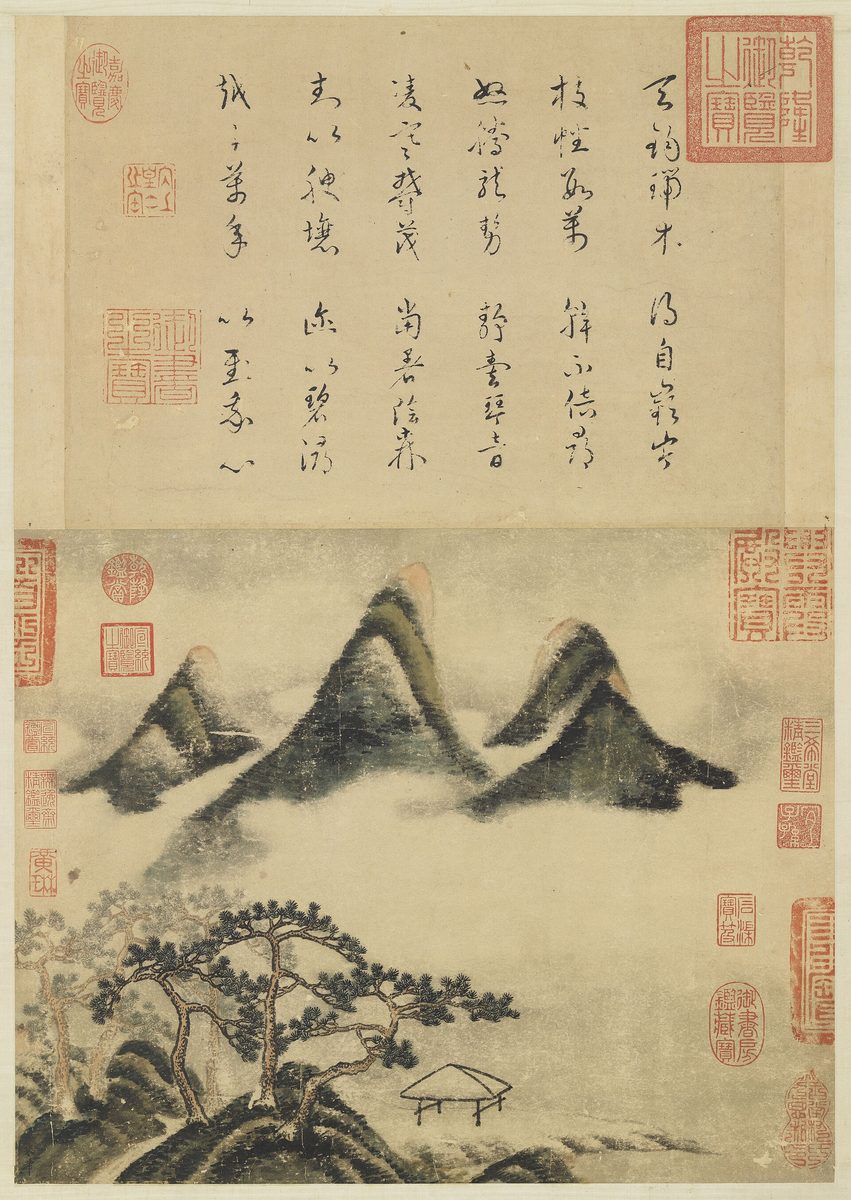
Attributed to Mi Fu; National Palace Museum, Taipei
Wang Ximeng and blue-green landscape. In the late Northern Song, blue-green landscape revived at court. Wang Ximeng, a student at the academy, was personally instructed by Emperor Huizong and at eighteen completed A Thousand Li of Rivers and Mountains. Nearly twelve meters long, it is built up in layers of azurite and malachite: continuous mountains and broad rivers and lakes, with villages, bridges, fishing boats and water mills. It is the summit of blue-green landscape. His life is known only from Cai Jing's colophon at the end of the scroll. His contemporary Wang Shen, an imperial son-in-law, followed Li Cheng while also using blue-green; his Misty River and Layered Peaks shows peaks along a river, and Su Shi wrote poems on it. Zhao Lingrang, of the imperial clan, painted small lakeside scenes, level, clear and moist; the monk Huichong also painted small southern scenes, and Su Shi's Spring River at Dusk, a Painting by Huichong was written on one of them. Xu Daoning followed Li Cheng; his Fishermen's Evening Song has steep peaks and spare, vigorous brushwork.
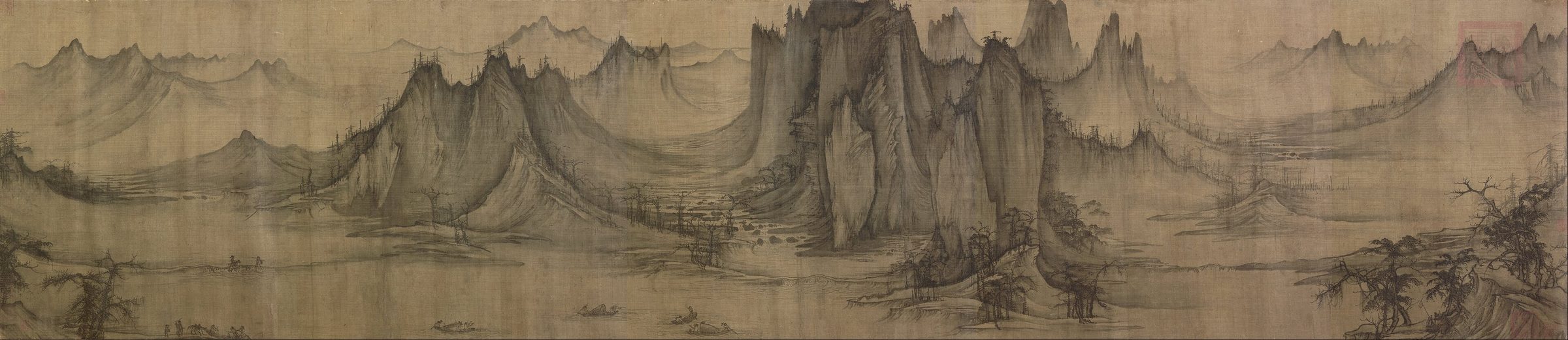
Full scroll of Fishermen's Evening Song; Nelson-Atkins Museum of Art
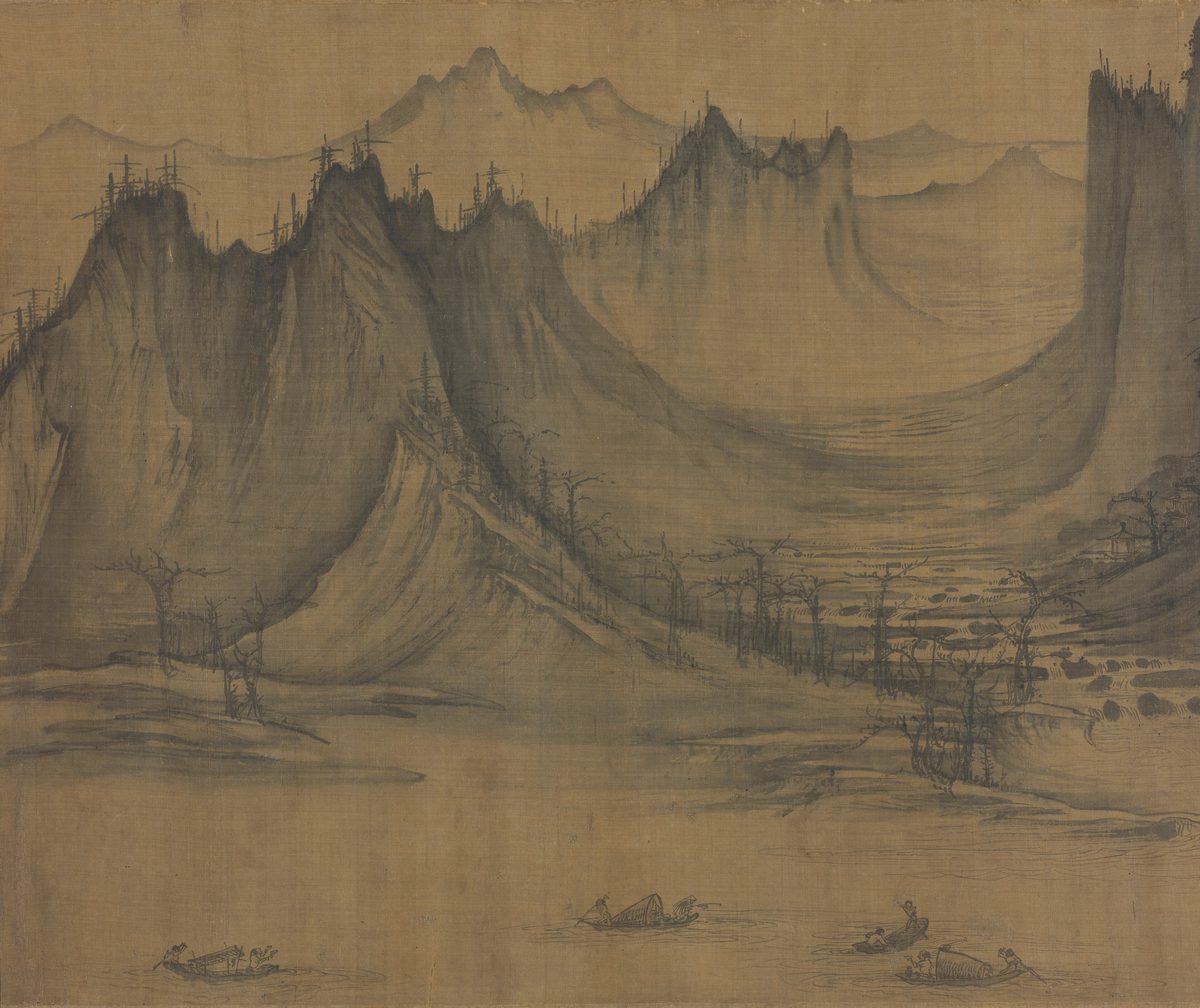
Detail
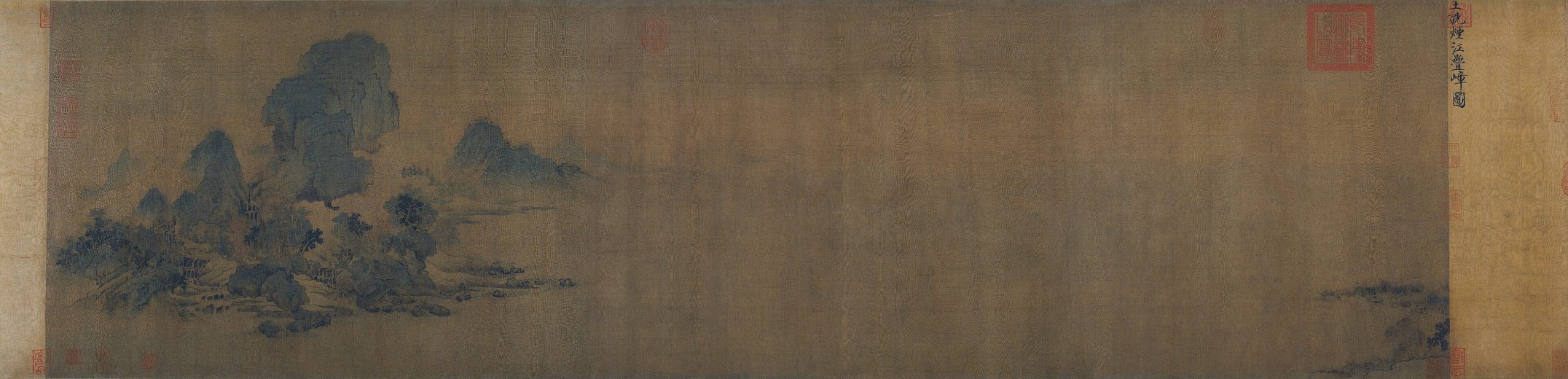
Blue-green version; Shanghai Museum

Full scroll; Palace Museum, Beijing
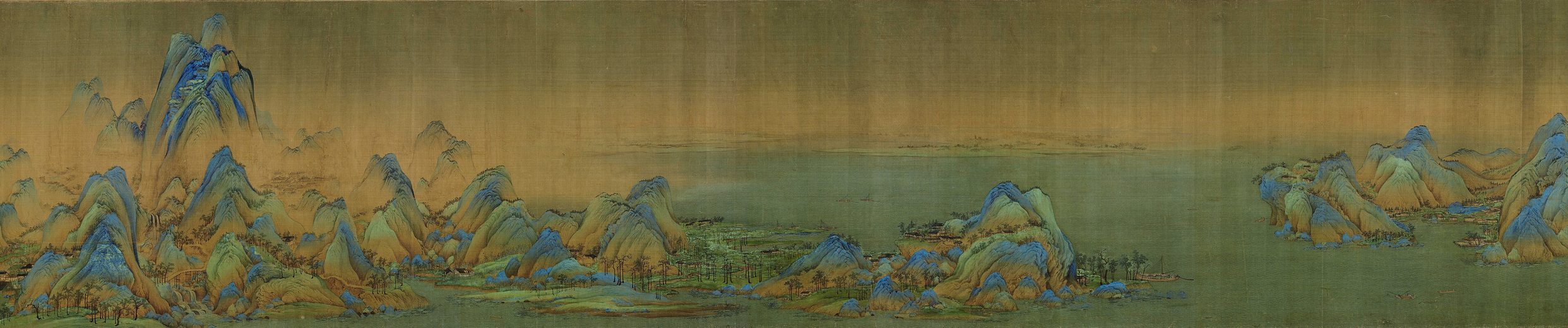
Detail

Metropolitan Museum of Art
Mi Fu and Mi Youren. Mi Fu was a calligrapher and connoisseur whose History of Painting praised Dong Yuan's "plain, natural and genuine" manner. He and his son Mi Youren painted southern mountains in mist and rain without outline or texture strokes, building up the mountain forms with layers of horizontal ink dots and washing in clouds and mist, a style called "Mi-dot landscape" or "Mi cloudy mountains". No reliable painting by Mi Fu survives. Mi Youren's Wonderful Views of the Xiao and Xiang shows cloudy mountains appearing and vanishing in mist along a river; "Xiao and Xiang" is a borrowed name, and some say the scenery is that around Zhenjiang. Father and son called their work "ink play", and they are important in the development of literati painting.
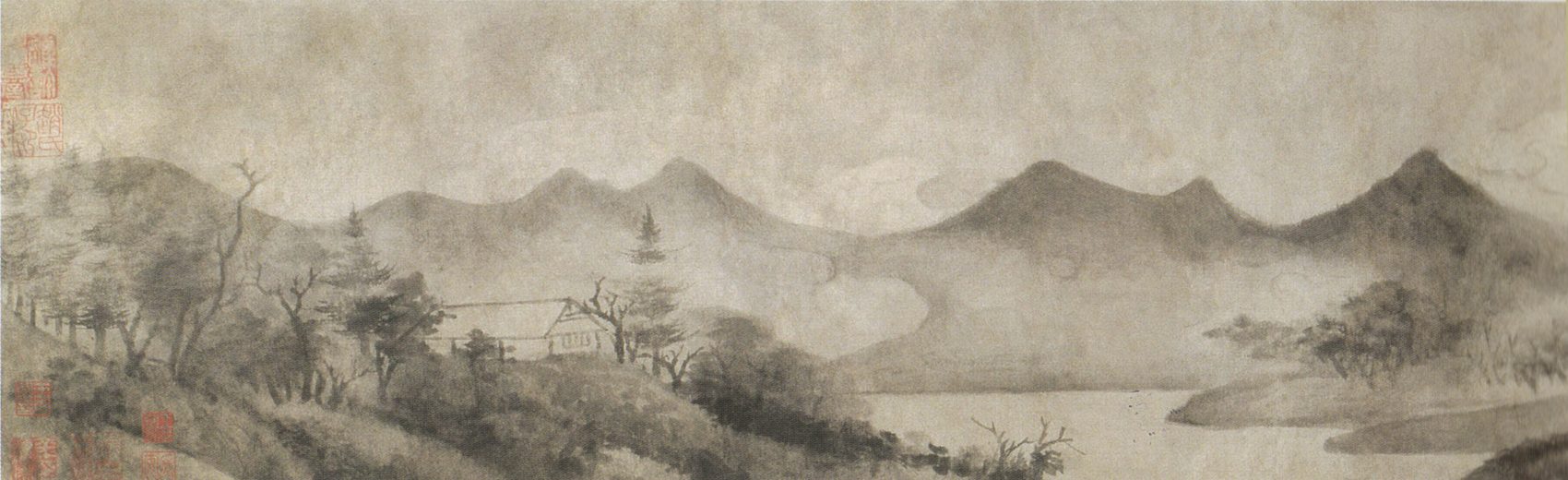
Detail; Palace Museum, Beijing
Ismoon (talk) 08:30, 9 April 2019 (UTC) / own work with Photoshop, CC BY-SA 4.0, Wikimedia Commons
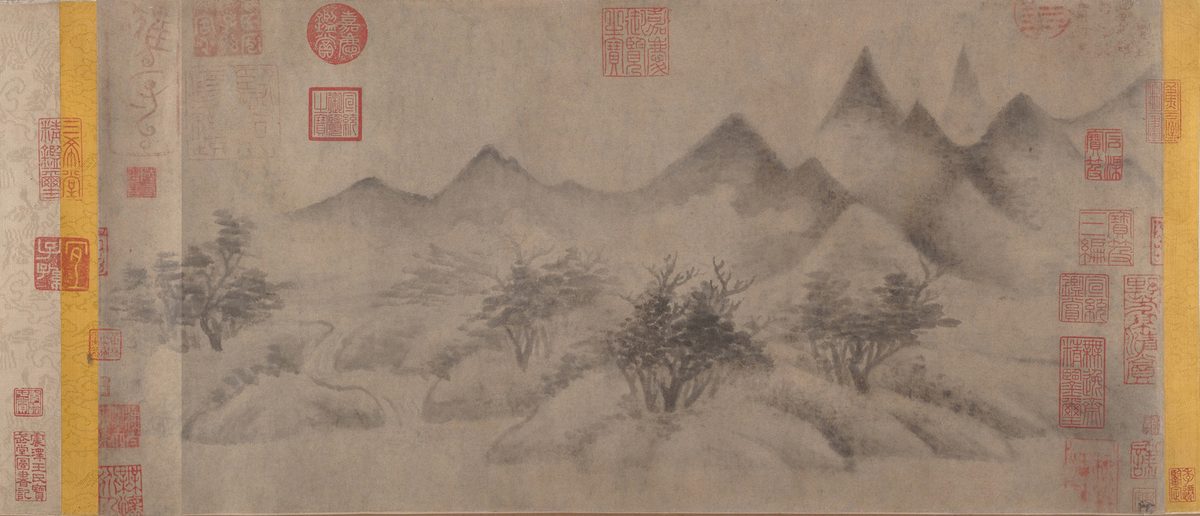
Mi Youren's Cloudy Mountains; Metropolitan Museum of Art
Su Shi and "scholars' painting". In the middle Northern Song, Su Shi, together with Wen Tong, Huang Tingjian, Mi Fu, Li Gonglin and others, came to regard painting as a scholar's cultivation and a vehicle for feeling. Su Shi proposed "scholars' painting": "Looking at scholars' painting is like judging the horses of the world: one takes in their spirit. With professional painters, one often sees only whips, hides and hair, troughs and fodder, without a trace of brilliance." He also wrote that "to judge a painting by likeness is to see like a child", holding that painting is valued for spiritual resemblance and expressive interest rather than likeness, and that "poetry and painting follow one rule: natural skill and freshness". He himself painted dead trees, bamboo and rocks; Dead Tree and Strange Rock, attributed to him, shows only a twisted dead tree and a swirling rock in a spare, casual brush. These ideas, put into practice by Yuan scholars, became the theoretical basis of literati painting, and from them Dong Qichang in the Ming coined the term "literati painting".

Wood and Rock (Dead Tree and Strange Rock)

Wen Tong and Li Gonglin. Su Shi's cousin Wen Tong excelled at ink bamboo, using dark ink for the upper surface of the leaves and pale ink for the underside. Su Shi said that to paint bamboo "one must first have the complete bamboo in one's breast", the origin of the idiom "to have a bamboo in one's breast" (to have a well-thought-out plan). Li Gonglin, who styled himself the Recluse of Longmian and held the jinshi degree, was famous for "baimiao" (plain line drawing): using ink line alone without color, he raised the line drawing that earlier painters used for drafts into an independent method. Five Horses depicts five famous horses presented as tribute from the Western Regions, with their grooms, and bears inscriptions by Huang Tingjian; Pasturing Horses, after Wei Yan shows more than a thousand horses and herders. He is regarded as a literati painter, and most later plain-line figure painting from the Yuan onward follows him.
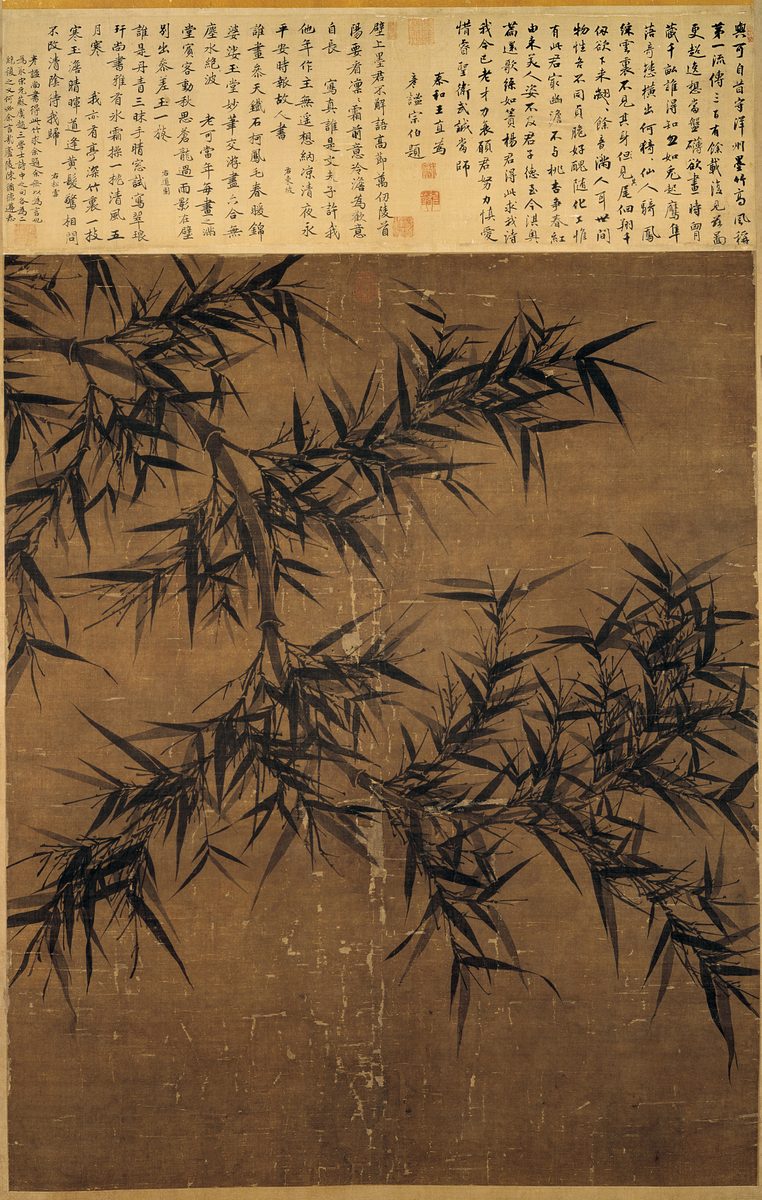
National Palace Museum, Taipei

Full scroll; Tokyo National Museum

Main painting
Zhang Zeduan. Zhang Zeduan, from Dongwu (present-day Zhucheng, Shandong), served at the academy; his life is known only from a colophon by Zhang Zhu of the Jin. Along the River during the Qingming Festival is a silk handscroll more than five meters long showing both banks of the Bian River in the capital, Bianjing. It begins with willow groves and farmhouses in the countryside, passes the Rainbow Bridge over the river with its boats, and enters the streets inside the city gate, with taverns, shops, carts and hundreds of people of every trade. At the Rainbow Bridge, a large boat is about to pass under the arch while boatmen and the crowd on the bridge shout to one another, the tensest moment of the scroll. Whether "Qingming" refers to the festival or has another meaning is disputed. The painting is a visual source for Northern Song cities, transport and architecture; the Qingming Riverside Park in Kaifeng is a reconstruction based on it.

Full scroll of Zhang Zeduan's original; Palace Museum, Beijing
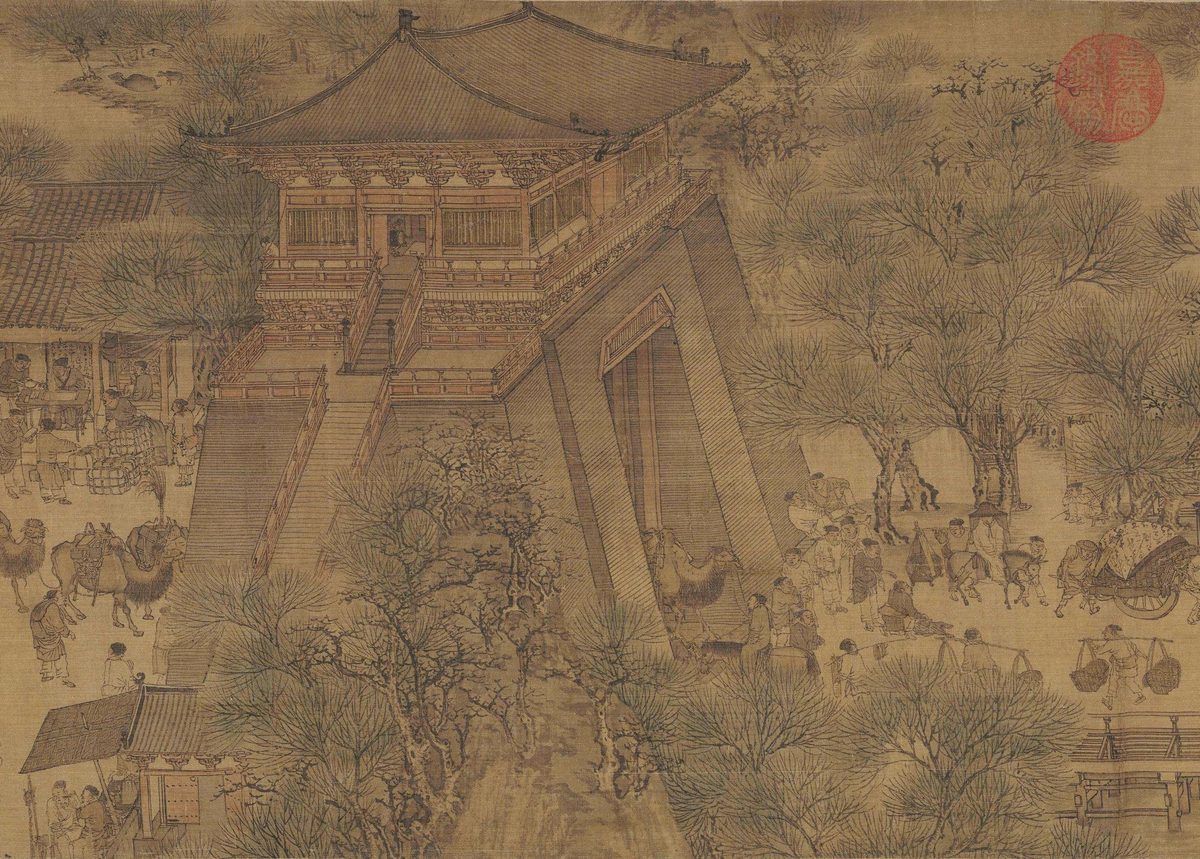
Detail (city gate)
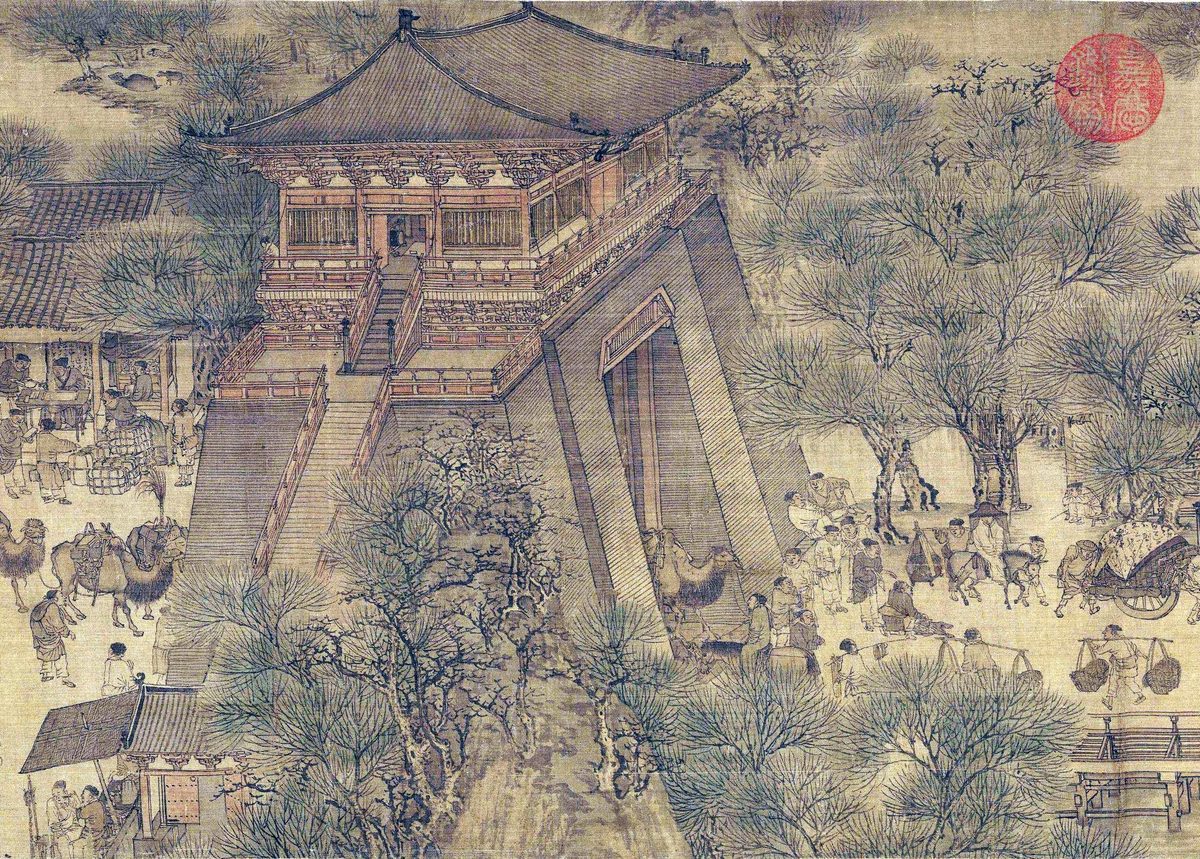
Colour-adjusted from the original by Park of China
The Four Masters of the Song. Northern Song calligraphy valued expressive interest; Su Shi, Huang Tingjian, Mi Fu and Cai Xiang are known as the "Four Masters of the Song". Su Shi's Cold Food Observance consists of two poems on the Cold Food Festival written during his exile in Huangzhou; the characters move with his feelings from steadiness to abandon, and it is called "the third finest running script under heaven". Huang Tingjian excelled at large running-cursive characters with expansive strokes; Mi Fu wrote with a swift brush and called his own writing "brushing characters". Emperor Huizong, Zhao Ji, created the "slender gold" script, with thin, hard strokes and exposed tips at the turns (see below). From the Song onward scholars were often both calligraphers and painters, and calligraphic brushwork entered painting more and more.

National Palace Museum, Taipei

National Palace Museum, Taipei
Zhao Ji and the academy. Zhao Ji, Emperor Huizong, enlarged the academy during his reign and examined painters on themes taken from lines of old poetry; reputed themes include "No one crosses the wild water; a lone boat lies across it all day" and "Returning from treading on flowers, the horse's hooves are fragrant." He demanded close observation, and is said to have pointed out that a peacock climbing always lifts its left foot first. He oversaw the compilation of the Xuanhe Catalogue of Paintings, recording 231 painters from the Wei and Jin to the Northern Song and more than 6,300 works in the imperial collection. He himself excelled at birds and flowers and created the "slender gold" script. Auspicious Cranes shows a flock of cranes circling above a palace gate, with his poem and inscription; Hibiscus and Golden Pheasant and Listening to the Qin also bear his inscriptions, though some of these may have been painted by academy artists on his behalf. In the Jingkang Incident (1127), Huizong was carried off north by the Jin army, and the Northern Song fell.

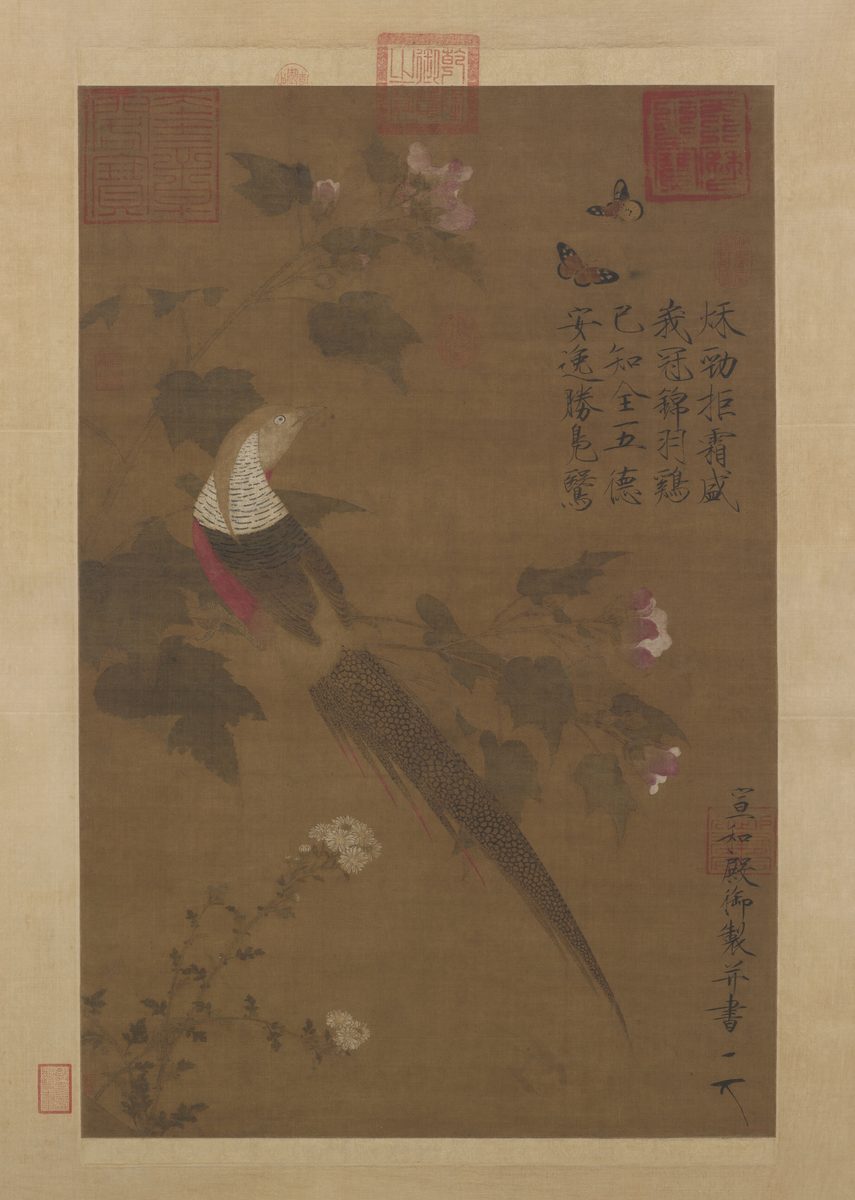
Palace Museum, Beijing
Cui Bai. Bird-and-flower painting at the early Song academy followed the Huang manner until Cui Bai broke the mold under Shenzong. His Magpies and Hare shows two magpies in the autumn wind crying at a hare that turns its head back, the dry grass and bamboo leaves bending in the wind, full of wildness and movement.
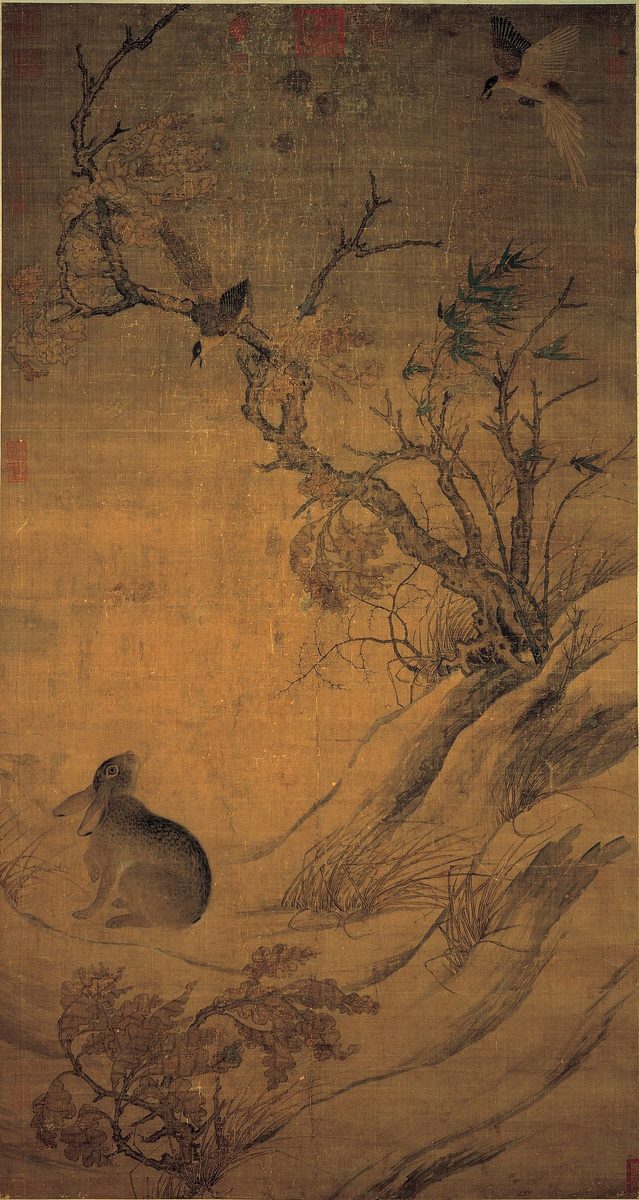
National Palace Museum, Taipei
Northern Song sculpture. In sculpture of the period, the Song figures of maids in the Hall of the Holy Mother at the Jinci Temple are the most realistic, each with her own expression. In the northern Liao state, the Guanyin in the Guanyin Pavilion of the Dule Temple and the Buddhas in the Yingxian Wooden Pagoda preserve the legacy of Tang sculpture. Most of the painted arhats in the Thousand Buddha Hall of the Lingyan Temple in Changqing, Jinan, are original Song works, each with a distinct expression; the bronze Thousand-armed Guanyin in the Dabei Pavilion of the Longxing Temple in Zhengding, cast in the early Song, is more than twenty meters high. The stone figures lining the spirit ways of the Song imperial tombs at Gongyi show the conventions of Northern Song tomb sculpture.
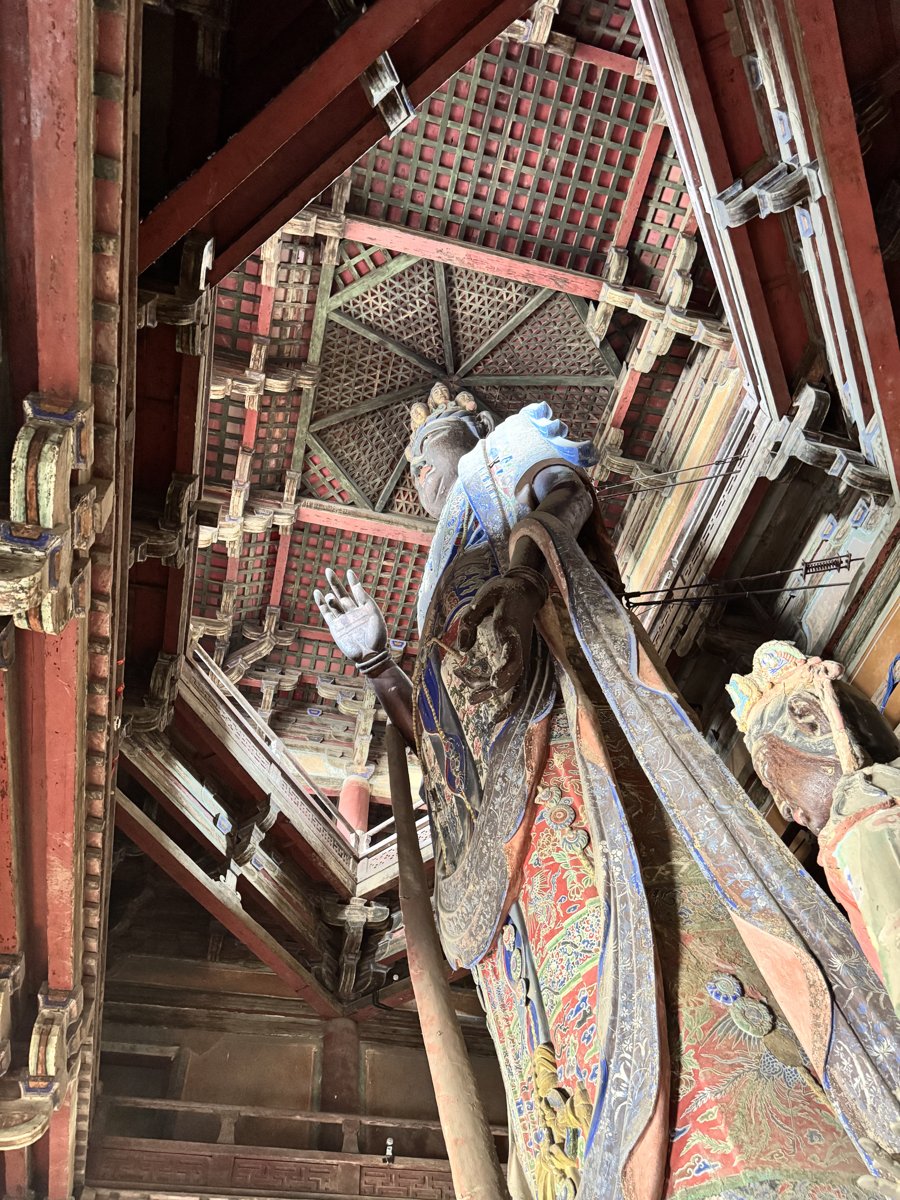
Liao clay sculpture; Jizhou, Tianjin
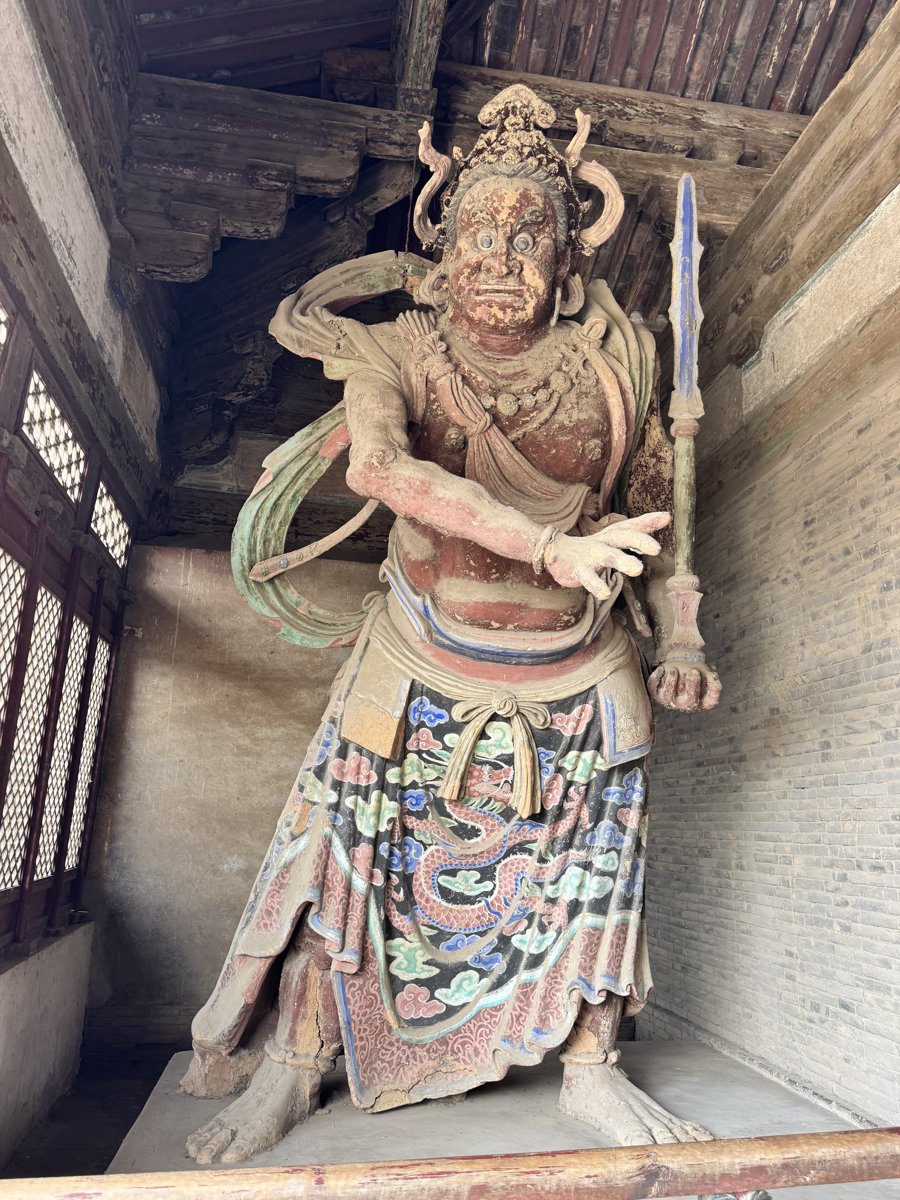
Liao clay sculpture
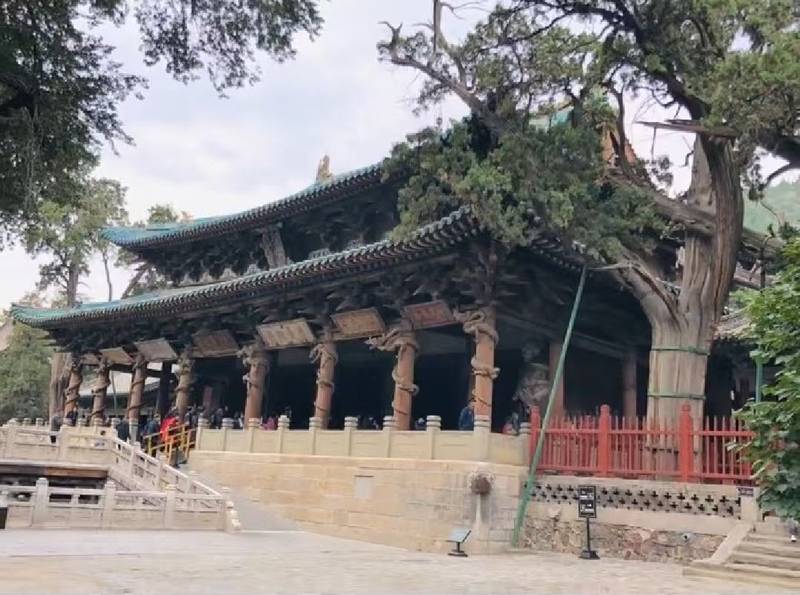
Northern Song building with Song painted figures of maids inside; Taiyuan
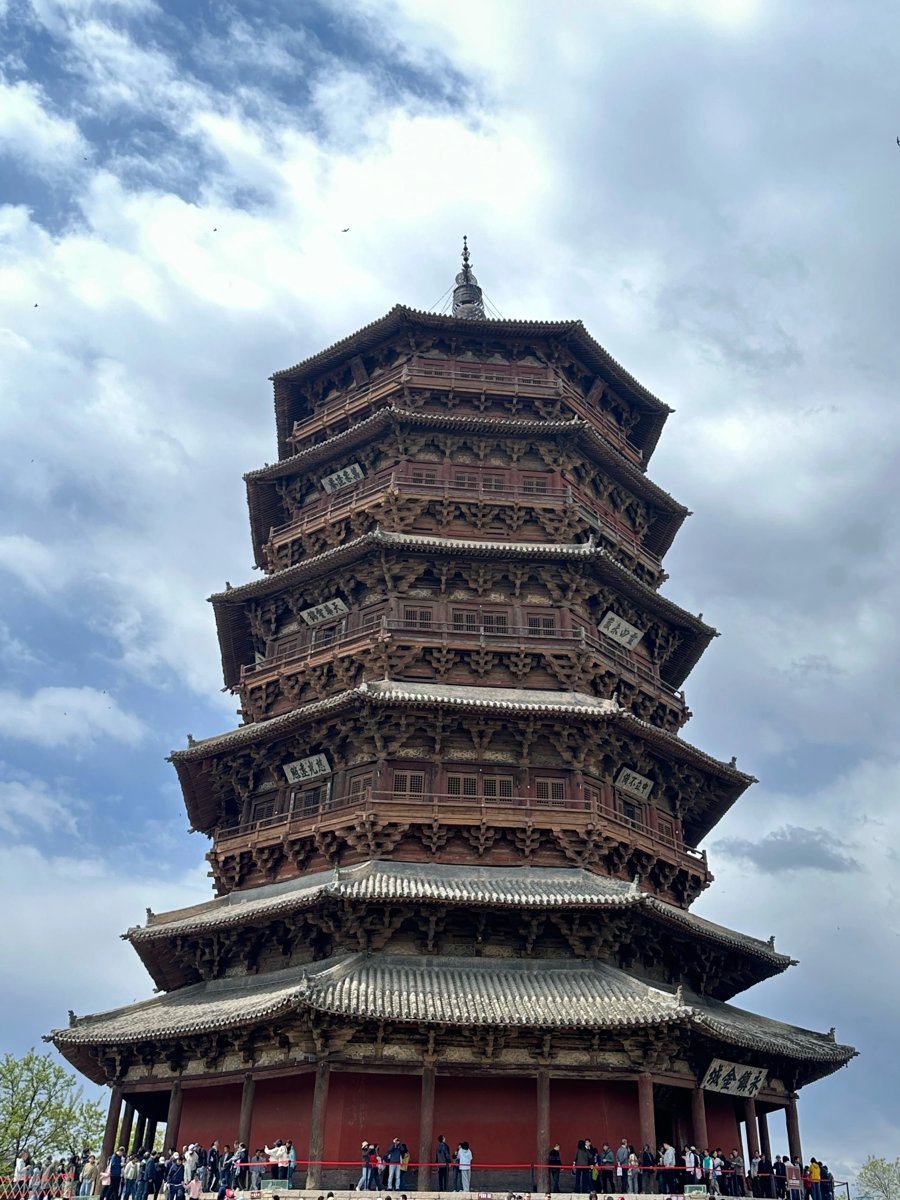
Liao; Yingxian, Shanxi
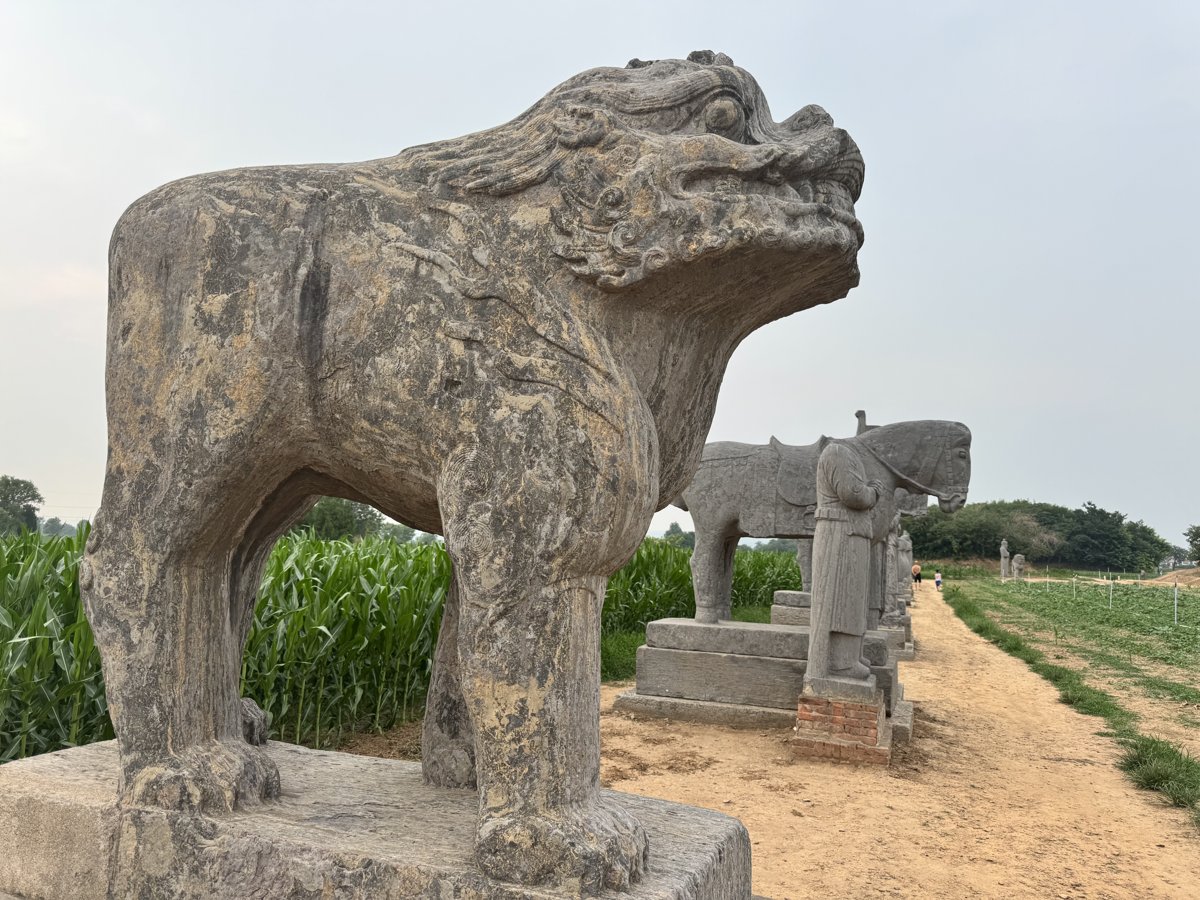
Yongtai Mausoleum (Emperor Zhezong); Gongyi, Henan
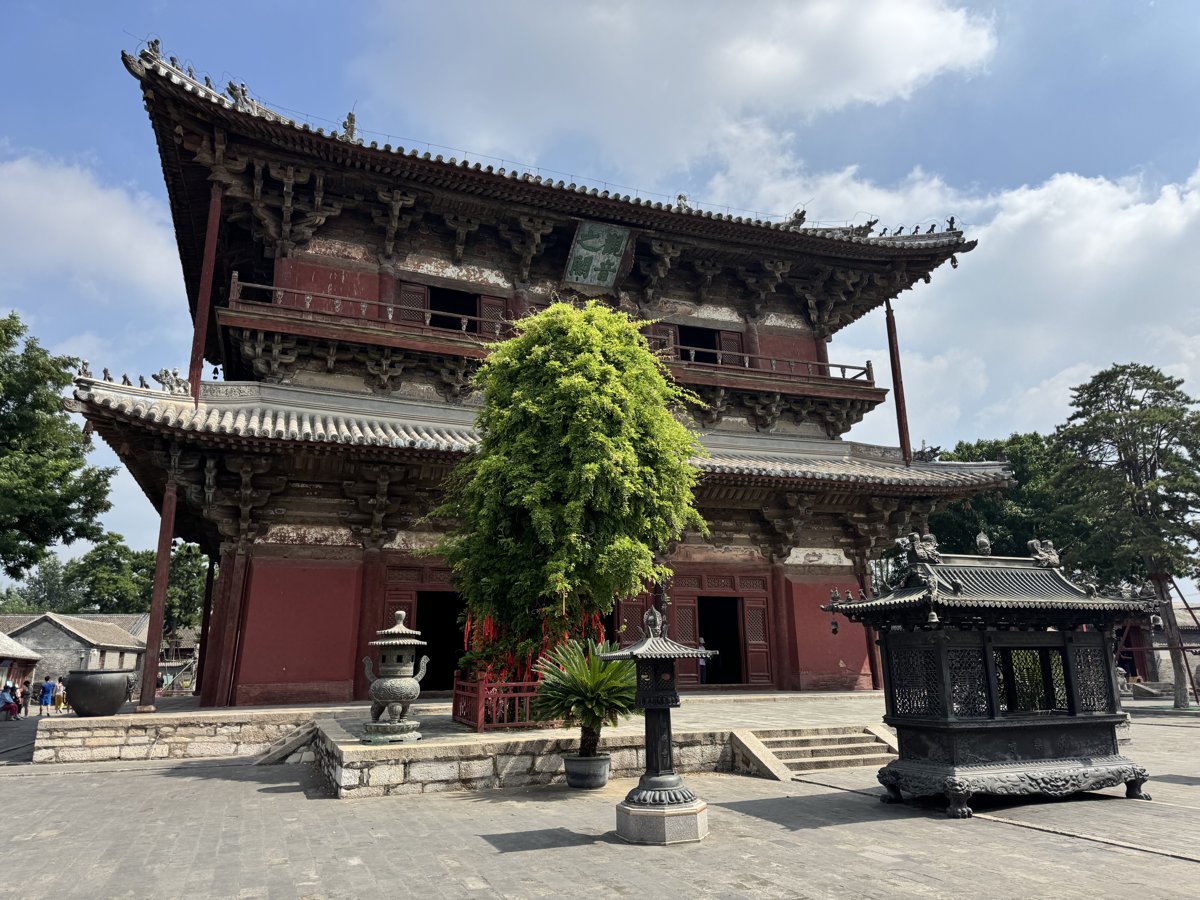
Jizhou, Tianjin

Jinci Temple Painted Sculptures (2003-15), 2003
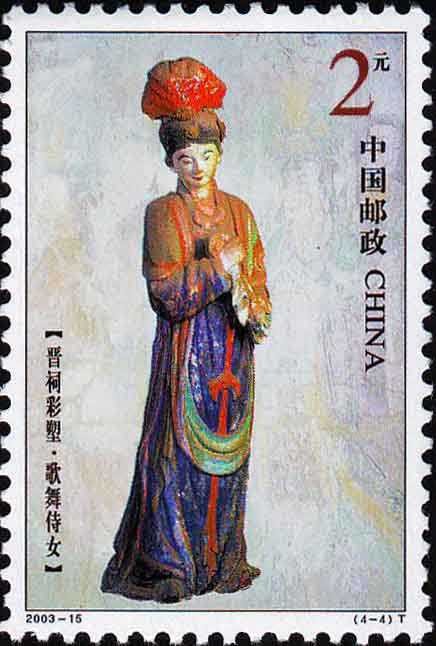
Jinci Temple Painted Sculptures (2003-15), 2003
Representative works
| Work | Period | Type | Collection | Notes | |
|---|---|---|---|---|---|
| Reading a Stele↑ | Northern Song | Hanging scroll, ink on silk, attributed to Li Cheng | Osaka City Museum of Fine Arts, Japan | Some say the figures were added by Wang Xiao. |
| A Solitary Temple amid Clearing Peaks↑ | Northern Song | Hanging scroll, ink and light color on silk, attributed to Li Cheng | Nelson-Atkins Museum of Art | A temple in the mountains. |
| Dense Forest and Distant Peaks | Northern Song | Handscroll, ink on silk, attributed to Li Cheng | Liaoning Provincial Museum | Level-distance landscape. | |
| Travelers among Mountains and Streams↑ | Northern Song | Hanging scroll, ink and light color on silk, Fan Kuan | National Palace Museum, Taipei | Raindrop texture strokes; the signature "Fan Kuan" is hidden among the leaves. |
| Winter Forest in Snow | Northern Song | Hanging scroll, ink on silk, attributed to Fan Kuan | Tianjin Museum | The mountains of Guanzhong in snow. | |
| Early Spring↑ | Northern Song | Hanging scroll, ink and light color on silk, Guo Xi | National Palace Museum, Taipei | Dated to Shenzong's reign; curling-cloud strokes. |
| Old Trees, Level Distance | Northern Song | Hanging scroll, ink and light color on silk, Guo Xi | Palace Museum | An autumn level-distance view. | |
| Fishermen's Evening Song | Northern Song | Handscroll, ink and light color on silk, Xu Daoning | Nelson-Atkins Museum of Art | Steep peaks. | |
| Misty River and Layered Peaks↑ | Northern Song | Handscroll, ink and color on silk, Wang Shen | Shanghai Museum | Su Shi wrote poems on it. |
| Fishing Village in Light Snow | Northern Song | Handscroll, ink and color on silk, Wang Shen | Palace Museum | A riverside village after snow. | |
| Summer Breeze at a Lakeside Villa↑ | Northern Song | Handscroll, ink and color on silk, Zhao Lingrang | Museum of Fine Arts, Boston | A small lakeside scene. |
| A Thousand Li of Rivers and Mountains↑ | Northern Song | Handscroll, blue-green color on silk, Wang Ximeng | Palace Museum | Nearly twelve meters long; the summit of blue-green landscape. |
| Wonderful Views of the Xiao and Xiang↑ | Northern to Southern Song | Handscroll, ink on paper, Mi Youren | Palace Museum | Mi-dot landscape. |
| Dead Tree and Strange Rock↑ | Northern Song | Handscroll, ink on paper, attributed to Su Shi | An early example of literati painting. | |
| Ink Bamboo↑ | Northern Song | Hanging scroll, ink on silk, Wen Tong | National Palace Museum, Taipei | Dark ink for the upper surface of the leaves, pale ink for the underside. |
| Five Horses↑ | Northern Song | Handscroll, plain line drawing on paper, Li Gonglin | Tokyo National Museum, Japan | Bears inscriptions by Huang Tingjian. |
| Pasturing Horses, after Wei Yan | Northern Song | Handscroll, ink and color on silk, Li Gonglin | Palace Museum | More than a thousand horses. | |
| Along the River during the Qingming Festival↑ | Northern Song | Handscroll, ink and light color on silk, Zhang Zeduan | Palace Museum | Both banks of the Bian River in Bianjing. |
| Auspicious Cranes↑ | Northern Song | Handscroll, ink and color on silk, Zhao Ji | Liaoning Provincial Museum | Cranes circling above a palace gate. |
| Hibiscus and Golden Pheasant↑ | Northern Song | Hanging scroll, ink and color on silk, signed by Zhao Ji | Palace Museum | Some say it was painted by an academy artist on his behalf. |
| Listening to the Qin | Northern Song | Hanging scroll, ink and color on silk, signed by Zhao Ji | Palace Museum | Playing the qin beneath a pine. | |
| Magpies and Hare↑ | Northern Song | Hanging scroll, ink and color on silk, Cui Bai | National Palace Museum, Taipei | Magpies and a hare. |
| Sparrows in Winter | Northern Song | Handscroll, ink and color on silk, Cui Bai | Palace Museum | A flock of sparrows on bare branches. | |
| Maids in the Hall of the Holy Mother, Jinci Temple↑ | Northern Song | Clay sculpture | In situ, Jinci Temple, Taiyuan | Realistic Song painted sculpture. |
| Guanyin of the Guanyin Pavilion, Dule Temple↑ | Liao | Clay sculpture | In situ, Dule Temple, Jizhou, Tianjin | An eleven-headed Guanyin more than ten meters high. |
← Chapter 6: Five DynastiesContentsChapter 8: Southern Song →