
How to Read a Confucian Temple
In the past nearly every prefectural, subprefectural and county town had a Confucian temple, all laid out in much the same way. This article explains where Confucian temples and Wenmiao came from, walks up the central axis to meet their gates, halls, pool and lecture hall one by one, and then looks at well-known examples in Qufu, Beijing and elsewhere.
Confucian temples and Wenmiao
A Confucian temple is a temple for offering sacrifices to Confucius. After his death the state of Lu turned his old house in Qufu into a temple; emperors of later dynasties kept enlarging it, and it became today’s Temple of Confucius in Qufu, the mother temple of all Confucian temples. Early in the Tang an imperial decree ordered every prefectural and county government school to set up a temple to Confucius, and from then on every school built one. Temple and school formed a single group of buildings, an arrangement known as “temple and school as one”: the temple for sacrifices, the school for teaching. The terms xuegong, prefectural school and county school all refer to such a group. In the Ming and Qing, local Confucian temples were mostly called Wenmiao, “temples of culture”, as opposed to the Wumiao, “temples of war”, dedicated to Guan Yu. So the Temple of Confucius in Qufu is both the Kong family temple and a site of state sacrifice, while local Wenmiao were mostly attached to government schools, places where scholars entered school, sat examinations and honoured Confucius.
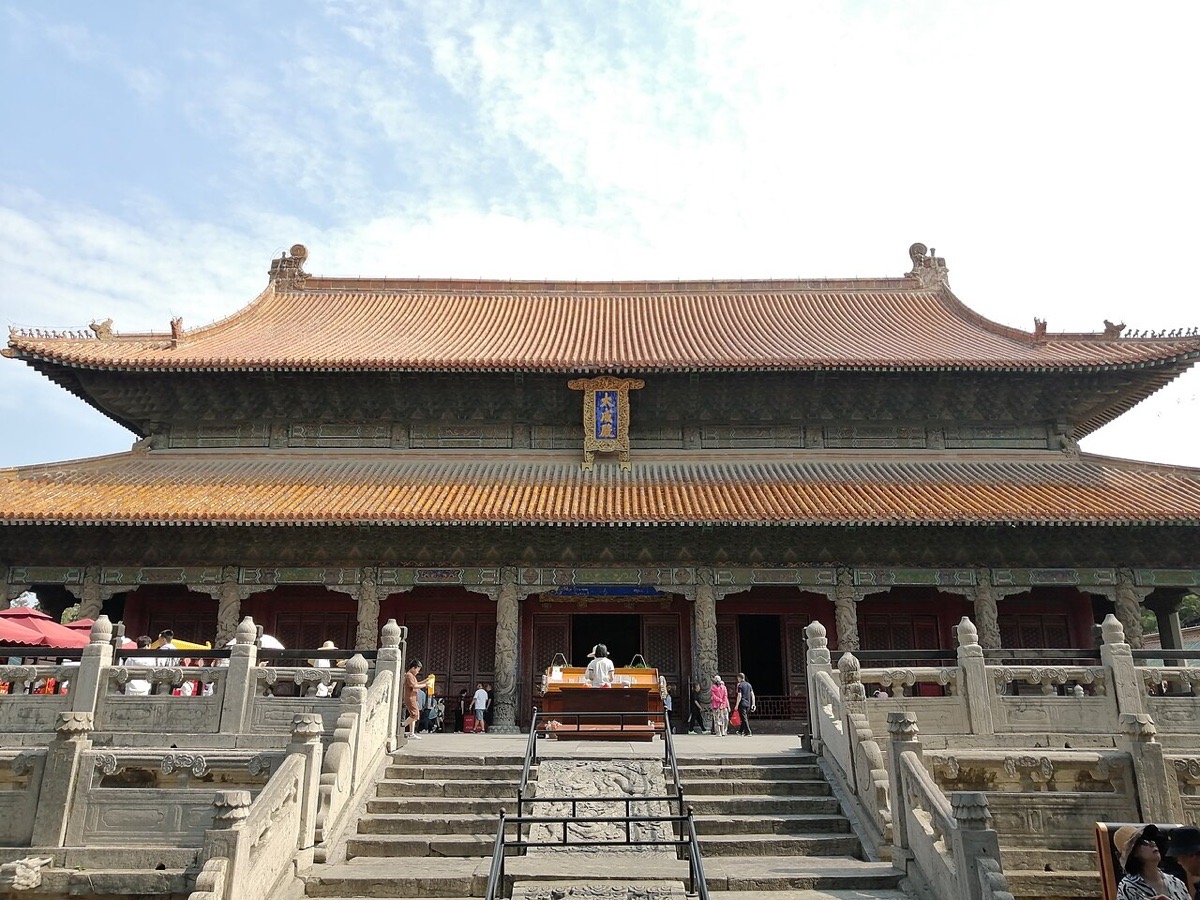
The main hall of the Temple of Confucius in Qufu, Shandong
Yumeto, CC BY-SA 4.0, Wikimedia Commons
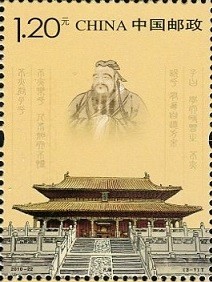
Temple of Confucius, Qufu
Stamp
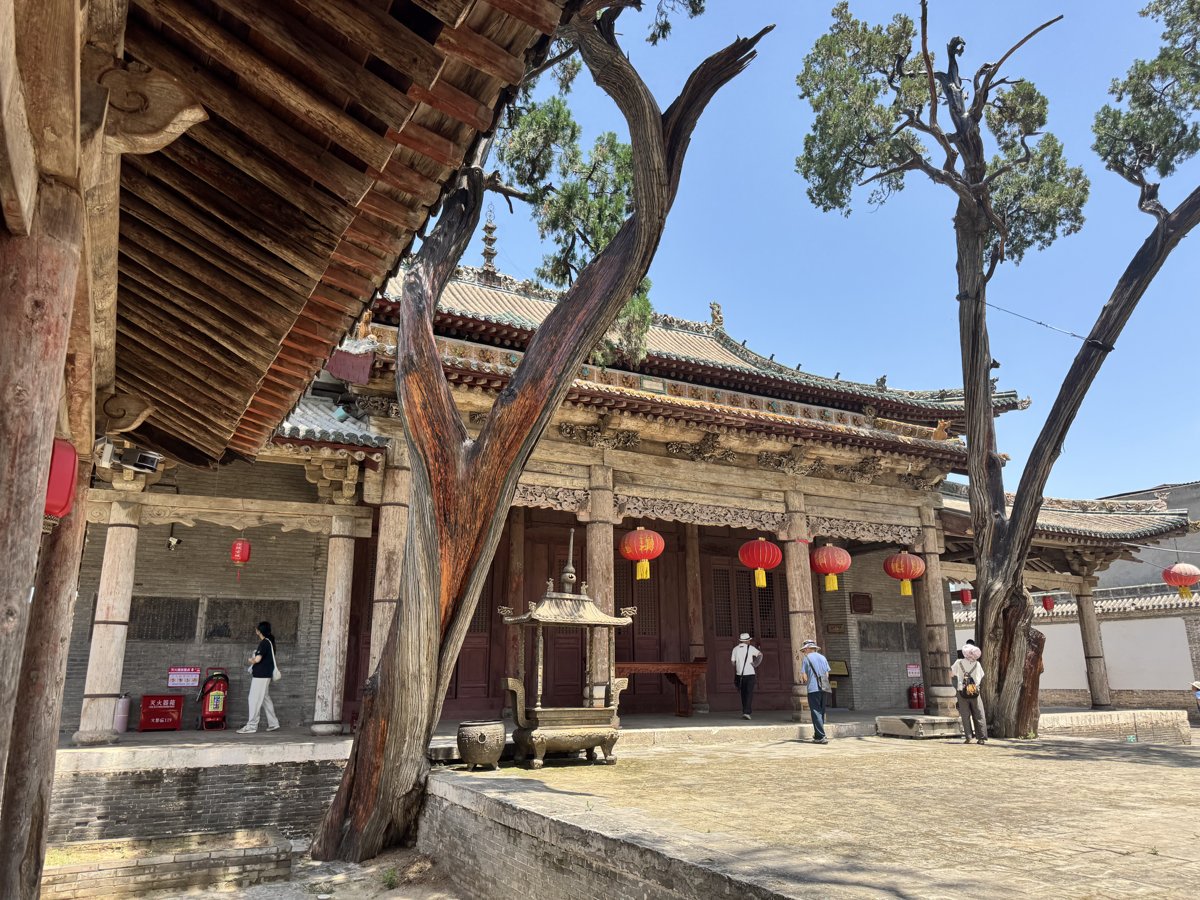
The county Confucian temple of Fencheng, Xiangfen, Shanxi
Temple and school stood in one of two arrangements. In one, the temple was in front and the school behind; in the other, the temple was on the left and the school on the right, or the reverse, side by side from east to west. Within an old city the position of the Wenmiao also followed rules: in the Ancient City of Pingyao the Wenmiao is in the east and the Wumiao in the west, roughly balancing the City God Temple, the county yamen and other buildings.
Along the central axis
A Wenmiao faces south, with its main buildings on a single central axis. From south to north they are:

A stone Lingxing Gate, with dragons carved on the pillars in front
Wanren Palace Wall (“wall ten thousand ren high”): a screen wall or city wall directly in front of the temple. The name comes from the Analects: Zigong said his master’s wall was several ren high, and whoever could not find the gate would never see the beauty of the ancestral temple within. In Qufu the Wanren Palace Wall is the main south gate of the Ming city; at most local Wenmiao it is a screen wall without an opening, and visitors enter the temple through gates on either side.
Lingxing Gate: a gateway in the form of a wooden or stone paifang (memorial archway). Lingxing was originally written with a character meaning “spirit star”; in ancient times this star received offerings before Heaven itself, and naming the temple gate after it meant that Confucius was honoured as Heaven was.
Pan Pool and Pan Bridge: a half-moon pool inside the Lingxing Gate, crossed by a stone bridge. In the Zhou, a school run by a feudal lord was called a pangong, and one run by the Son of Heaven a biyong; the biyong was surrounded by water on all four sides, the pangong on only half, hence the semicircular pool. The Book of Songs (“Hymns of Lu: Pan Waters”) has the lines “Joyful by the Pan waters, we gather the cress”; later, passing the first-level examination and entering a government school was called “entering the Pan” or “gathering the cress”. The Pan Bridge is popularly called the Zhuangyuan (Top Scholar) Bridge.
Dacheng Gate: the gate of the main hall’s courtyard, also called the Halberd Gate, as halberds were once displayed in front of it.
Dacheng Hall (Hall of Great Achievement): the main hall of the Wenmiao. Its name, fixed under Emperor Huizong of the Song, comes from Mencius’ description of Confucius as one who “gathered all into a great achievement”. Confucius is enshrined at the centre, flanked by the Four Correlates, Yan Hui, Zeng Shen, Kong Ji (Zisi) and Meng Ke (Mencius); further out are the Twelve Philosophers, mostly disciples of Confucius, to whom the Qing added Zhu Xi. In front of the hall is a broad terrace, the yuetai, where music and ritual dances were performed during the sacrifices to Confucius.
The two wings: two long buildings on the east and west in front of Dacheng Hall, holding the spirit tablets of the Former Worthies and Former Confucians. The Former Worthies are mostly disciples of Confucius; the Former Confucians are famous Confucian scholars of later ages.
Chongsheng Shrine: a small courtyard behind Dacheng Hall, dedicated to Confucius’ father and earlier ancestors.
The school lies behind or beside the temple. Minglun Hall is the lecture hall, named after Mencius’ words that schools exist to make clear the proper relations between people; Zunjing Pavilion holds the classics and usually stands at the very back. Many Wenmiao also have a Kuixing Tower and a Wenchang Pavilion, where people prayed for literary success. Fencheng is a well-preserved old county town whose Wenmiao, Minglun Hall, Kuixing Tower and examination hall all stand on their original sites, showing a county school complete.
Reading rank from the roof
Confucius received titles from dynasty after dynasty; in the Yuan he was styled “Dacheng Zhisheng Wenxuan Wang”, King of Culture and Most Accomplished Sage, and the Temple of Confucius in Qufu was built to the standard of a king, close to that of the imperial court. Dacheng Hall has a double-eaved hip-and-gable roof of yellow glazed tiles, the same colour as the palaces. The hall is nine bays wide, and the ten stone columns of its front eaves are deeply carved with coiled dragons. It is often named with the Hall of Supreme Harmony in the Forbidden City and the Tiankuang Hall of the Dai Temple at Mount Tai as the three great halls (see A Brief History of Chinese Architecture, Chapter 9). Local Wenmiao rank below Qufu; their Dacheng Halls mostly have hip-and-gable roofs (for roof ranks see Chapter 1), with far fewer bays and lower platforms.
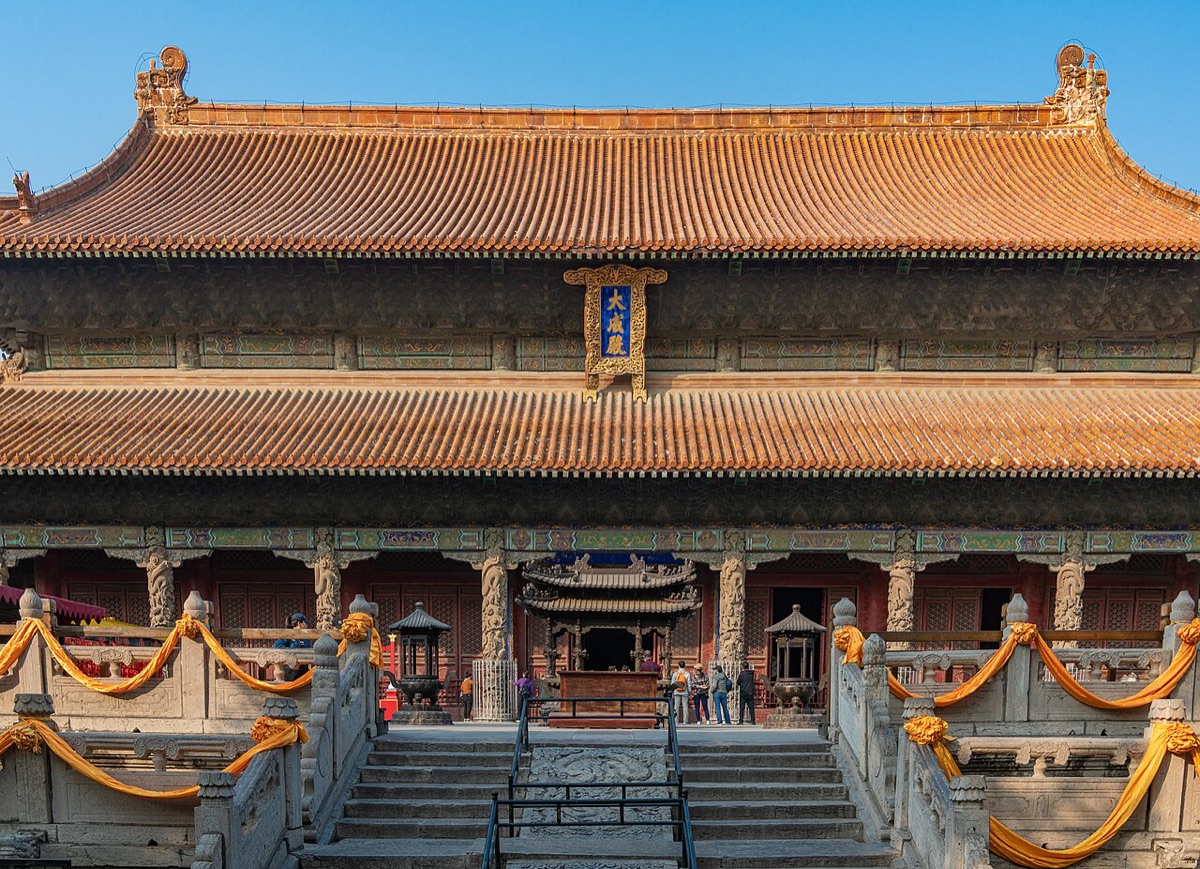
Double-eaved hip-and-gable roof, yellow glazed tiles, dragons carved on the front columns
xiquinhosilva, CC BY 2.0, Wikimedia Commons
For old Dacheng Halls, go to Hebei and Shanxi. Judging by its style, the Dacheng Hall of the county Wenmiao in Zhengding survives from the Five Dynasties or early Song, the oldest surviving main hall of any Wenmiao (see Chapter 6); the Dacheng Hall of the Pingyao Wenmiao is an original Jin-dynasty structure. Both are modest in size, with massive bracket sets, and look very different from Ming and Qing Wenmiao.
The Temple of Confucius in Qufu
The Temple of Confucius in Qufu grew, dynasty by dynasty, from the three rooms of Confucius’ house into a great temple of nine courtyards and several hundred rooms, which Liang Sicheng called unique in the world. Entering through the Wanren Palace Wall at the south, one passes through several gates and archways and courtyards full of ancient cypresses before reaching the Kuiwen Pavilion.
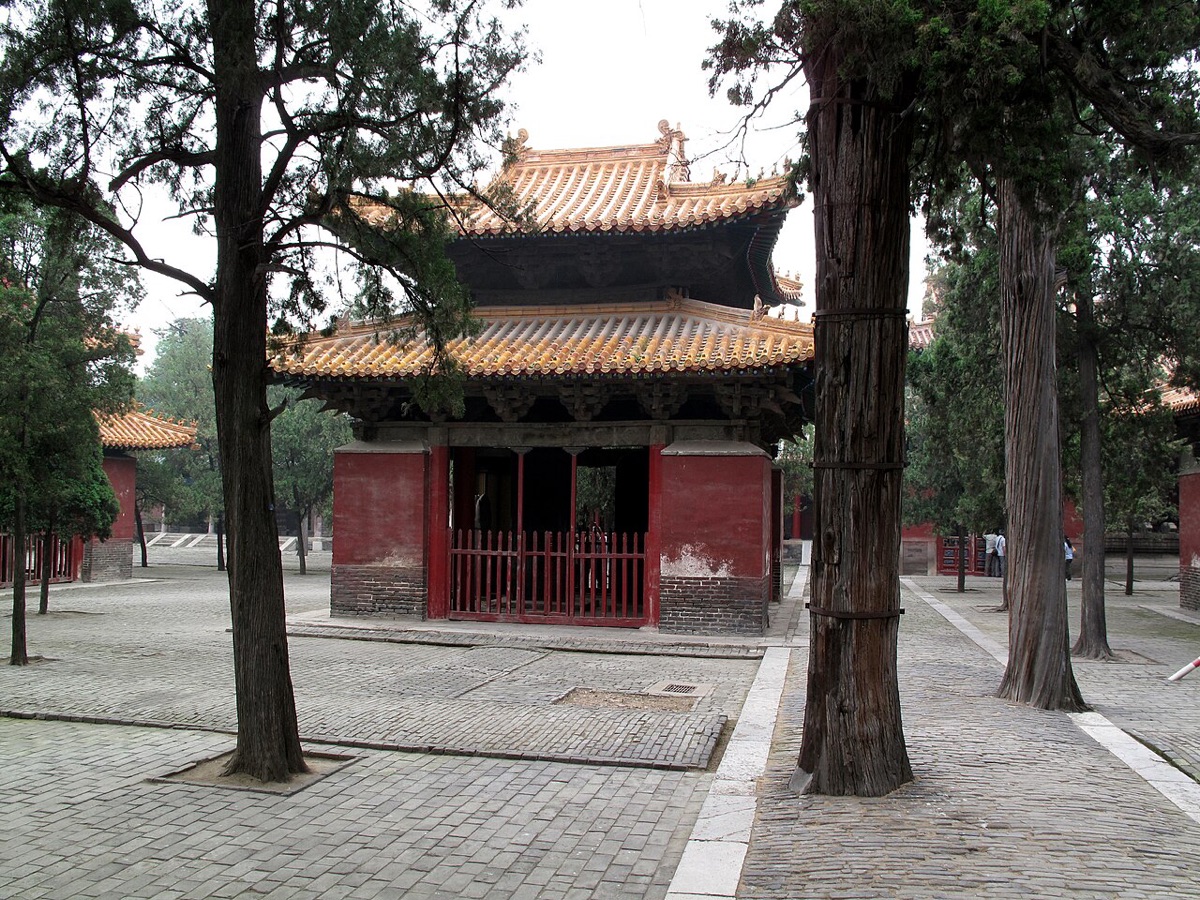
Ancient cypresses, halls and pavilions in the courtyards
G41rn8, CC BY-SA 4.0, Wikimedia Commons
The Kuiwen Pavilion is the library, equivalent to the Zunjing Pavilion of local Wenmiao; rebuilt in the mid-Ming, it has two storeys and three tiers of eaves (see Chapter 8). In the courtyard behind it stand the Thirteen Stele Pavilions, holding imperial steles of the Jin, Yuan, Ming and Qing; the two Jin stele pavilions are the oldest buildings in the temple, and the Chengsheng and Qisheng gates date from the Yuan (see Chapter 7). The Apricot Altar in front of Dacheng Hall is said to be where Confucius taught. In the Song an altar was built on the foundations of the old hall and ringed with apricot trees; later a pavilion was added, square, with double eaves and a cross-ridged roof. On the eastern axis are also the old well of the Kong house and the Lu Wall, where, according to tradition, classics in ancient script were found inside a wall of Confucius’ house in the Han.
East of the temple is the Kong Family Mansion, residence of the Duke Yansheng, Confucius’ senior direct descendant, with government offices in front and living quarters and a garden behind. North of the city, the Cemetery of Confucius is the burial ground of Confucius and his descendants, shaded by towering old trees. Together the three are known as the “Three Kongs” and are inscribed together as a World Cultural Heritage site.
Beijing and elsewhere
The Confucius Temple in Beijing is on Guozijian Street in Dongcheng, with the Guozijian, the Imperial Academy, right next to it on the west: temple on the left and school on the right, the temple in the east and the school in the west. The Guozijian was the highest school of the Yuan, Ming and Qing. At its centre is the Biyong, built under Qianlong, a square hall in the middle of a round pool, reached by bridges on four sides, where the emperor lectured, following the old idea that the Son of Heaven’s school was surrounded by water on all sides. In the Confucius Temple stand the steles of successive dynasties listing the names of those who passed the highest examination, the jinshi.
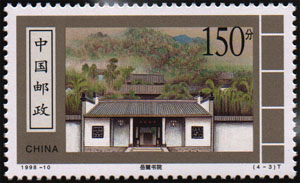
Yuelu Academy, Changsha
Stamp
Among local Wenmiao, these are worth seeing. The Wenmiao of Jianshui in Yunnan, founded in the Yuan, follows the layout of the Temple of Confucius in Qufu and is second only to it in size; the large Pan Pool inside its entrance is called the Sea of Learning. The Wenmiao of Jilin City is a Qing Confucian temple with orderly halls; the Wenmiao of Harbin is a large Confucian temple built in modern times to the traditional plan. The Wenmiao of Wuwei in Gansu, Hancheng in Shaanxi and Dai County in Shanxi are also well preserved. The Fuzimiao in Nanjing is the Confucian temple in the south of the city, right beside the Jiangnan Examination Hall, the examination ground of the Ming and Qing, so that temple, school and examination hall cluster on the bank of the Qinhuai River. Academies also often had a Confucian temple attached: at the foot of Mount Yuelu, Yuelu Academy has a Wenmiao beside it.