 Park of China
Overview
| Designation | UNESCO World Heritage (cultural, 1994) AAAAA tourist attraction |
| Province | Shandong |
| Location | Qufu, Shandong |
| Latitude, longitude | 35.6, 117.0 Google Maps |
| Highlights | Holy place of Confucianism |
| Top sights | The Temple of Confucius |
| Area | 2 km² |
| Nearby cities | Qufu, Tai'an, Jinan |
| Nearby sites | Mount Tai (Taishan) 73km, Lingyan Temple 85km, Qingzhou Scenic Area 174km Search nearby |
| Themes | Culture, Temple, Palace, Inscription, Building, Ancient Building, Tomb, Confucian academies & temples, Homes & tombs of notable people |
About
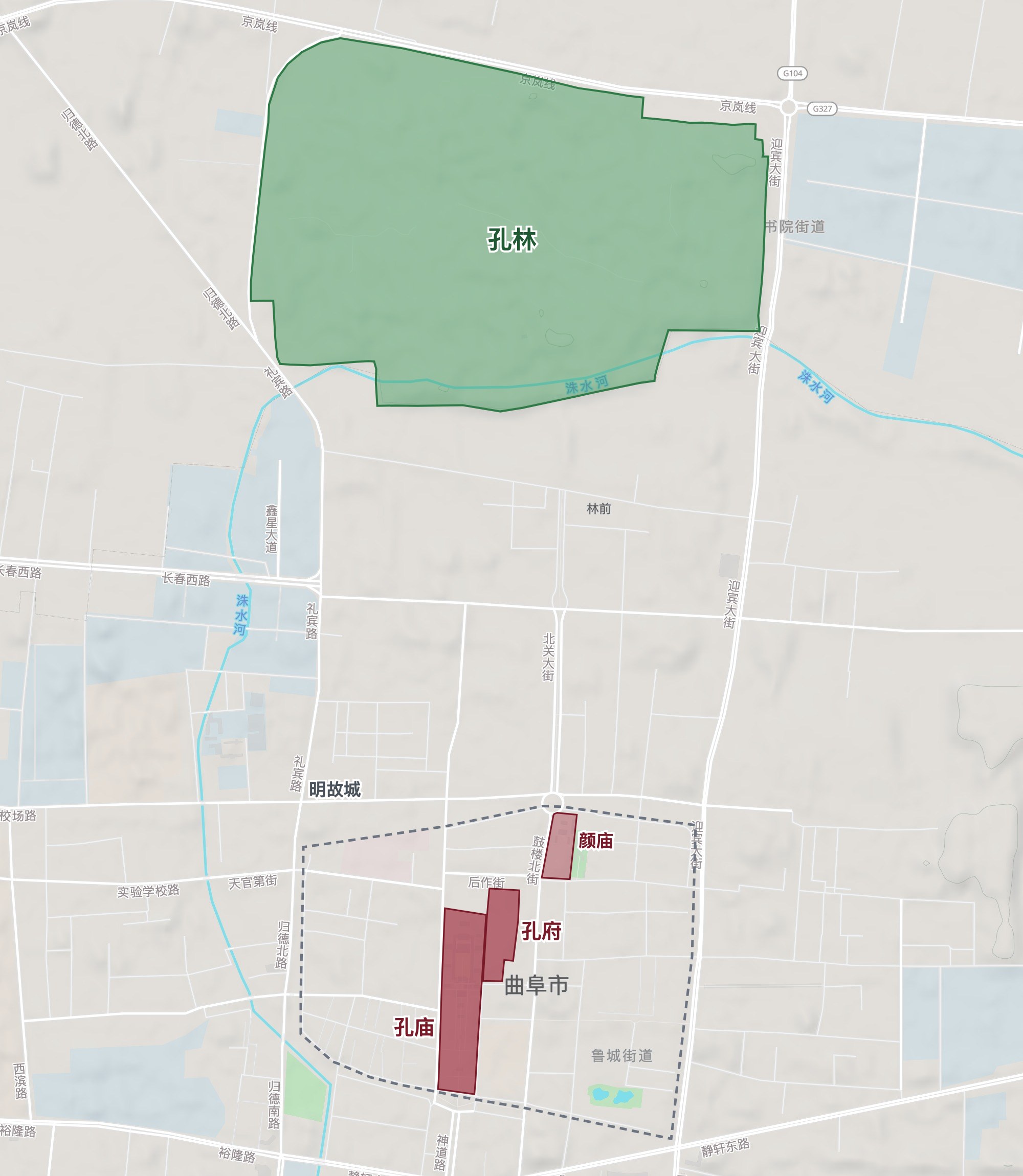
The Temple, Mansion and Cemetery of Confucius, together called the “Three Kongs”, are in the city of Qufu in south-west Shandong. They were inscribed on the World Heritage List in 1994.

The Lu Wall in the temple marks where, by tradition, Kong Fu, ninth-generation descendant of Confucius, hid the Book of Documents, the Analects and the Classic of Filial Piety in the walls of the family house during the Qin book-burning; Prince Gong of Lu found them when he pulled the house down in the Han dynasty.
The Hall of Great Achievement enshrines Confucius, flanked by the Four Correlates (Yan Hui, Zeng Shen, Kong Ji and Mencius) and the Twelve Wise Ones.
Before Confucius's tomb stands a stele of 1443 inscribed “Tomb of the Supremely Accomplished Sage, King of Culture”. His son Kong Li lies to the east and his grandson Kong Ji in front, a layout called “holding son and grandson”.
In 1771 the Qianlong Emperor gave the Kong Mansion ten Shang and Zhou bronze ritual vessels from the palace collection, the “Ten Shang and Zhou Offerings”, now in the Confucius Museum.
Kong Shangren, author of The Peach Blossom Fan and a 64th-generation descendant of Confucius, is also buried in the cemetery.
Map
Travel tips
Getting there: Qufu East station on the Beijing–Shanghai high-speed line is east of town, about half an hour by bus or taxi to the old walled town. The Temple and the Mansion are inside the walls, next to each other.
Temple of Confucius: enter from the south gate and follow the central axis past the Kuiwen Pavilion and the Apricot Altar to the Dacheng Hall; there are many stele pavilions and inscribed tablets.
Kong Family Mansion: east of the Temple, with offices at the front and living quarters and a garden behind; it can be seen straight after the Temple.
Cemetery of Confucius: one or two kilometres north of town and very large; walk or take the electric carts. Confucius's tomb is inside.
Time: one day is roughly enough for all three.
Other: the Confucius Museum is south of the old walled town; Mount Ni, southeast of town, is the traditional birthplace of Confucius.
Season: spring and autumn are best. The public ceremony for Confucius at the Temple on his birthday, 28 September, draws crowds.
Where to stay: inside Qufu is most convenient; the trip combines easily with Mount Tai and Jinan.
Confucius
Confucius (551–479 BC), personal name Kong Qiu, courtesy name Zhongni, was a native of the state of Lu, today’s Qufu. An educator and philosopher of the Spring and Autumn period, he founded the Confucian school; his thought shaped China for more than two thousand years and he was honoured as the teacher of all ages.
The Temple of Confucius
The temple stands inside the city. After Confucius died, Duke Ai of Lu turned his house into a shrine, and emperors of successive dynasties enlarged it. It now covers 200,000 m² with nine courtyards and 466 buildings, including the Dacheng Hall, the Apricot Altar and the Kuiwen Pavilion.
The Dacheng Hall, the main hall, is 32 m high and 54 m wide, with a double-eaved hip roof of yellow tiles and 28 stone columns carved with dragons; it is counted among the three great ancient halls of China. The Apricot Altar is said to be where Confucius taught; beside it is an ancient juniper, “planted by the Master’s own hand”.
The temple has 54 gateways and 13 imperial stele pavilions and a great collection of inscriptions, second only to the Forest of Steles in Xi’an.
The Kong Family Mansion
The mansion adjoins the temple on the east and was the hereditary residence of the Duke Yansheng, the senior descendant of Confucius in the direct line. It covers 160,000 m² with more than 400 rooms and holds a large collection of relics.
It is laid out in three axes: the east is the family temple; the west, called the Western School, is where the Dukes Yansheng studied and received guests. On the central axis the front is the official yamen and the rear the private quarters and garden. The great hall was the duke’s court.
The Cemetery of Confucius
The cemetery, also called the Forest of the Supreme Sage, lies outside the north gate of the city and is the family burial ground of Confucius and his descendants, about 2 km². Its wall is 5.6 km long, 3 m high and 1 m thick. Inside are more than 100,000 graves, over 10,000 old trees and many ornamental columns, stone figures and animals.
Stamps
In 2010 China Post issued 2010-22 “Temple, Mansion and Cemetery of Confucius”, three stamps: the Temple, the Mansion and the Cemetery.

Banknotes and coins
The 5-yuan coin “World Cultural Heritage: the Temple, Cemetery and Family Mansion of Confucius in Qufu”, issued by the People’s Bank of China in 2003, shows the Dacheng Hall, the Wangu Changchun archway and the name board over the gate of the Kong Family Mansion on the reverse.
The gold and silver coins “World Heritage: the Temple, Cemetery and Family Mansion of Confucius in Qufu”, issued by the People’s Bank of China in 2017, show the Dacheng Hall, the Wanren Palace Wall, the Wangu Changchun archway and the gate of the Kong Family Mansion.
Photo credits: The Temple of Confucius: G41rn8 (CC BY-SA 4.0, Wikimedia Commons); The Temple of Confucius: xiquinhosilva (CC BY 2.0, Wikimedia Commons)
Nearby
| World Heritage | Mount Tai (Taishan) 73km, Yin Xu, Anyang 258km |
| National parks | Thousand Buddha Mountain 115km, Boshan Scenic Area 121km, Qingzhou Scenic Area 174km, Mount Yuntai (Jiangsu) 236km |
| Detailed guides | Lingyan Temple 85km |
| AAAAA attractions | Yimeng Mountain Scenic Area 71km, Weishan Lake Tourist Area 113km, Jinan Springs 118km, Firefly Water Cave and Underground Grand Canyon Tourist Area 131km |
| AAAA attractions | Ming Prince of Lu Tomb 14km, Nishan Confucius Temple and Academy Scenic Area 22km, Shimenshan Green Leisure Scenic Area 23km, Mencius Temple and Mansion Tourism Area 23km |
| UNESCO Global Geoparks | Yimengshan UNESCO Global Geopark 71km |
| Historic cities | Qufu 1km, Zoucheng 22km, Tai'an 67km |
| Cities | Jinan 111km |
| Historical sites | Temple of the Duke of Zhou <1km, Yan Temple <1km, Former Qufu Normal School 1km, Ancient City of the Lu State at Qufu 2km |
| National geoparks | Yiyuan Lushan National Geopark 123km |
| Historic towns | Dawenkou Town 40km |