
← Chapter 10: MingContentsChapter 12: Modern Times →
Chapter 11: Qing
Early Qing painting took two directions. One was the Orthodox School represented by the "Four Wangs", who imitated the ancients and sought purity of brush and ink, and were favored by the court. The other was that of the Ming loyalist painters, above all the "Four Monks", who expressed their personal fate through painting in striking, unconventional brushwork. In the mid-Qing the "Eight Eccentrics of Yangzhou" appeared in Yangzhou, home of wealthy salt merchants; in the late Qing, after Shanghai was opened as a treaty port, the Shanghai School arose.
The Four Wangs. Wang Shimin, Wang Jian, Wang Hui and Wang Yuanqi were all from Taicang and Changshu in Jiangsu. The first two had been taught directly by Dong Qichang; Wang Hui was their pupil, and Wang Yuanqi was Wang Shimin's grandson. Following Dong Qichang's ideas, they took Huang Gongwang and other Song and Yuan masters as models, often inscribing their paintings "after the brush manner of so-and-so", and worked at the organization of brush and ink. Wang Hui directed the painting of The Kangxi Emperor's Southern Inspection Tour, and Wang Yuanqi directed the compilation of the Peiwenzhai Manual of Calligraphy and Painting at court; this school became the orthodoxy of the Qing court and scholar-officials. The Four Wangs, together with Wu Li and Yun Shouping, known for boneless (outline-free) flower painting, are called the "Six Masters of the Qing".
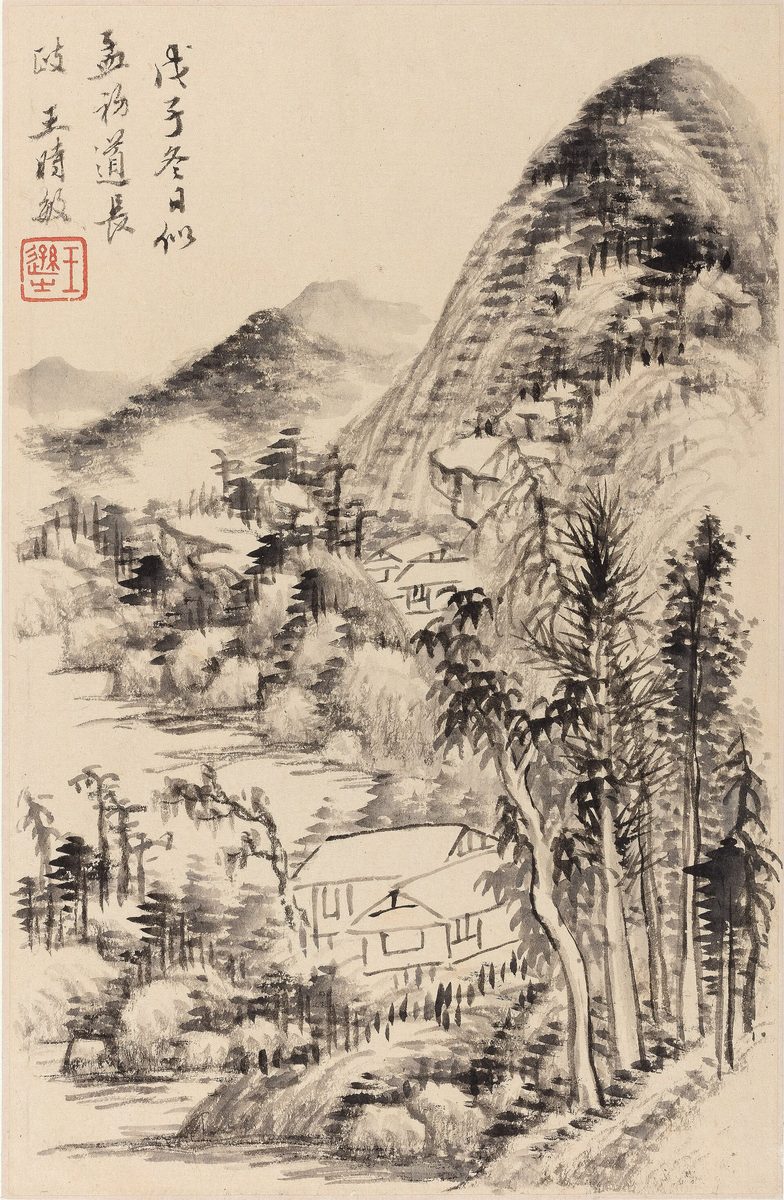
A leaf from an album of miscellaneous paintings
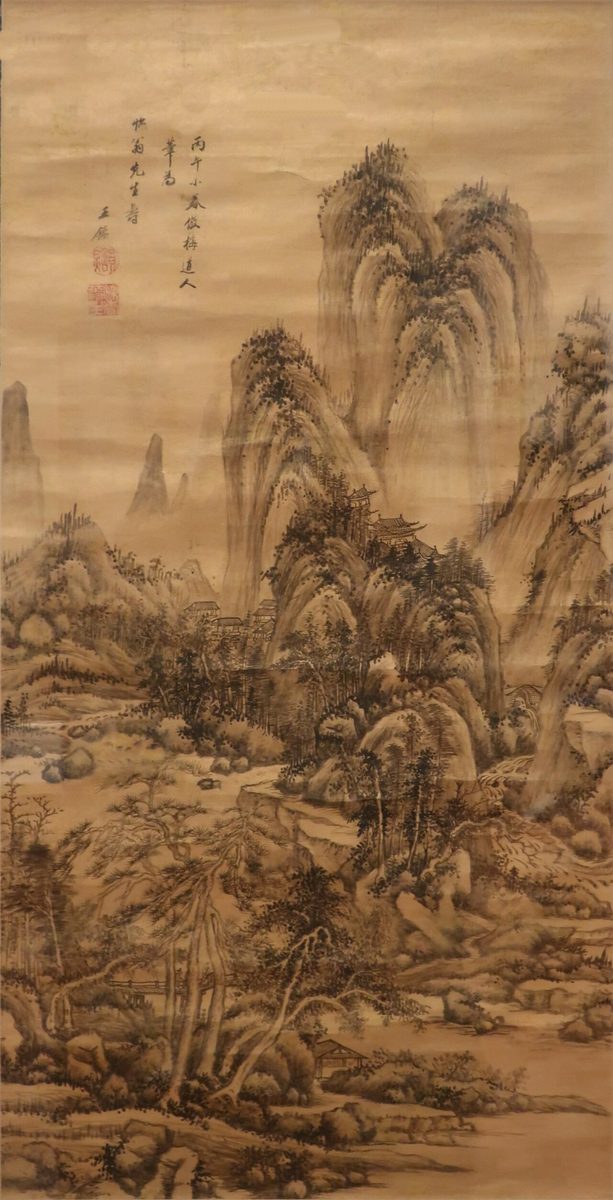
Landscape after Wu Zhen
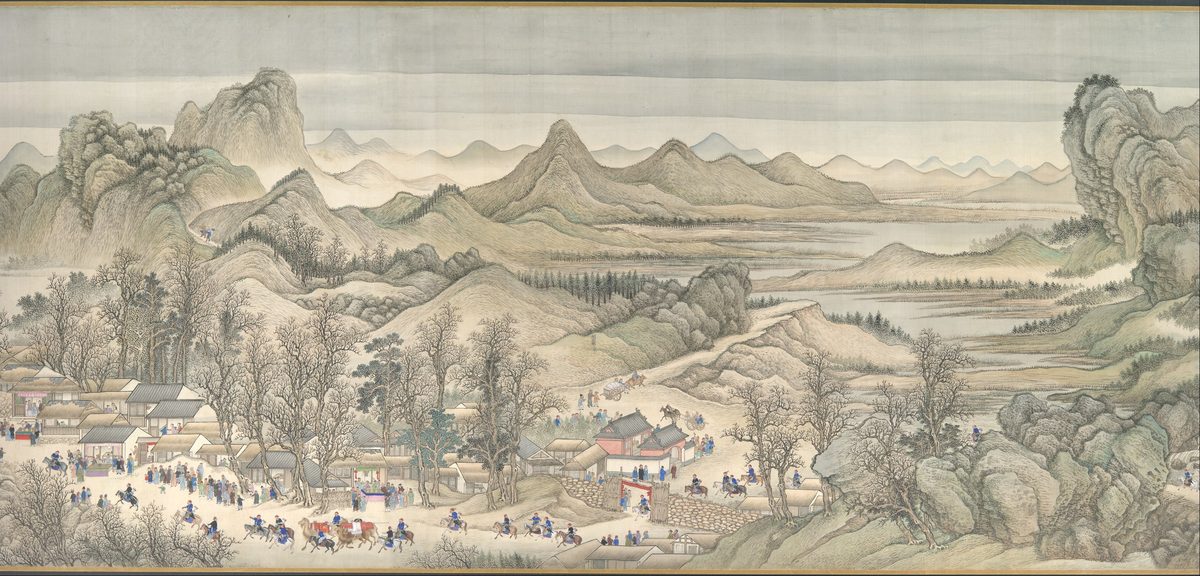
Detail
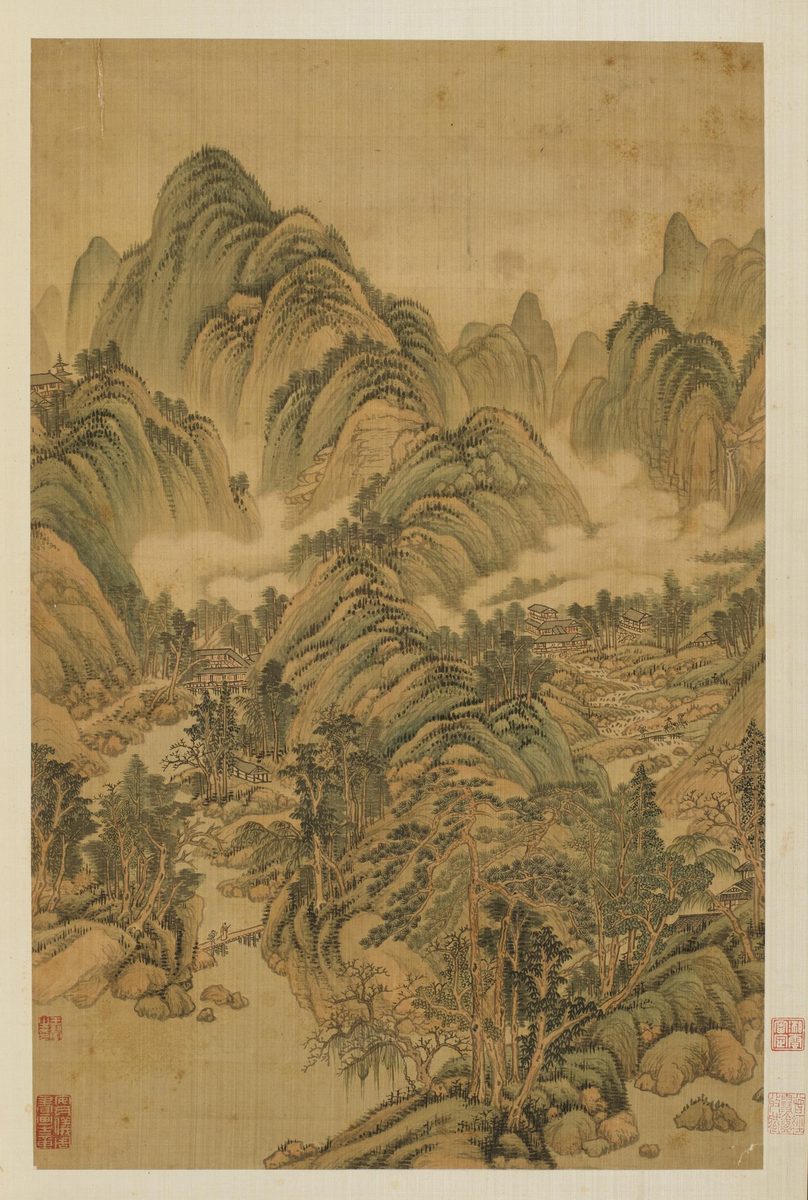
A leaf from the album Large Seen in Small
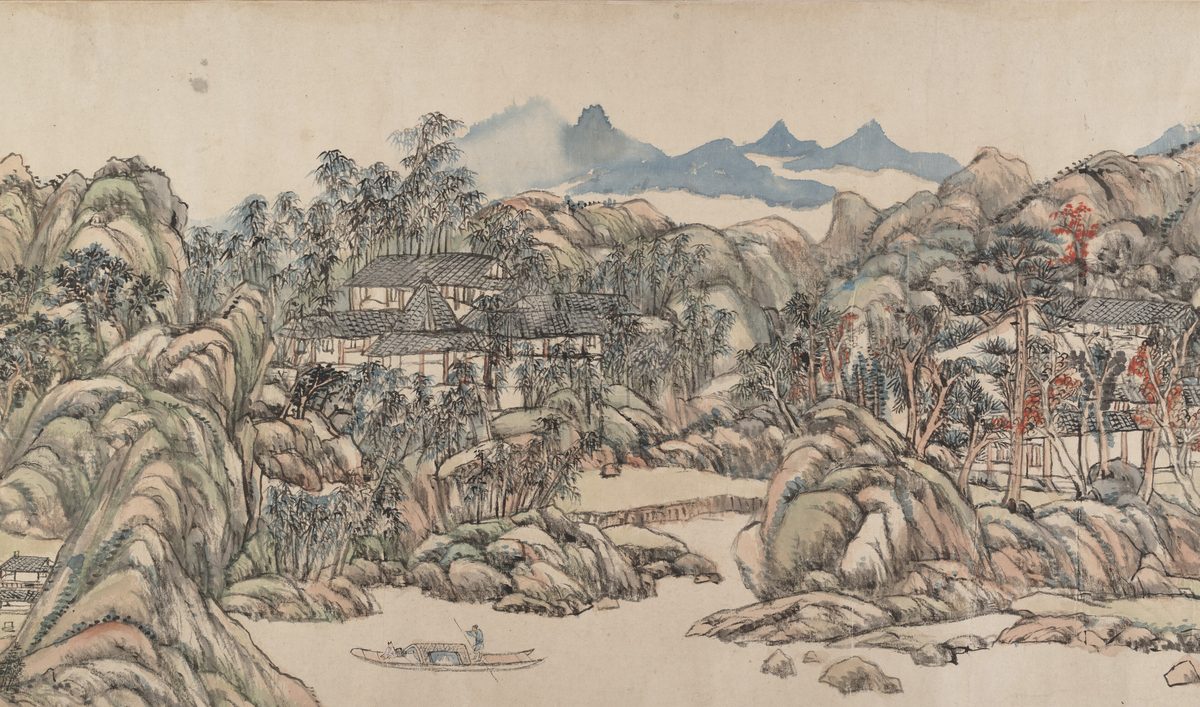
Wangchuan Villa; Metropolitan Museum of Art
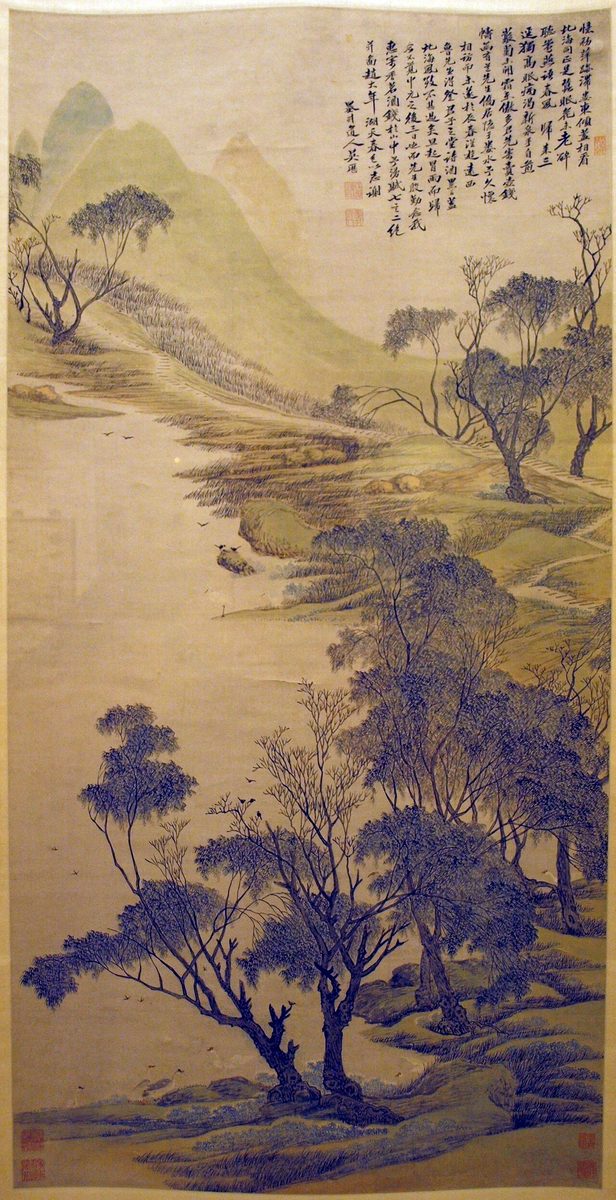
Spring on the Lake; Shanghai Museum
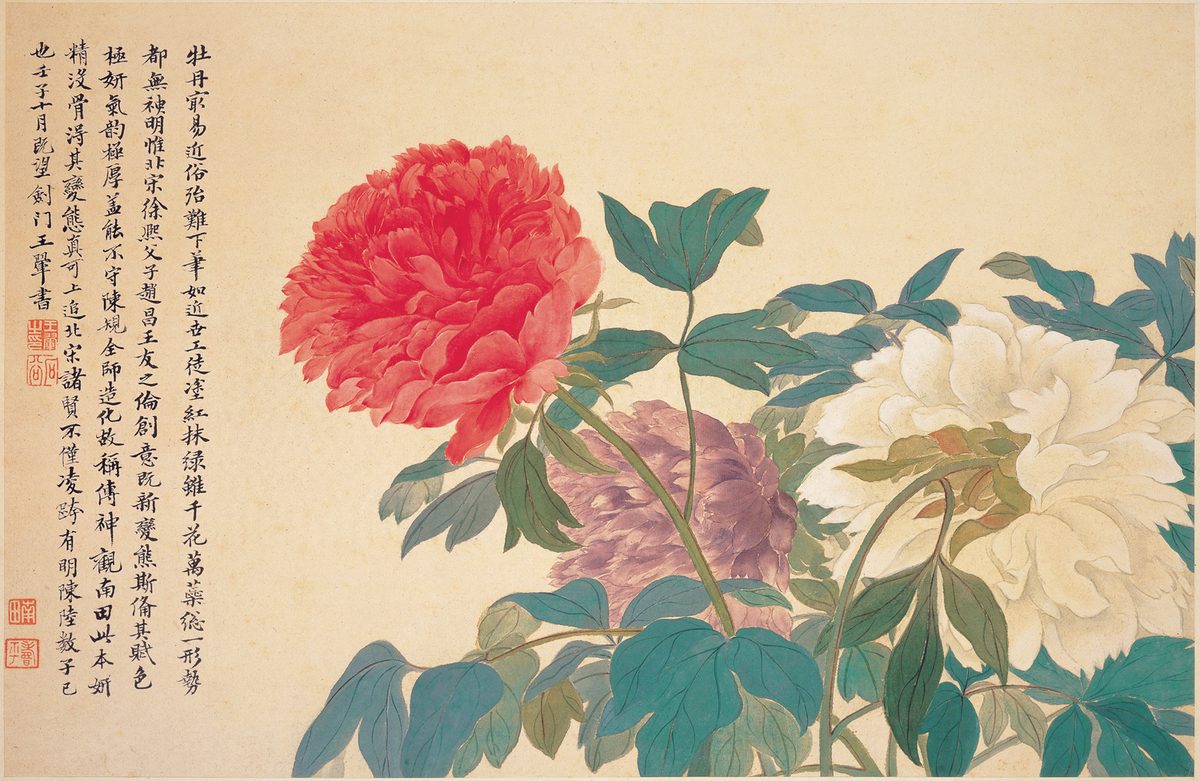
Peonies
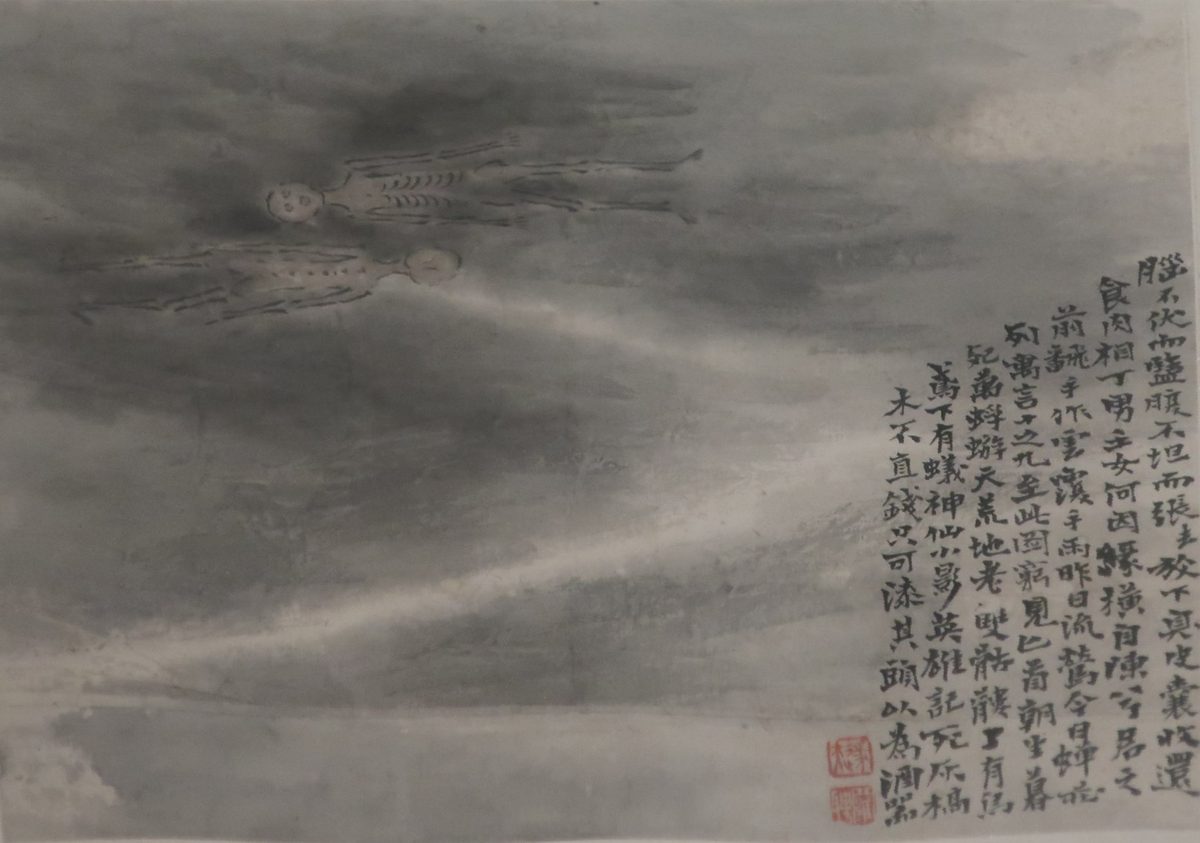
Amusements of Ghosts
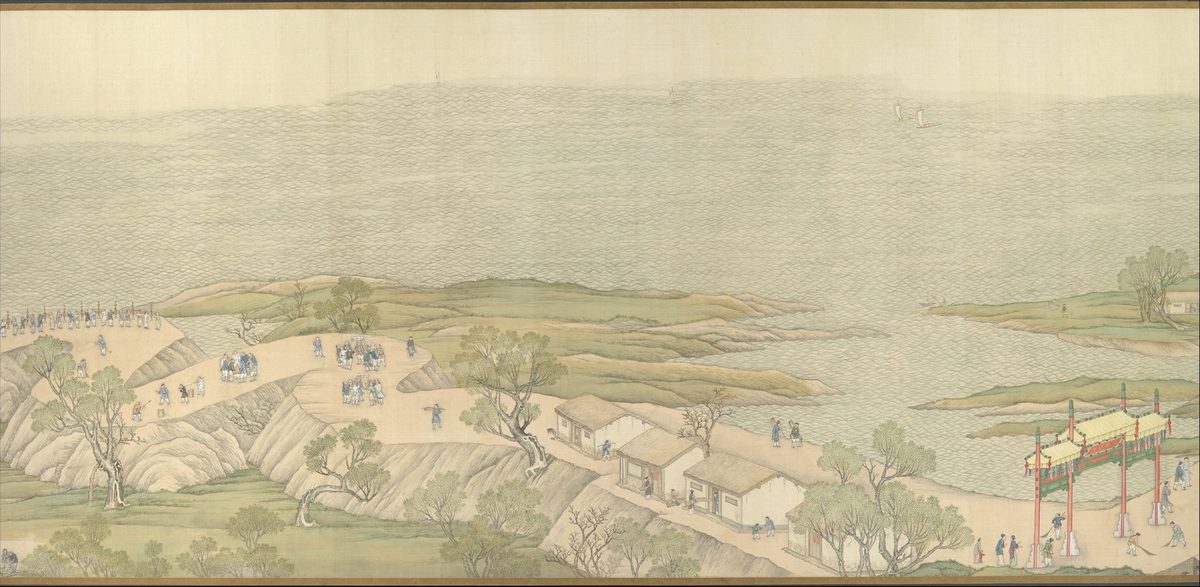
Xu Yang and others, detail of the fourth scroll; Metropolitan Museum of Art
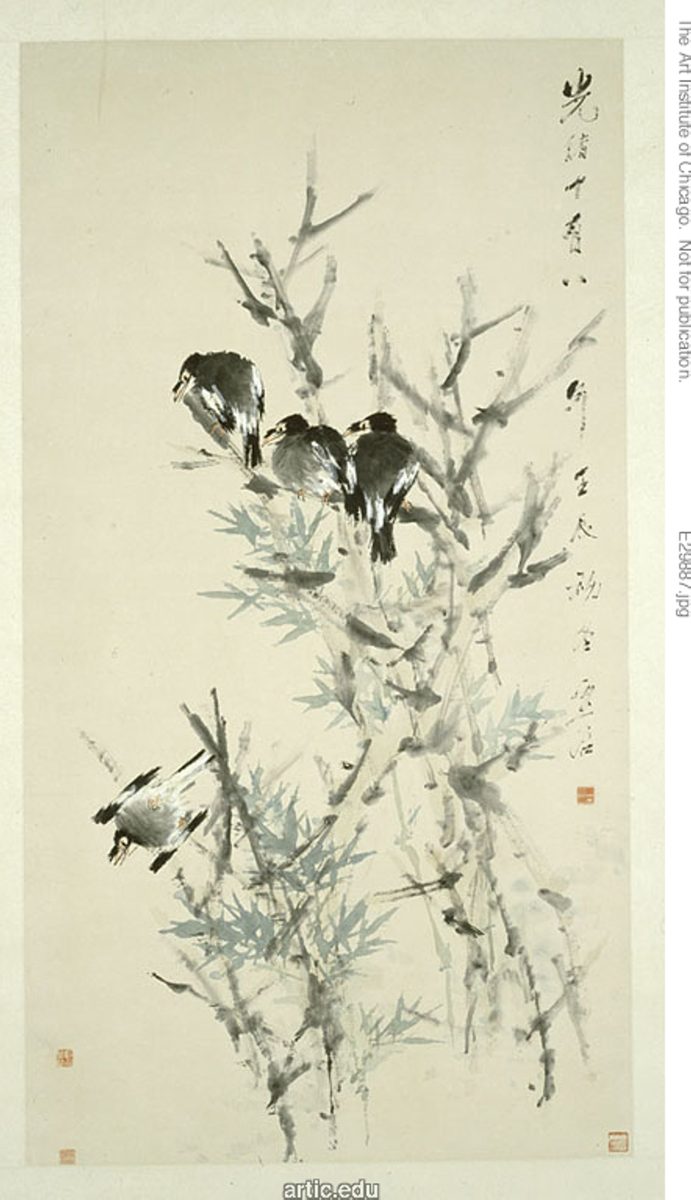
Art Institute of Chicago
Bada Shanren. The "Four Monks" were all members of the Ming imperial clan or Ming loyalists who became monks after the Qing conquest. Bada Shanren, Zhu Da, was a descendant of the Ming Prince of Ning. After the fall of the Ming he became a Buddhist monk, returned to lay life in old age and lived in Nanchang. His fish and birds often roll their eyes skyward, standing alone with hunched necks, proud and aloof; his compositions are extremely simple, a rock and a bird with large blank spaces. His signature "Bada Shanren", written as one linked form, resembles the characters for "weeping at it" or "laughing at it".
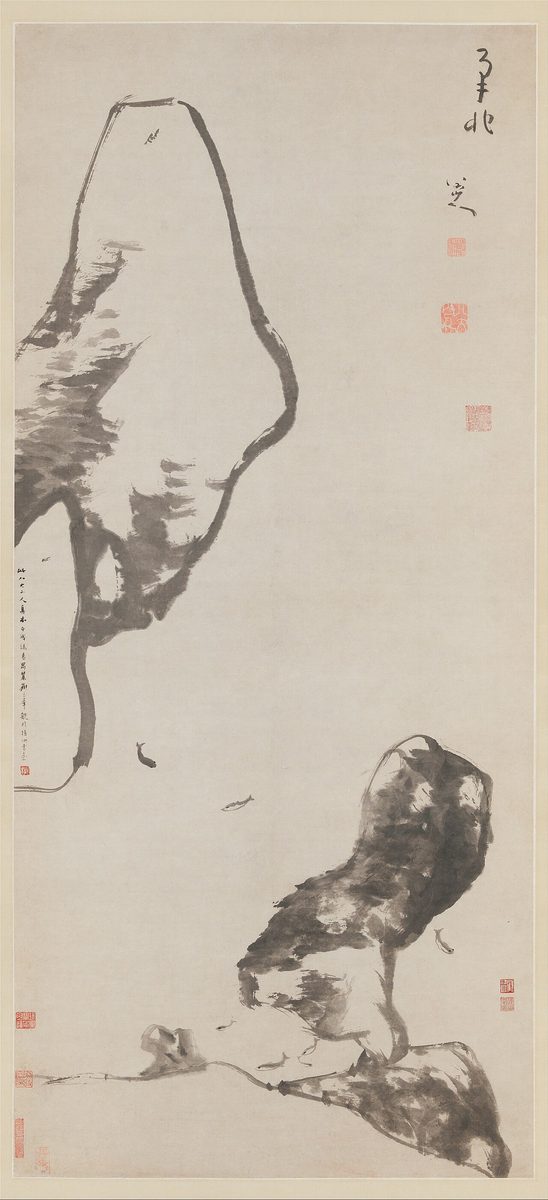
Fish and Rocks; Metropolitan Museum of Art
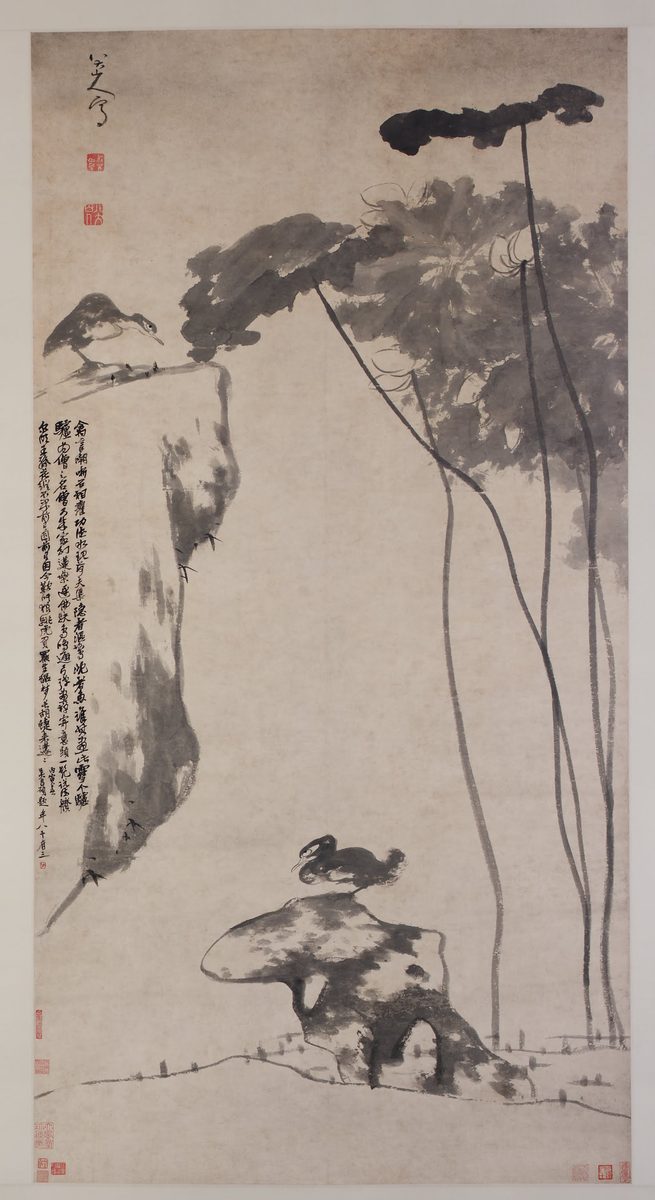
Lotus and Water Birds
Shitao. Shitao, born Zhu Ruoji, was also of the Ming imperial clan. He became a monk as a child, traveled widely, and settled in Yangzhou in his later years. His Sayings on Painting by the Monk Bitter Melon put forward the idea of the "single stroke", holding that the method of painting comes from the painter himself: "I am who I am; my self exists of itself." He opposed slavish imitation of the ancients, and in an inscription wrote that "brush and ink must follow the times". One of his inscriptions contains the line "searching out all the strange peaks to make sketches", which gave the title of his Searching Out All the Strange Peaks to Make Sketches. He visited Huangshan several times and painted many pictures of it.
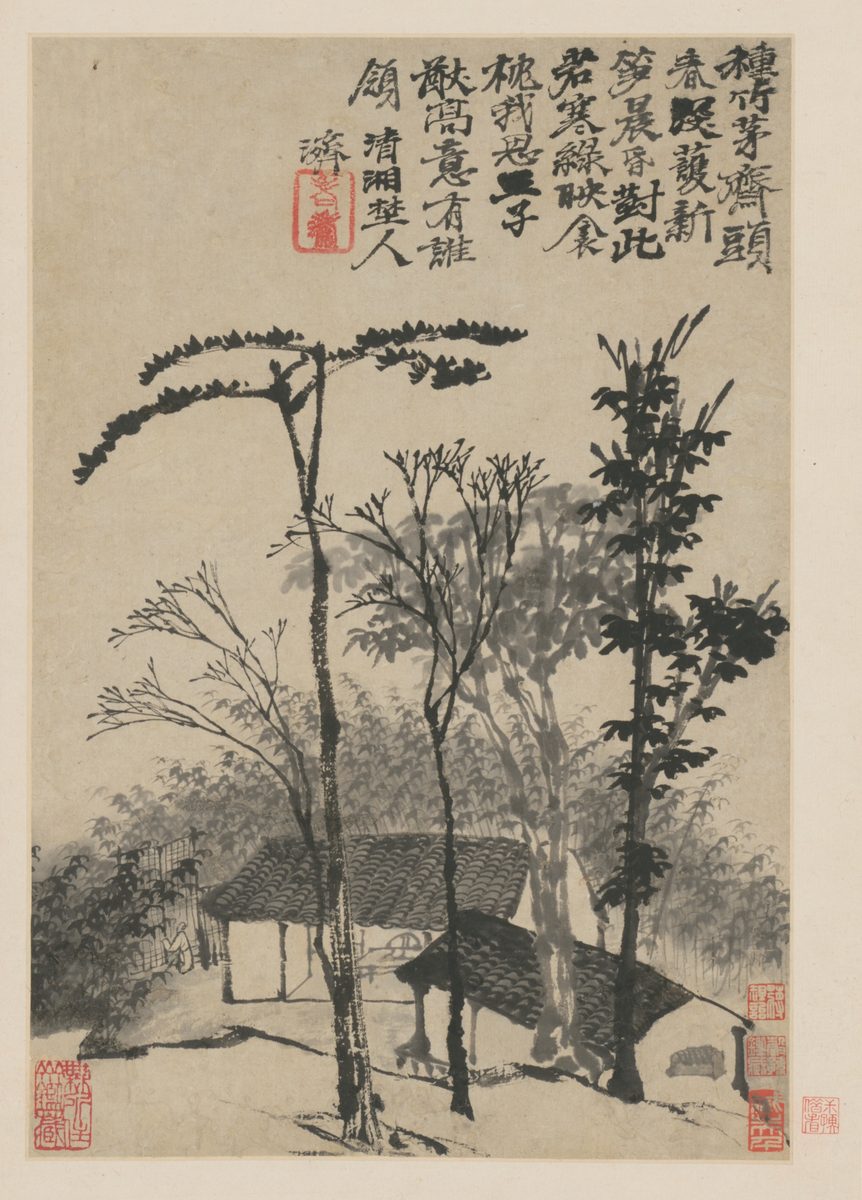
A leaf from the Huangshan album
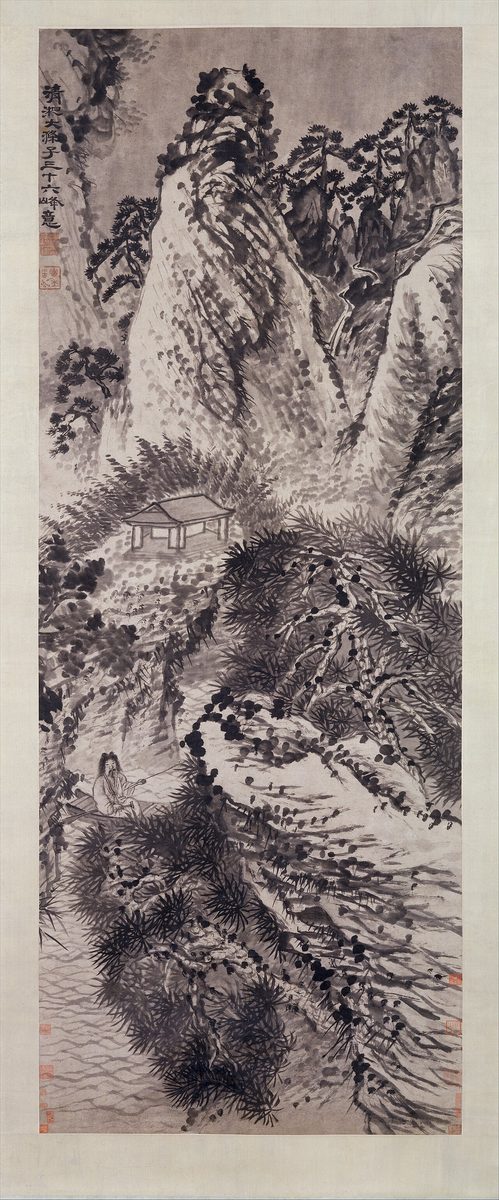
Thirty-six Peaks of Huangshan; Metropolitan Museum of Art

Pines and Rocks of Huangshan
Hongren, Kuncan and Gong Xian. Hongren, styled Jianjiang, from Shexian, became a monk after the fall of the Ming. He followed Ni Zan and for many years painted the pines and rocks of Huangshan in simple, square, hard lines, the rocks often in geometric planes; he represents the Xin'an School. Kuncan lived long in Nanjing and painted in a dense, vast, misty manner. Gong Xian, also in Nanjing, was the leader of the "Eight Masters of Jinling"; he built up ink in layer upon layer, luminous within the black, a method called "accumulated ink".
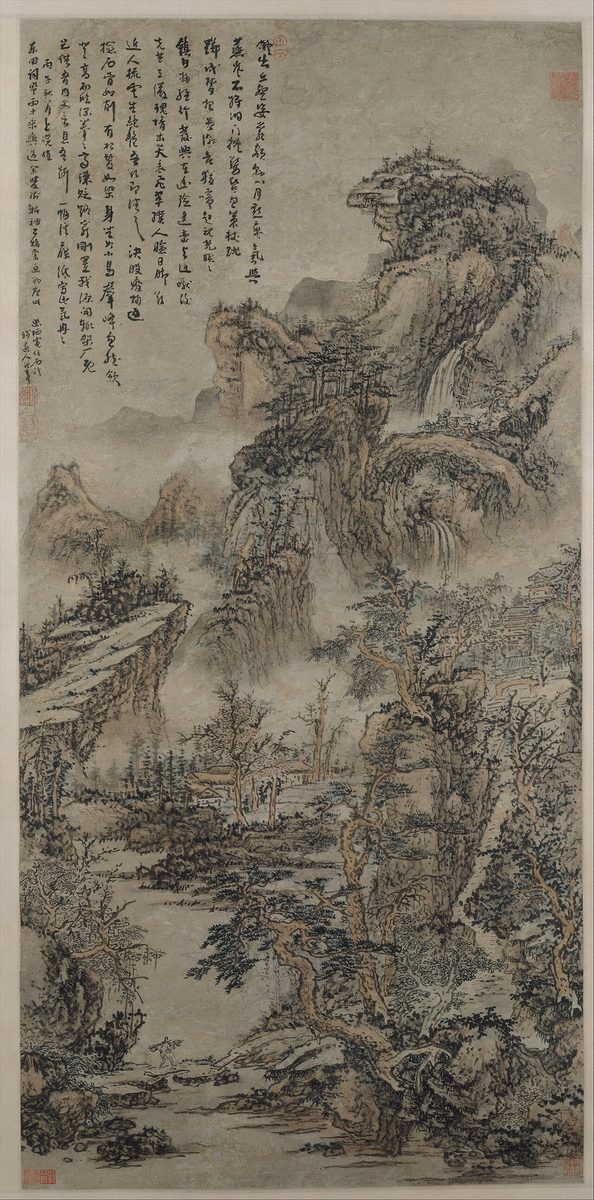
Metropolitan Museum of Art
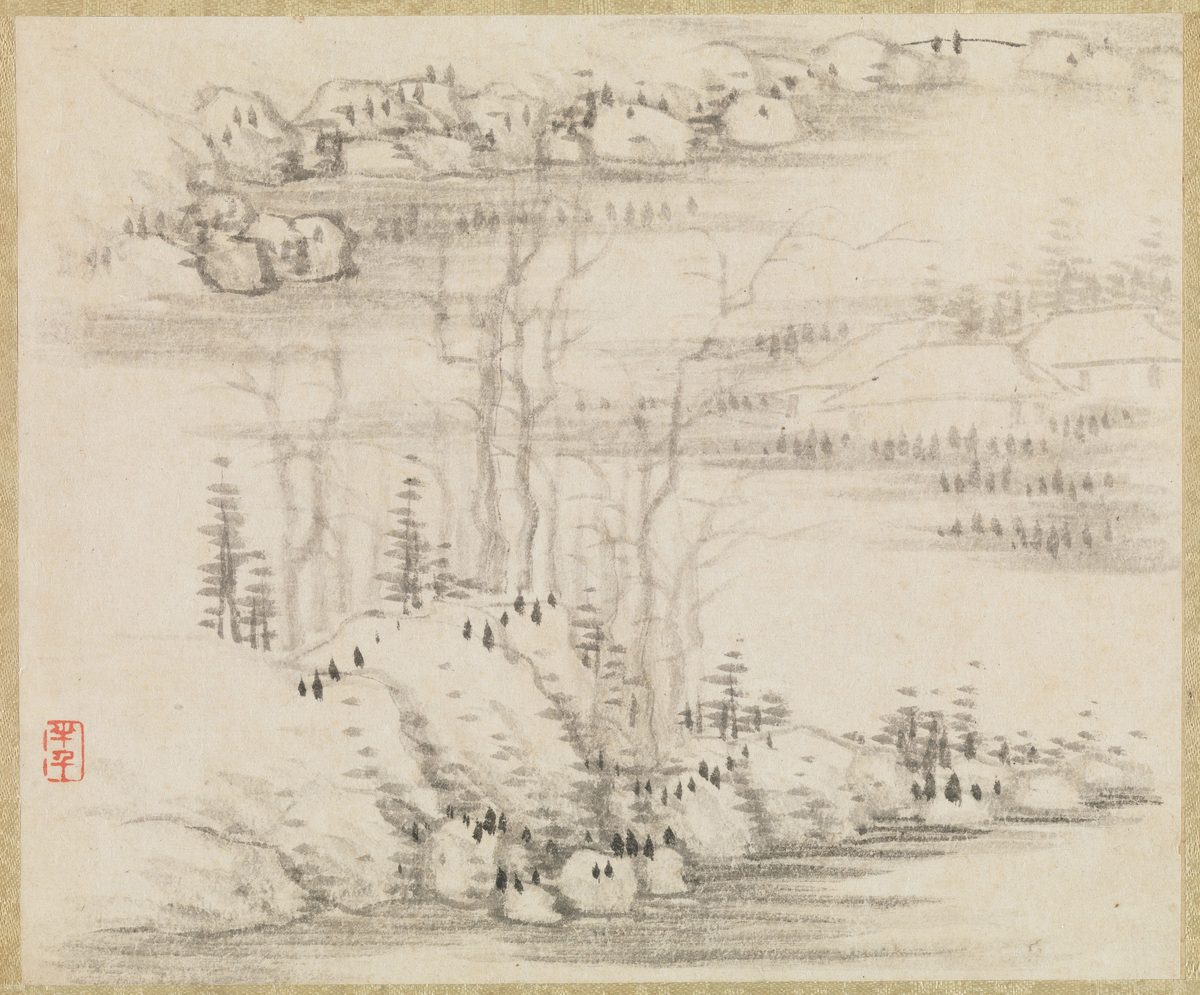
Landscape album; Metropolitan Museum of Art
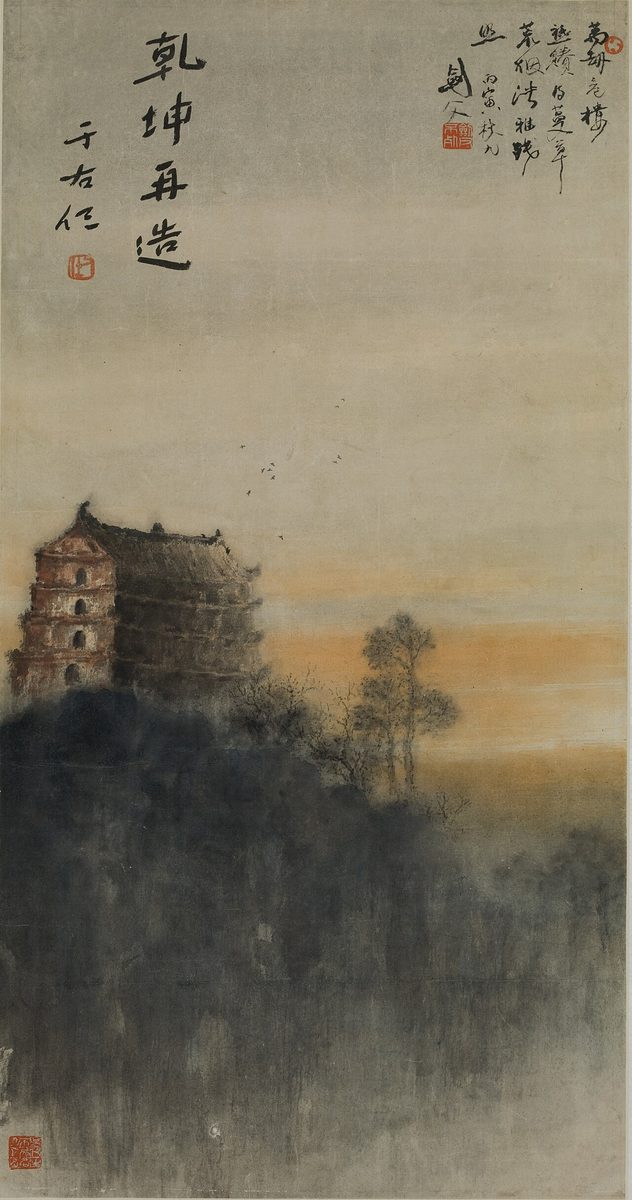
The Five-story Pagoda
The Eight Eccentrics of Yangzhou. In the mid-Qing, Yangzhou was the center of the Lianghuai salt trade, and its rich salt merchants loved collecting, drawing painters from everywhere to sell their work. A group of these painters ignored the established methods of the Four Wangs and followed Xu Wei, Bada Shanren and Shitao, mostly painting flowers, bamboo and rocks with unrestrained brush and ink, their poems and inscriptions illuminating the pictures. They were called the "Eight Eccentrics of Yangzhou"; "eight" is approximate, and lists have always varied. Zheng Xie (Zheng Banqiao) served as magistrate of Weixian in Shandong, then resigned and sold paintings in Yangzhou, painting bamboo, orchids and rocks with calligraphic brushwork. He wrote many poems on bamboo, the most famous being Bamboo and Rock: "Biting firmly into the green mountain, it will not let go." Jin Nong was famous for his self-invented flat, square clerical script ("lacquer script"); he began painting only after fifty, painting plum blossoms and Buddhas in an archaic, simple, solid manner.
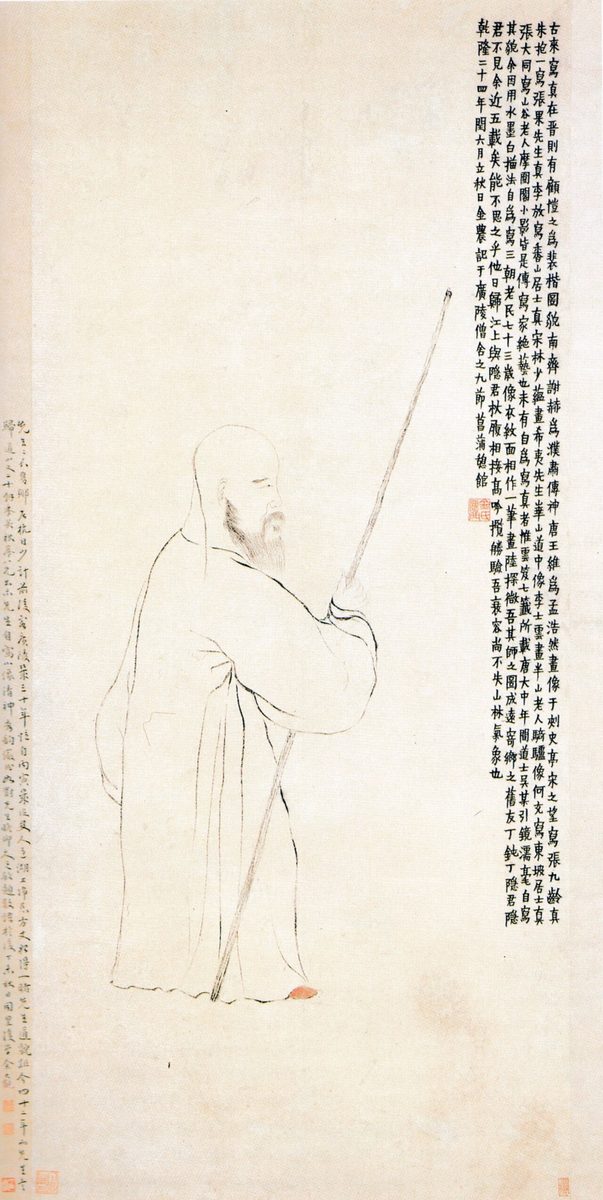
Self-portrait; Palace Museum, Beijing
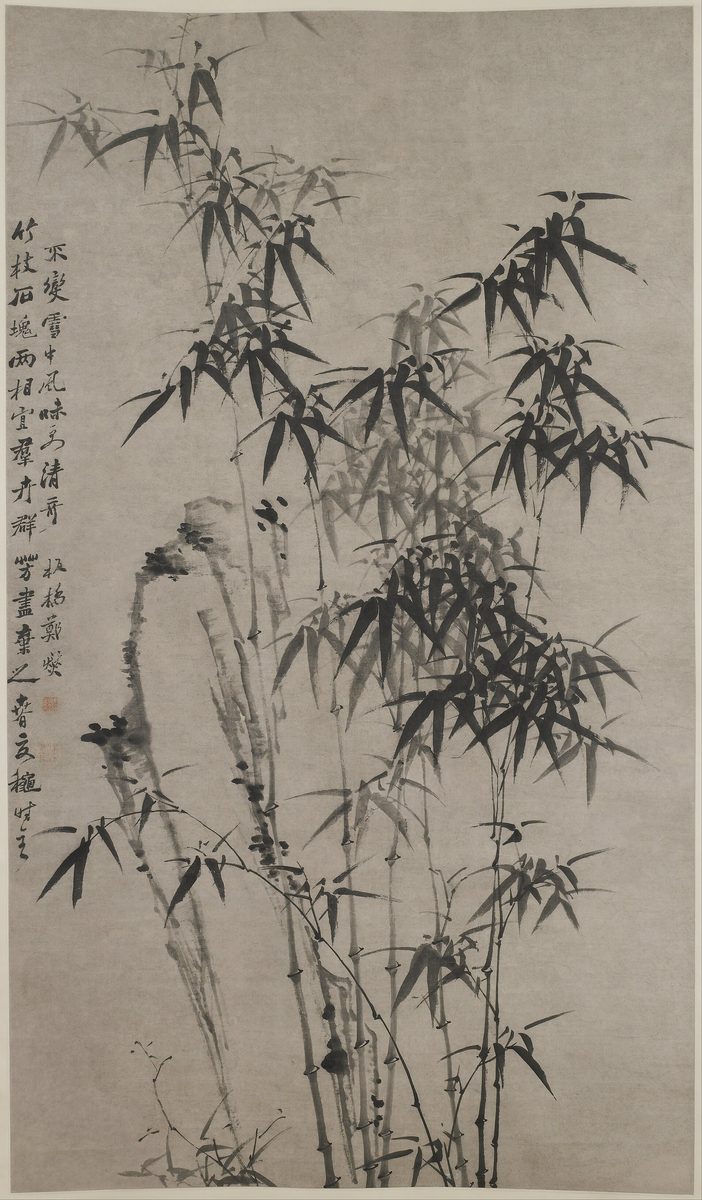
Bamboo and Rock

Handscroll of orchids, bamboo and rocks; Shanghai Museum
Giuseppe Castiglione. The Italian Jesuit Giuseppe Castiglione (Lang Shining) came to China at the end of the Kangxi reign and painted at court under the Kangxi, Yongzheng and Qianlong emperors. He used Western shading and perspective to paint horses, birds and flowers and imperial portraits, but with Chinese silk, paper, pigments and formats, creating a court style that combined Chinese and Western methods. One Hundred Horses shows a hundred horses grazing in open country. He also took part in designing the European-style palaces of the Yuanmingyuan.
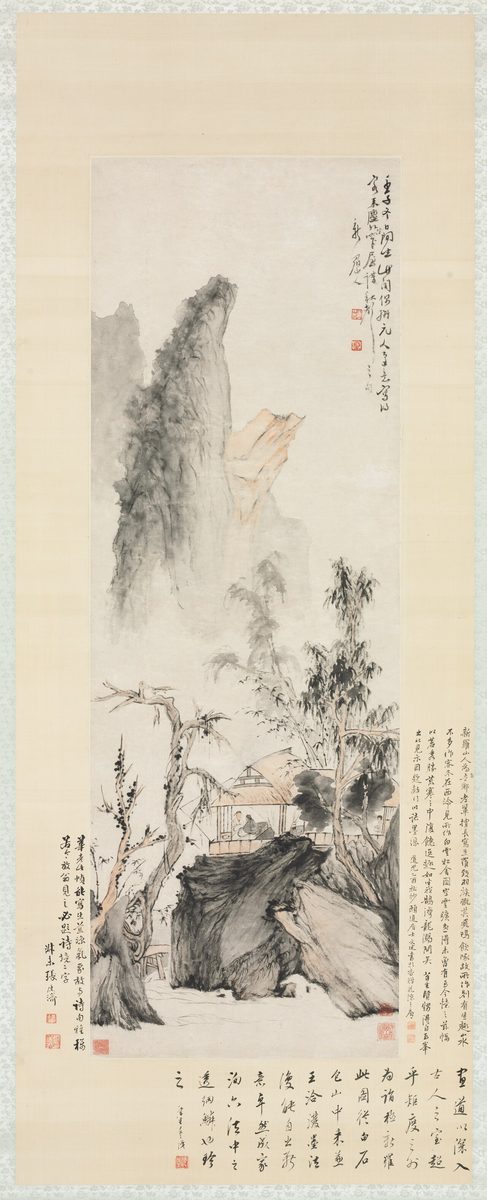
Autumn Sounds at the Golden House (after the Rhapsody on Autumn Sounds); Cleveland Museum of Art

Full scroll of One Hundred Horses; National Palace Museum, Taipei
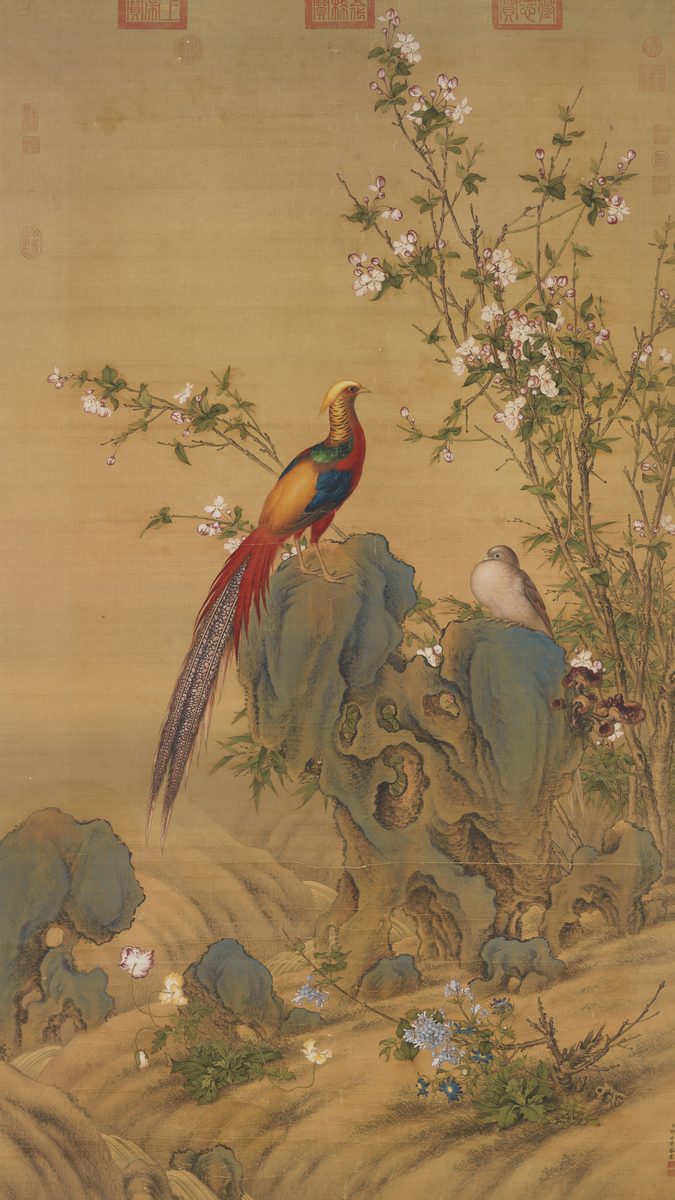
Immortal Blossoms of Everlasting Spring
The Shanghai School. After Shanghai was opened, commerce boomed and painters from everywhere gathered in Shanghai to sell their work; they are called the Shanghai School. Zhao Zhiqian applied the brushwork of ancient bronze and stone inscriptions to flowers; Ren Bonian excelled at both figures and birds and flowers, with lively forms and bright colors appealing to connoisseurs and the public alike. Wu Changshuo (1844–1927), from Anji, Zhejiang, mastered poetry, calligraphy, painting and seal carving. He painted plum blossoms, orchids, wisteria and rocks with the brushwork he used for the Stone Drum script, in rich colors and with great power, an approach called "bringing bronze and stone into painting". He was the first president of the Xiling Seal Engravers' Society. Qi Baishi, Pan Tianshou and others were influenced by him.

Flower screen
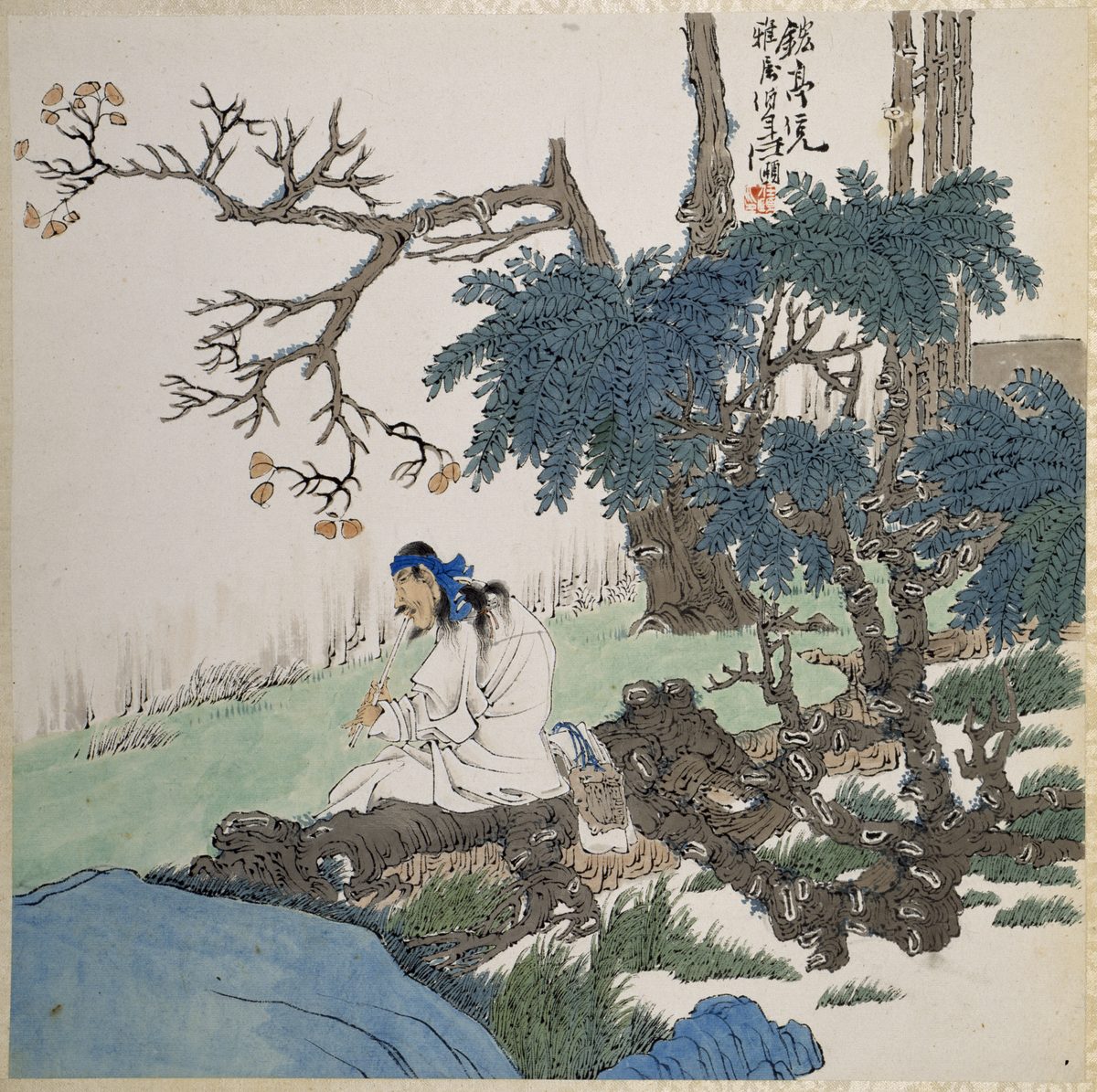
Playing the Xiao; Walters Art Museum
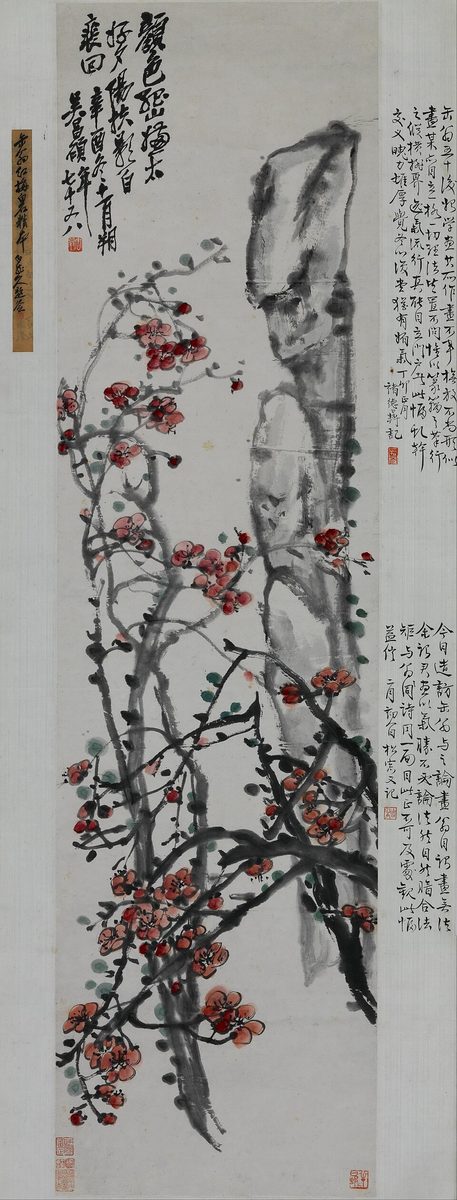
Red plum
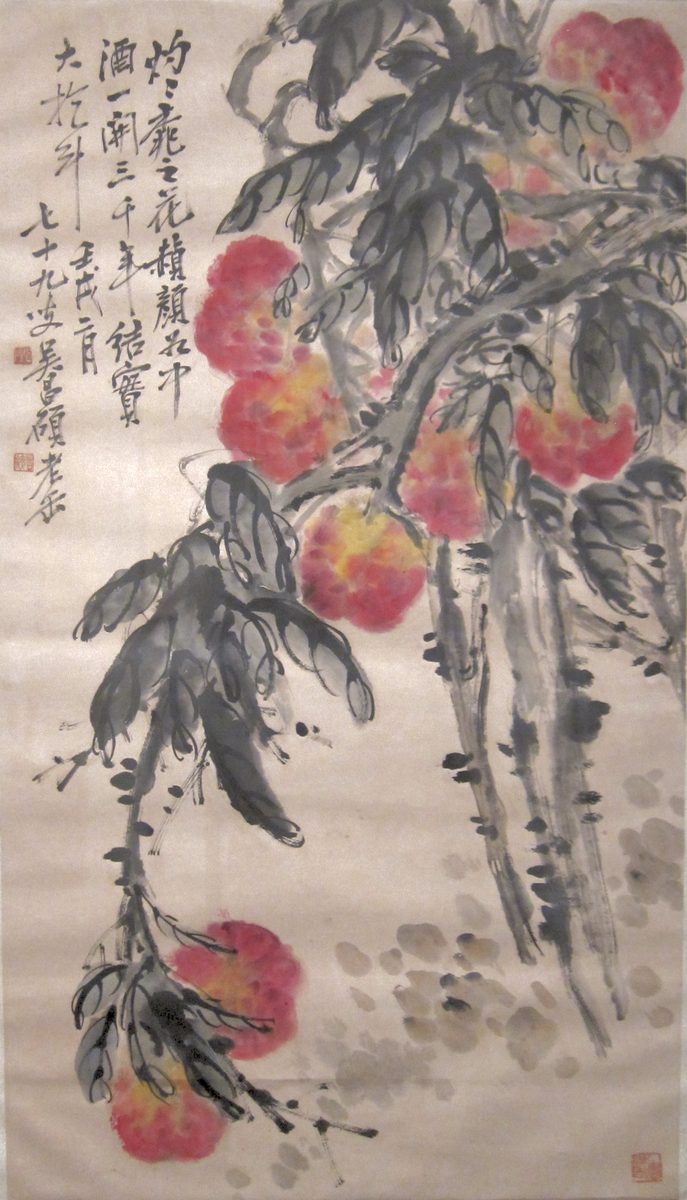
Peaches
New Year prints. Folk woodblock New Year prints were at their height in the Qing. The most famous come from Yangliuqing in Tianjin, Taohuawu in Suzhou and Yangjiabu in Weifang, Shandong. Yangliuqing prints are first printed in ink outline and then colored by hand, close to meticulous painting.
Representative works
| Work | Period | Type | Collection | Notes | |
|---|---|---|---|---|---|
| The Kangxi Emperor's Southern Inspection Tour↑ | Qing | Handscroll, ink and color on silk, Wang Hui and others | Palace Museum and others | Originally twelve scrolls, some now dispersed abroad. |
| Album for Anwan | Qing | Album, ink on paper, Bada Shanren | Sen-oku Hakuko Kan, Japan | Fish, birds, flowers and fruit in extremely simple compositions. | |
| Searching Out All the Strange Peaks to Make Sketches | Qing | Handscroll, ink on paper, Shitao | Palace Museum | Titled after a line from his inscription. | |
| Eight Views of Huangshan | Qing | Album, ink and color on paper, Shitao | Sen-oku Hakuko Kan, Japan | Scenes of Huangshan. | |
| Huangshan | Qing | Album, ink on paper, Hongren | Palace Museum | Scenes of Huangshan with geometric rocks. | |
| Verdant Peaks Reaching the Sky | Qing | Hanging scroll, ink and color on paper, Kuncan | Nanjing Museum | Dense and misty. | |
| Bamboo and Rock | Qing | Ink on paper, Zheng Xie | Zheng Xie painted many bamboo-and-rock pictures, each with a different poem. | ||
| One Hundred Horses | Qing | Handscroll, ink and color on silk, Giuseppe Castiglione | National Palace Museum, Taipei | Western shading techniques. | |
| Portrait of a Poor Official | Qing | Hanging scroll, ink and color on paper, Ren Bonian | Zhejiang Provincial Museum | A portrait of Wu Changshuo. | |
| Flowers↑ | Qing | Ink and color on paper, Wu Changshuo | Plum, orchid, wisteria and rock, bringing bronze and stone into painting. |