
How to Read a Daoist Temple
Like Buddhist temples, Daoist temples are laid out in successive courtyards along a central axis, but the hall names and deities differ greatly. This article explains what Daoist temples are called and who is enshrined in each hall on the axis, then looks at temples on several famous mountains.
Gong, Guan, Miao and Ci
Daoist temples are collectively called gongguan. A guan was originally a tall terrace for gazing into the distance. According to legend, Yin Xi, keeper of the Hangu Pass, built a thatched tower to watch the stars and the vapors, and so welcomed Laozi on his journey west; later the places where Daoists practiced came to be called guan. Gong (palace) originally meant an imperial residence, and only large Daoist temples honored by the court were called gong: the Zixiao Palace and Nanyan Palace on Mount Wudang were both built by imperial order in the Ming dynasty. Small Daoist temples are also called daoyuan or an, or are named after caves, such as the Tianshi Cave on Mount Qingcheng and the Mingxia Cave on Mount Lao. China has twenty-one national key Daoist temples (list).
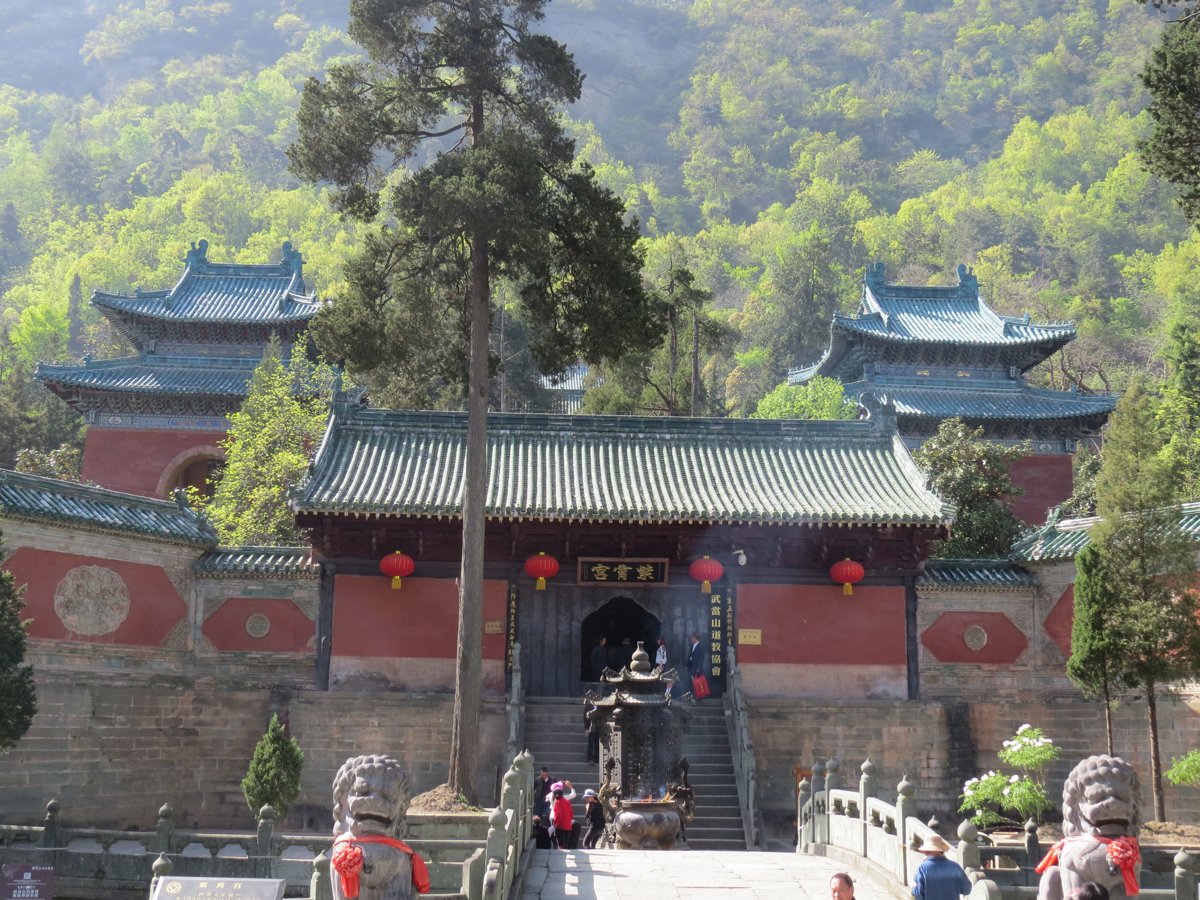
Zixiao Palace, Mount Wudang, Hubei
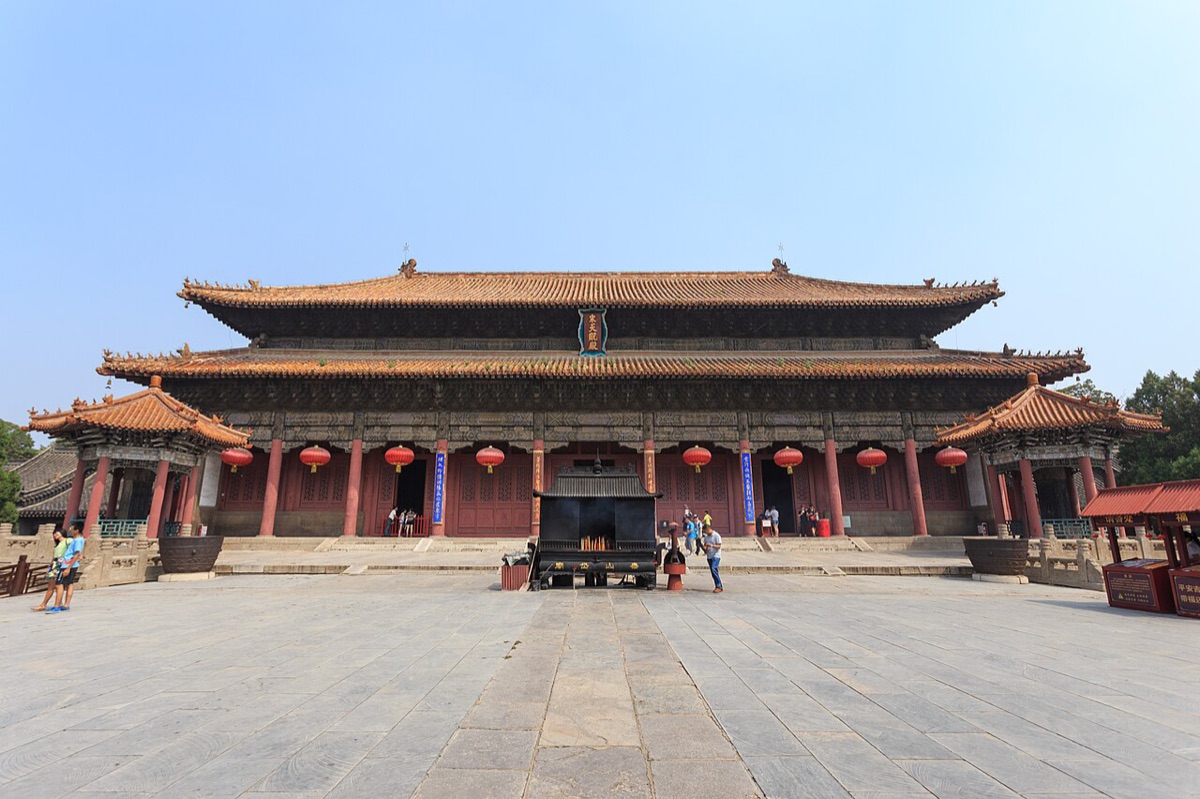
Temple of Mount Tai, Tai'an, Shandong, where the god of Mount Tai is worshipped
Zhangzhugang, CC BY-SA 4.0, Wikimedia Commons
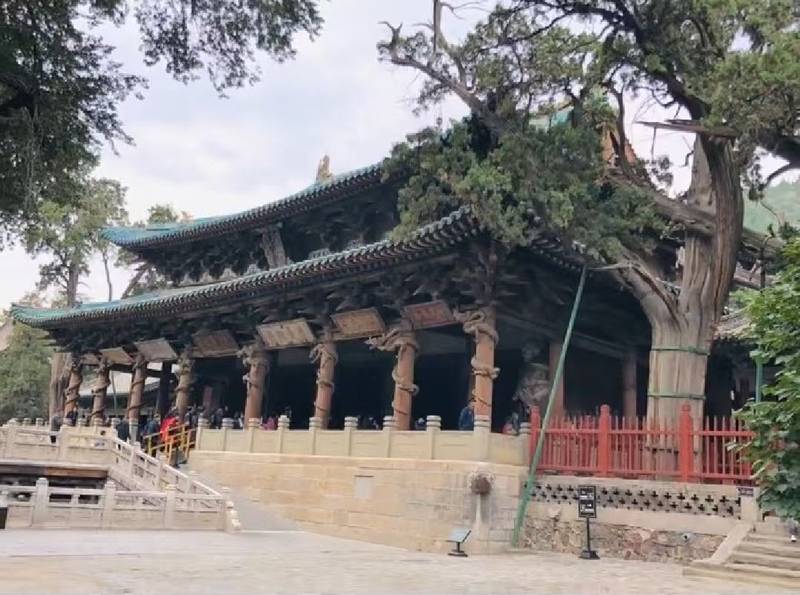
Hall of the Holy Mother and the Zhou cypress, Jinci Temple, Taiyuan, Shanxi; Northern Song
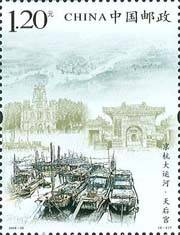
Tianhou Palace, Tianjin, dedicated to Mazu
Stamp
A miao or ci is not necessarily Daoist. A miao was originally a place of sacrifice to ancestors and gods. Each of the Five Sacred Mountains has its own mountain temple, where officials sent by the court offered sacrifices to the mountain god: the Temple of Mount Tai in Tai'an worships the god of Mount Tai, and its main hall is the Tiankuang Hall; the Dening Hall of the Beiyue Temple in Quyang is a Yuan-dynasty hall. A ci was mostly built to commemorate a particular person. Jinci in Taiyuan was originally a shrine to Shu Yu of Tang of the Western Zhou, and the Hall of the Holy Mother, built in the Song, honors Shu Yu's mother, Yi Jiang (see A Brief History of Chinese Architecture, Chapter 6). Gods of folk and state worship such as mountain gods, city gods and Mazu were later mostly absorbed into the Daoist pantheon. Temples to Mazu are also called Tianhou Palaces; the Tianhou Palace in Tianjin stands beside the Hai River.
Along the Central Axis
Larger Daoist temples mostly face south and, like Buddhist temples, extend back in successive courtyards along a central axis, with side halls, galleries and the Daoists' living quarters on either side (see Chapter 1). The number of halls varies from temple to temple; the usual sequence is roughly as follows.
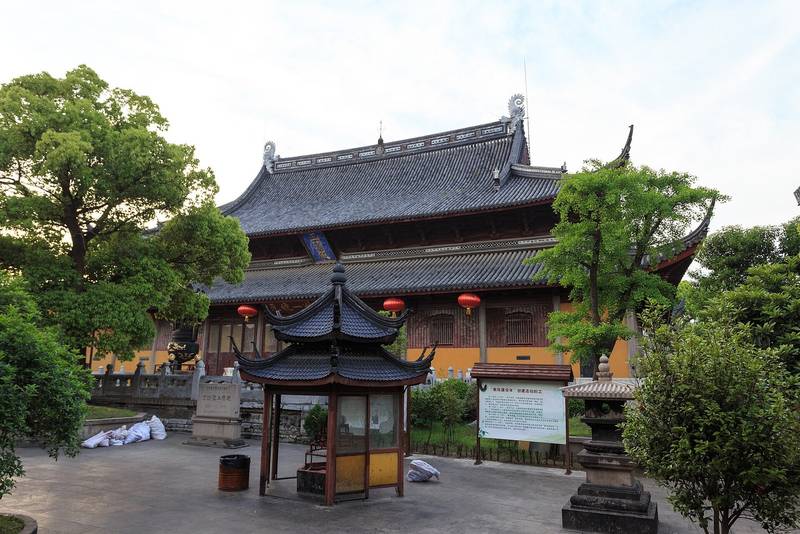
Sanqing Hall of the Xuanmiao Temple, Suzhou, Jiangsu; Southern Song
Zhangzhugang, CC BY-SA 4.0, Wikimedia Commons
Gate. In front of the gate there is often a memorial archway and a screen wall, and the gate usually has three openings. Inside, a bell tower and a drum tower stand on the left and right.
Lingguan Hall. The first hall is usually dedicated to Wang Lingguan, a guardian deity of Daoism. Red-faced and three-eyed, holding a golden whip, he guards the gate, playing the same role as the Four Heavenly Kings and Weituo in the Hall of Heavenly Kings of a Buddhist temple.
Jade Emperor Hall. It enshrines the Jade Emperor, revered in popular belief as the lord of all gods, often flanked by statues of heavenly generals and heavenly lords.
Hall of the Three Pure Ones (Sanqing Hall). Usually the main hall of the whole temple, it enshrines the three highest gods of Daoism: the Celestial Worthy of Primordial Beginning (Yuanshi Tianzun) of the Jade Purity in the center, with the Celestial Worthy of Numinous Treasure (Lingbao Tianzun) of the Supreme Purity and the Celestial Worthy of the Way and Its Virtue (Daode Tianzun) of the Great Purity on either side. Daode Tianzun is Taishang Laojun, the deified Laozi. The Sanqing Hall of the Xuanmiao Temple in Suzhou, built in the Southern Song, is an important Song timber hall in the Jiangnan region; it stands in the center of Suzhou, surrounded by busy streets.
Hall of the Four Sovereigns, Doumu Hall. The Four Sovereigns are four celestial emperors who assist the Three Pure Ones: the Jade Emperor at their head, the Ziwei Emperor, the Gouchen Emperor and Houtu, the earth goddess. Doumu, the mother of the stars of the Big Dipper, is usually shown with many heads and arms; the Doumu Palace on the climbing route of Mount Tai is named after her.
Patriarch Hall. It enshrines the founder of the school or the Daoist who founded the temple. Quanzhen temples often have a Lü Zu Hall for Lü Dongbin, one of the Eight Immortals, and a Qiu Zu Hall for Qiu Chuji, one of the Seven Quanzhen Masters, who traveled west to meet Genghis Khan. The White Cloud Temple in Beijing is the ancestral temple of the Quanzhen school, and Qiu Chuji is buried there. Its axis runs from the gate through the Lingguan Hall, the Jade Emperor Hall, the Laolü Hall and the Qiu Zu Hall to the two-story Sanqing Pavilion at the back, with the Three Pure Ones upstairs and the Hall of the Four Sovereigns downstairs.
Who is enshrined in the main hall also depends on a temple's origins. Mount Wudang takes Zhenwu, the Perfected Warrior, as its principal god, and both the Golden Hall on the summit and the palaces on the mountain enshrine him; the Taisu Palace on Mount Qiyun in Anhui also worships Zhenwu, and the mountain is known as "Little Wudang." Side halls often house the god of wealth, the King of Medicine, Wenchang, the Perfected Cihang and others, and they often draw more worshippers than the main hall.
Quanzhen and Zhengyi
After the Yuan dynasty, Daoism divided mainly into two schools, Quanzhen and Zhengyi, and the difference can be seen in their temples. Quanzhen (Complete Perfection) Daoism arose in the Jin dynasty with Wang Chongyang as its founder; its Daoists leave home to live in temples, keep their hair long and tied in a topknot, remain unmarried and eat no meat. Large Quanzhen temples are called shifang conglin, public monasteries where Daoists from anywhere may come and stay, and the abbot is chosen by common consent; small temples passed from master to disciple are called hereditary temples. Zhengyi (Orthodox Unity) Daoism, also called Celestial Masters Daoism, reveres Zhang Daoling of the Eastern Han as its founder; its Daoists may marry and do not necessarily live in temples.
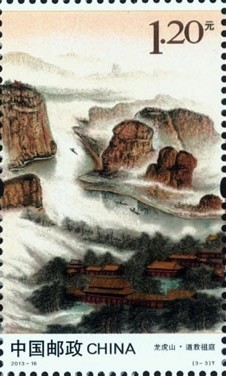
Mount Longhu, Jiangxi
Stamp
Taiqing Palace, Mount Lao, Qingdao, Shandong
Stamp
The center of the Zhengyi school is Mount Longhu in Jiangxi. The Mansion of the Celestial Masters, home of the successive Celestial Masters Zhang, has a temple in front and a residence behind, with a mansion gate, a Jade Emperor Hall, the Celestial Master's private residence, the Altar of the Ten Thousand Methods and more; the front half resembles a Daoist temple, the rear half an official's mansion. Quanzhen sites are mostly in the north: Mount Lao is where Qiu Chuji and Liu Chuxuan taught, and most of the temples on Mount Hua also belong to the Quanzhen line.
Temples on Famous Mountains
Daoist temples on flat ground favor a regular, symmetrical plan, while those in the mountains follow the terrain. Daoism values quiet cultivation and longs for the grotto-heavens and blessed lands where immortals dwell, so the temples of a famous mountain are often strung along the sacred way up the slope, within sight of one another, culminating at the summit.
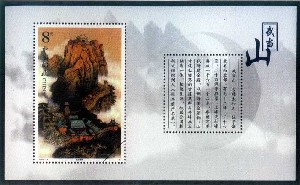
Golden Summit of Tianzhu Peak, Mount Wudang
Stamp
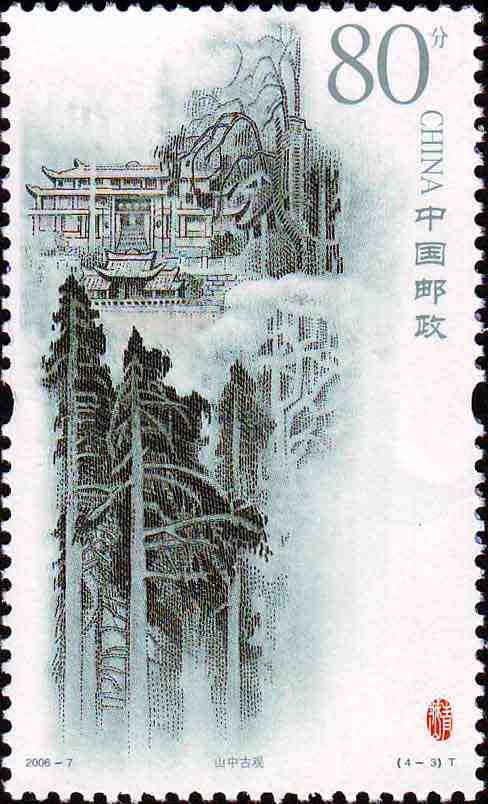
Mount Qingcheng, Sichuan
Stamp
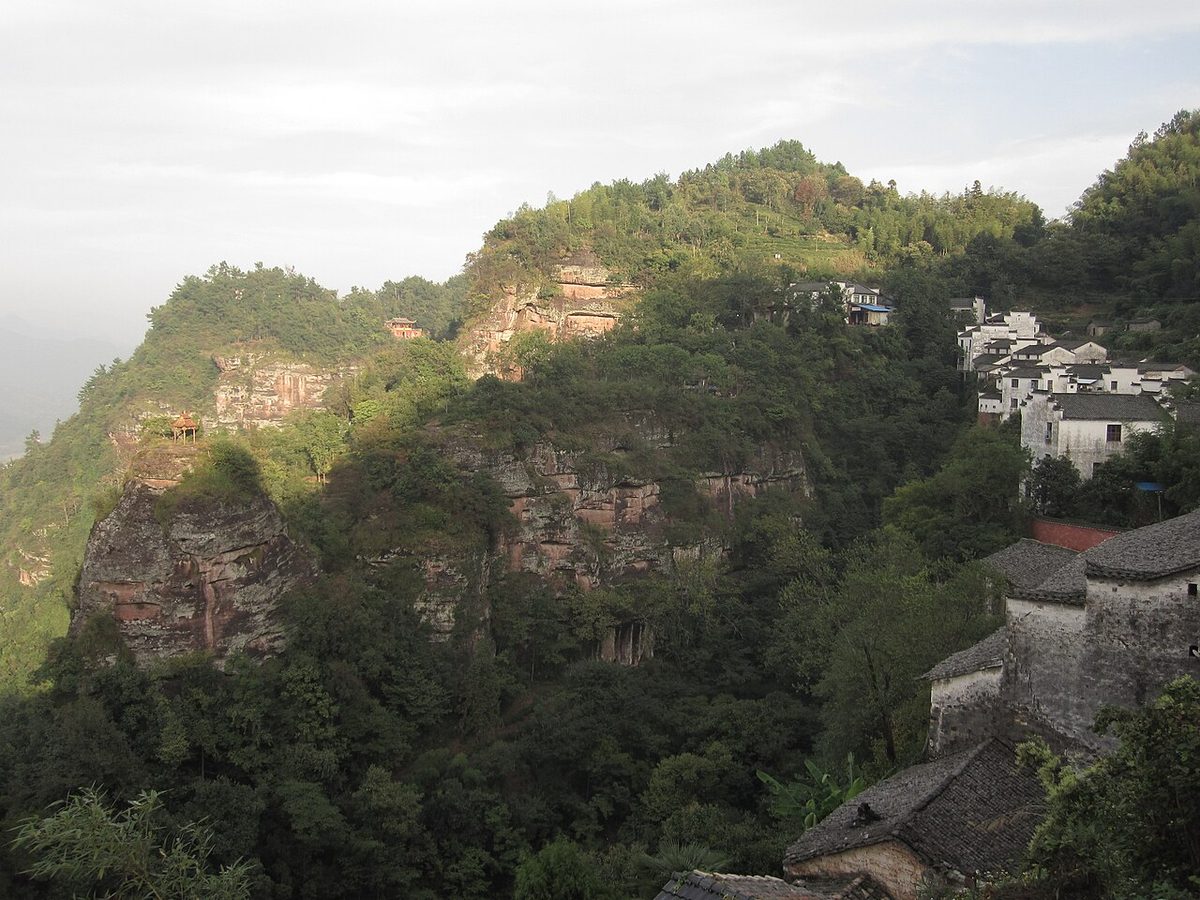
Mount Qiyun, Anhui
Julienfuchs, CC BY-SA 3.0, Wikimedia Commons
Mount Wudang has the largest complex. When the Yongle Emperor of the Ming rose in arms to seize the throne, he claimed the protection of Zhenwu, and after his accession he built up Mount Wudang on a grand scale as an imperial Daoist site. The palaces and temples line the ancient sacred way from the Yuxu Palace at the foot of the mountain all the way to the top of Tianzhu Peak. The Zixiao Palace stands below Zhanqi Peak, its halls rising terrace by terrace; the Nanyan Palace clings to a cliff; the Golden Hall on the summit is cast entirely in gilded bronze in imitation of timber construction, and is encircled by a stone wall called the Purple Forbidden City. The Ancient Building Complex in the Wudang Mountains is a World Cultural Heritage site.
Other famous mountains each have their own character. The front mountain of Qingcheng is mainly temples: the Jianfu Palace near the entrance, the Tianshi Cave halfway up and the Shangqing Palace near the top lie hidden in dense forest. The Tianshi Cave was anciently called the Changdao Temple, and Zhang Daoling is said to have practiced here. The Taiqing Palace of Mount Lao, on the seashore at the southern foot, is the largest and oldest Daoist temple on the mountain; in front of its Sanguan Hall grow a Han cypress and a Tang elm, and the Heavenly Official, Earthly Official and Water Official worshipped there are together called the Three Officials. On Mount Hua, Daoist temples were built all the way from the Yuquan Temple at the foot to the peaks. On Mount Tai, too, Daoist temples line the climbing route, from the Temple of Mount Tai at the foot and the Doumu Palace halfway up to the Bixia Temple and Jade Emperor Peak on the summit, so that climbing the mountain is a pilgrimage all the way.
Yongle Palace: Murals
In a Daoist temple, the murals inside the halls are often more worth seeing than the buildings themselves. The Yongle Palace in Ruicheng, Shanxi, originally named the Great Chunyang Palace of Longevity, was built in Lü Dongbin's home village and was a major Quanzhen temple of the Yuan dynasty. Along its axis stand the Palace Gate, the Wuji Gate, the Hall of the Three Pure Ones, the Chunyang Hall and the Chongyang Hall, and all three main halls are covered with Yuan murals. The Chaoyuan Tu in the Hall of the Three Pure Ones shows the gods paying homage to the Celestial Worthy of Primordial Beginning: several hundred immortals, their sashes floating, form a vast procession. The Chunyang Hall depicts the life of Lü Dongbin, and the Chongyang Hall Wang Chongyang and the Seven Quanzhen Masters. The temple originally stood beside the Yellow River; because of a reservoir project, the whole complex was moved, murals and all, and rebuilt on its present site (see Chapter 7).
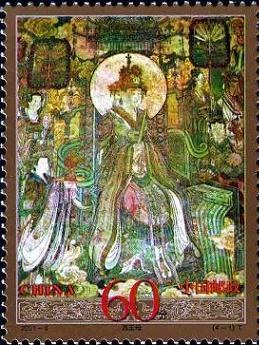
Mural in the Hall of the Three Pure Ones, Yongle Palace
Stamp
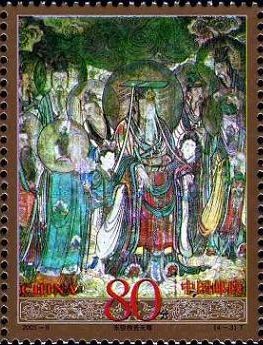
Mural in the Hall of the Three Pure Ones, Yongle Palace
Stamp
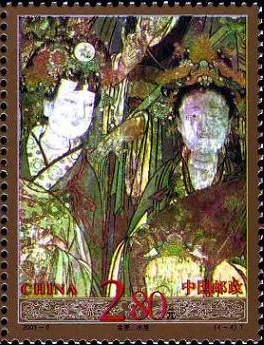
Mural in the Hall of the Three Pure Ones, Yongle Palace
Stamp
Compared with Buddhist Temples
Daoist temples and Buddhist temples come from the same Chinese building tradition: timber halls, axial symmetry and successive courtyards, with the gate, bell and drum towers, main hall and rear building in similar positions, so at first glance they are hard to tell apart. A few things give them away. The first hall inside the gate is the Hall of Heavenly Kings in a Buddhist temple and the Lingguan Hall in a Daoist one; the main hall is the Mahavira Hall in a Buddhist temple, and usually the Hall of the Three Pure Ones or the Jade Emperor Hall in a Daoist one. Buddha statues usually sit cross-legged in the lotus position with snail-shell curls, whereas Daoist deities wear crowns and robes like emperors and officials. Buddhist temples often have pagodas and pagoda forests; Daoist temples rarely build pagodas. Daoist roof ridges, doors, windows and incense burners often bear the eight trigrams, the taiji symbol, cranes and gourds. Daoists tie up their hair and wear caps, while monks shave their heads, another difference visible at a glance.