 Park of China
Overview
| Designation | UNESCO World Heritage (cultural, 1997) AAAAA tourist attraction |
| Province | Jiangsu |
| Location | Suzhou, Jiangsu |
| Latitude, longitude | 31.3, 120.6 Google Maps |
| Highlights | Classical gardens |
| Top sights | The Humble Administrator’s Garden, the Lingering Garden, the Master of the Nets Garden, the Lion Grove |
| Nearby cities | Shanghai, Wuxi, Suzhou |
| Nearby sites | Lake Tai 40km, Archaeological Ruins of Liangzhu City 116km, West Lake, Hangzhou 125km, Shugang and Slender West Lake, Yangzhou 167km, Zhongshan (Purple Mountain), Nanjing 187km Search nearby |
| Themes | Garden, Stone, Culture, Ancient Building, City, Stamp, Chinese gardens |
About
Suzhou in Jiangsu is known as the “city of gardens”, with more than ten famous ones. In 1997 and 2000 nine of its classical gardens were inscribed on the World Heritage List: the Humble Administrator’s Garden, the Canglang Pavilion, the Lingering Garden, the Master of the Nets Garden, the Couple’s Garden, the Lion Grove, the Mountain Villa with Embracing Beauty, the Garden of Cultivation and the Retreat and Reflection Garden. The Humble Administrator’s Garden and the Lingering Garden are among the four great gardens of China.
The Humble Administrator's Garden was built by Wang Xianchen, a censor who had left office, on the site of the Yuan-dynasty Dahong Temple. In 1533 Wen Zhengming painted 31 views of the garden. After Wang's death his son lost the garden to the Xu family in a single night of gambling.
The Lingering Garden began as the East Garden of the Ming official Xu Taishi. In 1798 Liu Shu rebuilt it as Hanbi Villa, known as the Liu Garden; Sheng Kang bought and rebuilt it, and on completion in 1876 renamed it Liu Yuan ("lingering"), a homophone of the old name. Its main hall, the Hall of Five Peaks, has nanmu columns and is the largest hall in any Jiangnan garden.
The Lion Grove was built as a Chan monastery by disciples of the monk Tianru, who named it after the Lion Cliff on Mount Tianmu where his teacher Zhongfeng had attained enlightenment. The Qianlong Emperor visited several times and wrote the plaque "True Delight" (Zhenqu), for which the Zhenqu Pavilion was built.
The Master of the Nets Garden stands on the site of the Southern Song official Shi Zhengzhi's Wanjuan Hall, first called Yuyin ("fisherman's retreat"). In the Qianlong era Song Zongyuan rebuilt it as Wangshi Yuan ("master of the nets" meaning fisherman); its present layout dates mostly from the later owner Qu Zhaokui.
The Canglang Pavilion garden was once the garden of Qian Yuanliao, Prince of Guangling of the Wuyue kingdom. In the 1040s the poet Su Shunqin bought the abandoned site and built a pavilion by the water, naming it after the Chuci line "When the Canglang waters are clear, I wash my hat-strings." Its Shrine of Five Hundred Worthies holds 594 stone portraits of figures from Suzhou's history.
Travel tips
Getting there: Suzhou station and Suzhou North station both have high-speed trains, under an hour from Shanghai. Most gardens are in the old city and linked by metro, bus or on foot.
Booking: tickets for the Humble Administrator's Garden and other popular gardens must be bought online in advance under your real name (passport for foreign visitors); on holidays they often sell out early.
Humble Administrator's Garden and Lion Grove Garden: in the northeast of the old city, close together and next to the Suzhou Museum; easy to see in one visit.
Lingering Garden: outside Changmen Gate on the west side of the old city; a separate trip.
Master of the Nets Garden and others: the Master of the Nets Garden, the Surging Waves Pavilion, the Garden of Cultivation and the Couple's Retreat are smaller and quieter; the Couple's Retreat is near Pingjiang Road. The Master of the Nets Garden has an evening garden from March to mid-November, but not in winter.
Time: one to two hours per garden; two days for four or five gardens.
Season: spring and autumn are best; the plum-rain season is around June, and summer is hot and humid.
Caution: the Humble Administrator's Garden and Lion Grove are crowded on holidays, so go at opening time; the small gardens suit a slow visit.
The Humble Administrator’s Garden
At 178 Dongbei Street, the garden was laid out in 1509 and covers 5.2 hectares; it is a national protected site and one of the four great gardens of China. It has an east, a central and a west garden and a residence; the central garden is the finest part. The name comes from Pan Yue’s Jin-dynasty “Rhapsody on Living at Leisure”, which calls tending a garden and selling vegetables the only “governing” of a humble man.
The bonsai garden holds nearly 10,000 Suzhou-style bonsai, and the Yashi Studio is a museum of curious rocks.
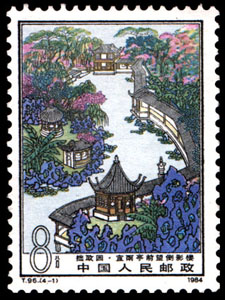
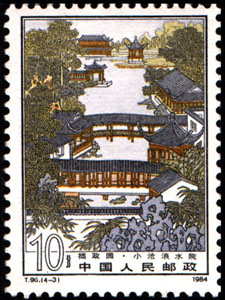
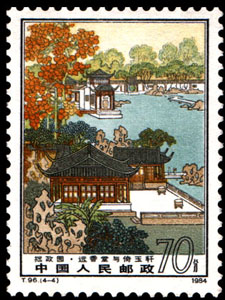
In 1984 T.96 “Suzhou Gardens: the Humble Administrator’s Garden” was issued, four stamps: the Reflection Tower seen from the Pavilion Suitable for Both (8 fen), the Loquat Garden (8 fen), the Little Canglang water court (10 fen) and the Hall of Distant Fragrance with the Jade Pavilion (70 fen).

The Lingering Garden
On Liuyuan Road outside Changmen Gate, the Lingering Garden was begun in 1593 and is famous for its rigorous layout and rich scenery; it is a national protected site and one of the four great gardens.
It has central, east, west and north sections, the central and east being the finest: the central section, the former Hanbi Villa, is built around water and rockery, the east around buildings.
Its three famous rocks are the Guanyun, Ruiyun and Xiuyun stones; the Guanyun Peak was a relic of the Song emperor Huizong’s “flower and rock tribute”.
The winding corridor runs more than 700 m, its walls set with over 300 inscribed tablets, the “Lingering Garden Calligraphy”, the most famous being the Ming engraver Dong Hance’s copies of the calligraphy of Wang Xizhi and his son Wang Xianzhi.
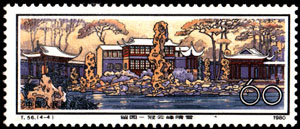
In 1980 T.56 “Suzhou Gardens: the Lingering Garden” was issued, four stamps: spring at the Winding Stream Tower (8 fen), summer at the Distant Green Pavilion (8 fen), autumn at the Hanbi Mountain House (10 fen) and the Cloud-Capped Peak after snow (60 fen).


The Lion Grove
The Lion Grove, 1.1 hectares, was founded in 1342 and is one of the four great gardens of Suzhou.
It is famous for its labyrinth of rockeries, the “kingdom of rockeries”: dry rockeries in the east and water rockeries in the west, the best known being the Nine Lion Peak.
The Master of the Nets Garden
In Kuojiatou Lane inside Fengmen Gate, the Master of the Nets Garden is a national protected site founded in the Southern Song. Only half a hectare, it has a residence in the east, the garden in the centre and a small courtyard in the west. Its speciality is the “night garden”, traditional music performed among the garden scenery after dark.
The Astor Court in the Metropolitan Museum of Art in New York was modelled on the garden’s Late Spring Studio.
In 2003 2003-11T “Suzhou Gardens: the Master of the Nets Garden” was issued, four stamps: the Late Spring Studio (80 fen), the Moon and Wind Pavilion, the Bamboo Branch Studio (80 fen) and the Hall of Ten Thousand Volumes (2 yuan), with a sheetlet.


Map

Photo credits: Humble Administrator's Garden, Suzhou: King of Hearts (CC BY-SA 4.0, Wikimedia Commons)
Nearby
| World Heritage | Archaeological Ruins of Liangzhu City 116km, West Lake, Hangzhou 125km, Zhongguo Huanghai Houniao Qixidi 135km, Shugang and Slender West Lake, Yangzhou 167km |
| National parks | Lake Tai 40km, Mount Mogan 111km, Taiji Cave 123km, The Three Hills of Zhenjiang 146km |
| Detailed guides | The Three Hills of Lake Tai 44km |
| AAAAA attractions | Jinji Lake Scenic Area 9km, Tongli Ancient Town Scenic Area, Wujiang 20km, Zhouzhuang 31km, Shajiabang - Yushan Shang Lake Tourist Area 32km |
| AAAA attractions | Panmen 2km, Seven-Li Shantang Street 2km, Master of the Nets Garden 3km, Pingjiang Historic District 4km |
| Historic cities | Wuxi 42km, Changshu 42km, Jiaxing 61km, Huzhou 68km |
| National key parks | Huanxiu Mountain Villa 2km, Canglang Pavilion 2km, Lingering Garden 2km, Humble Administrator's Garden 4km |
| Cities | Suzhou <1km, Shanghai 86km, Hangzhou 122km |
| Historical sites | Kaiyuan Temple Beamless Hall 1km, Song-Dynasty Stone Carvings in the Suzhou Confucian Temple 2km, Former Residence of Yu Yue 2km, Sanqing Hall of Xuanmiao Temple 3km |
| National geoparks | Suzhou Taihu Xishan National Geopark 30km, Chongming Island National Geopark 92km |
| Nature reserves | Chongming Dongtan Birds National Nature Reserve 128km, Jiuduansha Wetland National Nature Reserve 132km |
| Historic towns | Mudu Town 9km, Tongli Town 20km, Guangfu Town 20km, Luzhi Town 25km |
| Historic villages | Dongcun Village 34km, Luxiang Village 35km, Sanshan Village 40km, Mingyuewan Village 40km |