
How to Read a Chinese Pagoda
Old pagodas come in many forms. Once you know a few basic types and look at the material, the plan, the number of storeys and the top, you can roughly tell a pagoda’s background and date. This chapter explains where the pagoda came from, its main types and how to read its details.
From Stupa to Chinese Pagoda
The pagoda began as the Indian stupa, a burial mound for relics of the Buddha: a hemispherical dome on a base, topped by a mast carrying discs. Chinese renderings included sudupo, futu and tapo, and in time the general name became ta. When Buddhism arrived, China already had multi-storey timber towers; builders shrank the stupa and set it on top of the tower as the finial, while the tower below became the body of the pagoda. This is how the Chinese pagoda took shape. Early monasteries centred on a pagoda, which later gave way to the Buddha hall (see “How to Read a Chinese Buddhist Temple”).
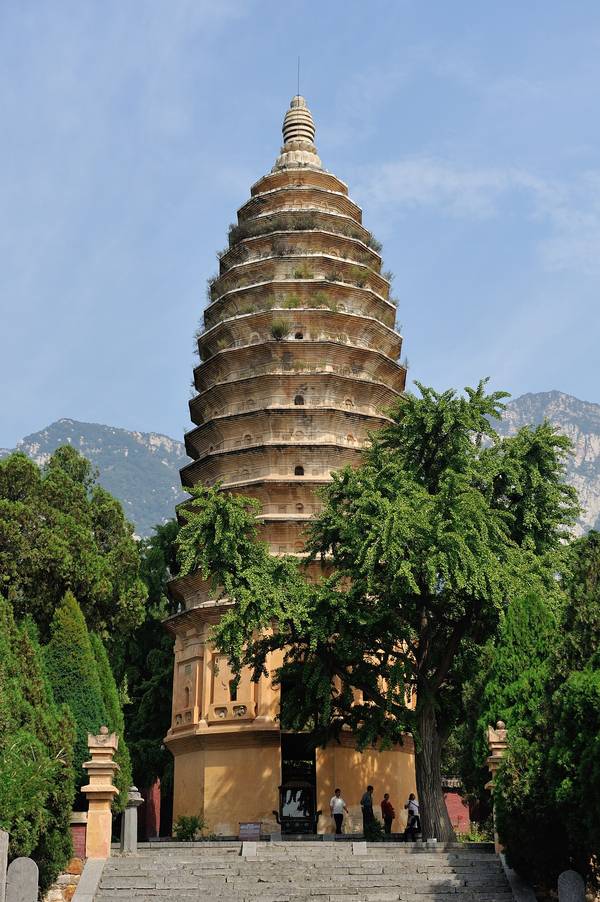
Dengfeng, Henan, Northern Wei; the oldest surviving brick pagoda
Siyuwj, CC BY-SA 4.0, Wikimedia Commons
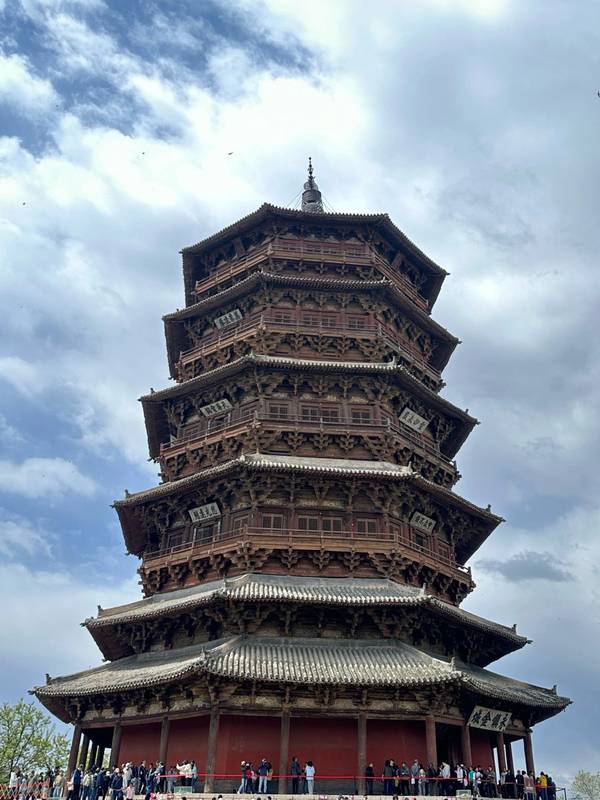
Sakyamuni Pagoda of Fogong Temple, Yingxian, Shanxi; Liao
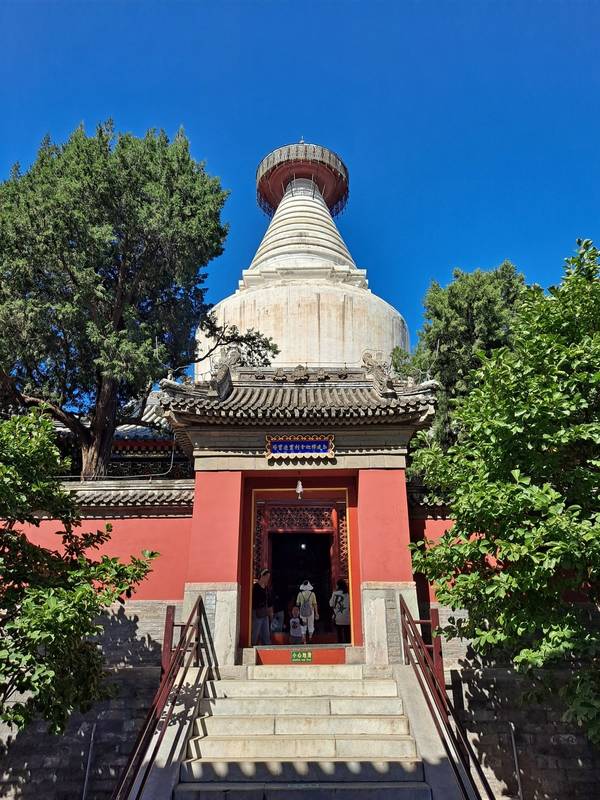
Beijing, Yuan
CC0, Wikimedia Commons
Pagodas were first built to enshrine relics, but their uses multiplied: tomb pagodas were raised for eminent monks after death and often cluster outside a monastery as a pagoda forest, the largest being at Shaolin Temple; there are also sutra pagodas for storing scriptures, pagodas for climbing and looking out, and wenfeng pagodas built for a place’s literary fortune and fengshui.
Five Basic Types
Pavilion-style (louge) pagodas. Each storey has eaves, doors and windows, often with a balcony and railing; storeys are of similar height and most can be climbed. This type is the closest to a multi-storey tower. The Yingxian Wooden Pagoda is octagonal, five storeys outside with hidden mezzanine floors inside, and is the oldest and tallest surviving timber pagoda. Xi’an’s Big Wild Goose Pagoda is a square Tang brick pagoda, built so that Xuanzang could store the sutras he had brought back. Hangzhou’s Liuhe Pagoda has thirteen storeys outside but only seven inside; its timber eaves were added in the Qing. Song brick pagodas often imitate timber construction, with columns and bracket sets built in brick, as at Suzhou’s Tiger Hill Pagoda and the Twin Pagodas of Luohan Temple. The Liaodi Pagoda in Dingzhou, Hebei, is the tallest surviving ancient brick pagoda; its name, “watching the enemy”, comes from its use as a lookout over the border with the Liao.

Da Ci’en Temple, Xi’an; Tang
Stamp
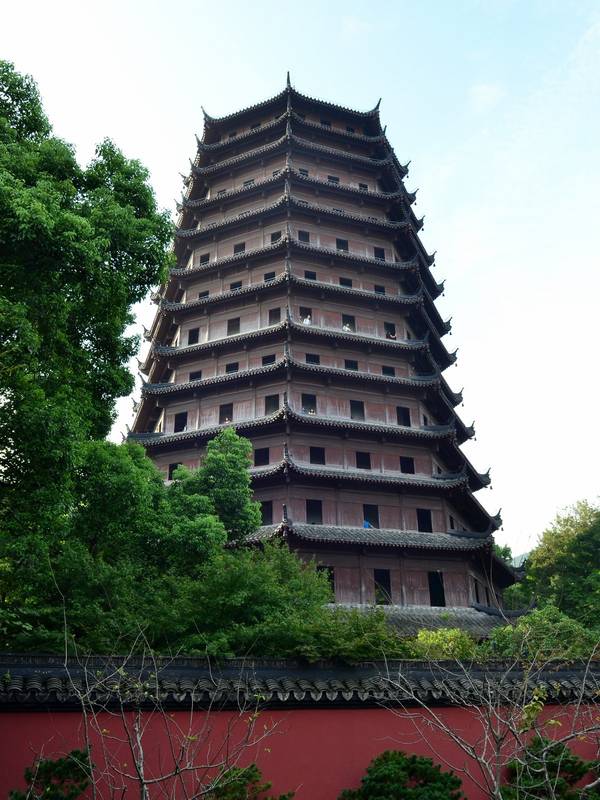
On the Qiantang River, Hangzhou
Tyg728, CC BY-SA 4.0, Wikimedia Commons
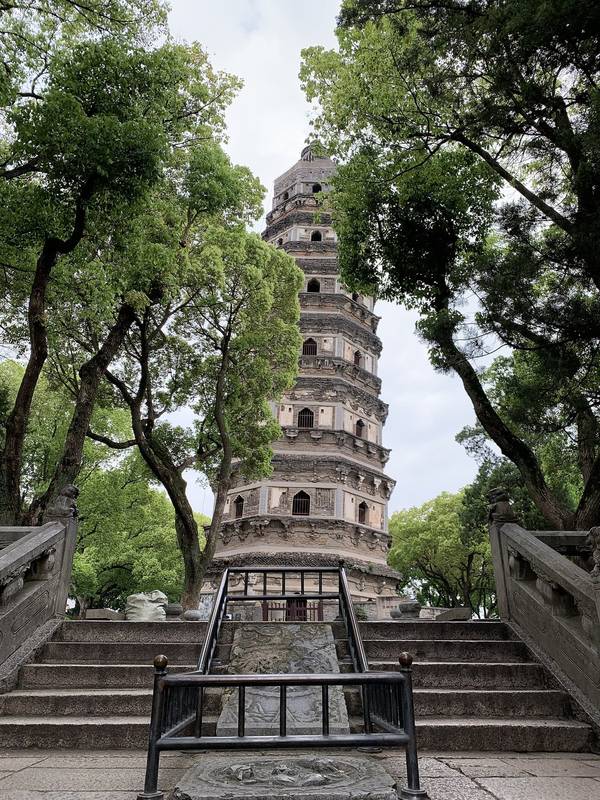
Suzhou, late Five Dynasties to early Northern Song; the pagoda leans
Chainwit., CC BY 4.0, Wikimedia Commons
Dense-eave (miyan) pagodas. The ground storey is especially tall, and above it the eaves are stacked one close upon another with almost no wall between them. Most cannot be climbed; what matters is the overall outline. The Songyue Temple Pagoda in Dengfeng, built in the Northern Wei, is twelve-sided with fifteen dense eaves and a slightly bullet-shaped outline. It is the only Buddhist pagoda with a twelve-sided plan, and Liang Sicheng called it the prototype of later dense-eave pagodas (see Chapter 4 of A Brief History of Chinese Architecture). Tang dense-eave pagodas are mostly square; Xi’an’s Small Wild Goose Pagoda and the Qianxun Pagoda of Chongsheng Temple in Dali both taper upward in a gentle curve (see Chapter 5). The Liao and Jin made them octagonal on a tall sumeru base, and Beijing’s Tianning Temple Pagoda is the typical example (see Chapter 6); the Randeng Pagoda in Tongzhou, at the northern end of the Grand Canal, is of the same kind.
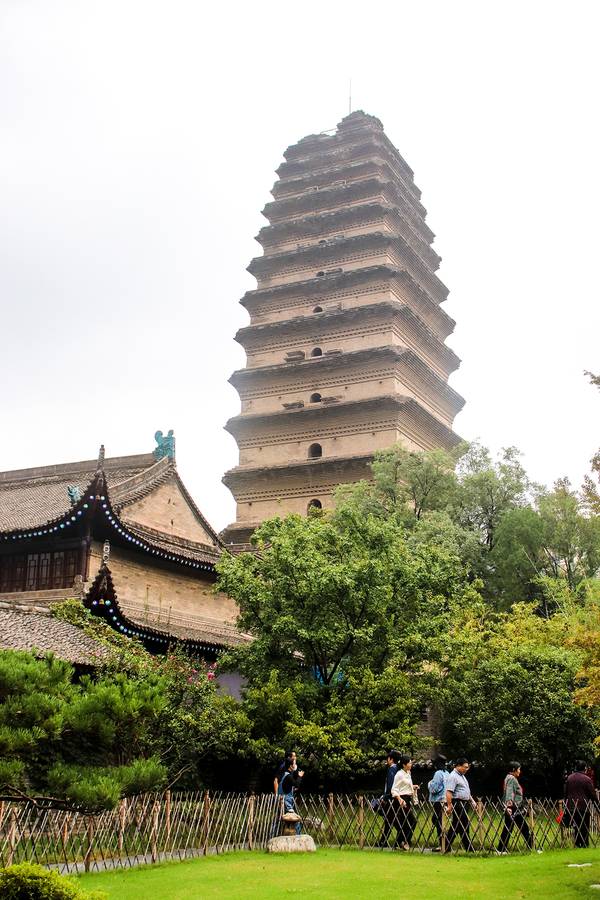
Jianfu Temple, Xi’an; Tang
Windmemories, CC BY-SA 4.0, Wikimedia Commons
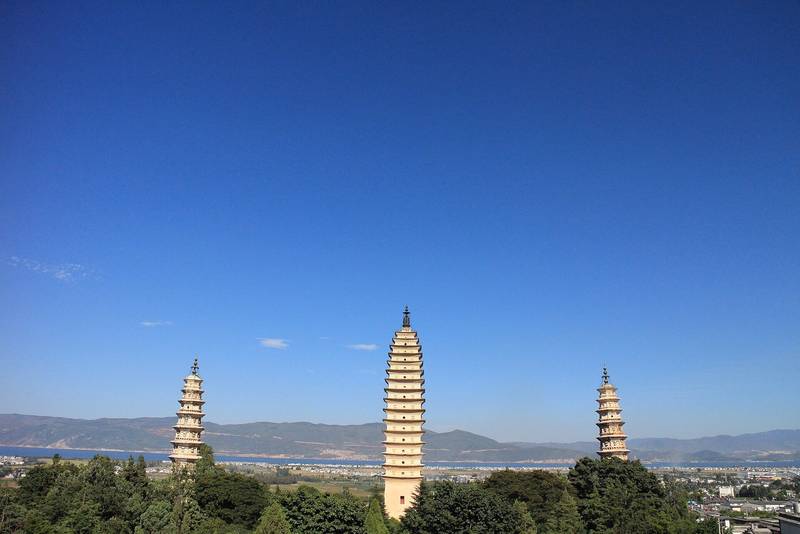
The main pagoda of the Three Pagodas of Chongsheng Temple, Dali
Xin, CC BY-SA 4.0, Wikimedia Commons
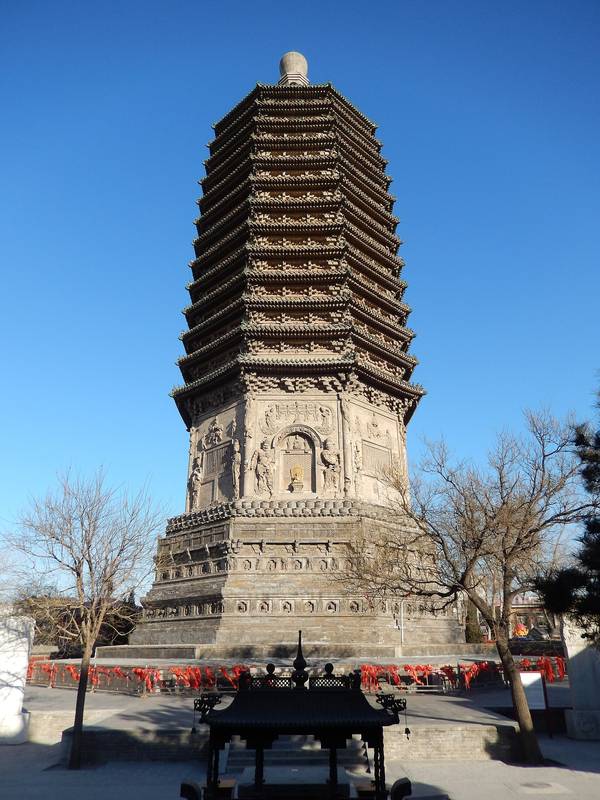
Beijing; Liao octagonal dense-eave pagoda
BabelStone, CC BY-SA 3.0, Wikimedia Commons
Stupa-style (fubo) pagodas. Also called lama pagodas or bottle-shaped pagodas, these belong to Tibetan Buddhism and are the closest to the original stupa: a rounded body on a sumeru base, topped by a slender stack of rings and a canopy, the whole painted white, so most are known as White Pagodas. The form reached inner China from Tibet in the Yuan. The White Pagoda of Miaoying Temple in Beijing, designed by the Nepalese craftsman Araniko, is the earliest and largest surviving example (see Chapter 7). The White Pagoda on Qionghua Island in Beihai, built in the early Qing, is the emblem of Beihai; the Great White Pagoda of Tayuan Temple is the emblem of Mount Wutai. At Kumbum Monastery in Qinghai the stupa came before the monastery, and the row of eight Ruyi stupas in front of it is also of this type.

Qionghua Island, Beihai, Beijing
Stamp
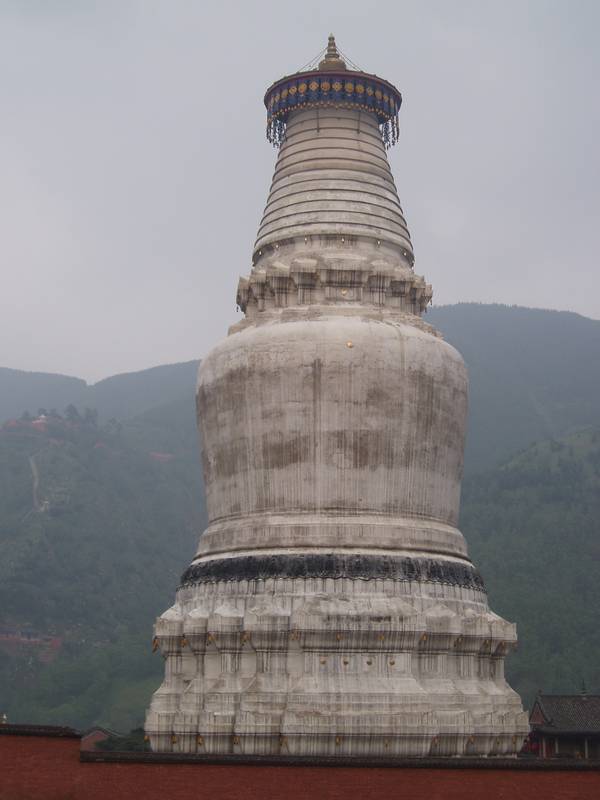
Mount Wutai, Shanxi
Angus Cepka, CC BY-SA 3.0, Wikimedia Commons

Huangzhong, Qinghai
Stamp
Vajrasana (diamond-throne) pagodas. Five small pagodas stand on a high square platform, the central one taller, symbolizing the Five Buddhas of the Five Directions, in imitation of the Mahabodhi Temple at Bodh Gaya in India. The diamond-throne pagoda of Zhenjue Temple (Five-Pagoda Temple) in Beijing dates from the Ming, its platform walls covered with carved Buddhas and Sanskrit script; the one at Biyun Temple in the Fragrant Hills, built under the Qing Qianlong emperor entirely of white stone, is taller and more elaborate (see Chapter 8).
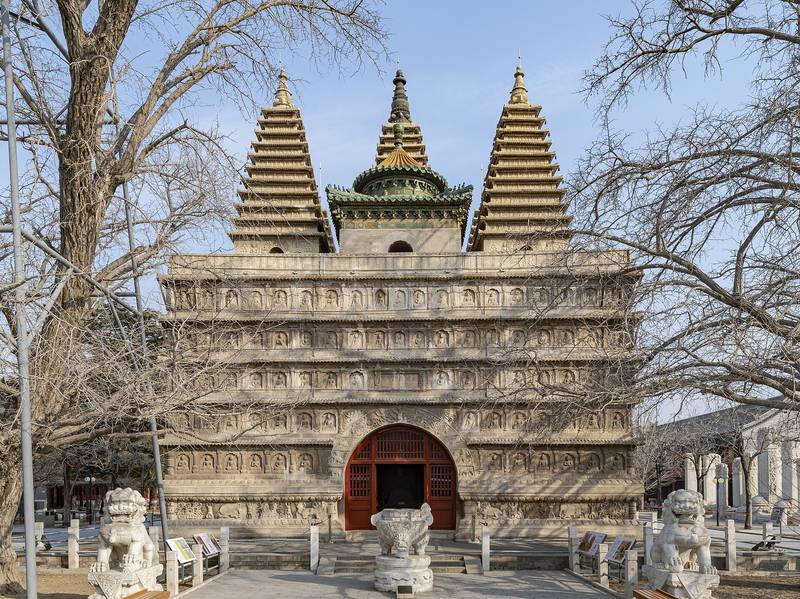
Beijing, Ming
ScareCriterion12, CC0, Wikimedia Commons
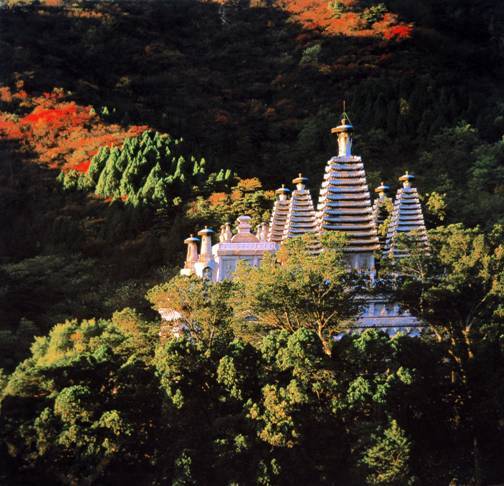
Fragrant Hills, Beijing; Qing
果布, CC BY-SA 3.0, Wikimedia Commons
Single-storey pavilion pagodas and flower pagodas. A pavilion pagoda has only one storey, like a pavilion, and usually serves as a tomb pagoda. The Four Gates Pagoda of Shentong Temple in Jinan is a Sui stone pagoda, square and single-storeyed with a door on each side, the prototype of many later tomb pagodas; the Xiuding Temple Pagoda in Anyang is a Tang single-storey square pagoda whose outer walls are covered in carved bricks. A flower pagoda has its upper body crowded with figures of Buddhas, lions, elephants and other sculpture, like a bouquet; the Flower Pagoda of Guanghui Temple in Zhengding is the only one of its kind. Jinan’s Nine-Top Pagoda does not taper to a point but carries nine small pagodas on a flat top, which is also very rare.
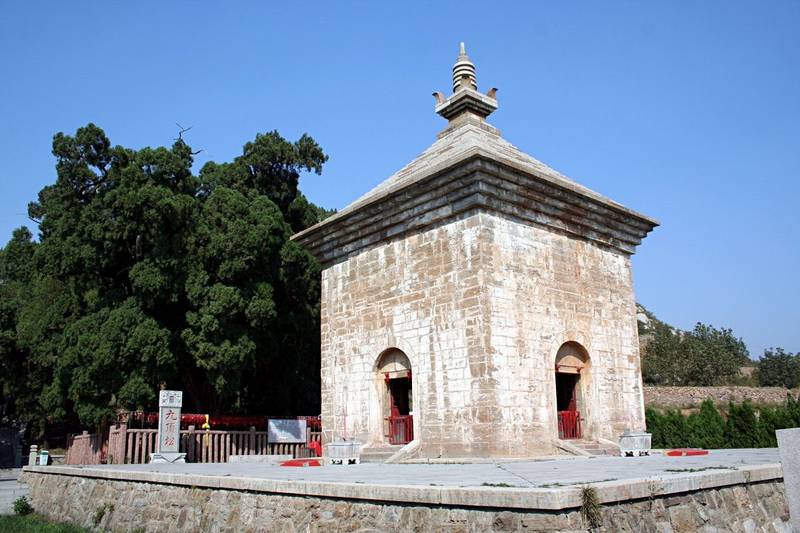
Site of Shentong Temple, Jinan; Sui
Rolf Müller (Rolfmueller), CC BY-SA 3.0, Wikimedia Commons
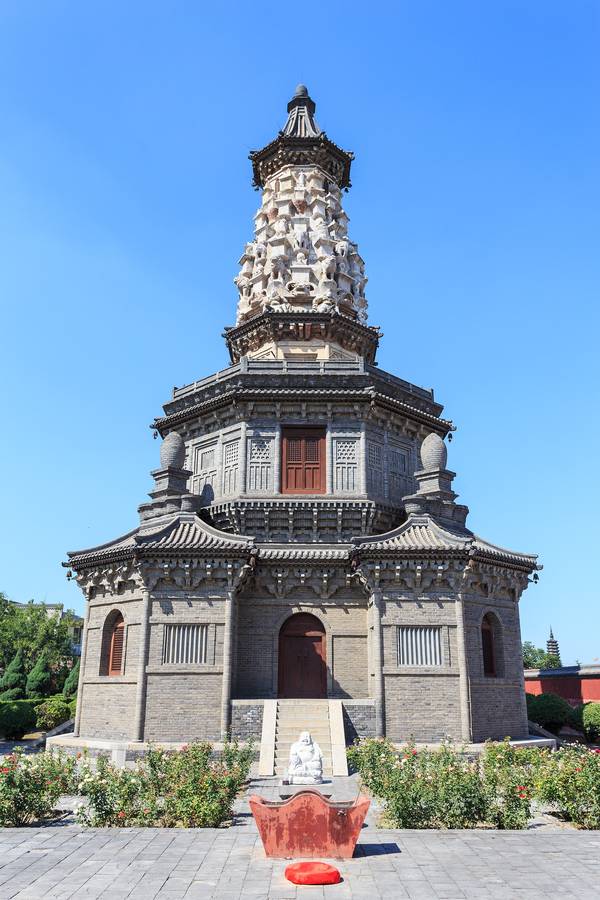
Zhengding, Hebei
Zhangzhugang, CC BY-SA 4.0, Wikimedia Commons
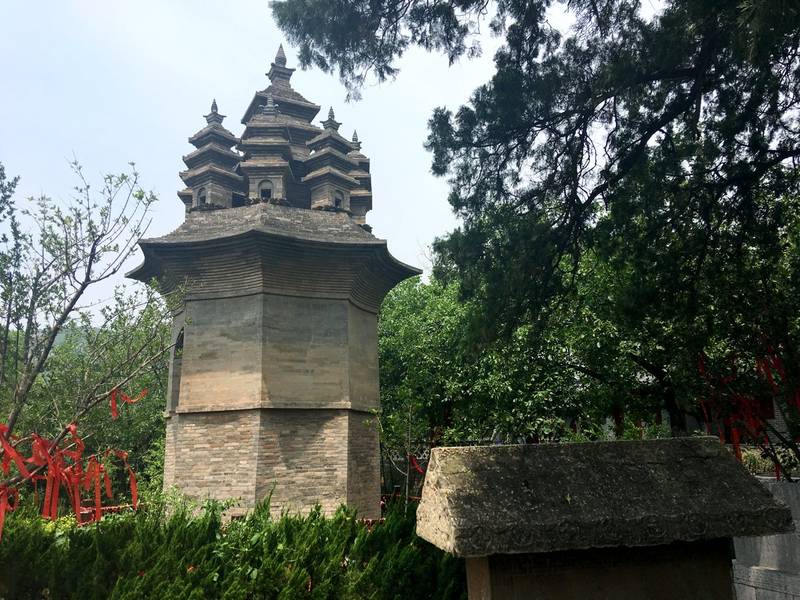
Liubu, Jinan; Tang
Gateway pagodas. Built over a road or a city gate, with an arched passage below; passing beneath the pagoda counted as paying homage to the Buddha. The Cloud Platform at Juyongguan in Beijing was originally the base of a Yuan gateway pagoda. The pagodas on top are long gone, but the passage is carved with dharani in six scripts and reliefs of the Four Heavenly Kings.
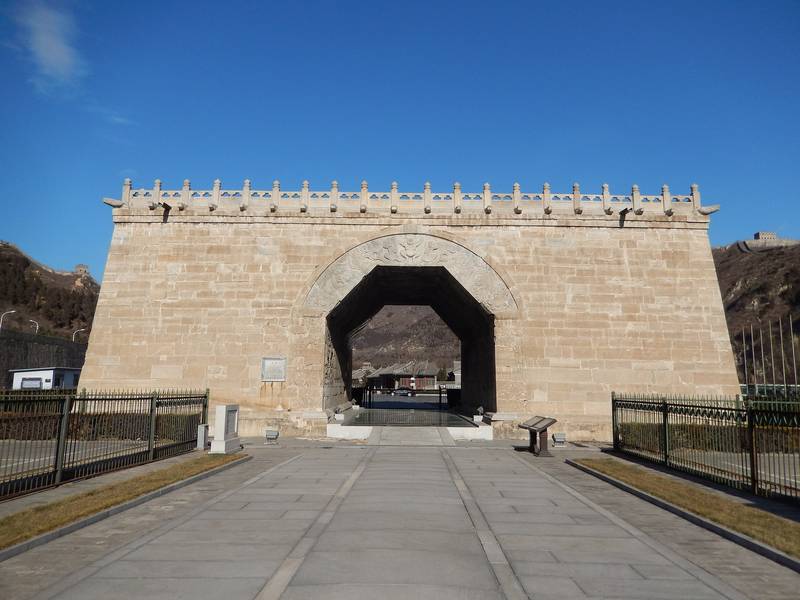
Changping, Beijing; base of a Yuan gateway pagoda
BabelStone, CC BY-SA 3.0, Wikimedia Commons
Materials: Wood, Brick, Stone, Iron and Glazed Tile
Early pagodas were mostly of timber. They caught fire easily and very few survive; the Yingxian Wooden Pagoda is almost the only complete one. Brick pagodas are the most numerous and were built in every period after the Songyue Temple Pagoda. Stone pagodas mostly imitate timber construction: the Twin Stone Pagodas in front of the main hall of Lingyin Temple in Hangzhou show columns, beams, bracket sets and balconies in clear detail; the scenes from the life of the Buddha on the sumeru base of the Sarira Pagoda of Qixia Temple in Nanjing are exceptionally fine; the two Song stone pagodas, east and west, of Kaiyuan Temple in Quanzhou are taller still. Iron pagodas were cast in sections; the thirteen-storey Northern Song iron pagoda of Yuquan Temple in Dangyang, Hubei, is one of the tallest surviving. Glazed pagodas are faced with coloured glazed bricks: the Iron Pagoda of Kaifeng is in fact not cast iron but covered entirely in brown glazed bricks, and is named for looking like iron from afar; the Flying Rainbow Pagoda of Guangsheng Temple in Hongtong is faced with yellow, green and blue glaze.
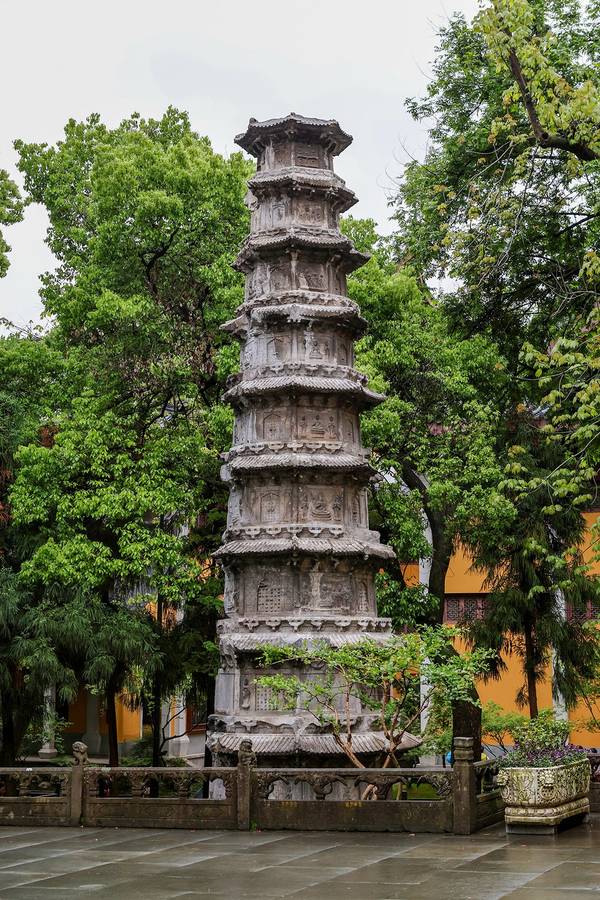
Hangzhou, late Five Dynasties to early Northern Song
Windmemories, CC BY-SA 4.0, Wikimedia Commons
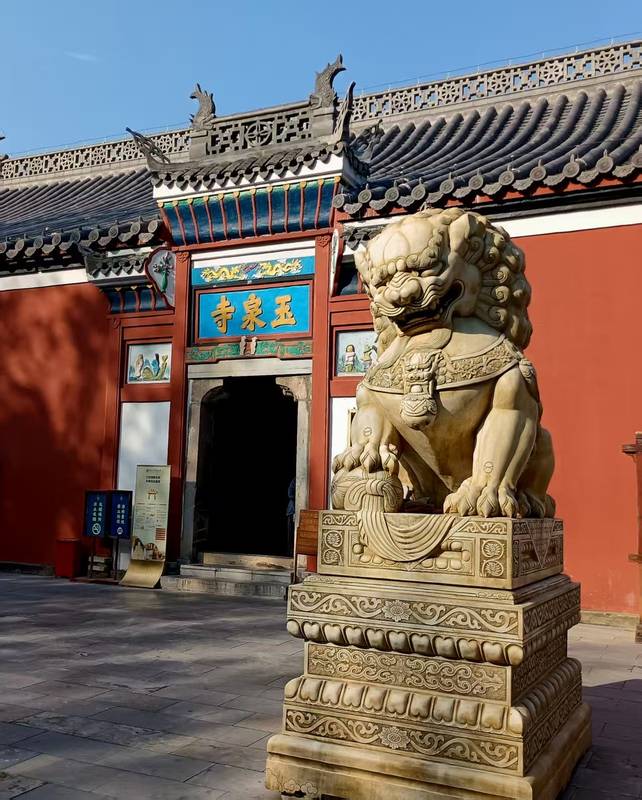
Dangyang, Hubei; Northern Song
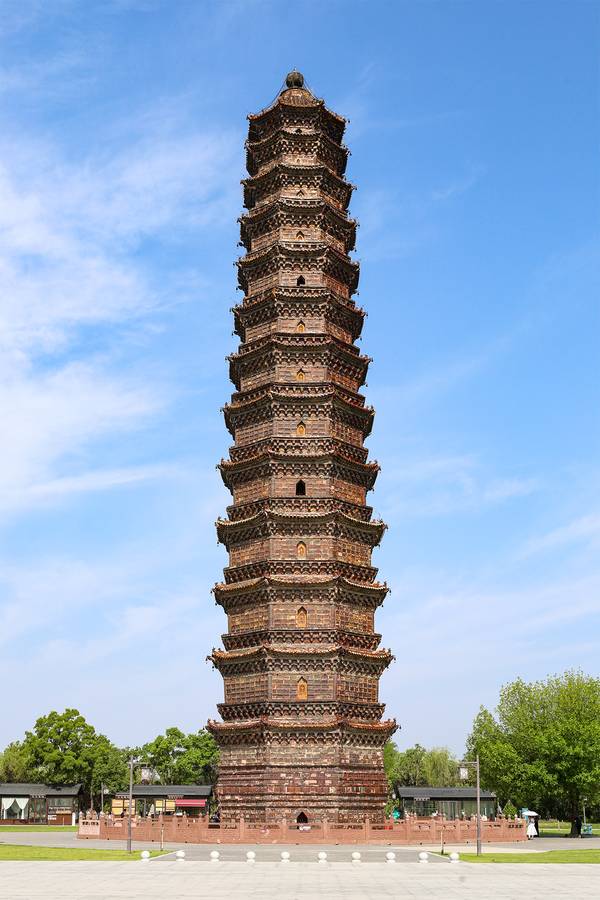
Youguo Temple Pagoda, a Northern Song glazed-brick pagoda
Windmemories, CC BY-SA 4.0, Wikimedia Commons

Guangsheng Temple, Hongtong, Shanxi; Ming
Stamp
Plan, Number of Storeys, Top and Bottom
Plan. Before the Tang nearly all pagodas were square. The Pagoda of Chan Master Jingzang in Dengfeng is the only surviving octagonal pagoda of the Tang; from the Song and Liao on, the octagon became the norm, as it resists wind and earthquakes better than a square and offers a wider view to those who climb it. The Fan Pagoda in Kaifeng is hexagonal. A square pagoda is most likely Tang or earlier; an octagonal one is mostly Song or later.
Number of storeys. Pagodas mostly have an odd number of storeys, five, seven, nine and thirteen being the most common, while the number of sides in plan is usually even. There are exceptions: the Qianxun Pagoda has sixteen storeys.
Underground palace and finial. Beneath a pagoda there is often an underground palace (crypt) holding relics and offerings; the Tang crypt of Famen Temple in Fufeng yielded a finger-bone relic of the Buddha and a large hoard of Tang treasures. The finial on top consists of a base, a stack of rings, a canopy and a jewel; the rings are a survival of the discs atop the stupa, and the finishing touch of the pagoda.
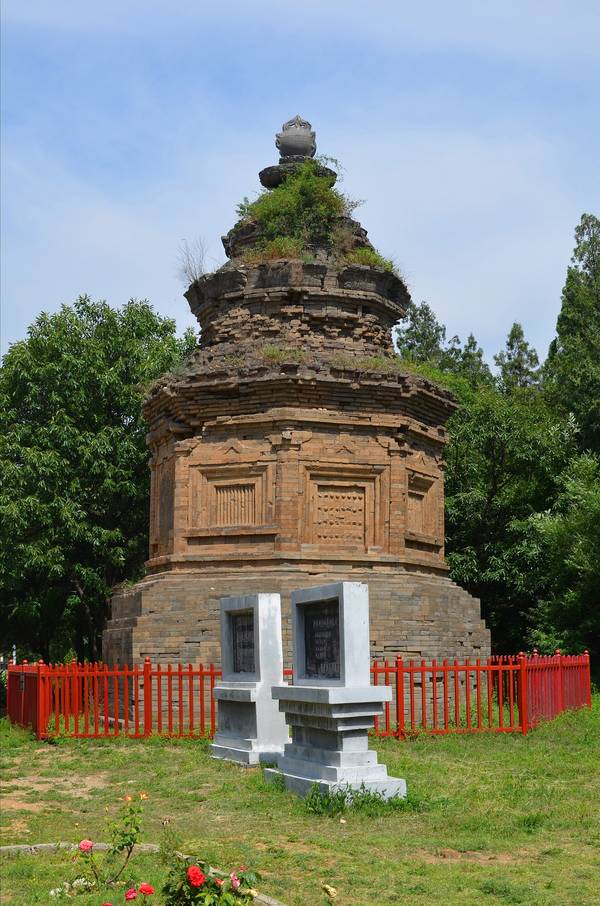
Dengfeng, Henan; Tang octagonal tomb pagoda
Acot一杯茶, CC BY-SA 4.0, Wikimedia Commons
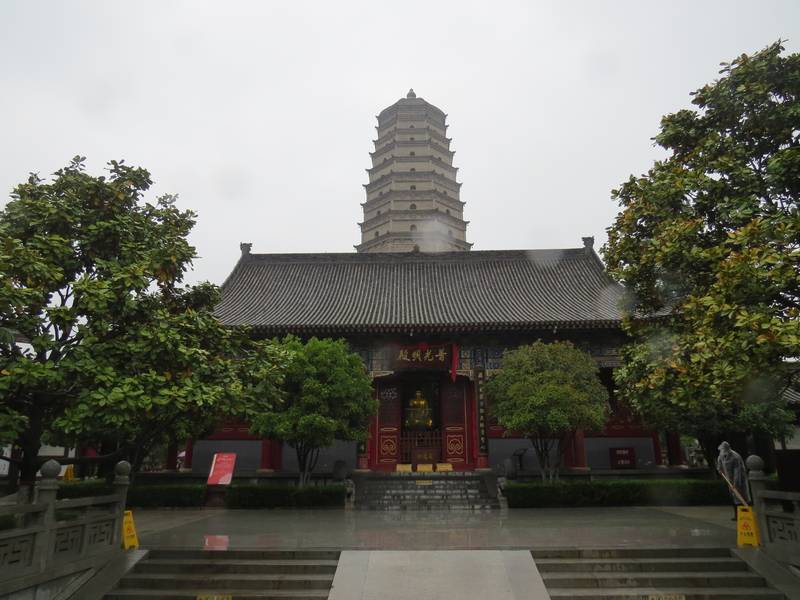
Fufeng, Shaanxi
Wenfeng Pagodas and Fengshui Pagodas
In the Ming and Qing, wenfeng and wenbi pagodas were built across the country, usually outside town where the water leaves, or on high ground. They did not belong to monasteries but were meant to improve fengshui and promote literary success, and most are pavilion-style. Some pagodas also became landmarks for river traffic: the Wenfeng Pagoda of Yangzhou stands beside the old canal, and the Randeng Pagoda of Tongzhou, the Wenfeng Pagoda of Yangzhou, the Liuhe Pagoda of Hangzhou and the Sarira Pagoda of Linqing are together called the “Four Great Pagodas of the Grand Canal”; boatmen knew where they were as soon as they saw a pagoda’s outline in the distance.
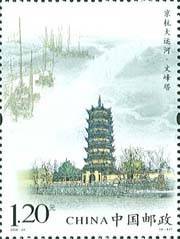
Beside the old canal; Ming
Stamp
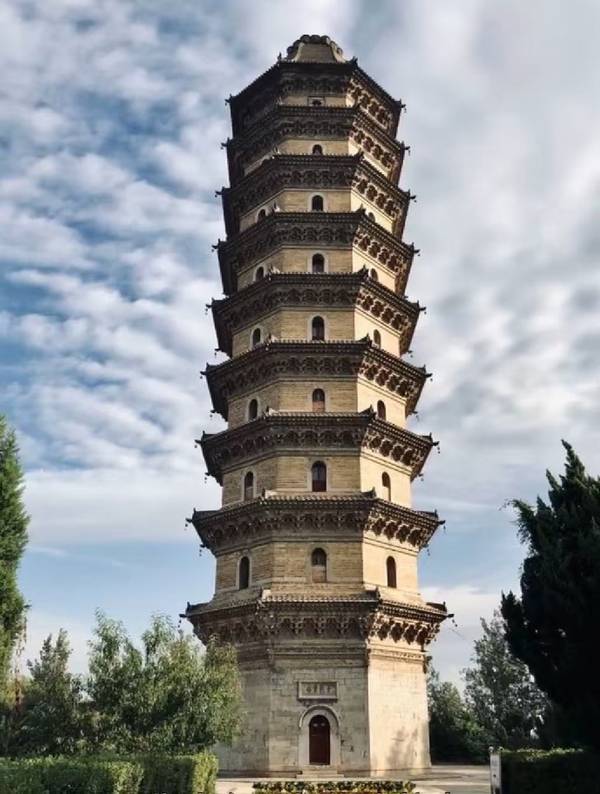
Linqing, Shandong; Ming