 Park of China
Overview
| Designation | UNESCO World Heritage (cultural, 1996) National Park of China (first batch) AAAAA tourist attraction |
| Province | Jiangxi |
| Location | South of Jiujiang, Jiangxi, where Poyang Lake meets the Yangtze |
| Mountains / Rivers and lakes | Mountain Ranges of China; Poyang Lake |
| Latitude, longitude | 29.6, 116.0 Google Maps |
| Highlights | Waterfalls, Buddhist sites, summer resort |
| Top sights | Hanpokou, the Five Old Men Peaks, the Three-Tier Spring, the White Deer Grotto Academy |
| Area | 302 km² |
| Highest point | 1,473 m |
| Nearby cities | Jiujiang, Nanchang |
| Nearby sites | Pavilion of Prince Teng 99km, Jingdezhen Handicraft Porcelain Industry Sites 127km, Mount Tianzhu 138km, Mount Longhu (Dragon and Tiger Mountain) 194km, Ancient Villages in Southern Anhui 198km Search nearby |
| Themes | Famous Mountain, Mountain, Lake, Waterfall, Buddha, Culture, Long River, Stamp, Temple, Peak, Confucian academies & temples, Sea of clouds & sunrise, Literary landmarks |
About
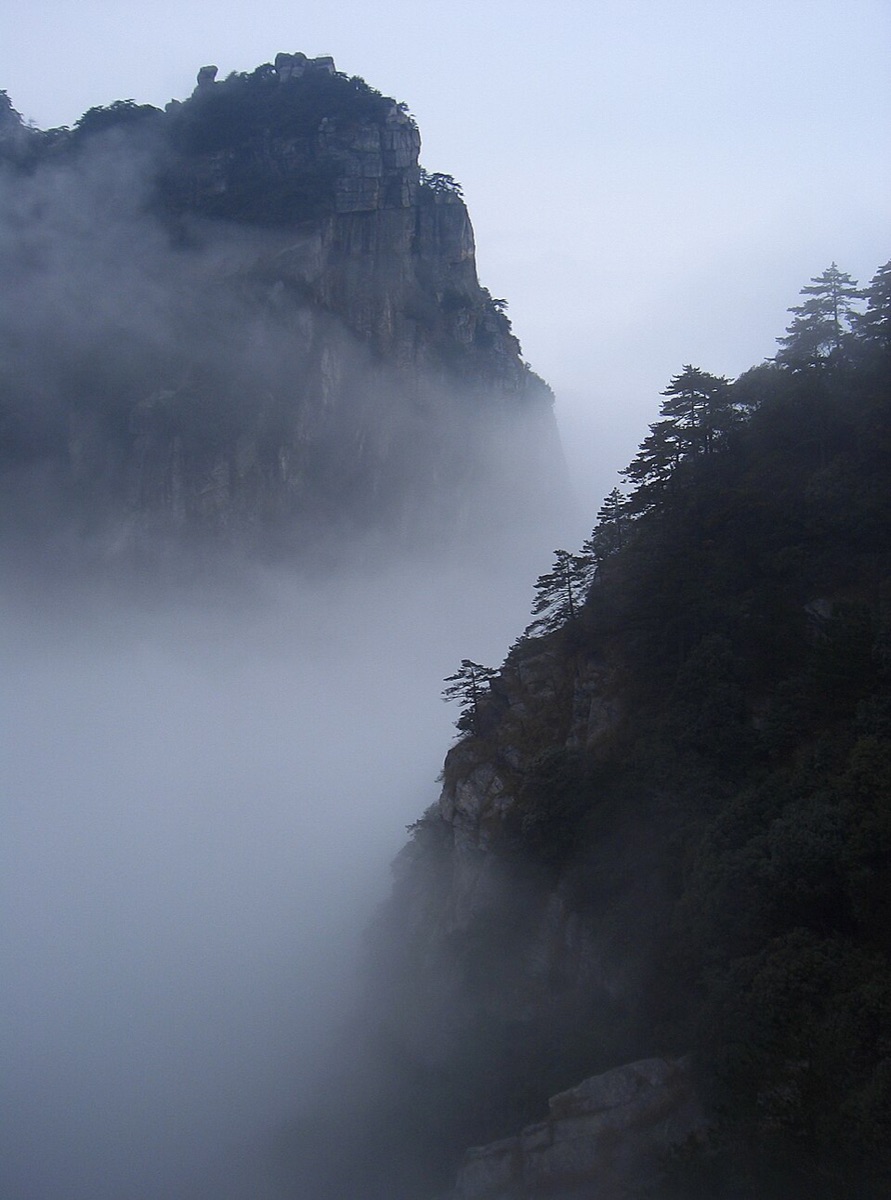
Mount Lu rises south of Jiujiang in Jiangxi, where Poyang Lake meets the Yangtze. A famous summer resort and one of the three great mountains of China, the scenic area covers 302 km²; the summit, Hanyang Peak, is 1,474 m. The main sights are Hanpokou, Guling town, the Five Old Men Peaks, the Three-Tier Spring, Dragon Head Cliff, Hanyang Peak, the botanical garden, Donglin Temple, the White Deer Grotto Academy, Flower Path and the site of the Lushan conferences. Mount Lu was inscribed on the World Heritage List in 1996.
Three-Tier Spring: in a valley east of the Five Old Men Peaks, streams from Dayue Mountain and the peaks fall over a cliff in three stages, about 155 m in all.
Xiufeng: on the southern side of Mount Lu, formed by Xianglu, Shuangjian, Wenshu and other peaks. Kaixian Temple was founded here in the Southern Tang and renamed Xiufeng Temple under Kangxi; the Horsetail Falls drop between Shuangjian and Wenshu peaks, and Mi Fu inscribed “First Mountain” here.
The White Deer Grotto takes its name from the Tang scholar Li Bo, who studied here in seclusion with his brother and kept a white deer. In 940 the Southern Tang set up the Lushan Academy here, which became a shuyuan in the early Northern Song.
It is in the first batch of national parks of China (national scenic areas) named by the State Council in 1982.
Travel tips
Getting there: Jiujiang has two high-speed stations, Jiujiang and Lushan; Jiujiang station is closer to the north gate of the mountain. From there a bus or taxi climbs the winding road to Guling town. On the mountain, park shuttle buses link the sights.
Guling: the town at the top is the base for food and lodging. Nearby are Huajing (Flower Path), Ruqin Lake, Jinxiu Valley, the Immortal's Cave, the Lushan Conference site and the old villas.
Hanpokou and Wulao Peaks: Hanpokou looks out over Poyang Lake and is a sunrise spot; the Five Old Men Peaks are to the southeast and need a walk to the top.
Three-Step Falls (Sandie Quan): more than a thousand steps down to the falls, and harder coming back up; a cable car covers part of the way.
At the foot: White Deer Grotto Academy below the Wulao Peaks and Donglin Temple at the northwest foot are far from Guling; plan them separately.
Time: two to three days for the main sights on the mountain.
Season: summer is cool and is the busiest time. Fog and rain are common and views are often hidden. Snow is possible in winter, when the road is sometimes restricted.
Caution: weather changes quickly on the mountain; bring rain gear and a jacket.
History
In the fourth century the monk Huiyuan founded Donglin Temple on the mountain and with it the Pure Land school of Buddhism.
In the 1930s Mount Lu became the “summer capital” of the Nationalist government in Nanjing; in 1937 Chiang Kai-shek delivered here the speech that began full-scale resistance to Japan.
In 1959 the Central Committee of the Communist Party met here, the famous Lushan Conference: Mao Zedong urged the Party to complete the year’s Great Leap Forward targets, and the defence minister Peng Dehuai wrote to Mao pointing out the Leap’s problems.
The White Deer Grotto Academy
The academy, at the southern foot of the Five Old Men Peaks, was founded in the Tang dynasty and is one of the four great academies of China. The Song philosopher Zhu Xi rebuilt it and taught here himself.
Zhu Xi’s rules for the academy: between father and son there is affection; between ruler and minister, duty; between husband and wife, distinction; between elder and younger, order; between friends, trust. These are the five teachings that Yao and Shun charged Xie to spread, and they are all a student need learn. The order of study is five: learn broadly, inquire carefully, think prudently, discriminate clearly, practise earnestly. For conduct: be loyal and truthful in word, earnest and respectful in deed; curb anger and desire; move towards good and correct faults. In affairs: do what is right without scheming for profit; make the Way clear without reckoning the reward. With others: do not do to others what you would not want done to you; when you fail, look for the cause in yourself.
Stamps
In 1981 China Post issued “Mount Lu”, seven stamps: the Five Old Men Peaks, Hanpokou, Yellow Dragon Pool, Sunlit Peak, the Three-Tier Spring, stone pines and Dragon Head Cliff.


In 1999 China and North Korea jointly issued stamps of Mount Lu and Mount Kumgang.

In 2014 China Post issued 2014-20 “The Yangtze River”, nine stamps; “the waters of Mount Lu” shows Mount Lu.

In 2019 China Post issued 2019-15 “Poyang Lake”, three stamps: Stone Bell Mountain, Shoe Hill and the wetlands.


The 50-fen stamp of the definitive set R16 “Revolutionary Sites” (fourth edition, 1974, 14 stamps) shows the Immortal’s Cave on Mount Lu.

In literature
Li Bai’s poem on the waterfall of Incense Burner Peak likens it to the Milky Way falling from the sky.
Su Shi’s poem on Lushan says the mountain looks different from every side and one cannot see its true face while standing inside it.
Poyang Lake
Poyang Lake, second in size only to Qinghai Lake, is China’s largest freshwater lake. At normal water level it covers nearly 4,000 km², though it has been shrinking in recent years.
Map

Photo credits: Mount Lu: rheins (CC BY 3.0, Wikimedia Commons); Mount Lu: pfctdayelise (CC BY-SA 2.5, Wikimedia Commons)
Nearby
| World Heritage | Jingdezhen Handicraft Porcelain Industry Sites 127km, Mount Longhu (Dragon and Tiger Mountain) 194km, Ancient Villages in Southern Anhui: Xidi and Hongcun 198km, Guifeng (Turtle Peak) 205km |
| National parks of China | Wuyishan National Park 288km |
| National parks | Mount Yunju–Zhelin Lake Scenic Area 63km, Meiling–Pavilion of Prince Teng Scenic Area 96km, Huating Lake 105km, Mount Jiugong 134km |
| Detailed guides | Mount Yunju 65km, Meiling 94km |
| AAAAA attractions | Zhelin Lake 61km, Pavilion of Prince Teng 99km, Jingdezhen Ancient Kiln Folk Customs Expo Area 122km, Tiantangzhai Tourist Area 174km |
| AAAA attractions | Luminggu <1km, Nanshan 4km, Guanyinqiao 7km, China Virtuous Mothers Garden 9km |
| Historic cities | Jiujiang 16km |
| National key parks | Nanhu Park 16km |
| Cities | Nanchang 102km |
| Historical sites | Site of the Lushan Conference and Lushan Villa Complex 1km, Lushan Imperial Stele Pavilion 2km, Lushan Cijing Pavilion 2km, White Deer Grotto Academy 9km |
| National geoparks | Lushan Quaternary Glacier National Geopark 19km |
| Nature reserves | Longgan Lake National Nature Reserve 48km, Taohongling Sika Deer National Nature Reserve 68km, Poyang Lake Nanji Wetland National Nature Reserve 70km, Guanshan National Nature Reserve 114km |