 Park of China
Overview
| Designation | Part of the fifth-batch National Park of China “Meiling–Pavilion of Prince Teng” AAAAA tourist attraction (2018) |
| Province | Jiangxi |
| Location | Central Nanchang, Jiangxi; on the east bank of the Gan River |
| Latitude, longitude | 28.68, 115.88 Google Maps |
| Highlights | One of the great towers of the south; Wang Bo’s “Preface to the Tengwang Pavilion” |
| Top sights | Pavilion of Prince Teng |
| Nearby cities | Nanchang |
| Nearby sites | Meiling 17km, Mount Lu (Lushan) 99km, Mount Longhu (Dragon and Tiger Mountain) 128km, Jingdezhen Handicraft Porcelain Industry Sites 149km, Guifeng (Turtle Peak) 164km Search nearby |
| Themes | Mountain, Ancient Building, City, Small Waterfall, Cave, Literary landmarks |
About
The pavilion stands on Yanjiang North Avenue by the river in Nanchang, facing Meiling across the water, one of the three great towers of the south, “the first tower on the West River”. Wang Bo’s famous preface has a celebrated line on the sunset clouds and a lone duck, the autumn river meeting the sky.
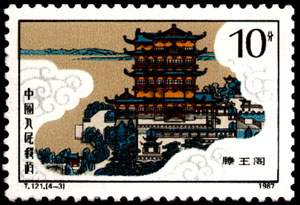
The third stamp of the 1987 set T121 “Famous Towers of China” shows the pavilion.
Wang Bo’s “Preface to the Tengwang Pavilion”, written for a banquet at the pavilion, praises Hongdu and its gathered talents, describes the autumn view of hills, river, boats and geese from the pavilion, laments his own frustrated career, and ends with a short poem on the empty pavilion beside the ever-flowing river.
The pavilion was first built in 653 by Li Yuanying, Prince of Teng and son of Emperor Gaozu of Tang, after whose title it is named; it was rebuilt many times afterwards.
The present building was begun in 1985 and completed in 1989; the main pavilion is 57.5 m high with nine floors, three visible from outside and seven within, after Song models.
The couplet at the main entrance, Wang Bo's lines on the sunset clouds and the lone duck, is in Mao Zedong's handwriting.
Travel tips
Getting there: Mount Mei is north-west of Nanchang, about 18 km from the city centre; buses and taxis reach the park. The Pavilion of Prince Teng stands on the Gan River in the city and can be reached by metro or bus from Nanchang West station and Nanchang station.
Pavilion of Prince Teng: it stands on the east bank of the Gan River, and is one of the three famous towers south of the Yangtze. The present structure was rebuilt in the 1980s. From the upper floors you look over the river and the city, and inside are exhibition rooms, including material on Wang Bo's Preface to the Pavilion of Prince Teng.
Nearby
| World Heritage | Mount Lu (Lushan) 99km, Mount Longhu (Dragon and Tiger Mountain) 128km, Jingdezhen Handicraft Porcelain Industry Sites 149km, Guifeng (Turtle Peak) 164km |
| National parks of China | Wuyishan National Park 233km |
| National parks | Meiling 17km, Mount Yunju 56km, Shennongyuan 134km, Mount Jiugong 147km |
| AAAAA attractions | Zhelin Lake 68km, Jingdezhen Ancient Kiln Folk Customs Expo Area 142km, Dajueshan Scenic Area 170km, Mingyueshan Tourist Area 198km |
| AAAA attractions | August 1st Uprising Memorial Hall 1km, Nanchang Greenland Center 303 Observation Deck 2km, New Fourth Army Headquarters Site Exhibition Hall 2km, Yuan Chengji Nanchang Urban Culture District 6km |
| Historic cities | Fuzhou 91km |
| Cities | Nanchang 4km |
| Historical sites | Site of the August 1 Uprising Headquarters 1km, Site of the New Fourth Army Headquarters in Nanchang 2km, Deng Xiaoping Residence and Workshop 8km, Qingyunpu 9km |
| National geoparks | Lushan Quaternary Glacier National Geopark 83km, Longhushan Danxia Landform National Geopark 126km |
| Nature reserves | Poyang Lake Nanji Wetland National Nature Reserve 53km, Jiulingshan National Nature Reserve 94km, Guanshan National Nature Reserve 119km, Taohongling Sika Deer National Nature Reserve 143km |
| Historic villages | Luotian Village 28km |