
← Chapter 3: Xia and ShangA Brief History of ChinaChapter 5: Spring and Autumn and Warring States →
Chapter 4: Western Zhou
c. 1046–771 BC
About 1046 BC King Wu of Zhou overthrew the Shang and made his capital at Haojing (southwest of today’s Xi’an). To rule its vast lands the early Zhou practiced enfeoffment: members of the royal clan, meritorious officials and descendants of ancient rulers were granted territories as lords, who in turn granted land to ministers and nobles, each tier owing loyalty to the Zhou king. The Duke of Zhou, regent for the young King Cheng, put down rebellions, built an eastern capital at Luoyi (today’s Luoyang), and “established the rites and music,” a system of ceremony and music that fixed the ranks of the nobility.
The lineage system (zongfa) went hand in hand with enfeoffment: the eldest son of the principal wife inherited the clan and the title, while the other sons founded branch lines. The idea of the “Son of Heaven” also took shape at this time: the Zhou held that the Mandate of Heaven goes to the virtuous, that the Shang fell because it lost virtue and the Zhou rose because it had it. The inscription on the He Zun contains the phrase “zhai zi Zhongguo” (to build the capital at the center of the world; “Zhongguo” here means the Central Plains around Luoyang), the earliest known occurrence of the word “Zhongguo” (China).
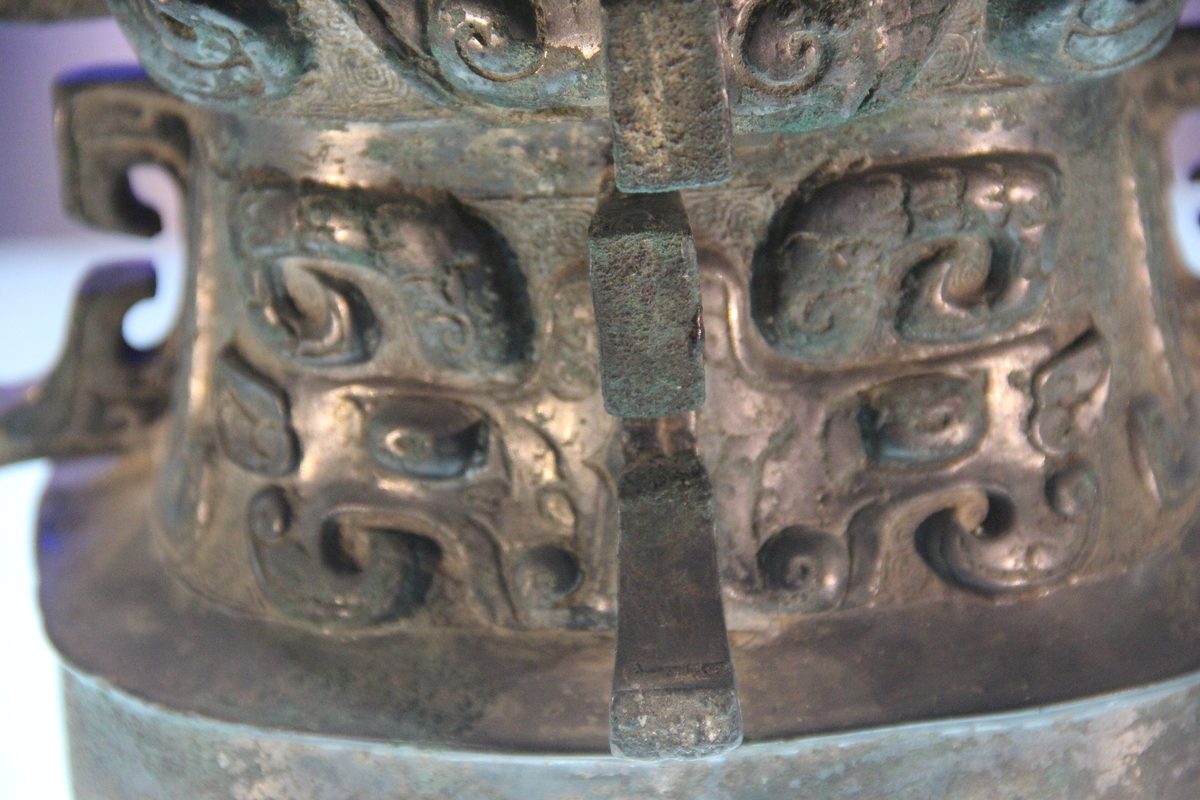
Gary Todd, CC0, Wikimedia Commons
In the late Western Zhou the royal house weakened. In 841 BC the people of the capital drove out King Li, and senior ministers governed jointly, a period known as the “Gonghe Regency”; from this year Chinese history has an exact year-by-year chronology. Later King You doted on Bao Si and deposed his queen and the crown prince; the queen’s father, the Marquis of Shen, joined with the Quanrong to sack Haojing, and in 771 BC King You was killed and the Western Zhou fell. In 770 BC King Ping moved the capital east to Luoyi, beginning the period known as the Eastern Zhou; the Western Zhou was over.
← Chapter 3: Xia and ShangContentsChapter 5: Spring and Autumn and Warring States →