 Park of China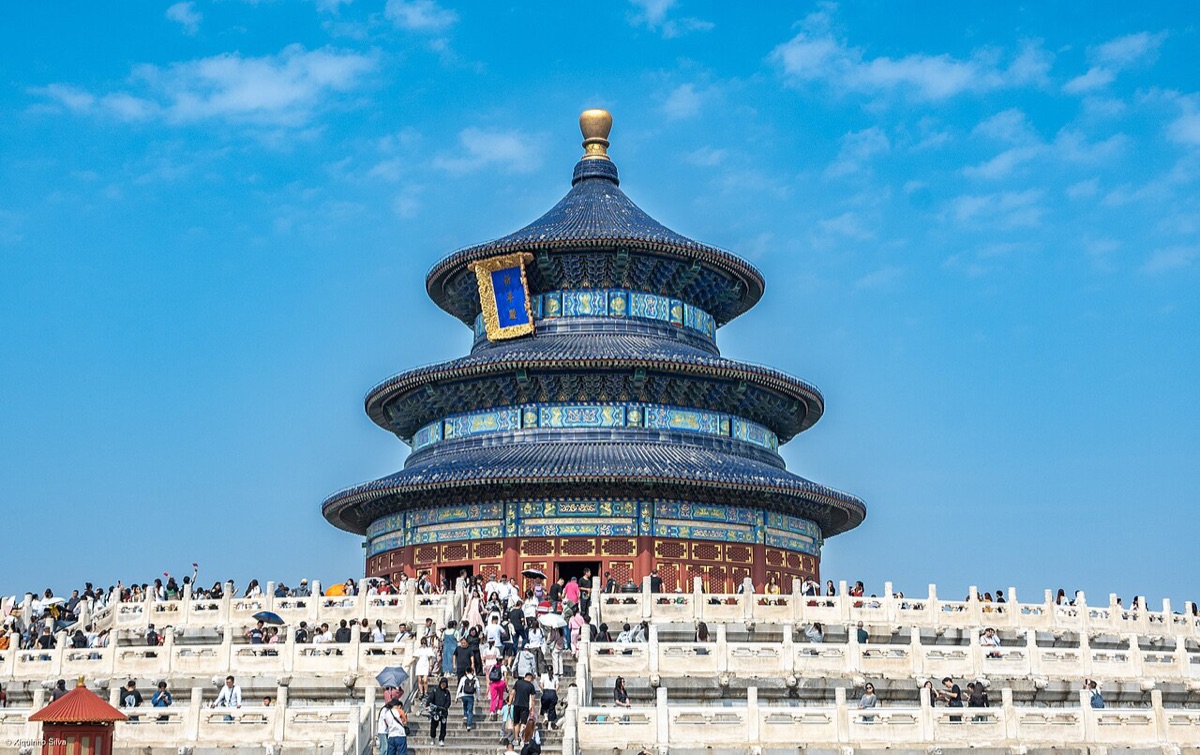
Overview
| Designation | UNESCO World Heritage (cultural, 1998) AAAAA tourist attraction |
| Province | Beijing |
| Location | Dongcheng District, Beijing |
| Latitude, longitude | 39.9, 116.4 Google Maps |
| Nearby cities | Beijing |
| Top sights | Hall of Prayer for Good Harvests |
| Area | 2.73 km² |
| Nearby sites | The Forbidden City (Palace Museum), Beijing 4km, The Summer Palace, Beijing 17km, Ming Tombs 49km, Chengde Mountain Resort and its Outlying Temples 179km Search nearby |
| Themes | Ancient Building, Temple, Building, Big City, Culture, Stamp, Banknote, Imperial palaces & gardens |
About
The Temple of Heaven, in Dongcheng District of Beijing, was first built in 1420 (the 18th year of Yongle). Covering about 2.73 km², it is where the Ming and Qing emperors worshipped Heaven and prayed for good harvests and rain. It is a Major Historical and Cultural Site protected at the national level and was inscribed as a World Heritage Site in 1998.
The temple is divided into an inner and an outer altar; the main structures are the Hall of Prayer for Good Harvests, the Circular Mound Altar and the Altar of Prayer for Grain.
The Hall of Prayer for Good Harvests is a round building with a triple-eaved conical roof, 38 m high and 32.7 m in diameter. It is supported by 28 nanmu pillars, the four central ones 19.2 m tall and 1.2 m thick.
The Circular Mound Altar is a round, three-tiered platform with white marble balustrades, where the emperor sacrificed to Heaven.
The Imperial Vault of Heaven has a single-eaved conical roof of blue glazed tiles topped with a gilded finial; it is 15.6 m across and 19 m high and holds the spirit tablets used in the ceremonies. The round wall around it is the famous Echo Wall; the courtyard is 61.5 m across. In front of the vault is the Triple-Sound Stone: clap once standing on it and you hear three echoes.
In the early Ming heaven and earth were worshipped together here, at the Altar of Heaven and Earth; in 1530 the rites were separated, a new Altar of Earth was built in the northern suburbs, and this site became the Temple of Heaven.
At the Circular Mound the steps, balustrade panels and paving stones all come in nines or multiples of nine; the round stone at the centre of the top tier is the Heart of Heaven Stone.
The Danbi Bridge, a raised brick walkway 360 m long, 28 m wide and 2.5 m high, links the Hall of Prayer for Good Harvests with the Imperial Vault and the Circular Mound.
Travel tips
Getting there: Tiantan Dongmen (East Gate) station on Metro Line 5 is right at the East Gate; buses serve the other gates.
Booking: tickets are booked in advance under your real name; the Hall of Prayer, the Imperial Vault and the Circular Mound need the combined ticket. The historic courtyards close on Mondays, with changes on holidays and in summer.
Visiting: the main buildings lie on the central axis; from north to south they are the Hall of Prayer for Good Harvests, the Imperial Vault of Heaven (with the Echo Wall and the Triple-Echo Stones) and the Circular Mound Altar. Enter by the East Gate and walk the Danbi Bridge both ways.
Hall of Abstinence and Divine Music Administration: the Hall of Abstinence, on the west side, is where the emperor fasted before the rites; the Divine Music Administration, inside the West Gate, shows the ritual music. Add them if you have time.
Early morning: the park opens early, and the Long Corridor and cypress groves fill with local people exercising, singing and playing cards and chess. The halls open later than the park.
Echo Wall: a railing now keeps visitors off the wall, and with crowds the echo is hard to hear.
Time: two or three hours for the main buildings; about half a day with the Hall of Abstinence, the music office and the grounds.
Season: any time of year; spring and autumn have the best weather. The central axis is crowded on holidays.
Stamps and banknotes
In 1997 China Post issued 1997-18T “The Temple of Heaven”, four stamps: the Hall of Prayer for Good Harvests (50 fen), the Imperial Vault of Heaven (50 fen), the Circular Mound Altar (150 fen) and the Hall of Abstinence (150 fen).

The fourth stamp of the 1956 set S15 “Scenic Spots of the Capital” shows the Temple of Heaven.

The temple also appears on the 1951 airmail stamps (C1). One variety of the 1,000-yuan note of the first series of renminbi (1949) shows the Temple of Heaven.

More photos

Map
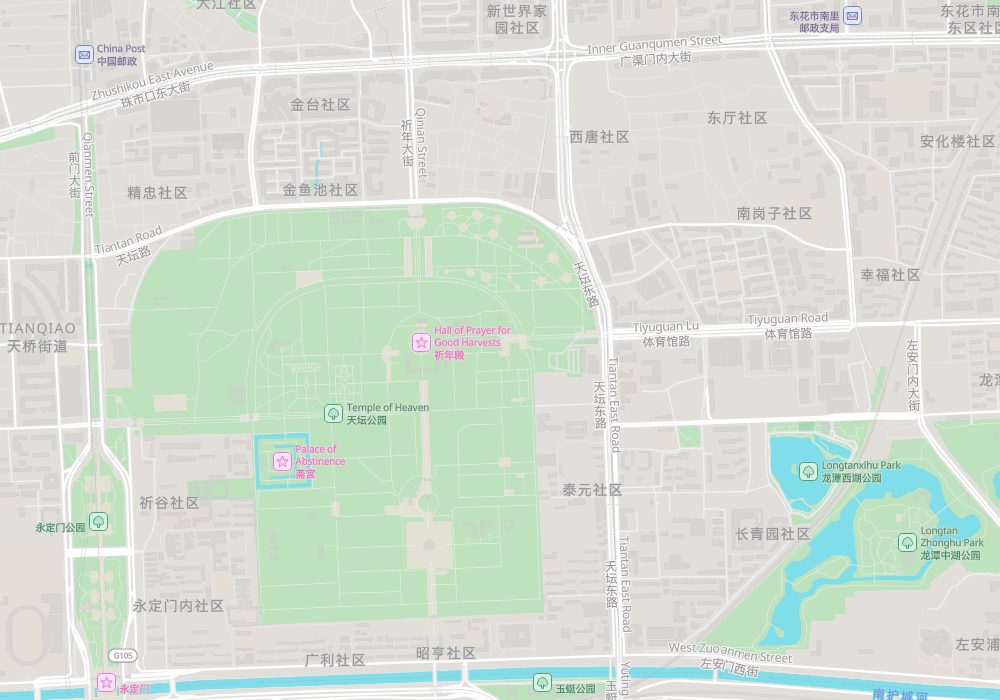
Photo credits: Hall of Prayer for Good Harvests: xiquinhosilva (CC BY 2.0, Wikimedia Commons); The Temple of Heaven: 钉钉 (CC BY-SA 4.0, Wikimedia Commons)
Nearby
| World Heritage | Beijing Central Axis: A Building Ensemble Exhibiting the Ideal Order of the Chinese Capital 3km, The Forbidden City (Palace Museum), Beijing 4km, The Summer Palace, Beijing 17km, Peking Man Site at Zhoukoudian 47km |
| National parks | Stone Flower Cave 40km, Badaling–Ming Tombs Scenic Area 56km, Mount Pan 77km, Yesanpo 108km |
| Detailed guides | Shidu 76km |
| AAAAA attractions | Prince Gong's Mansion Scenic Area 7km, Olympic Park 13km, Old Summer Palace (Yuanmingyuan) 17km, Mutianyu Great Wall Tourist Area 63km |
| AAAA attractions | Longtan Park 2km, Ming City Wall Ruins Park 2km, Taoranting Park 3km, Zhongshan Park 4km |
| UNESCO Global Geoparks | Yanqing UNESCO Global Geopark 72km |
| National key parks | Tiantan Park <1km, Beijing Zhongshan Park 4km, Beijing Botanical Garden 21km |
| Cities | Beijing 2km, Tianjin 102km |
| Historical sites | Dashilar Commercial Buildings 2km, Xiannongtan 2km, Remains of the Ming Beijing City Wall 2km, Tomb and Shrine of Yuan Chonghuan 2km |
| National geoparks | Jizhou National Geopark 86km, Yanqing Petrified Wood National Geopark 92km, Xinglong National Geopark 134km |
| Nature reserves | Baihuashan National Nature Reserve 68km, Songshan National Nature Reserve 86km, Dahaituo National Nature Reserve 92km, Baxianshan National Nature Reserve 104km |
| Historic villages | Liuliqu Village 30km |