 Park of China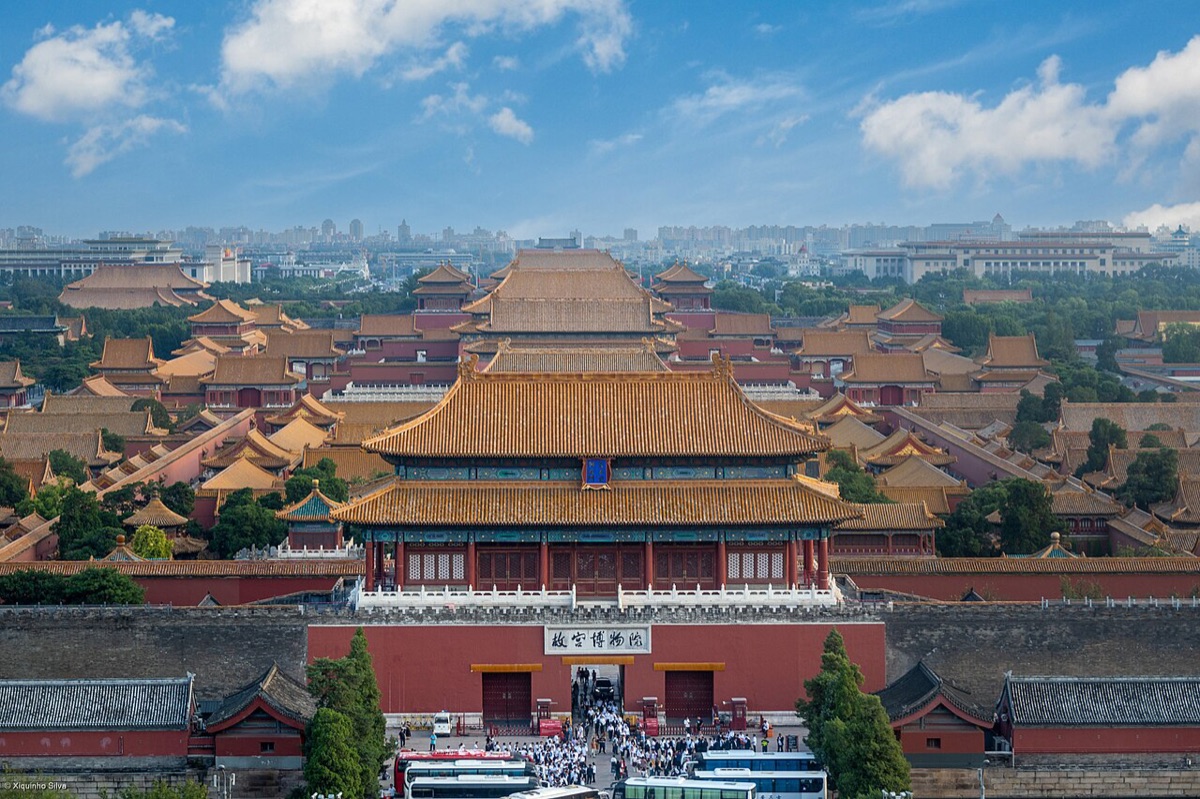
Overview
| Designation | UNESCO World Heritage (cultural, 1987) AAAAA tourist attraction |
| Province | Beijing |
| Location | Centre of Beijing |
| Latitude, longitude | 39.9, 116.4 Google Maps |
| Nearby cities | Beijing |
| Highlights | Imperial palace of the Ming and Qing dynasties |
| Top sights | Tian’anmen, the Three Great Halls, the corner towers, the Hall of Mental Cultivation, the Imperial Garden, the Treasure Gallery |
| Area | 720,000 m² |
| Nearby sites | The Temple of Heaven, Beijing 4km, The Summer Palace, Beijing 13km, Ming Tombs 44km, Chengde Mountain Resort and its Outlying Temples 177km Search nearby |
| Themes | Palace, Ancient Building, Big City, Garden, Museum, Stamp, Banknote, Imperial palaces & gardens |
The Forbidden City
The Palace Museum in Beijing, commonly called the Forbidden City (Zijincheng), was built in the early 15th century in the Yongle reign of the Ming emperor Zhu Di. Covering 720,000 m² with 150,000 m² of buildings, it was the imperial palace of the Ming and Qing dynasties.
The principal buildings are the Hall of Supreme Harmony (popularly the “Golden Throne Hall”), the Hall of Central Harmony and the Hall of Preserving Harmony. To the south stand, in order, the Gate of Heavenly Peace (Tian’anmen), the Upright Gate and the Meridian Gate; the East Glorious Gate is on the east, the West Glorious Gate on the west and the Gate of Divine Prowess on the north. Other famous buildings include the Palace of Heavenly Purity, the Hall of Union, the Palace of Earthly Tranquillity and the Imperial Garden.
It was inscribed on the UNESCO World Heritage List in 1987 as part of “Imperial Palaces of the Ming and Qing Dynasties in Beijing and Shenyang”, as a cultural site.
Main sights
Meridian Gate (Wumen): the main southern gate, a U-shaped structure topped by five pavilions, today the visitor entrance; in Ming and Qing times it was where ceremonies such as the presentation of prisoners of war were held.
Inner Golden Water River and Gate of Supreme Harmony: inside the Meridian Gate the river bends across the courtyard under five white marble bridges, and to the north is the gate leading into the Outer Court.
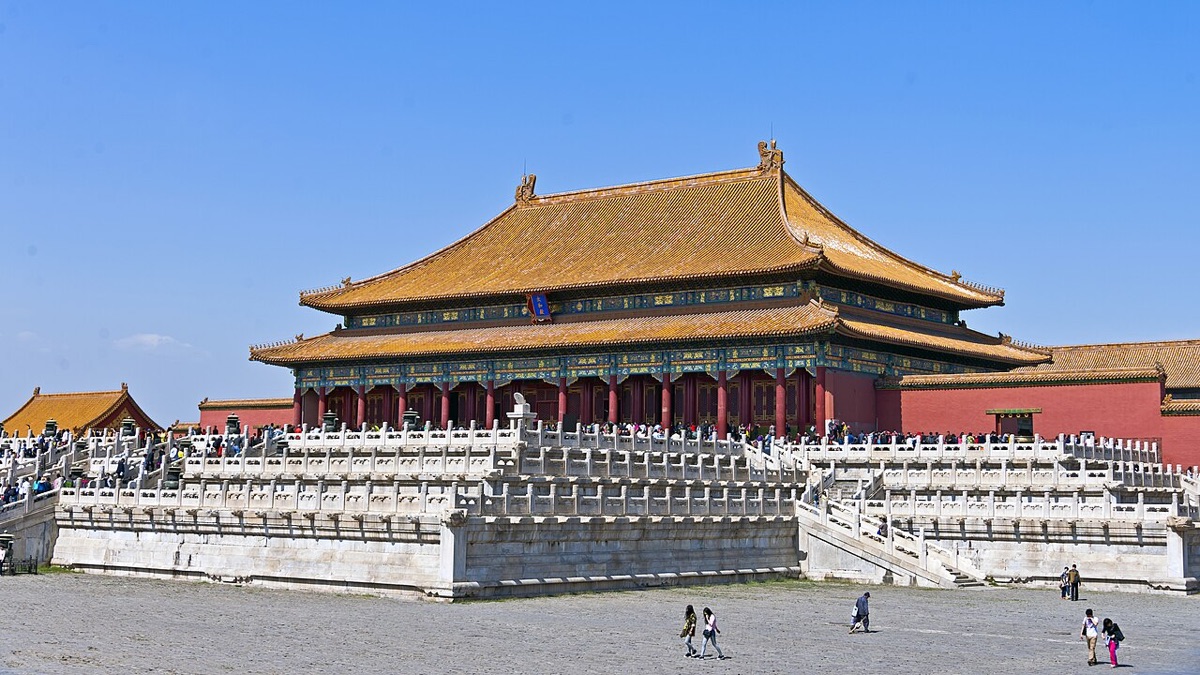
Hall of Supreme Harmony (Taihedian): the largest hall in the Forbidden City, eleven bays wide with a double-eaved hipped roof, where emperors held enthronements, weddings and major court ceremonies.
Halls of Central Harmony and Preserving Harmony: behind it on the same platform. The smaller Central Harmony was where the emperor rested before court; Preserving Harmony was used for the palace examination in the Qing.
Palace of Heavenly Purity, Hall of Union and Palace of Earthly Tranquillity: the rear palaces, bedrooms of emperors and empresses in the Ming. After Qing emperors moved to the Hall of Mental Cultivation, Heavenly Purity became a place for affairs of state and audiences.
Imperial Garden: in the north of the palace, small, with pavilions, the Qin'an Hall, old cypresses and rockeries, used by the court for leisure.
Hall of Mental Cultivation (Yangxindian): in the west section, the emperors' residence and workplace from the Yongzheng reign; the Three Rarities Studio inside was Qianlong's study.
Palace of Tranquil Longevity area: in the east section, built by Qianlong for his retirement, with the Nine-Dragon Screen, Huangji Hall and Qianlong's Garden; the Treasure Gallery is here.
Corner towers: three-tiered, with 72 ridges, among the most distinctive buildings of the palace and easiest to see from the moat side.
Above the throne of the Hall of Heavenly Purity hangs the plaque “Zheng Da Guang Ming” written by the Shunzhi Emperor. From the Yongzheng reign the name of the chosen heir was sealed in a box and kept behind it.
The Hall of Union, between the Hall of Heavenly Purity and the Palace of Earthly Tranquility, has held the 25 imperial seals fixed under the Qianlong Emperor; a plaque reading “Wu Wei” hangs inside.
Empress Dowager Cixi ruled “from behind the curtain” in the east chamber of the Hall of Mental Cultivation; on 12 February 1912 Empress Dowager Longyu issued the abdication edict of the last Qing emperor here.
The Hall of Supreme Harmony stands 35.05 m high including its three-tier marble terrace, with about 2,377 m² of floor space, the largest hall in the palace.
History and culture
Construction of the Forbidden City began in 1406 in the Yongle reign of the Ming and was completed in 1420; the capital formally moved to Beijing the following year.
The walls measure about 960 metres north to south and 750 metres east to west, with a moat about 52 metres wide. The buildings line up along the north-south central axis, symmetrical east and west.
Twenty-four emperors lived and ruled here across the Ming and Qing, 14 in the Ming and 10 in the Qing.
Fires destroyed and led to the rebuilding of the main halls several times; the present Hall of Supreme Harmony dates from a rebuilding in 1695.
The Qing emperor abdicated in 1912, but the last emperor, Puyi, kept living in the rear palaces until he was expelled in 1924. The Palace Museum was founded on 10 October 1925.
In the 1930s, during the war with Japan, part of the collection was moved south, and a part was later taken to Taiwan. The collection totals over a million items, including paintings and calligraphy, ceramics, bronzes, clocks and court objects.
Travel tips
Getting there: take Metro Line 1 to Tian'anmen East or Tian'anmen West, then walk through Tian'anmen and Duanmen to the Meridian Gate (Wumen).
Booking: entry is by advance real-name booking with a daily limit; on holidays and in summer tickets often sell out several days ahead. Bring the ID used for booking.
Opening: closed on Mondays except public holidays. Entry is only through the Meridian Gate; exit through the Gate of Divine Prowess (Shenwumen) or the East Prosperity Gate (Donghuamen).
Route: the central axis runs through the Halls of Supreme Harmony, Central Harmony and Preserving Harmony, then the Palace of Heavenly Purity, the Hall of Union and the Palace of Earthly Tranquillity, ending at the Imperial Garden. On either side, the Treasure Gallery, Clock Gallery and Hall of Mental Cultivation can be added as time allows; the Hall of Mental Cultivation reopened at the end of 2025 after nearly ten years of restoration. The Treasure and Clock galleries need separate tickets booked online, not sold on the day, so book them with your entry ticket.
Time: the central axis alone takes two to three hours; with the side palaces and galleries, most of a day.
Jingshan: across the road from Shenwumen; the Wanchun Pavilion at the top looks over the whole palace.
Season: spring and autumn are best; summer is hot with little shade in the courtyards; winter is quiet.
Caution: distances inside are long and the paving is stone; wear comfortable shoes. There are few places to eat, so bring water and a snack.
Jingshan
Jingshan (Prospect Hill) is a small hill just north of the palace’s northern gate. It rises 42.6 m (88.35 m above sea level) and is the highest point of the old city; it was built from earth dug out of the palace moats. Jingshan Park covers 23 hectares and adjoins Beihai Park to the west. Five pavilions stand along the ridge; the Wanchun Pavilion at the top is the best place to look down on the Forbidden City.
In 1644, when the rebel Li Zicheng took Beijing, the last Ming emperor, Chongzhen, hanged himself from a locust tree on the hill.
The hill was first laid out in the Jin dynasty. When the Yuan capital Dadu was built it was an imperial garden inside the palace city. The Ming and Qing dynasties rebuilt and enlarged it: in 1420, when Beijing was being built, rubble from demolished Yuan palaces and earth from the new moat were piled on the site of the Yuan Yanchun Pavilion into a hill named Wansui (“Long Life”) Hill, also called Zhen Shan, meaning “the hill that suppresses the Yuan dynasty’s royal aura”. The magnificent Shouhuang Hall complex, with its gate, main hall, side halls and stele pavilions, and the Yongsi and Guande halls were added over time. Cranes and deer were kept in the park, and every Double Ninth festival the emperor climbed the hill with his consorts and courtiers for a banquet.
In 1655 Wansui Hill was renamed Jingshan. In 1749 the Shouhuang Hall was moved to its present site, and in 1751 the five pavilions were built on the summit, from east to west the Zhoushang, Guanmiao, Wanchun, Jifang and Fulan pavilions, each housing a bronze Buddha, the “Buddhas of the Five Directions”. When the Eight-Nation Alliance occupied Beijing in 1900 the buildings were badly damaged and most of the bronze Buddhas were carried off.
Stamps and banknotes
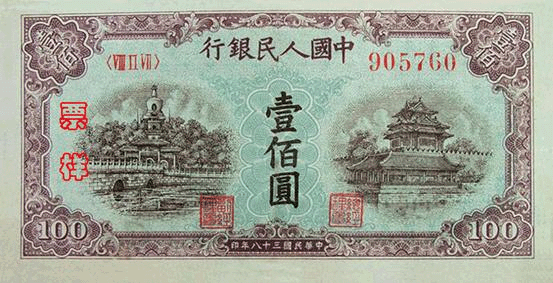
Some varieties of the 100-yuan note of the first series of renminbi (1949) show a corner tower of the Forbidden City and Beihai.
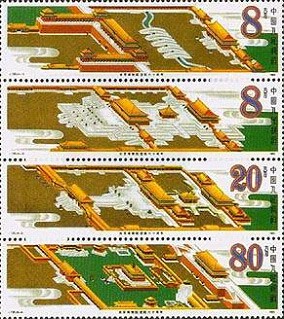
In 1985 China Post issued J.120, “60th Anniversary of the Palace Museum”, four stamps: Red Gate Towers in the Clouds (8 fen), Hall of Supreme Harmony in Morning Light (8 fen), Hall of Union (20 fen) and Imperial Garden in Spring (80 fen).
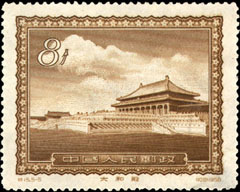
The fifth stamp of the 1956 set S15 “Scenic Spots of the Capital” shows the Hall of Supreme Harmony.
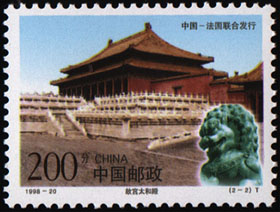
In 1998 China and France jointly issued 1998-20, “The Palace Museum and the Louvre”, two stamps.
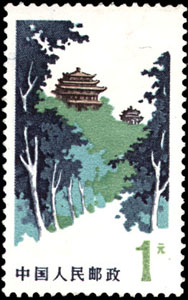
The first stamp of the 1979 definitive set R20 “Scenes of Beijing” shows Jingshan Park.
See also
More photos
Map
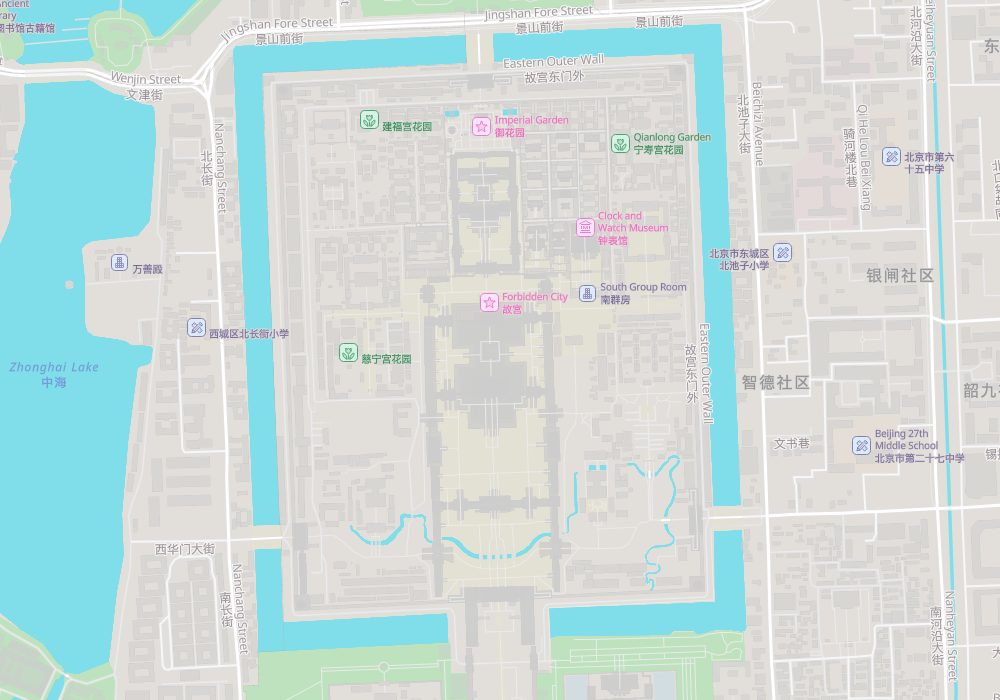
Photo credits: The Forbidden City: xiquinhosilva (CC BY 4.0, Wikimedia Commons); The Forbidden City: Daniel Case (CC BY-SA 3.0, Wikimedia Commons)
Nearby
| World Heritage | Beijing Central Axis: A Building Ensemble Exhibiting the Ideal Order of the Chinese Capital 1km, The Temple of Heaven, Beijing 4km, The Summer Palace, Beijing 13km, Ming Tombs 44km |
| National parks | Stone Flower Cave 40km, Badaling–Ming Tombs Scenic Area 51km, Mount Pan 77km, Yesanpo 108km |
| Detailed guides | Shidu 76km |
| AAAAA attractions | Prince Gong's Mansion Scenic Area 2km, Olympic Park 9km, Old Summer Palace (Yuanmingyuan) 13km, Mutianyu Great Wall Tourist Area 59km |
| AAAA attractions | Jingshan Park <1km, Zhongshan Park 1km, Beihai Park 1km, Shichahai 3km |
| UNESCO Global Geoparks | Yanqing UNESCO Global Geopark 68km |
| National key parks | Beijing Zhongshan Park 1km, Tiantan Park 4km, Beijing Botanical Garden 18km |
| Cities | Beijing 2km, Tianjin 106km |
| Historical sites | Jingshan <1km, Pudu Temple <1km, Altar of Land and Grain <1km, Site of the Peking University Geology Hall <1km |
| National geoparks | Jizhou National Geopark 87km, Yanqing Petrified Wood National Geopark 87km, Xinglong National Geopark 134km |
| Nature reserves | Baihuashan National Nature Reserve 67km, Songshan National Nature Reserve 82km, Dahaituo National Nature Reserve 88km, Baxianshan National Nature Reserve 104km |
| Historic villages | Liuliqu Village 27km |