 Park of China
Overview
| Designation | National Park of China (first batch) AAAAA tourist attraction |
| Province | Hubei |
| Location | The Yangtze gorges from Fengjie, Chongqing, to Yichang, Hubei |
| Mountains / Rivers and lakes | Wu Mountains; Yangtze River |
| Latitude, longitude | 31.0, 109.0 Google Maps |
| Highlights | Deep V-shaped gorges |
| Top sights | Kuimen, Wu Gorge |
| Wildlife | Baiji (Yangtze river dolphin) |
| Length | 193 km |
| Nearby cities | Chongqing, Fuling, Wanzhou, Yichang |
| Nearby sites | Shennongjia 144km, Wulingyuan (Zhangjiajie) 231km, Mount Wudang 245km, Dazu Rock Carvings 345km, Mausoleum of the First Qin Emperor and the Terracotta Army 377km Search nearby |
| Themes | Long River, Mountain, Peak, Canyon, Culture, Reservoir, Stamp, Banknote, Rafting & boat trips, Water conservancy works, Literary landmarks |
The Three Gorges
The Three Gorges are the Qutang, Wu and Xiling gorges, running more than 193 km from Baidicheng at Fengjie, Chongqing, to Nanjin Pass at Yichang, Hubei.
Qutang Gorge, the uppermost, is 8 km long and famed for its grandeur; its entrance, Kuimen, “the mightiest gate under heaven”, is one of the four great sights of Sichuan. A 40 m rock, the Yanyu Heap, once stood in the mouth of the gorge; it was blown up in 1959 for safe navigation.
Wu Gorge runs 45 km from the mouth of the Daning River to Guandukou, past the Twelve Peaks of Wushan, the most famous being Goddess Peak. In the Warring States period the poet Song Yu of Chu wrote the Gaotang and Goddess rhapsodies on the legend of the clouds and rain of Wushan. Wushan County also has the Lesser Three Gorges of the Daning River and the Mini Three Gorges.
Xiling Gorge is 66 km long, with the Military Books and Precious Sword Gorge, the Ox Liver and Horse Lung Gorge and the Lantern Shadow Gorge.
At Kuimen, the entrance to Qutang Gorge, Chijia Mountain on the north bank faces Baiyan Mountain on the south.
Xiling Gorge also includes the Huangniu (Yellow Ox) Gorge section; long known for rapids, it has become calm since the Gezhouba and Three Gorges dams were built.
The Lesser Three Gorges of the Daning River are Longmen, Bawu and Dicui gorges, running north from Wushan town toward Dachang.
It is in the first batch of national parks of China (national scenic areas) named by the State Council in 1982.
Travel tips
Getting there: there are two main ways to see the gorges: a cruise between Chongqing and Yichang, upstream or downstream, or the Zhengzhou–Chongqing high-speed railway to stations such as Fengjie and Wushan, seeing the gorges in stages. Yichang has an airport and a high-speed rail station.
Cruises: a Chongqing–Yichang cruise usually takes three to four days, stopping at places such as Fengdu, Shibaozhai, Baidi City, the Lesser Three Gorges and the Three Gorges Dam. Passing the dam through the ship locks takes several hours.
Qutang Gorge: at Fengjie; climb to Baidi City for the view of Kuimen, or take a short boat trip into the gorge.
Wu Gorge: at Wushan; boats run through Wu Gorge past Goddess Peak, and small boats go up the Daning River through the Lesser Three Gorges and the Mini Three Gorges.
Xiling Gorge and the dam: from Yichang you can visit the Three Gorges Dam and sights in the lower Xiling Gorge. Entry to the dam area is by real-name ticket, so bring your ID or passport.
Time: three to four days by cruise; if travelling on your own, one or two days each at Fengjie, Wushan and Yichang.
Season: spring and autumn are best; summer is hot and is the flood season; from late November to January the leaves turn red around Wu Gorge.
Caution: since the reservoir filled, the water is much higher and the gorges less deep than before; some old sites were flooded or moved, such as Zhang Fei Temple and the Qu Yuan Temple.
Other sights
Other famous sights on the Chongqing–Yichang route: the Baiheliang inscriptions at Fuling, the “ghost city” of Fengdu, Shibaozhai at Zhongxian, the Zhang Fei Temple at Yunyang, Taibai Rock at Wanzhou, Baidicheng at Fengjie, and the Qu Yuan Shrine and Wang Zhaojun’s home at Zigui.
The Zhang Fei Temple originally stood at the foot of Feifeng Hill on the south bank at the old Yunyang county seat; in July 2003 it was moved to Panshi town across the river from the new seat. It combines the Chinese temple tradition of successive courtyards with the hillside in a layout like the character 品, its flying eaves and plain walls blending with rock and old trees: “the finest view of Shu, a haven of letters”.
Shibaozhai stands on Yuyin Hill on the north bank at Zhongxian. Begun in the Wanli reign of the Ming, its nine-storey tower with a three-storey Kuixing pavilion on top rises 56 m, the largest and tallest surviving timber-frame building of its kind in China. Built against the cliff, each floor is joined by mortise and tenon without a single nail; from the river the lone peak rises between sky and water, red walls and grey tiles amid green leaves.
The old town of Dachang on the east bank of the Daning River in Wushan County has only two main streets, 150 m and 240 m long, mostly Ming and Qing buildings with a complete town wall: grey brick and dark tiles, double eaves, upturned corners and carved beams, one of the better preserved old towns in the gorges. Under the heritage plan for the Three Gorges reservoir it was moved and rebuilt at Xibaoling 5 km away.
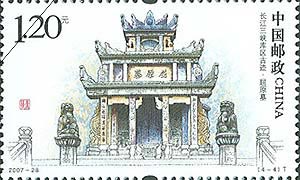
The Qu Yuan Shrine was first built as a temple in Qu Yuan village, Zigui County. In 1080 the Song emperor Shenzong ennobled Qu Yuan as Duke Qinglie and renamed the restored shrine after him. When the Gezhouba dam raised the water in 1976 it was moved to Xiangjiaping in Guizhou town and renamed the Qu Yuan Shrine, with a gate, side rooms, a stele gallery, a memorial hall and Qu Yuan’s tomb; the gate is a six-column, five-bay archway with “Qu Yuan Shrine” in the hand of Guo Moruo. After the Three Gorges reservoir filled it was rebuilt on Phoenix Hill in the new Zigui county town.
The Three Gorges Dam
The Three Gorges Dam stands at Sandouping in Xiling Gorge, Hubei. The Gezhouba dam lies downstream near Yichang.
Stamps and banknotes
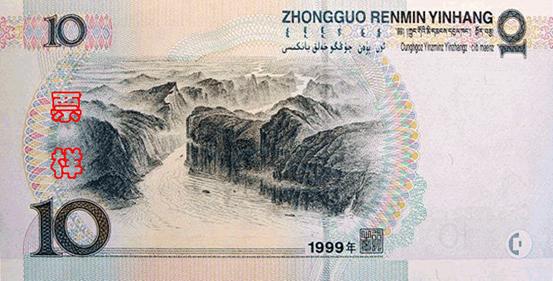
The backs of the 5-yuan note of the fourth series (1988) and the 10-yuan note of the fifth series show the Three Gorges.

In 1994 China Post issued “The Three Gorges”, six stamps and a souvenir sheet: Baidicheng, Qutang Gorge, Wu Gorge, Goddess Peak, Xiling Gorge and the Qu Yuan Shrine.


The 15th stamp of the 1981 definitive set R21 “Scenery of the Motherland” shows the Three Gorges.

On 20 August 2003 2003-21 “Three Gorges Project: Power Generation”, three stamps: the reservoir filling, the ship locks opening and the power station generating. On 13 October 2007 2007-28 “Monuments of the Three Gorges Reservoir Area”, four stamps: the Zhang Fei Temple, Shibaozhai, Dachang old town and Qu Yuan’s tomb.


In 2014 China Post issued 2014-20 “The Yangtze River”, nine stamps; “the wonders of the Three Gorges” shows the Three Gorges.

In literature
An old song of Badong tells of the long Wu Gorge and the gibbons whose cries bring travellers to tears.
Liu Yuxi wrote of the twelve peaks of Wushan and the slender Goddess Peak in the morning mist.
Li Bai’s “Leaving Baidicheng at Dawn” tells of a light boat speeding a thousand li downstream to Jiangling in a day, past the crying gibbons of the gorges.
Map


Photo credits: Kuimen, gate of the Three Gorges: Tan Wei Liang Byorn (CC BY 3.0, Wikimedia Commons)
Nearby
| World Heritage | Shennongjia 144km, Tangya Tusi Chengzhi 146km, Furong River, Wulong 224km, Wulingyuan (Zhangjiajie) 231km |
| National parks | Tiankeng and Difeng (Sinkhole and Fissure) 49km, Tanzhang Gorge 63km, Mengdong River 243km, Mount Guangwu–Nuoshui River Scenic Area 246km |
| AAAAA attractions | Yunyang Longgang Scenic Area 36km, Enshi Grand Canyon Scenic Area 68km, Tenglong Cave Scenic Area 74km, Lesser Three Gorges and Mini Three Gorges 87km |
| AAAA attractions | Three Gorges Ladder City 29km, Yunyang Zhang Fei Temple 30km, Kuizhou Museum 52km, Three Gorges Homeland 55km |
| UNESCO Global Geoparks | Yunyang UNESCO Global Geopark 14km, Enshi Grand Canyon-Tenglongdong Cave UNESCO Global Geopark 77km |
| Historical sites | Peng Clan Ancestral Hall 25km |
| National geoparks | Yunyang Longgang National Geopark 36km |
| Nature reserves | Xuebaoshan National Nature Reserve 69km, Yintiaoling National Nature Reserve 103km, Tangjiahe National Nature Reserve 104km, Hualongshan National Nature Reserve 119km |