 Park of China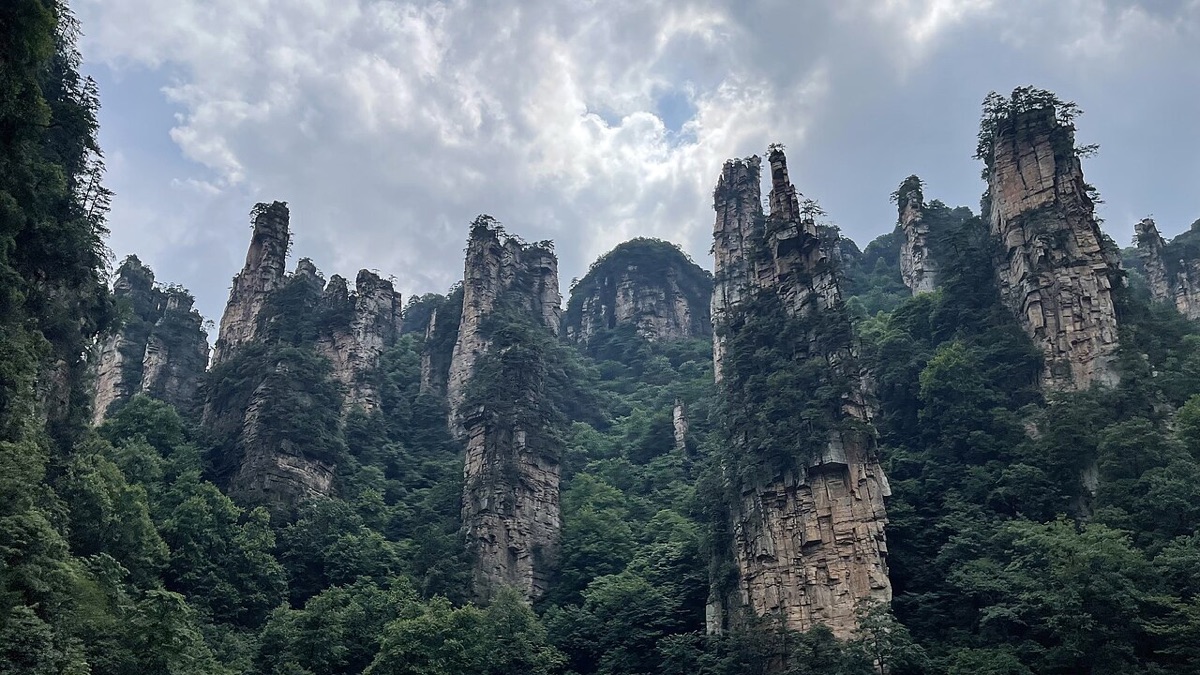
Overview
| Designation | UNESCO World Heritage (natural, 1992) National Park of China (second batch) AAAAA tourist attraction |
| Province | Hunan |
| Location | North-west Hunan |
| Mountains | Wuling Mountains |
| Latitude, longitude | 29.4, 110.5 Google Maps |
| Nearby sites | Mengdong River 73km, Peach Blossom Land (Taohuayuan) 111km, Meishan Dragon Palace 175km, Tiankeng and Difeng (Sinkhole and Fissure) 185km, Ziquejie Terraces 189km Search nearby |
| Highlights | Quartz sandstone pillars hundreds of metres high, natural bridges, wildlife |
| Top sights | Tianzi Mountain: Imperial Brush Peak, Fairy Scattering Flowers, Shentang Bay; Yuanjiajie and Yangjiajie: Wulong Village, Tianbo Mansion, the Number One Bridge under Heaven |
| Wildlife | Leopard, giant salamander, macaques |
| Area | 390 km² |
| Highest point | 1,256 m |
| Nearby cities | Zhangjiajie (Dayong, Hunan) |
| Themes | Mountain, Stone, Stonetower, Forest, Wildlife, Stream, Arch, Stamp, Cable Car, Peak, Cave, Hiking & climbing, Fossils & geological sites |
About
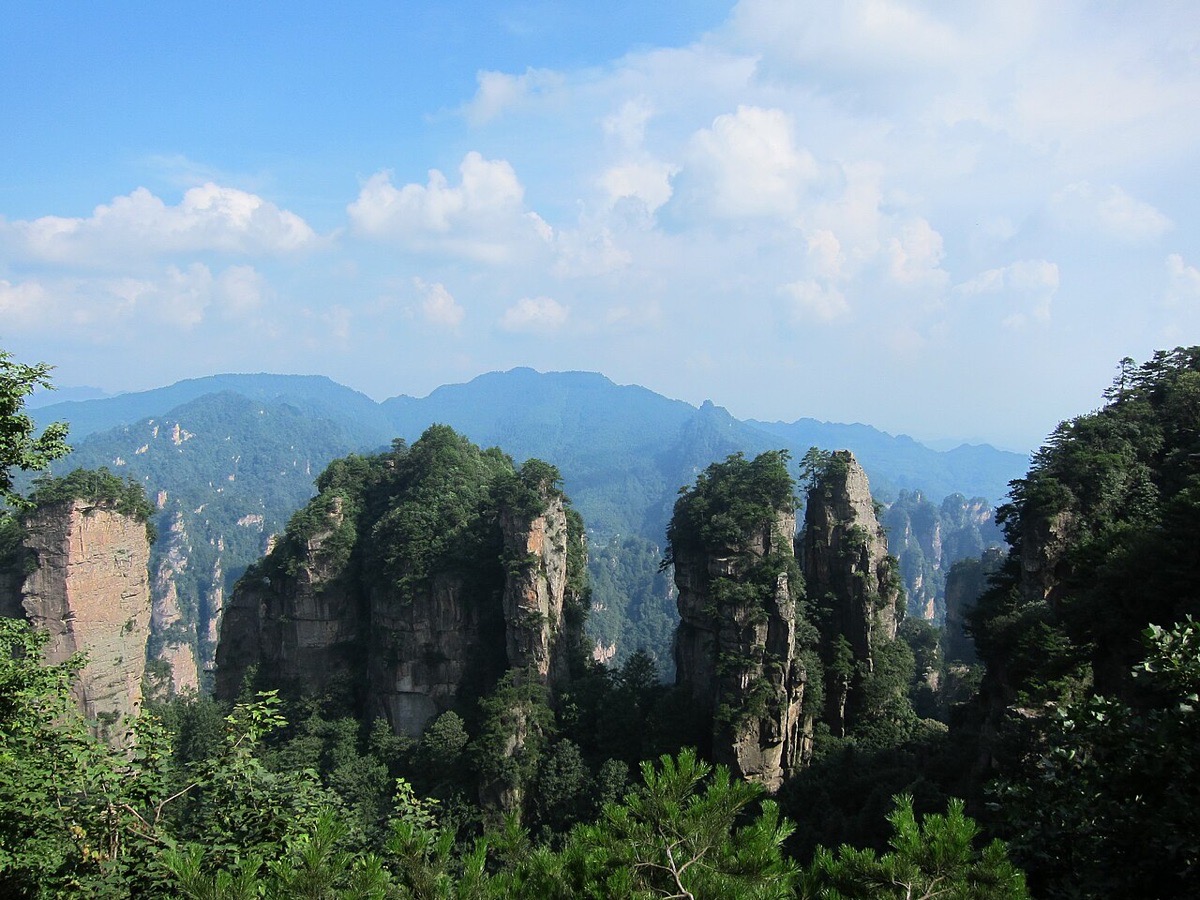
Wulingyuan, better known as Zhangjiajie, lies in the middle of the Wuling range in north-west Hunan. A World Natural Heritage Site and a Global Geopark, it is made up of Zhangjiajie National Forest Park and the Suoxiyu and Tianzi Mountain nature reserves, 390 km² in all with a 260 km² core. Within it stand some three thousand quartz sandstone pillars, many of them hundreds of metres tall, together with two large natural bridges, numerous caves and rich wildlife.
Tianzi Mountain ("Son of Heaven") is named after the Tujia leader Xiang Dakun, who rose in revolt and called himself the Xiang King, Son of Heaven.
It was inscribed on the UNESCO World Heritage List in 1992, as a natural site. It is in the second batch of national parks of China (national scenic areas) named by the State Council in 1988.
Main sights
Huangshizhai: a lookout in Zhangjiajie National Forest Park developed early; the summit platform looks over the surrounding pillars, and a cable car runs up and down.
Golden Whip Stream: a valley running into the mountains from near the Forest Park gate, lined with tall rock pillars, pools and dense forest; it is the gentlest path in the park.
Yuanjiajie: a plateau-like upland of pillars and rock walls in the north of the Forest Park, with the First Bridge Under Heaven, Mihun Terrace and Tianbo Fort viewpoints. One pillar, named Hallelujah Mountain after a film shot here, is well known.
First Bridge Under Heaven: a natural rock bridge on Yuanjiajie spanning two pillars above a deep gorge.
Yangjiajie: north-west of Yuanjiajie, less visited, with Wulong Village and other viewpoints and steeper terrain.
Tianzi Mountain: in the north-west of Wulingyuan and higher than the rest; viewpoints include Imperial Brush Peak, Shentang Bay, Fairy Offering Flowers and Helong Park, with wide views and pillars rising like islands from the cloud.
Ten-Mile Gallery: a valley on the Suoxiyu side with rock pillars lined up along both sides like a scroll painting; reached on foot or by small train.
Baofeng Lake: a lake among the peaks in the Suoxiyu area, ringed by pillars, with the Baofeng waterfall nearby.
Huanglong Cave: in Suoxiyu, Wulingyuan District, formed in limestone, with two dry and two water levels and a total length of 7.5 km; its stalagmite "Sea-Calming Needle" is about 20 m tall.
Geology and landscape
The rock of Wulingyuan is mainly Devonian quartz sandstone, laid down about 380 million years ago in shallow sea and shoreline settings, in beds hundreds of metres thick.
Later uplift cut the beds with vertical joints. Running water widened the joints over time, leaving free-standing pillars and walls.
The sandstone is hard and heavily jointed, so the pillars are tall and steep, from tens of metres to over 300 metres. This is the main difference from karst stone forests.
Between the pillars are streams, gorges, natural bridges and caves. Caves such as Yellow Dragon Cave lie in limestone nearby, not in the sandstone peak area.
The forest is dense and the valleys are damp, with frequent mist and rain; pines and other plants grow on top of the pillars and in cracks in the rock.
Travel tips
Getting there: Zhangjiajie Hehua Airport and Zhangjiajie West high-speed station are near the city; buses go on to the Forest Park gate or Wulingyuan district in about an hour.
Booking: the core area uses timed, real-name booking with no ticket sales at the gate; the ticket is valid for several days, but each entry must be booked again.
Entrances: the main gates are the Forest Park, Wulingyuan, Tianzi Mountain and Yangjiajie; park shuttle buses link the areas.
Golden Whip Stream: a level path along the stream starts near the Forest Park gate; allow two to three hours.
Yuanjiajie: take the Bailong Elevator up to see the First Bridge Under Heaven and the pillars around Wulong Village and Tianbo Fort.
Tianzi Mountain: Imperial Brush Peak, Fairy Scattering Flowers and Shentang Bay are here; a cable car goes up and down.
Ten-Mile Gallery: a valley on the Wulingyuan side with a small tourist train, or you can walk.
Time: allow two to three days for the main sights.
Where to stay: you cannot stay overnight on Yuanjiajie, Tianzi Mountain or elsewhere inside the core area; most visitors stay in Wulingyuan district (Suoxiyu) or near the Forest Park gate.
Caution: on holidays the queues for shuttle buses, the elevator and cable cars are long. Monkeys along Golden Whip Stream grab food. After rain it is often foggy and the distant peaks may be hidden.
Suggested itinerary
The finest scenery is at Tianzi Mountain and Yuanjiajie/Yangjiajie. Huangshizhai was developed earliest; its slogan “no trip to Zhangjiajie is complete without Huangshizhai” is generally thought an exaggeration.
Day 1: enter at the Zhangjiajie park gate, take the bus to the Huangshizhai cable car, ride up and down and walk the loop on top; return to the gate area and walk along Golden Whip Stream; take the Bailong Elevator up and the bus to Yuanjiajie for the night.
Day 2: the sights around the Number One Bridge under Heaven; Wulong Village and Tianbo Mansion; bus to Tianzi Mountain for the Immortals’ Bridge; stay the night on Tianzi Mountain.
Day 3: the main sights of Tianzi Mountain in the morning; South Heavenly Gate or the Ten-Mile Gallery in the afternoon.
Stamps
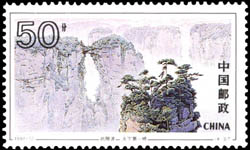
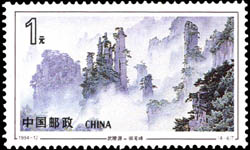
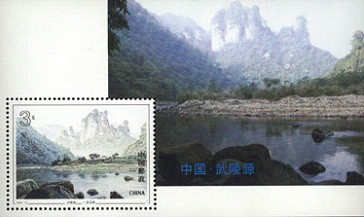
In 1994 China Post issued “Wulingyuan”, four stamps: South Heavenly Gate, Shentang Bay, the Number One Bridge under Heaven and Imperial Brush Peak, with a 3-yuan souvenir sheet 1994-12M.


Further afield
Tianmen Mountain: aircraft have flown through its natural arch, Tianmen Cave.
Maoyan River: a 20 km lake cruise and a 35 km rafting run.
Jiutian Cave: nine natural skylights, 2.6 million m² on three levels, styled an “international cave exploration base” and claimed as the largest in Asia.
Huanglong Cave.
Baofeng Lake: 2.5 km long, 200 to 1,000 m wide, 27 m deep on average, with Baofeng Waterfall.
More photos
Map

Photo credits: Wulingyuan (Zhangjiajie): Kuruman (CC BY 2.0, Wikimedia Commons); Wulingyuan (Zhangjiajie): 颐园居 (CC BY-SA 4.0, Wikimedia Commons)
Nearby
| World Heritage | Laosicheng Site 63km, Tangya Tusi Chengzhi 146km, Fanjingshan 238km, Shennongjia 239km |
| National parks | Mengdong River 73km, Peach Blossom Land (Taohuayuan) 111km, Dehang 134km, Liye and Wulong Mountain 140km |
| AAAAA attractions | Tianmen Mountain Scenic Area <1km, Changyang Qingjiang Gallery Scenic Area 140km, Zhuoshui Scenic Area 164km, Enshi Grand Canyon Scenic Area 170km |
| AAAA attractions | Baofeng Lake 9km, Yellow Dragon Cave 13km, Zhangjiajie Grand Canyon 23km, Zhangjiajie Tusi City 25km |
| UNESCO Global Geoparks | Zhangjiajie UNESCO Global Geopark <1km, Xiangxi UNESCO Global Geopark 96km, Enshi Grand Canyon-Tenglongdong Cave UNESCO Global Geopark 156km |
| Historical sites | Puguang Chan Temple Historic Building Complex 25km, Site of the Starting Point of the Long March of the Red Second and Sixth Army Corps 26km, Tian Family Compound 26km |
| National geoparks | Hongshilin National Geopark 90km, Wufeng National Geopark 93km |
| Nature reserves | Yingzuijie National Nature Reserve 8km, Baiyunshan National Nature Reserve 9km, Xiaoxi National Nature Reserve 64km, Badagongshan National Nature Reserve 71km |