 Park of China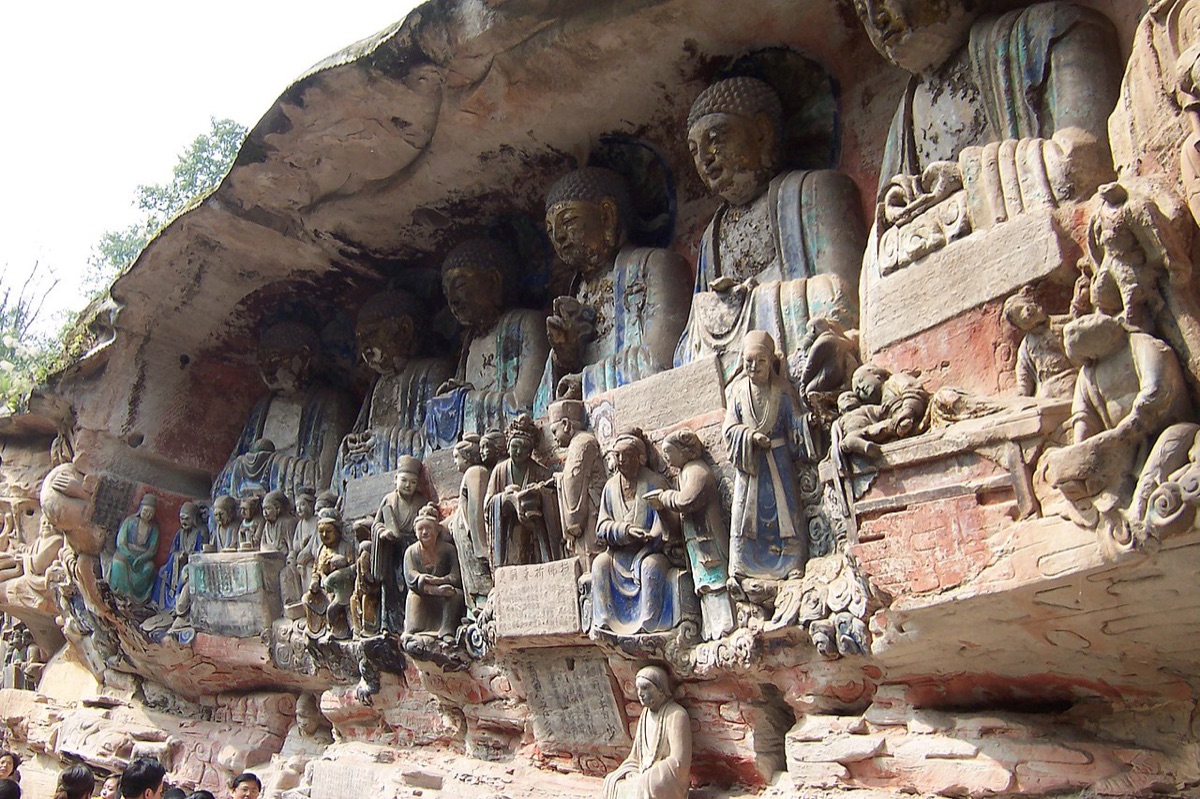
Overview
| Designation | UNESCO World Heritage (cultural, 1999) AAAAA tourist attraction |
| Province | Chongqing |
| Location | Chongqing |
| Latitude, longitude | 29.5, 105.8 Google Maps |
| Highlights | Buddhist sculpture |
| Top sights | The Beishan and Baodingshan cliff carvings |
| Nearby cities | Chongqing |
| Nearby sites | Mount Jinyun 63km, Chishui Scenic Area 116km, Mount Jinfo 144km, Shunan Bamboo Sea 145km, Leshan Giant Buddha 199km Search nearby |
| Themes | Statue, Grotto, Buddha, Stamp |
About
The Dazu Rock Carvings, in the Dazu, Tongnan, Tongliang and Bishan districts in Chongqing, are among China’s most famous Buddhist cliff sculptures: more than 70 sites and over 100,000 figures, the most important at Baodingshan and Beishan.

In 1999 the carvings at Beishan, Baodingshan, Nanshan, Shizhuanshan and Shimenshan were inscribed on the World Heritage List.
Travel tips
Getting there: buses and high-speed trains run from Chongqing to Dazu (now a district of Chongqing); the train station is Dazu South. From town, buses and taxis go to Baoding Shan and Bei Shan.
Booking: tickets are booked in advance under your real name through the official channels; book early for holidays.
Baoding Shan: about 15 km northeast of town. The Great Buddha Bend is the main part, with the Thousand-Armed Guanyin, the Reclining Buddha and the Wheel of Rebirth; the Dazu Rock Carvings Museum is near the entrance. Allow about half a day.
Bei Shan: a short way north of town, with the carvings concentrated on the cliff at Fowan. One to two hours is enough.
Nan Shan, Shimen Shan and Shizhuan Shan: smaller and quieter sites some distance from town, for those with more time.
Time: Baoding Shan and Bei Shan are about 20 km apart and fit into one day, usually Baoding in the morning and Bei Shan in the afternoon; a day trip from Chongqing is possible.
Season: spring and autumn are best; summer is hot with frequent thunderstorms.
Caution: most carvings are on open cliffs, some under eaves. Do not use flash or touch the carvings.
The Beishan carvings
The Beishan (North Hill) carvings, 1.5 km north of the county town, were begun in 892 in the late Tang and completed in 1162 in the Southern Song, a span of more than 250 years; they are a national protected site.
Nearly 10,000 figures are carved at Fowan, Yingpanpo, Guanyinpo, Beita Temple and Fo’eryan, the densest at Fowan: on a cliff more than 300 m long and 7 m high are 6 stelae, 55 inscriptions, 8 sutra pillars and 264 niches of sculpture.
Fowan has a south and a north section. The south is mostly late Tang and Five Dynasties work, the north mostly Song. The late Tang figures are dignified and full, robust in spirit, simply dressed and fluid in line; those of the Five Dynasties are delicate and varied, their dress growing more elaborate as foreign influence fades, marking a transition; in the Song work the Chinese character is fully developed.
The Baodingshan carvings
The Baodingshan carvings, 15 km north-east of the county town, are a national protected site cut between 1179 and 1249, more than 70 years; there are 13 groups, the largest at Dafowan and Xiaofowan.
Dafowan is a horseshoe-shaped hollow carved on its east, south and north faces: a vast ensemble of 19 scenes from the sutras with more than 10,000 figures, no two alike.
The Cave of Complete Enlightenment is hollowed from a single rock and as roomy as a hall. Three Buddhas occupy the rear wall with a kneeling bodhisattva before them, hands joined in reverence; on the side walls sit the twelve bodhisattvas of enlightenment on lotus thrones, each in a different pose, their robes and flesh so lifelike the drapery seems to cling like gauze. Pavilions, people, birds and beasts, flowers and trees, springs and rocks are carved between them, almost realistic: the finest work at Dafowan. There are more than 30 large reliefs, among them the Wheel of Rebirth, the Great Jewelled Pavilion, the Three Sages of the Avatamsaka, the Thousand-Armed Guanyin, the Parinirvana of Shakyamuni, Nine Dragons Bathing the Prince, the Peacock King, the Vairocana Assembly, the Kindness of Parents, the Buddha’s Repayment of Kindness, the Six Beasts and the Hells. Scriptures and hymns are carved beside the scenes like captions to a picture story, a feature found at no other Chinese grotto.
Stamps
In 2002 China Post issued 2002-13T “Dazu Rock Carvings”, four 80-fen stamps: the Sun and Moon Guanyin and Samantabhadra at Beishan, the Three Sages of the Avatamsaka at Baodingshan and the Three Sovereigns Cave at Shimenshan, all Song, with an 8-yuan souvenir sheet of the Thousand-Armed Guanyin at Baodingshan.

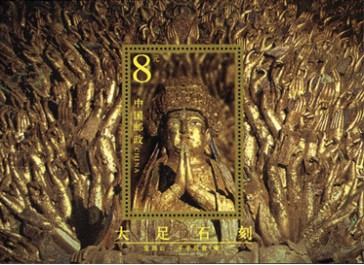
The fourth stamp of the 1988 definitive set R24 “Chinese Grotto Art” shows the Song figure of a girl feeding chickens at Dazu.

Banknotes and coins
The gold and silver coins “World Heritage: the Dazu Rock Carvings”, issued by the People’s Bank of China in 2016, show the Thousand-Armed Guanyin, the Sun and Moon Guanyin, the Nirvana of Sakyamuni and Baodingshan.
Map
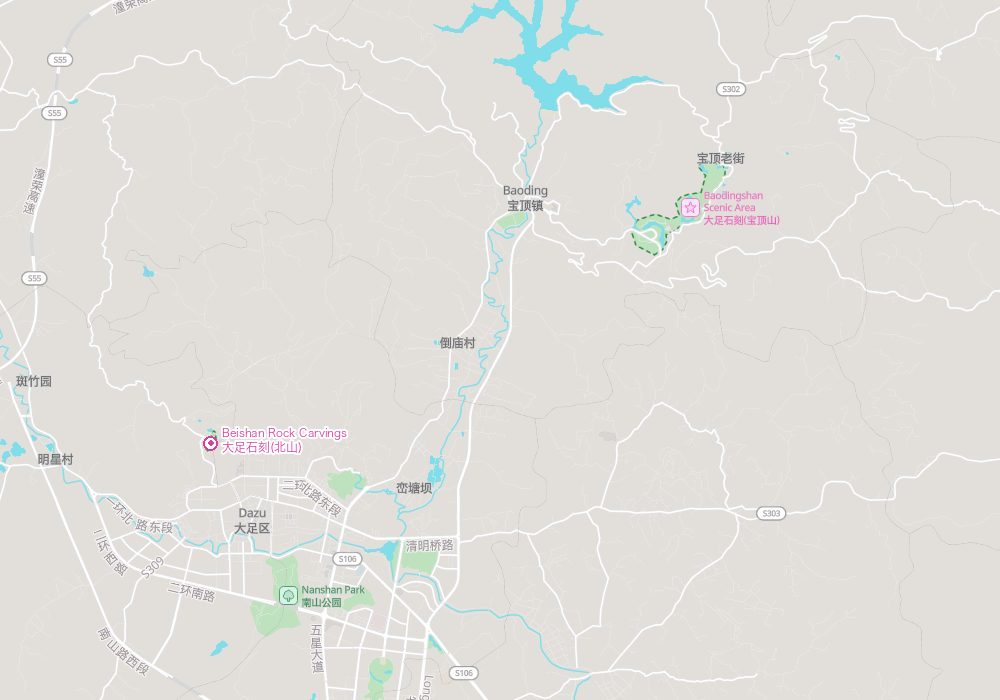
Photo credits: Dazu Rock Carvings: Gerd Eichmann (CC BY-SA 4.0, Wikimedia Commons); Dazu Rock Carvings: Truthven (CC BY-SA 3.0, Wikimedia Commons)
Nearby
| World Heritage | Chishui Scenic Area 116km, Mount Jinfo 144km, Leshan Giant Buddha 199km, Furong River, Wulong 201km |
| National parks of China | Giant Panda National Park 286km |
| National parks | Mount Jinyun 63km, Simian Mountains 114km, Shunan Bamboo Sea 145km, Shihai Dongxiang (Stone Sea and Caves) 152km |
| AAAAA attractions | Heishan Valley Scenic Area 133km, Deng Xiaoping's Hometown Tourist Area 134km |
| AAAA attractions | Wanling Ancient Town 18km, Dazu Xiangguo Park 19km, Chashan Bamboo Sea 19km, Xuantian Lake 36km |
| UNESCO Global Geoparks | Zigong UNESCO Global Geopark 98km, Xingwen UNESCO Global Geopark 159km |
| Historic cities | Chongqing 66km, Luzhou 81km |
| Cities | Chongqing 65km |
| Historical sites | Beishan Cliff Statues (including Fowan, Guanyinpo, Fo'erfeng and Yingpanshan) 22km, Baodingshan Cliff Statues (including Dafowan, Xiaofowan, Guangdashan, Longtan and Songlinpo) 24km |
| National geoparks | Qijiang National Geopark 113km, Huayingshan National Geopark 120km, Wansheng National Geopark 124km, Shehong Petrified Wood National Geopark 133km |
| Nature reserves | Laojunshan National Nature Reserve 97km, Changning Bamboo Sea National Nature Reserve 144km |
| Historic towns | Wutan Town 39km, Zouma Town 46km |