 Park of China
Overview
| Designation | National Park of China (first batch) AAAAA tourist attraction |
| Province | Zhejiang |
| Location | Zhoushan Islands near Hangzhou Bay, Zhejiang |
| Mountains | Mountain Ranges of China |
| Latitude, longitude | 30.0, 122.4 Google Maps |
| Highlights | Sacred Buddhist mountain, seat of Guanyin; island |
| Top sights | Fanyin Cave, Pantuo Rock |
| Highest point | 286 m |
| Nearby cities | Ningbo |
| Nearby sites | Shengsi Islands 80km, The Grand Canal 82km, Mount Xuedou 119km, Mount Tiantai (Zhejiang) 161km, Migratory Bird Sanctuaries along the Coast of Yellow Sea-Bohai Gulf of China 173km Search nearby |
| Themes | Mountain, Famous Mountain, Ocean, Island, Buddha, Temple, Stamp, Cable Car, Beach, Statue, Coastal landforms |
About
Mount Putuo, in the Zhoushan Islands near Ningbo, Zhejiang, is the seat of the bodhisattva Guanyin and one of the four sacred Buddhist mountains of China, “the Buddhist kingdom of sea and sky”.
Putuoshan is a small island of the Zhoushan archipelago, 8.6 km long and about 12.5 km², facing Zhoushan island across a strait. In the Tang the Japanese monk Egaku, carrying a statue of Guanyin home from Mount Wutai, was stopped here by storms and left the image in a shrine, the “Guanyin who would not leave”; the island has been the seat of Guanyin ever since. At its height it had over 80 temples; the three great monasteries of Puji, Fayu and Huiji and dozens of nunneries survive, their incense never ceasing, and the golden sand, blue sea and old temples make the “Buddhist kingdom of sea and sky”.
It is in the first batch of national parks of China (national scenic areas) named by the State Council in 1982.
Travel tips
Getting there: bridges link Zhoushan Island to Ningbo. Buses from Ningbo and Shanghai go to the pier on Zhujiajian; the boat to Putuo takes about fifteen minutes by fast boat or half an hour by ordinary ferry.
Boat tickets: sold under your real name, so you need your ID or passport; book ahead in peak season. Boats stop in thick fog or strong wind.
On the island: shuttle buses link the pier and the main temples. A cable car goes up Foding Mountain, or you can walk up the stone steps of the Xiangyun Path from Fayu Temple.
Visiting: a usual route covers Puji Temple, the South Sea Guanyin statue, the Purple Bamboo Grove and Chaoyin Cave, then Fayu Temple and Thousand-Step Beach, and finally Huiji Temple on Foding Mountain.
Time: one day for the main temples; staying a night lets you see the sunrise without rushing for the boat.
Season: spring and autumn are best; typhoons from July to September can stop the boats. Around the 19th day of the 2nd, 6th and 9th lunar months there are many pilgrims and rooms are hard to find.
Where to stay: rooms on the island are limited; Zhujiajian and Shenjiamen are alternatives.
Caution: dress modestly in temples, follow the signs about photography inside halls, and ask before photographing monks.
Main sights
Puji Temple: the “front temple” in the south, the island’s largest, founded in the Song and rebuilt under Kangxi, with the great Yuantong Hall of Guanyin.
Fayu Temple: the “rear temple” in the middle of the island, founded in the Ming; its Nine Dragon Hall was moved from the Ming palace in Nanjing and has a superb nine-dragon caisson ceiling.
Huiji Temple: on the summit of Foding Mountain in the north, the highest point, overlooking the island and the sea.
Guanyin of the South Sea: a 33 m bronze statue at the southern tip of Shuangfeng Mountain, completed in 1997, the island’s emblem.
Chaoyin and Fanyin caves: sea caves where the tide thunders in, legendary places of Guanyin’s appearances.
Hundred-Step and Thousand-Step beaches: two sandy beaches on the east coast for bathing and sunrise.
Purple Bamboo Grove and the Guanyin Who Would Not Leave: the site of Egaku’s shrine beside Chaoyin Cave in the south.
Duobao Pagoda: southeast of Puji Temple, built in 1334 of Taihu stone, square with five tiers, one of the oldest structures on the island; with the Willow-branch Guanyin Stele and the Putuo hornbeam it is one of the island's 'three treasures'.
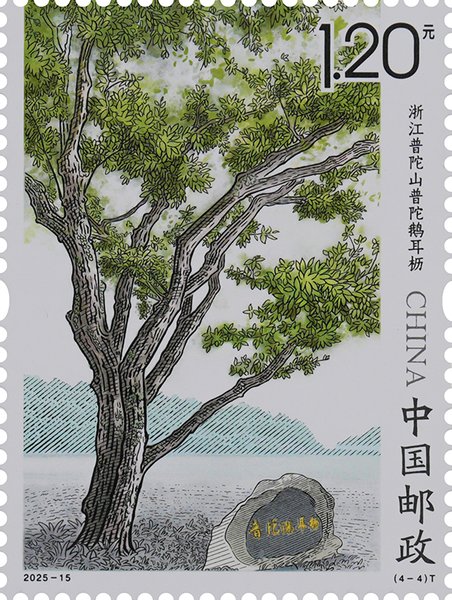
Putuo hornbeam: a wild tree over 250 years old beside Huiji Temple, found by the botanist Zhong Guanguang in 1930 and described as a new species in 1932; a first-class protected plant in China.
Pantuo Rock: one huge boulder balanced on another with only a hairline gap between them, called 'the first rock under heaven'; the carved name is attributed to the Ming anti-pirate general Hou Jigao.
Fayu Temple was founded in 1580 as the Haichao Hermitage and took its present name after the Kangxi Emperor granted the plaque 'Heavenly Flowers, Dharma Rain' in 1699.
Stamps
In 1999 China Post issued “Mount Putuo”, six stamps: Puji Temple, the South Heavenly Gate, Baibusha beach, Pantuo Rock, Fanyin Cave and Fayu Temple.


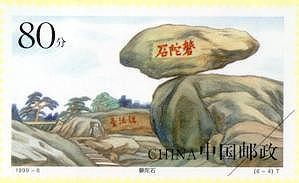

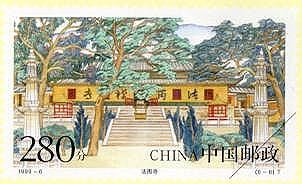
The fourth stamp of the 2025 set 2025-15 “Ancient and Famous Trees” shows the Putuo hornbeam on Mount Putuo.
Map
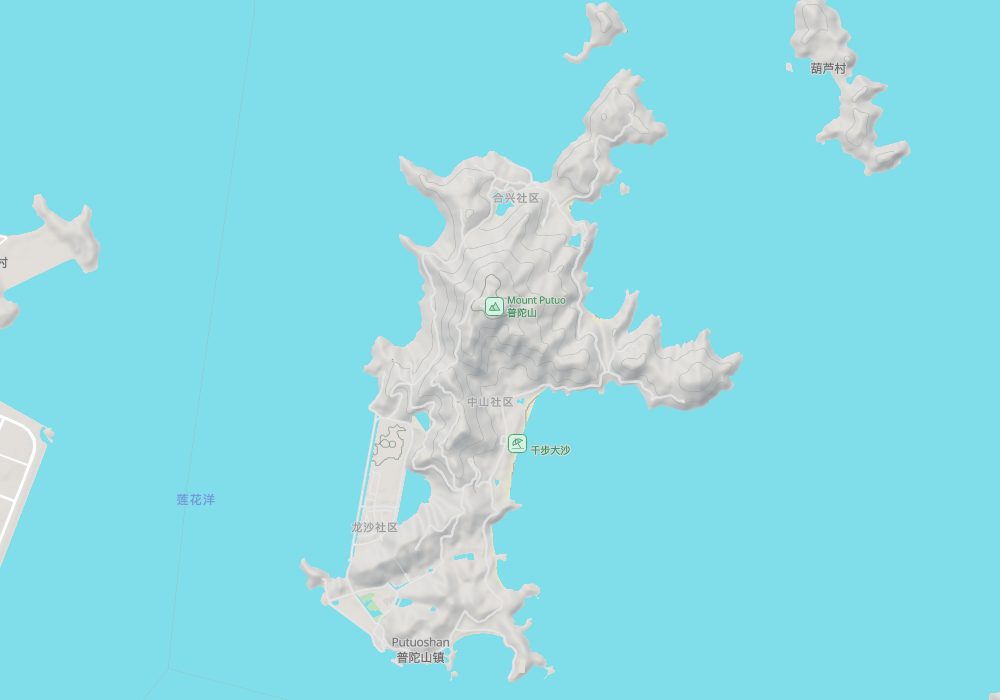
Photo credits: Mount Putuo: Jakub Hałun (CC BY-SA 3.0, Wikimedia Commons)
Nearby
| World Heritage | The Grand Canal 82km, Zhongguo Huanghai Houniao Qixidi 173km, West Lake, Hangzhou 219km, Classical Gardens of Suzhou 225km |
| National parks | Shengsi Islands 80km, Mount Xuedou 119km, Taozhu 155km, Mount Tianmu (Tianlao) 159km |
| AAAAA attractions | Tianyi Pavilion - Moon Lake Scenic Area 84km, Xikou-Tengtou Tourist Area 113km, Shanghai Wild Animal Park 134km, Shanghai Science and Technology Museum 159km |
| AAAA attractions | Zhoushan Zhujiajian Nansha Scenic Area 10km, Shenjiamen Fishing Port Town 11km, Peach Blossom Island 24km, China Port Museum 55km |
| Historic cities | Ningbo 83km |
| Historical sites | Fayu Temple <1km, Putuoshan Duobao Pagoda 2km |
| Nature reserves | Xiangshan Jiushan Islands National Nature Reserve 66km, Jiuduansha Wetland National Nature Reserve 138km |
| Historic towns | Dongsha Town 43km |