
← Chapter 6: QinA Brief History of ChinaChapter 8: Three Kingdoms, Jin and Northern and Southern Dynasties →
Chapter 7: Han
202 BC–AD 220
Western Han (202 BC–AD 8) In 202 BC Liu Bang defeated Xiang Yu at the Battle of Gaixia and founded the Han dynasty with its capital at Chang’an, known as the Western Han (202 BC–AD 8). After an early period of recovery, the Han reached its height under Emperor Wu. Emperor Wu “dismissed the hundred schools and honored Confucianism alone,” making Confucian learning the orthodox ideology from then on; he sent Wei Qing and Huo Qubing against the Xiongnu, and from 138 BC sent Zhang Qian as envoy to the Western Regions, opening a route through the Hexi Corridor to Central Asia that later came to be called the Silk Road. Sima Qian wrote the Records of the Grand Historian (Shiji), creating the biographical form of history writing.
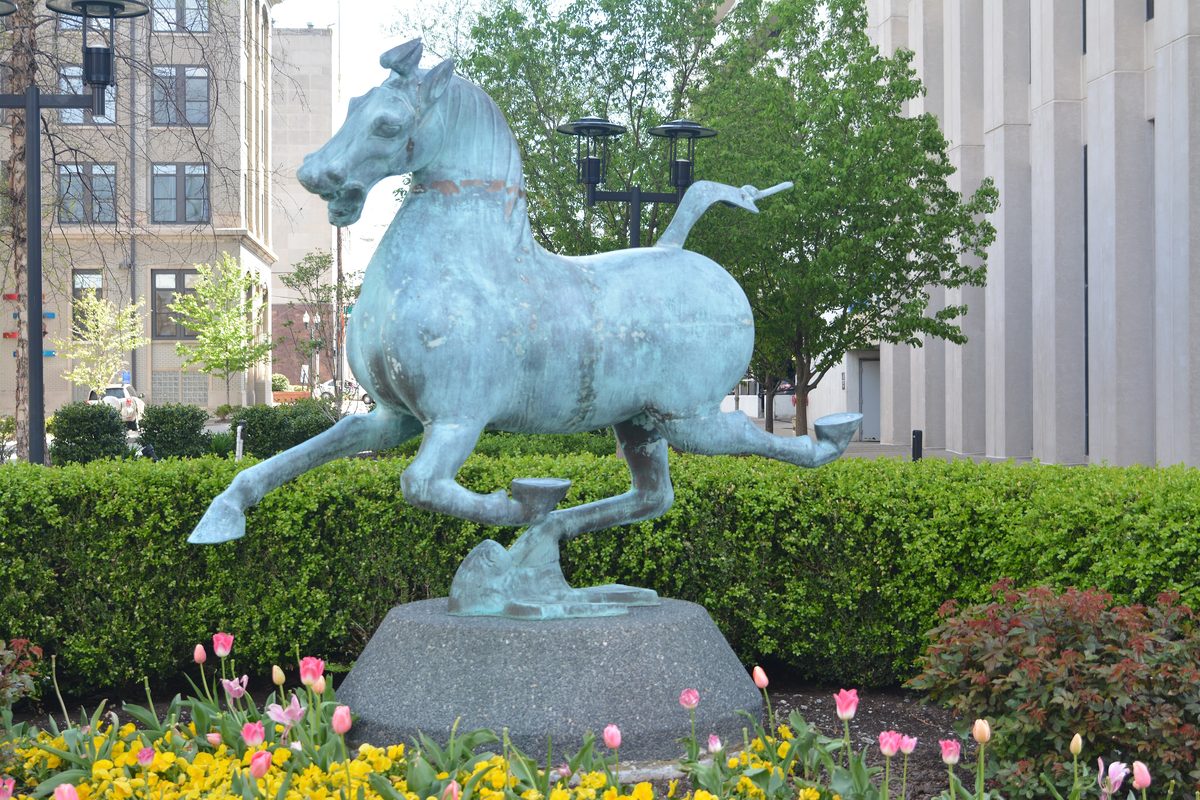
Gary Todd, CC0, Wikimedia Commons
In AD 8 Wang Mang, a relative of the empress, seized power and renamed the dynasty Xin (8–23), ending the Western Han. Wang Mang’s reforms, modeled on antiquity, repeatedly changed the currency and the offices of state; together with years of famine they plunged the country into chaos, and revolts broke out everywhere. In 23 the Lülin army took Chang’an, Wang Mang was killed and the Xin fell.
Eastern Han (25–220) In AD 25 Liu Xiu restored the Han with its capital at Luoyang, known as the Eastern Han. In this period Cai Lun improved papermaking, Zhang Heng built a seismoscope, and Buddhism reached China; the White Horse Temple in Luoyang is said to be China’s first Buddhist temple.
In the late Eastern Han, empresses’ relatives and eunuchs took turns dominating the court, and government grew corrupt. After the Yellow Turban Rebellion, regional strongmen raised armies and carved out territories, and the Han survived in name only. In 220 Cao Pi forced Emperor Xian to abdicate, ending the Eastern Han. The four centuries of Han rule gave their name to the “Han” people, “Han” characters and the “Han” language.
← Chapter 6: QinContentsChapter 8: Three Kingdoms, Jin and Northern and Southern Dynasties →