 Park of China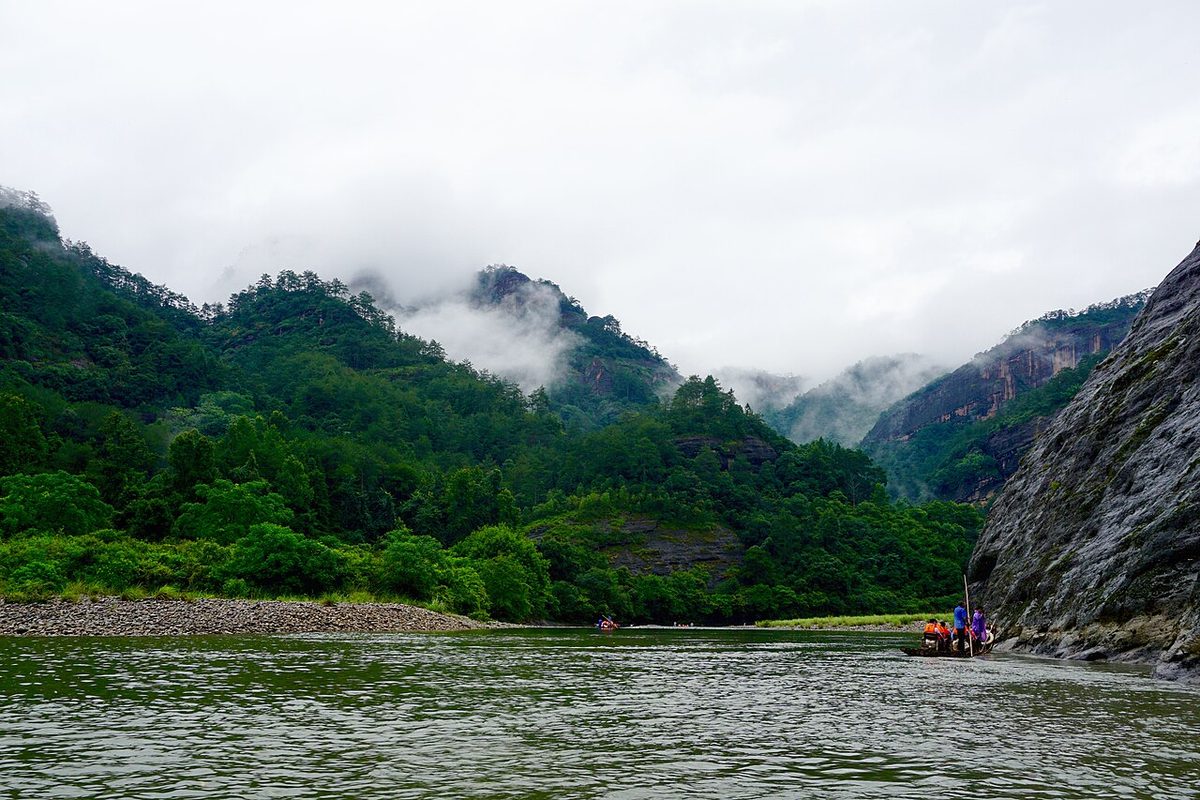
Overview
| Designation | UNESCO World Heritage (mixed, 1999) National Park of China (first batch) AAAAA tourist attraction |
| Province | Fujian |
| Location | Fujian |
| Mountains | Wuyi Mountains |
| Latitude, longitude | 27.7, 117.9 Google Maps |
| Nearby cities | Fuzhou, Nanchang |
| Highlights | Red cliffs and clear water; rich wildlife; home of the philosopher Zhu Xi |
| Top sights | The Nine-Bend Stream, Great King Peak, Jade Maiden Peak |
| Wildlife | South China tiger, giant salamander, cobra |
| Area | 70 km² |
| Highest point | 718 m (Sanyang Peak) |
| Nearby sites | Guifeng (Turtle Peak) 84km, Mount Longhu (Dragon and Tiger Mountain) 106km, Mount Jianglang 109km, Mount Sanqing 140km, Jingdezhen Handicraft Porcelain Industry Sites 194km Search nearby |
| Themes | Famous Mountain, Mountain, Peak, Red Rock, Stream, Cliff, Small Waterfall, Taoism, Culture, Wildlife, Plant, Stamp, Forest, Tea, Rafting & boat trips |
About
The Mount Wuyi scenic area in northern Fujian is famed for its red Danxia cliffs and green hills and clear water, “the most wonderful scenery in the south-east”. The main sights are the Nine-Bend Stream, Great King Peak and Jade Maiden Peak.
Rich in wildlife, it is a UNESCO biosphere reserve. The Southern Song philosopher Zhu Xi lived in the Wuyi area for over forty years; in 1183 he founded the Wuyi Jingshe academy (later called the Ziyang Academy) here and taught there.
Mount Wuyi was inscribed on the UNESCO World Heritage List in 1999 as a mixed cultural and natural site. It was also in the first batch of national parks of China (national scenic areas) named by the State Council in 1982. In 2021 the Wuyishan National Park was set up around it.
In Taoism Mount Wuyi is listed as the 16th of the 36 Lesser Grotto-Heavens.
Main sights
Nine-Bend Stream: rising on the south-west flank of Huanggang Mountain, the highest peak of the Wuyi range, it winds through nine bends between red sandstone cliffs; drifting down it on a bamboo raft is the classic way to see Wuyishan.
Wuyi Jingshe: below Yinping Peak at the Fifth Bend, the academy founded by Zhu Xi in 1183, where he taught and wrote for many years.
Wuyi Palace: on the north bank at the First Bend, first built in the Tang, a Daoist temple where Lord Wuyi was worshipped; the bamboo rafts end nearby.
Boat coffins: boat-shaped coffins over three thousand years old survive in cliff caves above the Nine-Bend Stream.
Han city site at Chengcun: at Chengcun village, Wuyishan city, the ruins of the royal city of the Minyue kingdom of the Western Han, part of the World Heritage site.
Tianyou Peak: behind Yinping Peak at the Fifth Bend, about 409 m high. It does not stand on the stream yet overlooks most of the Nine-Bend Stream; Xu Xiake ranked it first among the Wuyi peaks.
Jade Maiden Peak: on the south bank at the Second Bend, the best-known peak along the Nine-Bend Stream; it can only be viewed from across the water.
Dawang Peak: on the north bank at the mouth of the Nine-Bend Stream, called the first peak on entering the mountains; it is sheer on all sides and can only be climbed by a narrow cleft in the south face.
Travel tips
Getting there: Wuyishan Airport and Wuyishan East station on the Hefei–Fuzhou high-speed line are both near the scenic area; buses and taxis go on to the park and the resort area. Inside the park, shuttle buses link the sights.
Booking: entry, the bamboo rafts on the Nine-Bend Stream and the shuttle buses all need advance booking under your real name; on holidays the rafts are often fully booked.
Bamboo rafts on the Nine-Bend Stream: from a pier near Xingcun the rafts drift downstream to near Wuyi Palace at the First Bend, about 9.5 km in a little over an hour, past Jade Maiden Peak and Great King Peak. They stop when the water is high in the rainy season.
Tianyou Peak: in the middle of the park, with a view over the Nine-Bend Stream from the top. The steps are steep; allow one to two hours up and down.
Da Hong Pao area: a path up a gorge ends at the cliff with the original Da Hong Pao tea bushes, which have not been picked since 2006.
Other sights: One-Thread Sky, Tiger Roar Rock and Water Curtain Cave, as time allows; Wuyi Palace and the Wuyi Academy (Ziyang Academy), where Zhu Xi taught, are the main historic sites.
Time: two days are enough for the main sights.
Season: spring and autumn are best; summer is hot and rainy; April and May are the tea-picking season.
Where to stay: most visitors stay in the Wuyishan National Tourist Resort on the east bank of the Chongyang River.
Buying tea: Wuyi rock teas vary widely in kind and price; taste a little before you buy.
Local products
Wuyi rock tea (a type of oolong), including the famous Da Hong Pao tea.
Stamps
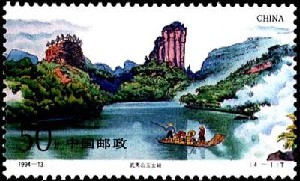
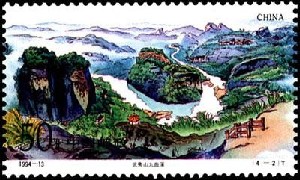
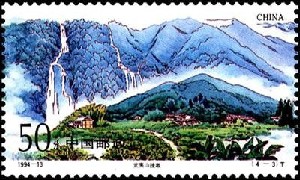
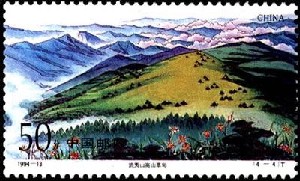
In 1994 China Post issued “Mount Wuyi”, four stamps: Jade Maiden Peak, the Nine-Bend Stream, Guadun and the alpine meadows.
Map
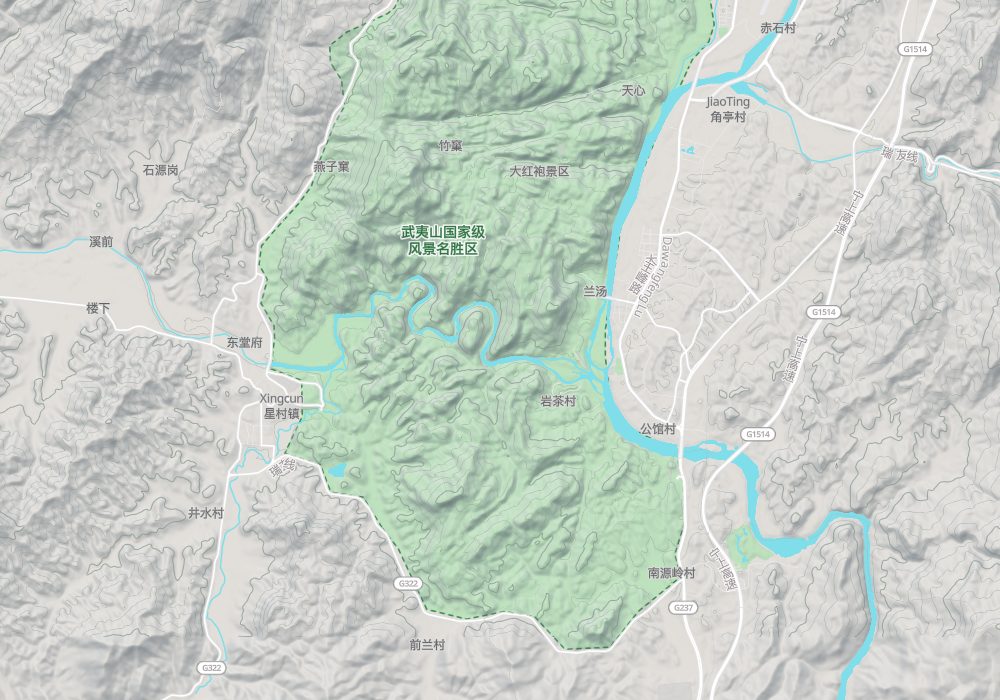
Photo credits: Nine-Bend Stream, Wuyi Mountains: John Lian (CC BY-SA 4.0, Wikimedia Commons)
Nearby
| World Heritage | Guifeng (Turtle Peak) 84km, Taining - North Section 101km, Mount Longhu (Dragon and Tiger Mountain) 106km, Mount Jianglang 109km |
| National parks of China | Wuyishan National Park <1km |
| National parks | Baoshan Scenic Area 89km, Lingshan Scenic Area 104km, Mount Fozi 116km, Mandarin Duck Creek 127km |
| AAAAA attractions | Dajueshan Scenic Area 74km, Taining Scenic Area 123km, Yunhe Terraces Scenic Area 158km, Liu Bowen Hometown Scenic Area 169km |
| AAAA attractions | Daanyuan Tourism Scenic Area 26km, Tongboshan 56km, Gexianshan 60km |
| UNESCO Global Geoparks | Taining UNESCO Global Geopark 122km, Changshan UNESCO Global Geopark 154km, Ningde UNESCO Global Geopark 164km |
| Historical sites | Wuyishan Cliff Tombs <1km, Chengcun Han City Site 15km, Zhangshantou Red Army Tombs 22km |
| National geoparks | Longhushan Danxia Landform National Geopark 107km, Dajinhu National Geopark 123km, Pingnan Baishuiyang National Geopark 127km |
| Nature reserves | Wuyishan National Nature Reserve 33km, Tongboshan National Nature Reserve 56km, Matoushan National Nature Reserve 77km, Mangdangshan National Nature Reserve 112km |
| Historic towns | Wufu Town 26km |
| Historic villages | Chengcun Village 15km |