 Park of China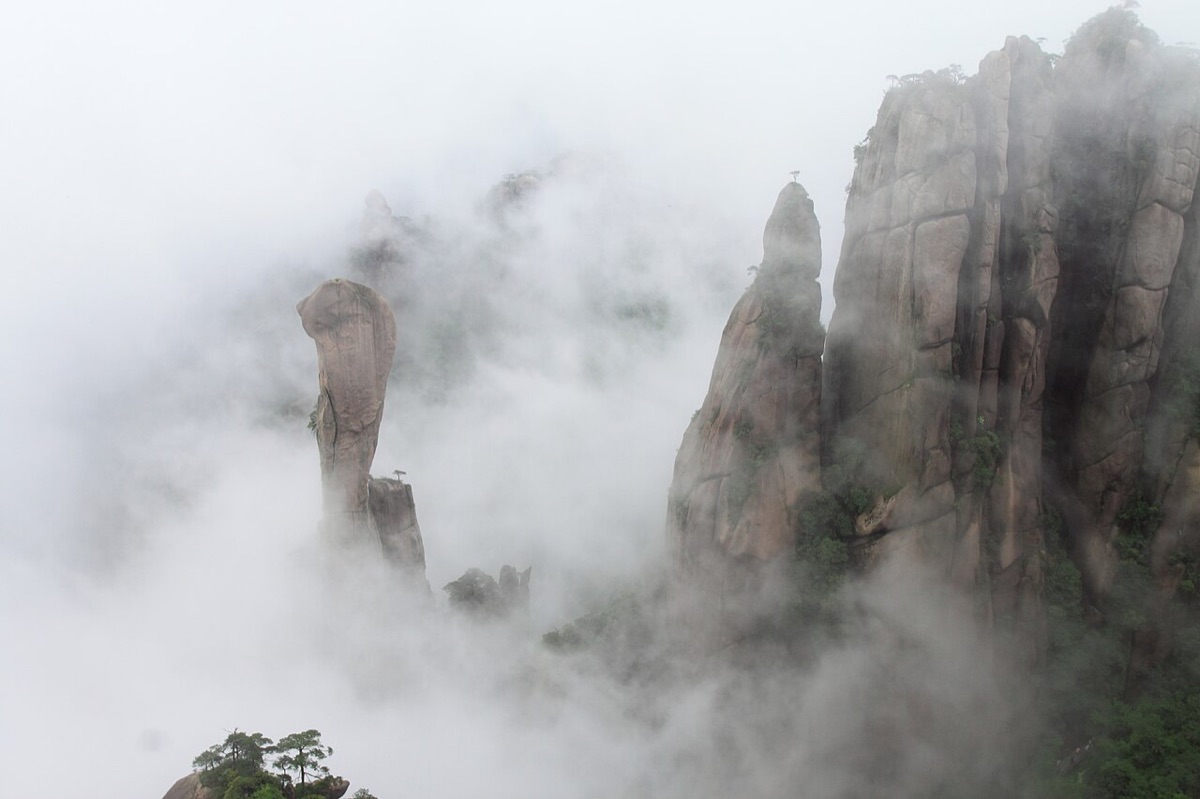
Overview
| Designation | UNESCO World Heritage (natural, 2008) National Park of China (second batch) |
| Province | Jiangxi |
| Location | Jiangxi |
| Mountains | Mountain Ranges of China |
| Latitude, longitude | 28.9, 118.1 Google Maps |
| Highlights | Granite pillars and peaks |
| Top sights | The Goddess of Spring, the Giant Python, the Monkey King Offering Treasure, Ten Thousand Tablets Facing Heaven |
| Area | 220 km² |
| Highest point | 1,820 m |
| Nearby cities | Yushan (Jiangxi), Shangrao |
| Nearby sites | Guifeng (Turtle Peak) 87km, Ancient Villages in Southern Anhui 111km, Qiandao Lake 129km, Huangshan (Yellow Mountains) 136km, Wuyishan National Park 140km Search nearby |
| Themes | Mountain, Famous Mountain, Cliff, Peak, Stonetower, Stone, Taoism, Small Waterfall, Wildlife, Forest, Stamp, Cable Car, Sea of clouds & sunrise, Hiking & climbing |
About
Mount Sanqing, a famous Taoist mountain, lies 50 km north of the Yushan county seat on the border of Yushan and Dexing in Jiangxi. Its three peaks, Yujing, Yuxu and Yuhua, sit like the Three Pure Ones of Taoism, hence the name; Yujing, the highest, is 1,819.9 m.
The scenic area covers 220 km² with a 71 km² core in seven zones: the Sanqing Palace, Tiyun Ridge, Sandongkou, Yuling Temple, Xihua Terrace, Shigu Ridge and Yujing Peak. The ten great sights are the Goddess of Spring, the Giant Python Emerging from the Mountain, Laozi Reading, the Monkey King Offering Treasure, the Jade Curtain Waterfall, Ten Thousand Tablets Facing Heaven, Yujing Peak, Xiu Peak, Tianmen Peak and Guanyin Listening to Music.
It is in the second batch of national parks of China (national scenic areas) named by the State Council in 1988.
Main sights
Goddess of Spring: a granite pinnacle in Nanqing Garden that looks like a standing woman from the side; it is the mountain's most common emblem and appears on the stamp set.
Giant Python: a slender, steep pillar rising out of the mountain in Nanqing Garden, shaped like a snake with its head raised; also on the stamp set.
Monkey King Offering Treasure: a peak shaped like a crouching monkey, one of the ten named sights.
Ten Thousand Tablets Facing Heaven: a dense cluster of stone pillars resembling officials holding court tablets; a typical example of the pillar groups here.
Laozi Reading Scripture: a peak shaped like an old man bending over a text, echoing the mountain's Taoist tradition.
Yujing Peak: the highest point at 1,819.9 m, one of the three peaks (with Yuxu and Yuhua) that give the mountain its name; the summit looks out over the surrounding peaks.
Sanqing Palace: the Taoist temple complex on the mountain, mostly rebuilt from the Ming period onward, with inscriptions and old bridges nearby; tradition holds that Ge Hong of the Eastern Jin practised here.
Yulian Waterfall: one of the ten named sights; the flow varies with the season and is fuller after rain.
Taoist buildings were first raised here by descendants of the Tang prefect Wang Jian; Wang Lin funded a temple in the Song, and the Sanqing Palace was rebuilt in 1450–1456 by his descendant Wang Hu.
Geology and landscape
The mountain is built mainly of granite that formed in the Mesozoic. After uplift the rock was exposed and then shaped by weathering and running water.
The granite contains near-vertical joints. Water, frost and erosion working along them have cut the rock into pillars and spires, while near-horizontal joints divide some pillars into stacked blocks.
When Sanqing was inscribed as a World Heritage Site in 2008, it was noted for the density and variety of its granite pillars and peaks, which together with the forest and mist form the landscape.
Vegetation changes with altitude, from evergreen broadleaf forest at lower levels to conifers and shrubs higher up; the summit area is damp and often misty, and moss grows on many rock surfaces.
Travel tips
Getting there: take a high-speed train to Shangrao or Yushan South, then a tourist bus or taxi to the mountain. Entrances include Jinsha on the east side, Waishuangxi on the south and Gangshou on the north.
Going up: Jinsha, Waishuangxi and Gangshou all have cable cars; walking up or down means many steps and several hours.
Nanqing Garden: the main sights, including the Goddess of Spring and the Giant Python peak, are here; the loop path takes two to three hours.
Cliff walkways: the West Coast and Sunshine Coast walkways are built along cliff faces; they are fairly level and look out over the peaks.
Sanqing Palace: a Ming-dynasty Taoist temple in the north of the summit area, with old buildings and inscriptions nearby; it is a short walk from the top of the Gangshou cable car.
Time: with the cable car, a day trip covers Nanqing Garden and part of the walkways; to see sunrise or walk the whole circuit, stay a night on the mountain.
Season: spring and summer are foggy, often with a sea of clouds; winter can bring rime and snow, and icy walkways may be closed.
Caution: the weather changes quickly; bring rain gear and warm clothes. On holidays the cable car queues are long.
Stamps
In 1995 China Post issued “Mount Sanqing”, four stamps: the Sanqing Taoist realm, the Goddess of Spring, Guanyin Listening to Music and the Giant Python.


More photos

Map

Photo credits: Mount Sanqing: Zhangzhugang (CC BY-SA 3.0, Wikimedia Commons); Mount Sanqing: Yumeto (CC BY-SA 4.0, Wikimedia Commons)
Nearby
| World Heritage | Mount Jianglang 63km, Guifeng (Turtle Peak) 87km, Jingdezhen Handicraft Porcelain Industry Sites 89km, Ancient Villages in Southern Anhui: Xidi and Hongcun 111km |
| National parks of China | Wuyishan National Park 140km |
| National parks | Damao Mountain 25km, Lingshan Scenic Area 42km, Shennongyuan 81km, Gaoling and Yaoli 85km |
| AAAAA attractions | Kaihua Root Palace Buddhist Culture Tourist Area 41km, Huangling Scenic Area 46km, Wuyuan Jiangwan Scenic Area 51km, Jingdezhen Ancient Kiln Folk Customs Expo Area 94km |
| AAAA attractions | Lingshan Craftsman Town 6km, Qili Street 32km, Gutianshan 33km, Wengongshan 38km |
| UNESCO Global Geoparks | Changshan UNESCO Global Geopark 49km |
| Historic cities | Quzhou 80km, Jingdezhen 92km |
| Historical sites | Sanqing Mountain Historic Building Complex <1km |
| National geoparks | Changshan National Geopark 49km, Longhushan Danxia Landform National Geopark 141km |
| Nature reserves | Gutianshan National Nature Reserve 33km, Wuyuan Forest Birds National Nature Reserve 75km, Tongboshan National Nature Reserve 94km, Guanshan National Nature Reserve 103km |
| Historic villages | Huangling Village 48km, Wangkou Village 49km |