
ContentsChapter 1: Prehistory (Neolithic) →
Introduction
This book traces Chinese art period by period, from Neolithic pottery and jade to modern painters such as Qi Baishi and Zhang Daqian. The ages before painting are treated briefly, and bronzes only by vessel type and decoration; the focus is Chinese painting, above all landscape and literati painting.
In China, objects came before calligraphy and painting. The decoration on prehistoric painted pottery and jade and on Shang and Zhou bronzes often carried ritual or religious meaning, with ornament and function joined. In Warring States paintings on silk and in Han pictorial stones and tomb murals, painting gradually separated from objects. After the Wei and Jin, painters became famous for their pictures and treatises on painting appeared, and painting became an art in its own right. Landscape emerged as a distinct genre in the Sui and Tang, and from the Song and Yuan onward literati painting gradually became the mainstream.
Chinese painting is closely bound to calligraphy. Both use the same brush and both depend on the weight, speed, pressing and lifting, and turning of the stroke. The Tang writer Zhang Yanyuan already said that calligraphy and painting have "different names but the same body", and the Yuan master Zhao Mengfu urged painters to use the brushwork of calligraphy, an idea known as "calligraphy and painting share one origin". From the Song and Yuan onward, poems, inscriptions and seals were added to paintings, and poetry, calligraphy, painting and seal carving merged into a single whole. This sets Chinese painting apart from other painting traditions.
Criticism and theory. Xie He of the Southern Qi set out the "Six Principles", headed by "spirit resonance and lifelike vitality"; for more than a thousand years they remained the basic standard for judging painting. From the Tang onward paintings were also ranked as inspired, marvelous, capable or untrammeled. In the late Ming, Dong Qichang divided landscape painting since the Tang into a "Northern and Southern School" and championed the Southern School, the literati line descending from Wang Wei. His view shaped painting throughout the Qing.
Genres and techniques. By subject, Chinese painting has three main genres, figures, landscape, and birds and flowers, along with horses and ruled-line painting (jiehua, buildings drawn with a ruler). By technique, it divides into gongbi (meticulous) and xieyi (freehand): gongbi outlines forms in fine lines and builds up color in layers; xieyi uses spare brush and ink and aims at expressive effect. By color, there is blue-green (mainly azurite and malachite), ink (ink alone) and light crimson (ink with light washes of ochre and indigo). Formats include the handscroll, hanging scroll, album leaf and fan. A handscroll is unrolled horizontally from right to left and viewed section by section, which suits continuous landscapes and unfolding stories.
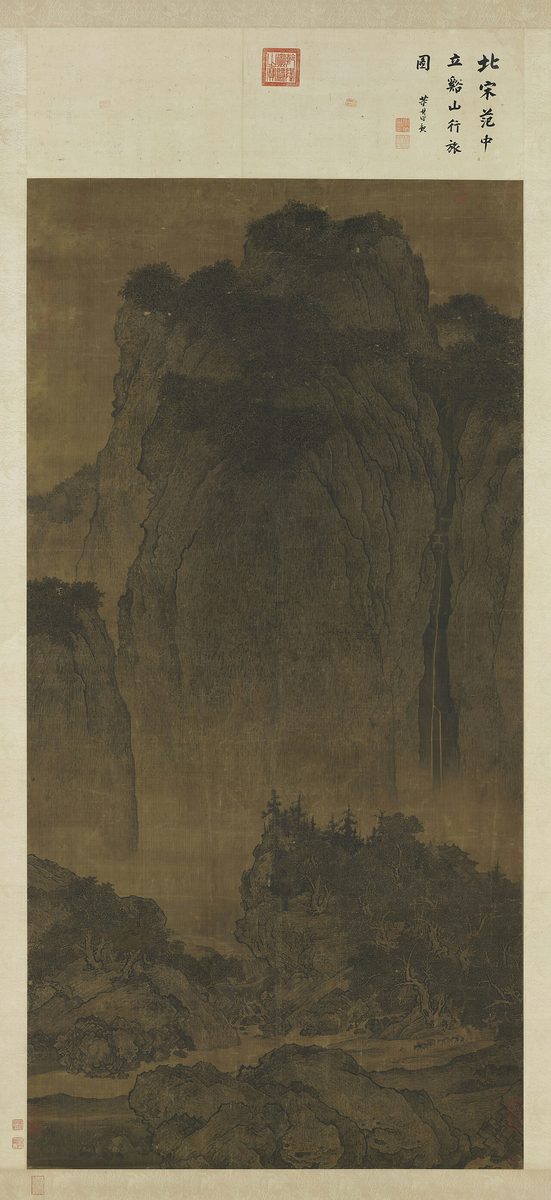
Hanging scroll: a tall vertical format, hung up for viewing.
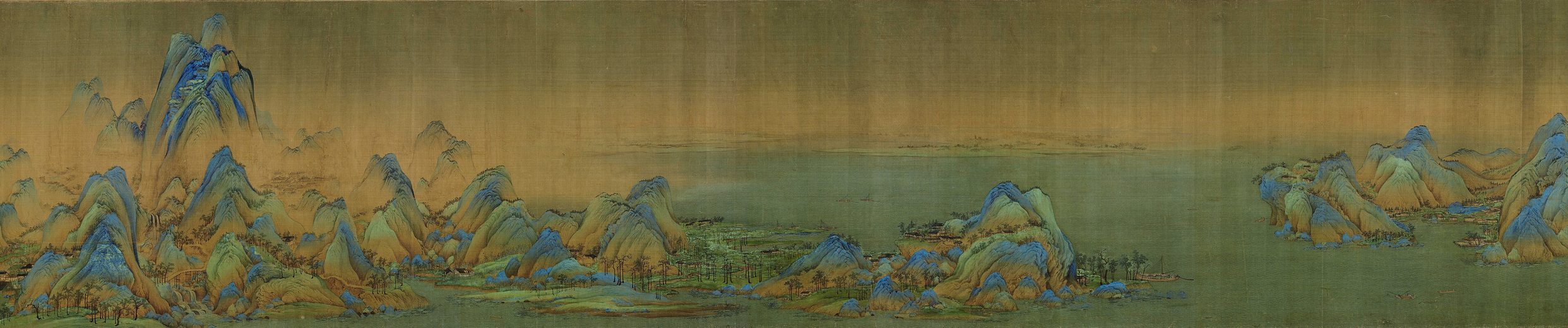
Handscroll: unrolled horizontally and viewed section by section from right to left; blue-green landscape.
Materials and tools. Early paintings were mostly on silk; from the Song and Yuan onward paper became more common. Xuan paper is highly absorbent and shows ink from dense to pale and from wet to dry, which made freehand painting possible. Brush, ink, paper and inkstone are called the "Four Treasures of the Study". Pigments are mineral or vegetable: mineral colors such as azurite, malachite and cinnabar resist fading, while vegetable colors such as indigo and gamboge are transparent and suited to washes.