
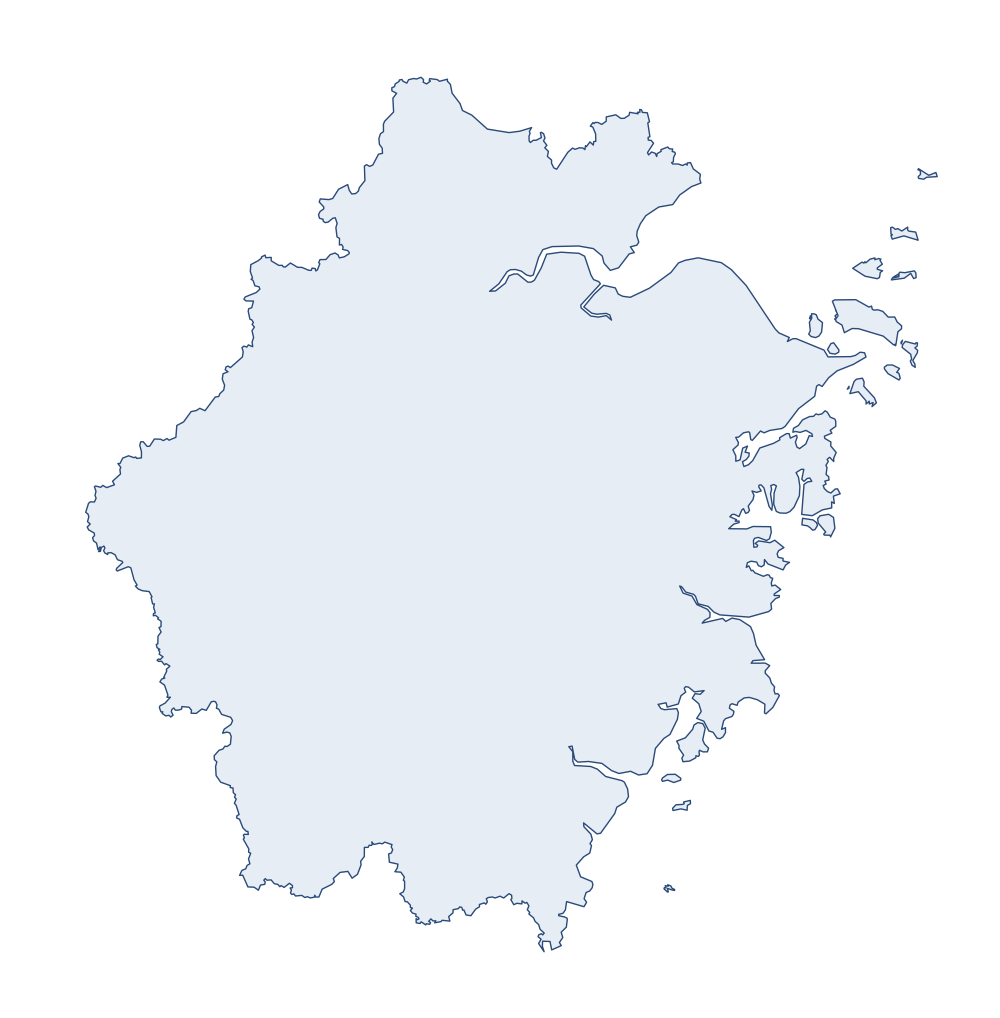
280 Major Historical and Cultural Sites Protected at the National Level in Zhejiang (batches 1–8, named by the State Council 1961–2019; 1 of them cross provincial borders, such as the Great Wall and the Grand Canal). Dots are coloured by category. See also Zhejiang and all provinces.
Liste:



Hangzhou (45)
- Liuhe-Pagode 六和塔Alte Bauwerke · 1. Liste (1961)Octagonal pavilion-style brick-and-wood pagoda on the bank of the Qiantang River, first built by Qian Chu, king of Wuyue; the present body was built in the Southern Song and its outer eaves were rebuilt in the Qing.
- Grab von Yue Fei 岳飞墓Alte Gräber · 1. Liste (1961)Temple and cemetery commemorating the Southern Song general Yue Fei, at the northwest corner of West Lake at the southern foot of Qixia Ridge; first built in the 14th year of the Jiading reign of the Southern Song (1221).
- Skulpturen am Feilaifeng 飞来峰造象Grotten und Steinschnitzereien · 2. Liste (1982)Group of stone-carved Buddha statues on the rock face of Feilai Peak beside Lingyin Temple, carved from the Five Dynasties to the Yuan, 345 in total.
- Apotheke Hu Qingyu Tang 胡庆余堂Alte Bauwerke · 3. Liste (1988)The former pharmacy founded by Hu Xueyan, a Qing-dynasty 'red-button' merchant; the buildings are on Dajing Lane in Shangcheng District.
- Weiße Pagode Zhakou 闸口白塔Alte Bauwerke · 3. Liste (1988)Timber-imitating octagonal pavilion-style stone pagoda on the bank of the Qiantang River, built around the Five Dynasties to Northern Song, formerly a landmark where the canal joined the Qiantang River.
- Fundstätte Liangzhu 良渚遗址Alte Fundstätten · 4. Liste (1996)Neolithic site group about 5,300 to 4,300 years old, centered on the Liangzhu ancient city site and covering 34 square kilometers.
- Stadtruine Lin'an 临安城遗址Alte Fundstätten · 5. Liste (2001)Site of Lin'an, the Southern Song capital, in what are now the Shangcheng and Gongshu districts of Hangzhou, a capital from 1138 to 1276.
- Gräber der Könige von Wuyue, Lin'an 临安吴越国王陵Alte Gräber · 5. Liste (2001)The royal tombs of the Five Dynasties Wuyue kingdom, including the tomb of Qian Liu, the Kangling tomb of Lady Ma, and the tombs of Qian Liu's parents.
- Moschee Fenghuang 凤凰寺Alte Bauwerke · 5. Liste (2001)One of the four great ancient mosques on the southeast coast, first built around the Tang or Song and rebuilt in the Yuan with funds from the master Alaodin from the Western Regions.
- Wenlan-Pavillon 文澜阁Alte Bauwerke · 5. Liste (2001)One of the seven great libraries built in the Qing to house the Siku Quanshu, and the only one of the three southern libraries to survive.
- Gongchen-Pagode 功臣塔Alte Bauwerke · 5. Liste (2001)A brick-and-wood pagoda funded by the King of Wuyue in the 1st year of Zhenming of the Later Liang (915), five stories high with a cast-iron finial.
- Mahakala-Relief im Baocheng-Tempel 宝成寺麻曷葛剌造像Grotten und Steinschnitzereien · 5. Liste (2001)A Mahakala statue carved in the 2nd year of Zhizhi of the Yuan (1322), the only Mahakala image in China with a definite date.
- Sutrasäulen des Fantian-Tempels 梵天寺经幢Grotten und Steinschnitzereien · 5. Liste (2001)A pair of sutra pillars built by Qian Chu, King of Wuyue, in the 3rd year of Qiande of the Northern Song (965), 15.76 m high with finely carved octagonal shafts.
- Xiling-Siegelkunstgesellschaft 西泠印社Stätten der neueren Geschichte · 5. Liste (2001)Home of an academic society a century old devoted to epigraphy and seal carving, beside Xiling Bridge on Gushan, called the "foremost society under heaven".
- Fundstätte Kuahuqiao 跨湖桥遗址Alte Fundstätten · 6. Liste (2006)A Neolithic site about 8,000 to 7,000 years old on the south bank of Xiang Lake, rated one of the Top Ten New Archaeological Discoveries of 2001.
- Brennofenstätte Maowanli 茅湾里窑址Alte Fundstätten · 6. Liste (2006)A kiln site of the Zhou to the Warring States, mainly producing stamped pottery and proto-celadon.
- Brennofenstätten Jiaotanxia und Laohudong 郊坛下和老虎洞窑址Alte Fundstätten · 6. Liste (2006)Official kiln sites of the Song to the Yuan; a ceramics museum has been built on the Jiaotanxia Southern Song official kiln site.
- Grab von Yu Qian 于谦墓Alte Gräber · 6. Liste (2006)The tomb of Yu Qian, Ming Minister of War, at the foot of Santai Mountain on the south shore of West Lake, completed in the 3rd year of Tianshun of the Ming (1459), with the Jinggong Shrine beside it.
- Qiantang-Brücke 钱塘江大桥Stätten der neueren Geschichte · 6. Liste (2006)A road-rail bridge begun in 1934 and completed in 1937 over the Qiantang River, blown up 89 days after completion to hinder Japanese forces.
- Stätte der Zhijiang-Universität 之江大学旧址Stätten der neueren Geschichte · 6. Liste (2006)The site of the missionary Zhijiang University, whose origin goes back to the Chongxin Yishu of Ningbo in 1845.
- Stätte der Zentralen Luftfahrtschule in Jianqiao 笕桥中央航校旧址Stätten der neueren Geschichte · 6. Liste (2006)The Republic's Central Aviation School was established here and called the "cradle of the Chinese air force"; the site is today's Jianqiao Airport.
- Ehemaliger Wohnsitz von Zhang Taiyan 章太炎故居Stätten der neueren Geschichte · 6. Liste (2006)The birthplace and childhood home of the scholar and revolutionary Zhang Taiyan, now the Zhang Taiyan Memorial Hall.
- Fundstätte Wuguidong 乌龟洞遗址Alte Fundstätten · 7. Liste (2013)Late Paleolithic site excavated in 1974, yielding a Homo sapiens right upper canine and fossils of giant pandas and Stegodon orientalis, about 50,000 years old.
- Fundstätte Xiaogucheng 小古城遗址Alte Fundstätten · 7. Liste (2013)Site of a large artificial earthen platform of about 350,000 square meters; remains range from the Majiabang culture to the Spring and Autumn and Warring States periods, with the Maqiao culture the richest.
- Stätte der Papiermanufaktur Sizhou 泗洲造纸作坊遗址Alte Fundstätten · 7. Liste (2013)Song-dynasty papermaking workshop site, the earliest, largest and most technologically complete ancient papermaking site found in China.
- Tianmu-Brennofenstätten 天目窑遗址群Alte Fundstätten · 7. Liste (2013)Kiln cluster of the Song to Yuan dynasties along both banks of the Tianmu Stream, firing celadon, black-glazed and qingbai porcelain, of which the black-glazed ware is the most famous.
- Stone Pagodas and Scripture Pillars of Lingyin Temple 灵隐寺石塔和经幢Alte Bauwerke · 7. Liste (2013)Two stone pagodas and two scripture pillars in front of the Daxiong Hall; the octagonal nine-story stone pagodas imitate timber tower construction and were first built in 969 (Northern Song Kaibao 2), originally at Fengxian Temple, the Qian family temple, and later moved here.
- Baochu-Pagode 保俶塔Alte Bauwerke · 7. Liste (2013)A solid pagoda on top of Baoshi Hill north of West Lake, and one of the symbols of the West Lake scenic area.
- Xishan-Brücke 西山桥Alte Bauwerke · 7. Liste (2013)A Southern Song single-arch bridge of stone slabs with angled sides, 18 meters long overall and more than 700 years old.
- Steinpagode des Puqing-Tempels 普庆寺石塔Alte Bauwerke · 7. Liste (2013)A Yuan dynasty granite pagoda with seven hexagonal stories and a total height of 7 meters; the temple is gone and only this pagoda remains.
- Traditionelle Bauten des Dorfes Xinye 新叶村乡土建筑Alte Bauwerke · 7. Liste (2013)An ancient village inhabited by the Ye clan, whose founding ancestor Ye Kun moved here in the 1st year of the Jiading reign of the Southern Song; it is a Chinese Historic and Cultural Village.
- Sutrensäule des Longxing-Tempels 龙兴寺经幢Grotten und Steinschnitzereien · 7. Liste (2013)A stone scripture pillar built in 837 (Tang Kaicheng 2), originally in Longxing Temple, which no longer exists; it is the earliest surviving stone scripture pillar in Zhejiang.
- Skulpturen am Nanshan 南山造像Grotten und Steinschnitzereien · 7. Liste (2013)Cliff sculptures cut into the rock face left by quarrying; 23 survive, 14 of them Yuan, mainly images of Amitabha.
- Kornspeicher Cangqian 仓前粮仓Stätten der neueren Geschichte · 7. Liste (2013)A granary of the Qing to Republican periods; four individual buildings survive, two of them old wooden houses, of the house-type granary.
- Stätte der Zhejiang-Industriebank 浙江兴业银行旧址Stätten der neueren Geschichte · 7. Liste (2013)A bank building of 1923, a three-story Western classical building on Zhongshan Middle Road.
- Zehn Szenen des Westsees 西湖十景Sonstiges · 7. Liste (2013)Ten representative scenic spots around West Lake in Hangzhou, including Dawn on Su Causeway in Spring, Lotus in the Breeze at Crooked Courtyard, Autumn Moon on the Calm Lake, Lingering Snow on Broken Bridge and Three Pools Mirroring the Moon.
- Dammstätte Liyushan–Laohuling 鲤鱼山—老虎岭水坝遗址Alte Fundstätten · 8. Liste (2019)Remains of a water-conservancy project outside the Liangzhu ancient city; the oldest known large-scale water project in China and the earliest flood-control dam system in the world.
- Hangzhou-Zhongyi-Brücke 杭州忠义桥Alte Bauwerke · 8. Liste (2019)Built in the wuyin year of Jiading in the Southern Song (1218), spanning the Xixi River; the only original Song-dynasty bridge in urban Hangzhou.
- Südgipfel- und Nordgipfel-Pagode von Meicheng 梅城南峰塔和北峰塔Alte Bauwerke · 8. Liste (2019)Pagodas built in the Sui and Tang and rebuilt in the 29th year of Jiajing of the Ming (1548); the South Peak Pagoda faces the North Peak Pagoda across the Xin'an River.
- Stelenwald im Konfuziustempel Hangzhou 杭州孔庙碑林Grotten und Steinschnitzereien · 8. Liste (2019)Made up of the Hangzhou Confucian Temple and the Hangzhou Stele Forest, on the site of the Hangzhou Prefectural School since the Southern Song.
- Ehemalige Stätte der Qiushi-Akademie 求是书院旧址Stätten der neueren Geschichte · 8. Liste (2019)A new-style institution of higher learning founded in 1897, one of the earliest Chinese schools to follow the Western educational system.
- Ehemalige Zhejiang-Bibliothek 浙江图书馆旧址Stätten der neueren Geschichte · 8. Liste (2019)Former site of a public library founded in the 26th year of Guangxu of the Qing (1900).
- Ehemaliges Renai-Krankenhaus 仁爱医院旧址Stätten der neueren Geschichte · 8. Liste (2019)Former hospital site of 1922, in the area of the present Hangzhou Red Cross Hospital.
- Former Industry Hall of the First West Lake Exposition 第一届西湖博览会工业馆旧址Stätten der neueren Geschichte · 8. Liste (2019)Former site of the Industry Hall of the First West Lake Exposition of 1928, on Beishan Road, now the West Lake Exposition Museum.
- Stätte der Ausarbeitung der Verfassung von 1954 五四宪法起草地旧址Stätten der neueren Geschichte · 8. Liste (2019)Where the 1954 Constitution was drafted; a place in Hangzhou commemorating Mao Zedong, used in 1953-1954.
Jinhua (38)
- Attendant Prince's Mansion of the Taiping Heavenly Kingdom 太平天国侍王府Stätten der neueren Geschichte · 3. Liste (1988)A relatively well-preserved and large prince's mansion among surviving Taiping buildings, made up of eastern and western courtyards, a drill ground and a rear garden, with abundant murals.
- Wohnhäuser der Familie Lu in Dongyang 东阳卢宅Alte Bauwerke · 3. Liste (1988)Residential complex of the Lu family, gradually built after the Yongle years of the Ming, centered on the Lu Great Ancestral Hall and surrounded by the three branch complexes of Fujing Hall, Suyong Hall and Shude Hall.
- Haupthalle des Tianning-Tempels 天宁寺大殿Alte Bauwerke · 3. Liste (1988)Temple first built in the Dazhong Xiangfu years of the Northern Song and rebuilt in the Yanyou years of the Yuan; only the main hall survives.
- Yanfu-Tempel 延福寺Alte Bauwerke · 4. Liste (1996)Yuan-dynasty Buddhist temple whose main hall is the earliest Yuan timber structure in Zhejiang.
- Wohnhäuser der Dörfer Zhuge und Changle 诸葛、长乐村民居Alte Bauwerke · 4. Liste (1996)Group of Ming and Qing dwellings formed since the Yuan; most residents of Zhuge Village bear the surname Zhuge, and Changle Village is nearby.
- Brennofenstätte Tiedian 铁店窑遗址Alte Fundstätten · 5. Liste (2001)One of the representative kiln sites of the Wuzhou kilns of the Song and Yuan, discovered in 1981, with three kiln sites surviving.
- Guyue-Brücke 古月桥Alte Bauwerke · 5. Liste (2001)A Song dynasty single-arch stone bridge with a polygonal profile, the earliest surviving ribbed-arch stone bridge in China, 31.2 m long.
- Bamian-Halle, Huangshan 黄山八面厅Alte Bauwerke · 5. Liste (2001)A large residence built by a local wealthy merchant in the Qianlong and Jiaqing reigns of the Qing, rectangular in plan, with especially fine wood carving.
- Alter Gebäudekomplex im Dorf Yuyuan 俞源村古建筑群Alte Bauwerke · 5. Liste (2001)An ancient village first built in the Southern Song, with mostly Yu-surnamed residents, which flourished in the Ming and Qing and preserves ancient buildings from the Yuan to the Qing.
- Alter Gebäudekomplex Zhengyimen 郑义门古建筑群Alte Bauwerke · 5. Liste (2001)A group of ancient buildings where the Zheng clan lived and ate together for fifteen generations from the Southern Song, represented by the Zheng ancestral hall and known in history as Zhengyimen.
- Fundstätte Shangshan 上山遗址Alte Fundstätten · 6. Liste (2006)An early Neolithic site on the upper Puyang River, a main component of the Shangshan culture, found in 2000.
- Hügelgräber von Dongyang 东阳土墩墓群Alte Gräber · 6. Liste (2006)A group of Zhou dynasty mound tombs concentrated in Dongyang, from which a large number of relics were unearthed in rescue excavations.
- Gebäudekomplex des Dorfes Zhiyan 芝堰村建筑群Alte Bauwerke · 6. Liste (2006)An ancient village begun in the Southern Song with sixty-six surviving Ming and Qing buildings, mostly Ming, including Yande Hall and Xiaosi Hall.
- Alte Teestation Yushan 玉山古茶场Alte Bauwerke · 6. Liste (2006)Tea station buildings begun in the Song and repaired in the 46th year of the Qing Qianlong reign (1781), consisting of the tea station temple, the inspectorate and the tea station.
- Ahnentempel der Familie Kong in Juxi 榉溪孔氏家庙Alte Bauwerke · 6. Liste (2006)An ancestral temple built by descendants of Confucius; the branch of Kong Duangong settled here after moving south at the end of the Northern Song.
- Dharani-Säule des Falong-Tempels 法隆寺经幢Grotten und Steinschnitzereien · 6. Liste (2006)A dharani pillar begun in the 11th year of Dazhong of the Tang (857), belonging to Falong Temple (once called Jinqian Temple), which no longer exists.
- Gräber von Lü Zuqian und seiner Familie 吕祖谦及家族墓Alte Gräber · 7. Liste (2013)Cemetery of Lü Zuqian, Southern Song Neo-Confucian and founder of the Wu school, and his family; tombs of his great-grandfather Lü Haowen and others lie around it.
- Pagode des Longde-Tempels 龙德寺塔Alte Bauwerke · 7. Liste (2013)A Northern Song multi-storied brick pagoda located in Tashan Park, Pujiang County.
- Qijiating-Halle 七家厅Alte Bauwerke · 7. Liste (2013)A Ming dynasty residential compound with a square plan, composed of a screen wall, courtyard, front hall, rear hall and side wings, with a complete layout.
- Ahnenhalle Xijiang 西姜祠堂Alte Bauwerke · 7. Liste (2013)A Ming dynasty ancestral hall with four courtyards and side wings on both sides, with a total area of about 2,000 square meters.
- Volksarchitektur Dorf Siping 寺平村乡土建筑Alte Bauwerke · 7. Liste (2013)An ancient village settled from the late Yuan and early Ming, preserving its complete layout of dwellings and a number of halls.
- Shide-Halle 世德堂Alte Bauwerke · 7. Liste (2013)Also called the "Soldiers' Hall", begun in the Southern Song; the three surviving courtyards were rebuilt in the Ming and Qing, covering 710 square meters.
- Ahnenhalle Shangzu 上族祠Alte Bauwerke · 7. Liste (2013)The ancestral hall of the local Xu clan, also called the Xu Clan Great Ancestral Hall or Xiaolun Hall, built around the late Ming and early Qing with three courtyards in all.
- Jiqing-Halle 积庆堂Alte Bauwerke · 7. Liste (2013)Also called Sijian Hall or the Minor Ancestral Hall; the existing buildings date from the Chongzhen reign at the end of the Ming and were repaired in the Kangxi and Qianlong reigns of the Qing.
- Yuqing-Halle 余庆堂Alte Bauwerke · 7. Liste (2013)A hall built in the Hongwu reign of the Ming dynasty, with three courtyards and a connecting hall; a pair of Ming dynasty stone lions stands in front, and the floor area is about 860 square meters.
- Blumenhalle Mashangqiao 马上桥花厅Alte Bauwerke · 7. Liste (2013)Also called "Yijing Hall", begun in the 25th year of the Jiaqing reign of the Qing (1820) and completed in the 10th year of the Daoguang reign (1830), a residence of a wealthy local merchant.
- Pagode des Yiwu Da'an-Tempels 义乌大安寺塔Alte Bauwerke · 8. Liste (2019)The Da'an Temple Pagoda, first built, according to the county gazetteer, in the 4th year of Daguan of the Northern Song (1110); on the shore of Xiu Lake, it originally belonged to Da'an Teaching Temple.
- Residenz Ziweishan 紫薇山民居Alte Bauwerke · 8. Liste (2019)A residence built jointly by Xu Honggang, Minister of War at Nanjing in the Ming, and his second younger brother; it originally had three axes.
- Ahnenhalle Shinantang der Familie Xu 石楠塘徐氏宗祠Alte Bauwerke · 8. Liste (2019)An ancestral hall first built in the Wanli era of the Ming, on the bank of the Wuyi River, facing south; enlarged and repaired many times in the Ming and Qing.
- Wohnkomplex der Familie Zhu, Chi'an 赤岸朱宅建筑群Alte Bauwerke · 8. Liste (2019)An ancient building complex made up of the Ming-dynasty Jianxu Hall, the Qing-dynasty Liufang Hall, the Guangxu-era Daifu Residence and the Republic-era Zhongxiang.
- Alter Gebäudekomplex im Dorf Houwu 厚吴村古建筑群Alte Bauwerke · 8. Liste (2019)An ancient village whose history goes back to the Jiading era of the Southern Song; the village layout is fairly well preserved.
- Ahnenhalle von Chen Dazu in Xiabaishi 下柏石陈大宗祠Alte Bauwerke · 8. Liste (2019)The Chen family ancestral hall first built in the 32nd year of Kangxi of the Qing (1693); the main structure remains in its original state.
- Tongzhou-Brücke, Lanxi 兰溪通洲桥Alte Bauwerke · 8. Liste (2019)A pavilion-style bridge spanning the Meixi Stream; among the best-preserved bridges of its kind on the Chinese mainland.
- Alter Gebäudekomplex Dorf Yaduan 雅端村古建筑群Alte Bauwerke · 8. Liste (2019)An ancient village inhabited by the Chen clan, surrounded by mountains on three sides, with a Ming-dynasty site layout and buildings built by Chen Qiwen and his grandson Chen Songyao in the Qing.
- Ahnenhalle Tangxia Fang Dazu 塘下方大宗祠Alte Bauwerke · 8. Liste (2019)An ancestral hall first built in the Jiajing era of the Ming and rebuilt in the 24th year of Guangxu (1898), facing south, with three rows and two corridors.
- Residenz Baitan, Dongyang 东阳白坦民宅Alte Bauwerke · 8. Liste (2019)A residence made up of two buildings, Fuyutang and Wubentang; Fuyutang was built from the Jiaqing to the Xianfeng era of the Qing, with two axes and four wings arranged in a triangular pattern.
- Ehemaliger Wohnsitz von Chen Wangdao 陈望道故居Stätten der neueren Geschichte · 8. Liste (2019)Birthplace of Chen Wangdao, a former president of Fudan University, where in 1920 he translated the Japanese edition of the Communist Manifesto into Chinese.
- Blumenhalle Shijiazhuang 史家庄花厅Stätten der neueren Geschichte · 8. Liste (2019)Also called the Ye Family Flower Hall; built in 1915 by the ham merchant Ye Zhangchao, with three bays and a double-eaved flush gable roof.
Wenzhou (33)
- Festungsstadt Puzhuangsuo 蒲壮所城Alte Bauwerke · 4. Liste (1996)Coastal defense fortress built in the Hongwu years of the Ming against Japanese pirates, with a wall five li and thirty paces around, near the Zhejiang-Fujian border.
- Yuhai-Turm 玉海楼Alte Bauwerke · 4. Liste (1996)Library built in the 14th year of the Guangxu reign (1888) by the late Qing scholar Sun Yirang and his father Sun Yiyan, combining library, dwelling and garden.
- Dolmengräber im südlichen Zhejiang 浙南石棚墓群Alte Gräber · 5. Liste (2001)Dolmen tombs of the Shang and Zhou, spread across Rui'an, Pingyang and Cangnan; megalithic remains found in China's south only on the southern Zhejiang coast.
- Tempel und Grab des Liu Ji 刘基庙及墓Alte Bauwerke · 5. Liste (2001)A temple commemorating Liu Ji, a founding statesman of the Ming, built in the 5th year of Tianshun of the Ming (1460), a seven-bay cloister courtyard, with Liu Ji's tomb beside it.
- Ehrenbögen von Nange 南阁牌楼群Alte Bauwerke · 5. Liste (2001)A group of memorial archways set up by the Zhang family in the Ming to display their achievements; five wood-and-stone archways survive.
- Fort Yongchang 永昌堡Alte Bauwerke · 5. Liste (2001)A fort against Japanese pirates built with private funds in the 37th year of Jiajing of the Ming (1558), the only surviving privately built ancient fort in Zhejiang.
- Papiermühle Sileidui 四连碓造纸作坊Sonstiges · 5. Liste (2001)A papermaking workshop named for the four water-powered pestles built on the Longxi stream in the early Ming, making bamboo paper from bamboo and called a "living fossil" of Chinese papermaking.
- Friedhof der Familie Gao 高氏家族墓地Alte Gräber · 6. Liste (2006)The family cemetery of Gao Youji, Ming Minister of Justice, and his descendants, in three groups arranged by the zhao-mu order of left and right.
- Chixi-Wudong-Brücke 赤溪五洞桥Alte Bauwerke · 6. Liste (2006)A five-span beam stone bridge rebuilt in the 3rd year of Xianchun of the Southern Song (1267), 24.6 meters long and 1.7 meters wide.
- Alter Gebäudekomplex Dorf Furong 芙蓉村古建筑群Alte Bauwerke · 6. Liste (2006)A representative ancient Chen-family village in the middle reaches of the Nanxi River, said to have been founded in the late Tang and planned on the idea of the "Seven Stars and Eight Dippers."
- Steinhalle Shengjingshan 圣井山石殿Alte Bauwerke · 6. Liste (2006)A stone-built complex begun in the 1st year of Jingding of the Southern Song (1260); the existing buildings were built between the Ming Wanli and Qing Guangxu reigns, the largest stone-built complex in southern Zhejiang.
- Gedeckte Brücken von Taishun 泰顺廊桥Alte Bauwerke · 6. Liste (2006)A collective name for the covered bridges of Taishun County, centered on timber arch covered bridges, including the Sixi timber arch bridge (Xidong Bridge) and Beijian Bridge.
- Trittsteine Shishui 仕水矴步Alte Bauwerke · 6. Liste (2006)A stream crossing laid with stone piers, regarded as one of the prototypes of bridges.
- Alter Gebäudekomplex Shunxi 顺溪古建筑群Alte Bauwerke · 6. Liste (2006)An ancient village of the Chen family in the heart of South Yandang Mountain; apart from the Chen ancestral hall it has ten large houses, basically intact.
- Stätte der Medizinschule Liji 利济医学堂旧址Stätten der neueren Geschichte · 6. Liste (2006)The site of a new-style medical school run in 1885 by Chen Qiu and others to promote reform ideas.
- Fundstätte Caowanshan 曹湾山遗址Alte Fundstätten · 7. Liste (2013)Formerly known as the Laoshushan Site; a major breakthrough in Wenzhou pre-Qin archaeology, proving that people lived in Wenzhou 5,000 years ago.
- Pagode des Guo'an-Tempels 国安寺塔Alte Bauwerke · 7. Liste (2013)A solid stone pagoda in the multi-storied style built in the Yuanyou reign of the Northern Song (1090-1093); it has nine hexagonal stories and a surviving height of about 17 meters.
- Steinpagode des Guanyin-Tempels 观音寺石塔Alte Bauwerke · 7. Liste (2013)Originally named the Thousand Buddha Pagoda, a hexagonal multi-storied stone pagoda built in the 1st year of the Xining reign of the Northern Song (1068); six stories survive.
- Brücke und Pagode des Hufa-Tempels 护法寺桥和塔Alte Bauwerke · 7. Liste (2013)A three-span beam-type stone bridge of the 3rd year of the Yuanyou reign of the Northern Song (1088), 10.3 meters long, with a pagoda beside it.
- Ost-Pagode Yueqing 乐清东塔Alte Bauwerke · 7. Liste (2013)A hexagonal multi-storied brick pagoda of seven stories and about 18 meters high, begun in the Xining reign of the Northern Song and continued in the Chunxi reign of the Southern Song.
- Bagua-Brücke und Hexi-Brücke 八卦桥和河西桥Alte Bauwerke · 7. Liste (2013)A five-span beam-type stone bridge built in the Chunxi reign of the Southern Song, 25.4 meters long, designated together with Hexi Bridge.
- Fünf-Buddha-Pagode des Qizhen-Tempels 栖真寺五佛塔Alte Bauwerke · 7. Liste (2013)A Song dynasty single-eaved stone pagoda imitating timber construction, arranged in a row, with a hexagonal plan.
- Steinpagoden des Zhenru-Tempels 真如寺石塔Alte Bauwerke · 7. Liste (2013)Stone pagodas left from the 1298 (2nd year of the Dade reign, Yuan) rebuilding of Zhenru Temple; there were originally seven in front of the temple, and only four survive.
- Jinzhao Memorial Archway and Xiantai Memorial Archway 金昭牌坊和宪台牌坊Alte Bauwerke · 7. Liste (2013)Ming dynasty memorial archways; the Jinzhao Archway was built to commemorate Jin Zhao passing the imperial examination in the 44th year of the Jiajing reign (1565), and is designated together with the Xiantai Archway.
- Ahnenhallen am Nanxi-Fluss 楠溪江宗祠建筑群Alte Bauwerke · 7. Liste (2013)A collective name for the clan ancestral hall buildings of the Ming to Qing periods in the Nanxi River basin, including Xiaosi Hall and Yongjiajun Hall.
- Ahnenhalle der Familie Bao in Yuyan 玉岩包氏宗祠Alte Bauwerke · 7. Liste (2013)An ancestral hall begun in the Chenghua reign of the Ming dynasty and rebuilt in the 27th year of the Daoguang reign of the Qing (1847), symmetrical along its central axis and grand in scale.
- Anwesen der Familie Hu, Xuexi 雪溪胡氏大院Alte Bauwerke · 7. Liste (2013)A compound built between the Daoguang and Tongzhi reigns of the Qing dynasty.
- Taishun Tulou 泰顺土楼Alte Bauwerke · 7. Liste (2013)A collective name for earthen tulou buildings in Taishun County, six of which were added to the national list of key cultural heritage sites in 2013.
- Stätte des Hauptquartiers der 13. Roten Armee 红十三军军部旧址Stätten der neueren Geschichte · 7. Liste (2013)The site of the Red 13th Army headquarters in 1930, set in the Hu Clan Fourth Branch Ancestral Hall, begun in the 6th year of the Yongzheng reign of the Qing.
- Brennofenstätte Tantou 坦头窑遗址Alte Fundstätten · 8. Liste (2019)A typical kiln site of the Tang-dynasty Ou ware; two kiln sites were found, on the southeast hillside of Longxia Village.
- Longbi Cave Cliff Inscriptions at Yandang Mountain 雁荡山龙鼻洞摩崖题记Grotten und Steinschnitzereien · 8. Liste (2019)Also called the Yanshan Stele Cave; inside Longbi Cave in the Lingyan scenic area of Yandang Mountain, with 94 surviving inscriptions from the Tang to modern times.
- Ehemaliges britisches Konsulat in Wenzhou 英国驻温州领事馆旧址Stätten der neueren Geschichte · 8. Liste (2019)Former site of the British consulate established in Wenzhou in 1877, withdrawn in 1900 and formally abolished in 1924, with 12 consuls in all.
- Alaunminen-Stätte Fanshan 矾山矾矿遗址Sonstiges · 8. Liste (2019)Former alum-mining production base from the Qing dynasty to 1994, mainly producing potassium alum and sodium alum; the site is on the north slope of Jilong Mountain and includes calcining furnaces.
Ningbo (31)
- Baoguo-Tempel 保国寺Alte Bauwerke · 1. Liste (1961)Ancient Buddhist temple first built in the Eastern Han; its main hall, built in the sixth year of the Dazhong Xiangfu reign of the Northern Song (1013), is one of the older surviving timber buildings south of the Yangtze.
- Tianyi-Pavillon 天一阁Alte Bauwerke · 2. Liste (1982)Library built under the direction of Fan Qin, Vice Minister of War, in the Jiajing years of the Ming; the oldest surviving private library in China.
- Fundstätte Hemudu 河姆渡遗址Alte Fundstätten · 2. Liste (1982)Neolithic site dating from 5000 BC to 3000 BC, discovered in 1973, yielding remains of stilt-style buildings, charcoal-tempered black pottery and large amounts of cultivated rice.
- Tashan-Wehr 它山堰Alte Bauwerke · 3. Liste (1988)Ancient weir built in the seventh year of the Dahe reign of the Tang (833) of stacked stone strips; the ancient hydraulic work with the largest irrigated area in Zhejiang.
- Brennofenstätte Shanglinhu Yue 上林湖越窑遗址Alte Fundstätten · 3. Liste (1988)Site of the Yue kilns, one of the seven great kilns of the Tang, distributed along lakes including Shanglin Lake, with nearly 200 kiln sites found, dating from the Eastern Han to the Southern Song.
- Küstenverteidigungsanlagen Zhenhaikou 镇海口海防遗址Alte Bauwerke · 4. Liste (1996)Group of coastal defense remains on both banks of the mouth of the Yong River, from the Ming to the Republic, concentrating remains from the resistance to Japanese pirates, the British, the French and Japan.
- Ehemaliger Wohnsitz der Familie Chiang 蒋氏故居Stätten der neueren Geschichte · 4. Liste (1996)Chiang family former residence building group at Xikou Town, including Fenggao House, Yutai Salt Shop, the small Western-style house and Wenchang Pavilion.
- Gildenhalle Qing'an 庆安会馆Alte Bauwerke · 5. Liste (2001)A Tianhou Palace and guild hall completed in the 3rd year of Xianfeng of the Qing (1853), the guild hall of the Ningbo northern shipping guild.
- Steinerne Torbögen Miaogouhou und Hengsheng 庙沟后、横省石牌坊Alte Bauwerke · 5. Liste (2001)Two Song-Yuan stone archways before tombs, imitating timber construction, whose form corroborates the Song Yingzao Fashi; among the earliest surviving stone archways in China.
- Steinmetzarbeiten am Dongqian-See 东钱湖石刻Grotten und Steinschnitzereien · 5. Liste (2001)Stone carvings of the tomb avenues of eminent Song, Yuan and Ming ministers and scholars along Dongqian Lake; the Shi family tomb avenue is the only surviving group of Southern Song tomb avenue carvings in China.
- Wohnanlage der Familie Yu, Longshan 龙山虞氏旧宅建筑群Stätten der neueren Geschichte · 5. Liste (2001)Also called Tianxutang, a residence built in 1916 to 1929 by Yu Qiaqing of the Ningbo clique, with the first three courtyards Chinese in style and the last two Western.
- Fundstätte Yongfengku 永丰库遗址Alte Fundstätten · 6. Liste (2006)The site of a Yuan government storehouse, where storage remains of the Song, Yuan and Ming were found, including building foundations, roads, courtyards and wells.
- Ningbo-Tianning-Tempel 宁波天宁寺Alte Bauwerke · 6. Liste (2006)The surviving west pagoda of the Tang-dynasty Tianning Temple, also called Xiantong Pagoda, the oldest surviving Tang brick pagoda in Zhejiang.
- Ashoka-Tempel 阿育王寺Alte Bauwerke · 6. Liste (2006)A Buddhist temple first founded in the Western Jin, the fifth of the "Five Mountains under Heaven" in the Southern Song and the ancestral temple of Japan's Rinzai school; said to house a skull relic of Sakyamuni.
- Baiyun Villa and Tombs of Huang Zongxi, Wan Sitong and Quan Zuwang 白云庄和黄宗羲、万斯同、全祖望墓Alte Bauwerke · 6. Liste (2006)The Wan Tai estate of the late Ming, built in 1611 and once a venue of the East Zhejiang school; announced together with the tombs of Huang Zongxi, Wan Sitong and Quan Zuwang.
- Historischer Gebäudekomplex Cicheng 慈城古建筑群Alte Bauwerke · 6. Liste (2006)A collective name for the representative ancient buildings in Cicheng Town, the former seat of Cixi County.
- Tiantong-Tempel 天童寺Alte Bauwerke · 6. Liste (2006)A Chan Buddhist temple said to have been founded in the Western Jin, ranked third of the Five Mountains in the Southern Song and the ancestral temple of Japan's Soto school; its oldest existing building is the Buddha hall built in the 4th year of the Ming Chongzhen reign.
- Ehemaliger Wohnsitz und Grab von Wang Shouren 王守仁故居和墓Alte Bauwerke · 6. Liste (2006)The birthplace of the Ming philosopher Wang Shouren, where he spent his childhood, now a memorial hall; his tomb is in Shaoxing.
- Alte Bühnen Ninghai 宁海古戏台Alte Bauwerke · 6. Liste (2006)A collective name for the Ming, Qing and Republic stages in Ninghai County; more than 120 survive, represented by ten such as the City God Temple stage, many with painted caissons.
- Katholische Kirche Jiangbei 江北天主教堂Stätten der neueren Geschichte · 6. Liste (2006)A Gothic Catholic church completed in the 11th year of the Tongzhi reign (1872) under a French bishop, once called the "foremost church of Zhejiang."
- Gildenhalle Qianye 钱业会馆Stätten der neueren Geschichte · 6. Liste (2006)A guildhall of the native banking trade begun in 1925 with three courtyards in a mixed Chinese and Western brick-and-timber structure, the only completely preserved native-bank guildhall in China.
- Stätten der Antijapanischen Basis Ost-Zhejiang 浙东抗日根据地旧址Stätten der neueren Geschichte · 6. Liste (2006)Eight buildings connected with the Eastern Zhejiang Anti-Japanese Base, in Guanhaiwei of Cixi and Liangnong of Yuyao, including the site of the CPC East Zhejiang Regional Committee.
- Fundstätte Tianluoshan 田螺山遗址Alte Fundstätten · 7. Liste (2013)Ancient site of the Hemudu culture, discovered in 2001 and dating to about 7,000 to 5,500 years ago, with well-preserved remains.
- Fundstätte Zishan 鲻山遗址Alte Fundstätten · 7. Liste (2013)Hemudu culture site of about 5,000 square meters, excavated in 1981 and 1996.
- Fundstätte Tashan 塔山遗址Alte Fundstätten · 7. Liste (2013)Site from the Neolithic to the Shang and Zhou periods, with remains spanning 4000 BC to 500 BC.
- Stätte der Kaserne Hua'ao 花岙兵营遗址Alte Fundstätten · 7. Liste (2013)Barracks site built on Hua'ao Island by the Southern Ming general Zhang Huangyan during his resistance against the Qing; built of pebbles, with city walls, tunnels and other features.
- Erling-Pagode 二灵塔Alte Bauwerke · 7. Liste (2013)A Northern Song stone pagoda on Erling Hill at Dongqian Lake, built in the Zhenghe reign, and a rare representative Northern Song stone structure in Zhejiang.
- Wohnhaus der Familie Lin 林宅Alte Bauwerke · 7. Liste (2013)Also called Dan Wu Lu, the residence of the brothers Lin Zhongsong and Lin Zhonghua, juren of the Tongzhi reign of the Qing, covering about 3,500 square meters.
- Stätte der Jintang-Schule 锦堂学校旧址Stätten der neueren Geschichte · 7. Liste (2013)The site of a private school founded in 1909 with funds donated by Wu Jintang, an overseas Chinese in Japan.
- Guangji-Brücke in Nandu 南渡广济桥Alte Bauwerke · 8. Liste (2019)A covered bridge first built in the Song; the existing piers were set up in the Yuan, and it was repaired many times in the Ming and Qing; it spans a tributary of the Fenghua River.
- Yuyao-Tongji-Brücke 余姚通济桥Alte Bauwerke · 8. Liste (2019)Also called Shunjiang Bridge and Laojiang Bridge; first built in the Northern Song, the existing bridge is a Qing-dynasty three-arch stone bridge, known as the "Foremost Bridge of Eastern Zhejiang."
Shaoxing (29)
- Ehemaliger Wohnsitz von Lu Xun in Shaoxing 绍兴鲁迅故居Stätten der neueren Geschichte · 3. Liste (1988)Place where Lu Xun was born and lived until 1898, including the old Zhou family Taimen, the New Taimen, Baicao Garden and Sanwei Study.
- Ehemaliger Wohnsitz von Qiu Jin 秋瑾故居Stätten der neueren Geschichte · 3. Liste (1988)Courtyard house where the revolutionary Qiu Jin lived in her girlhood and after returning home in 1906; she was executed in 1907.
- Alter Treidelpfad 古纤道Alte Bauwerke · 3. Liste (1988)Ancient towpath along the Eastern Zhejiang Canal, nearly 100 li in length; the section from Qianqing to Keqiao in Keqiao District is well preserved, 7.5 kilometers long.
- Mausoleum des Großen Yu 大禹陵Alte Gräber · 4. Liste (1996)Memorial tomb of Yu the Great, founder of the Xia dynasty, at the foot of Kuaiji Mountain, facing west.
- Grab des Königs von Yue am Yinshan 印山越国王陵Alte Gräber · 5. Liste (2001)A royal tomb of the State of Yue in the Spring and Autumn period, also called Mukedazhong, on the top of Yinshan; it was excavated as a rescue after being looted in 1996.
- Bazi-Brücke 八字桥Alte Bauwerke · 5. Liste (2001)A Song dynasty stone bridge named for its shape resembling the character "ba", at the east end of Bazi Bridge Straight Street in Yuecheng District.
- Lü-Residenz 吕府Alte Bauwerke · 5. Liste (2001)The mansion of Lu Ben, Minister of Rites in the Jiajing reign of the Ming, with three longitudinal and five transverse axes forming thirteen courtyards, all with flush-gable roofs.
- Alte Wohnhäuser der Familie Si 斯氏古民居建筑群Alte Bauwerke · 5. Liste (2001)A group of residences of the Si clan, who have lived together since the Tang; fourteen large Qing to Republican residences survive, including Sishengju, Faxiangju and Huaguogong Villa.
- Ehemaliger Wohnsitz von Cai Yuanpei 蔡元培故居Stätten der neueren Geschichte · 5. Liste (2001)The home where the educator Cai Yuanpei was born and raised, a traditional Shaoxing taimen building in Ming and Qing style, in the Jishan historical and cultural district.
- Brennofenstätte Fusheng 富盛窑址Alte Fundstätten · 6. Liste (2006)A kiln site of the Zhou to the Warring States, where two parallel dragon kiln sites were found, yielding proto-celadon and stamped hard pottery.
- Brennofenstätte Xiaoxiantan 小仙坛窑址Alte Fundstätten · 6. Liste (2006)A celadon kiln site of the Yue kilns of the Eastern Han, showing that mature porcelain was successfully fired in Zhejiang in the Eastern Han.
- Qingteng-Studio und Grab von Xu Wei 青藤书屋和徐渭墓Alte Bauwerke · 6. Liste (2006)The birthplace and study of the Ming painter and writer Xu Wei, the origin of the Qingteng school of painting, announced together with Xu Wei's tomb.
- Dorfgebäudekomplex Chongren 崇仁村建筑群Alte Bauwerke · 6. Liste (2006)An ancient village preserving over two hundred building remains from the early Ming to the Republic, including 154 old taimen gates; Qiu is the largest surname in the village.
- Datong-Schule und ehemaliger Wohnsitz von Xu Xilin 大通学堂和徐锡麟故居Stätten der neueren Geschichte · 6. Liste (2006)The Datong Normal School founded in 1905 by Xu Xilin and Tao Chengzhang, an activity center of the Restoration Society, with Xu Xilin's former residence beside it.
- Fundstätte Xiaohuangshan 小黄山遗址Alte Fundstätten · 7. Liste (2013)Early Neolithic cultural site, discovered in 1984 and given a rescue excavation in 2005.
- Brennofengruppe Fenghuangshan 凤凰山窑址群Alte Fundstätten · 7. Liste (2013)Kiln cluster of the Three Kingdoms to Jin period, spread across the gentle lower slopes of Qianshan, Fenghuangshan and other hills.
- Adelsgräber des Staates Yue, Shaoxing 绍兴越国贵族墓群Alte Gräber · 7. Liste (2013)Noble tombs of the Yue state from the Spring and Autumn to the Warring States period; 11 burial sites have been found, most in Pingshui Town.
- Sechs Song-Mausoleen 宋六陵Alte Gräber · 7. Liste (2013)Site of six Southern Song imperial tombs, plus one tomb of Emperor Huizong of Song.
- Östliche Pagode des Huacheng-Tempels 东化成寺塔Alte Bauwerke · 7. Liste (2013)Built in the 7th year of the Yuanyou reign of the Northern Song (1092) and also called the Yuanyou Pagoda; it was originally a seven-story, four-sided brick-and-wood multi-storied pagoda, and four stories survive.
- Windschutzhafen Zhuhu-See 㹧湖避塘Alte Bauwerke · 7. Liste (2013)A long bridge-style wind shelter on the lake, running from Tianji Temple in the south to Pingfeng Bay at Qilijiang Village in the north; similar to a towpath, it let boats shelter from wind and waves.
- Ahnenhalle der Familie Wang in Huatang 华堂王氏宗祠Alte Bauwerke · 7. Liste (2013)Composed of the Great Ancestral Hall and the New Ancestral Hall; the Great Ancestral Hall was begun in the 7th year of the Zhengde reign of the Ming (1512) and honors Wang Qiong and his wife, the 36th-generation descendant of Wang Xizhi.
- Orchideenpavillon 兰亭Alte Bauwerke · 7. Liste (2013)The site of the garden residence of the Eastern Jin calligrapher Wang Xizhi, at the foot of Lanzhu Hill, now a cultural heritage site.
- Shun-Wang-Tempel 舜王庙Alte Bauwerke · 7. Liste (2013)Tradition holds that Shun took refuge from turmoil here and later generations built a temple in memory; the existing buildings were repaired in the Xianfeng reign of the Qing.
- Stone Maitreya and Thousand Buddha Cliff Carvings of Dafo Temple 大佛寺石弥勒像和千佛岩造像Grotten und Steinschnitzereien · 7. Liste (2013)The stone Maitreya and Thousand Buddha Cliff images in Dafo Temple, Xinchang, grotto carvings of the Northern and Southern Dynasties, on Shicheng Mountain.
- Skulpturen und Felsinschriften Keyan 柯岩造像及摩崖题刻Grotten und Steinschnitzereien · 7. Liste (2013)Song and Qing sculptures and cliff inscriptions at the south foot of Ke Mountain, now within the Keyan scenic area.
- Stätte der Chunhui-Mittelschule 春晖中学旧址Stätten der neueren Geschichte · 7. Liste (2013)A middle school founded in 1921, planned by Jing Hengyi and funded by the wealthy merchant Chen Chunlan, beside Baima Lake.
- Cao-E-Tempel 曹娥庙Stätten der neueren Geschichte · 7. Liste (2013)A temple honoring the filial daughter Cao E of the Eastern Han, originating from Cao E's tomb built in the 1st year of the Yuanjia reign of the Eastern Han (151), on the west bank of the Cao'e River.
- Pagode des Dashan-Tempels in Shaoxing 绍兴大善寺塔Alte Bauwerke · 8. Liste (2019)A hexagonal seven-story tower-style brick-and-timber pagoda 40.5 m high, originally in Dashan Temple, founded in 504 (Liang Tianjian 3); both temple and pagoda were destroyed in 1197 (Southern Song Qingyuan 3) and rebuilt in 1228 (Shaoding 1).
- Land Purchase Inscription of the First Year of Jianchu, Han 汉建初元年买地刻石Grotten und Steinschnitzereien · 8. Liste (2019)Also called the Daji Stele, a cliff inscription of the 1st year of Jianchu of the Eastern Han (76), on the east slope of Tiaoshan.
Huzhou (26)
- Feiying-Pagode 飞英塔Alte Bauwerke · 3. Liste (1988)Pagoda first built in the Tang; the present one is a Northern Song brick-and-wood pagoda enclosed within a stone pagoda, the only pagoda-within-a-pagoda surviving in China.
- Stadtruine Xiagucheng 下菰城遗址Alte Fundstätten · 5. Liste (2001)Ruinen einer alten Stadt aus der Frühlings- und Herbstperiode.
- Jiayetang-Bibliothek und Xiaolianzhuang 嘉业堂藏书楼及小莲庄Alte Bauwerke · 5. Liste (2001)A private library built by Liu Chenggan in 1920 to 1924, famous for its collection of ancient books and woodblock printing, with Xiaolianzhuang adjoining it to the east.
- Ehemaliger Wohnkomplex der Familie Zhang in Nanxun 南浔张氏旧宅建筑群Stätten der neueren Geschichte · 5. Liste (2001)Also called Yidetang, a large private residence of the late Qing and early Republic built in 1899 to 1906, with fine carving and a mix of Chinese and Western styles.
- Site of the New Fourth Army Jiangsu-Zhejiang Military Region 新四军苏浙军区旧址Stätten der neueren Geschichte · 5. Liste (2001)The site of the New Fourth Army's Jiangsu-Zhejiang Military Region in 1943 to 1945, called the "Little Yan'an of Jiangnan", where the military region was established in 1945.
- Fundstätte Qianshanyang 钱山漾遗址Alte Fundstätten · 6. Liste (2006)Fundstätte von der Jungsteinzeit bis zur Zhou-Zeit.
- Ruinen der alten Stadt Dipu 递铺城址Alte Fundstätten · 6. Liste (2006)An ancient city site from the Spring and Autumn to the Northern and Southern Dynasties, square in plan, covering about 0.33 square kilometers, with remnants of rammed-earth walls.
- Dusong-Pass und alte Poststraße 独松关和古驿道Alte Bauwerke · 6. Liste (2006)The ancient Hang-Xuan road, begun in the Tang; the surviving section through Dusong Pass is about 1,500 meters, paved with cobbles and with four ancient bridges.
- Shouchang-Brücke 寿昌桥Alte Bauwerke · 6. Liste (2006)Also called Shangzhu Bridge, an ancient bridge built by Yao Zhi, a local man, in the Xianchun era of the Southern Song (1265-1274).
- Stadtmauer Ancheng 安城城墙Alte Bauwerke · 6. Liste (2006)Also called Taocheng, the wall of the former seat of Anji County and Anjizhou, the best-preserved ancient prefectural or county wall in Zhejiang.
- Guzhu Tribute Tea Court Site and Cliff Inscriptions 顾渚贡茶院遗址及摩崖Grotten und Steinschnitzereien · 6. Liste (2006)The site of the tribute tea court set up in the Tang to produce Zisun tea as tribute; nearby cliffs bear the inscribed names of Tang and Song officials and scholars.
- Villengruppe am Mogan Shan 莫干山别墅群Stätten der neueren Geschichte · 6. Liste (2006)A group of modern villa buildings in the Moganshan scenic area, built in the Qing to Republic periods.
- Grab von Chen Yingshi 陈英士墓Stätten der neueren Geschichte · 6. Liste (2006)The tomb of Chen Yingshi (Qimei), a core member of the Tongmenghui, built in the 7th year of the Republic (1918) in three parts: the tomb path, stone archway and burial chamber.
- Fundstätte Shangmakan 上马坎遗址Alte Fundstätten · 7. Liste (2013)Altsteinzeitliche Fundstätte.
- Fundstätte Qiliting 七里亭遗址Alte Fundstätten · 7. Liste (2013)Altsteinzeitliche Fundstätte.
- Fundstätte Pishan 毘山遗址Alte Fundstätten · 7. Liste (2013)An important site in the Tiaoxi River basin, around Pishan Mountain in Pishan Village, Balidian Town, dating from the Neolithic to the Zhou dynasty.
- Protoporzellan-Brennofenstätten Deqing 德清原始瓷窑址Alte Fundstätten · 7. Liste (2013)Ancient kiln sites from the Shang dynasty to the Warring States period, covering about 6 square kilometers; large in scale, long in duration and well preserved.
- Ruinen der Alten Stadt Chengshan 城山古城遗址Alte Fundstätten · 7. Liste (2013)Rammed-earth ancient city site with inner and outer walls; city gates, a crossbow platform and a pool remain.
- Grab von Zhao Mengfu 赵孟頫墓Alte Gräber · 7. Liste (2013)The tomb of Zhao Mengfu, painter and calligrapher of the Yuan dynasty.
- Pangong-Brücke und Grab des Pan Xiao 潘公桥及潘孝墓Alte Bauwerke · 7. Liste (2013)Brücke und Grab aus der Ming- und Qing-Zeit.
- Drei Brücken von Shuanglin 双林三桥Alte Bauwerke · 7. Liste (2013)Three three-span stone arch bridges with thin piers and thin solid-spandrel arches, Wankui Bridge, Huacheng Bridge and Wanyuan Bridge, all crossing the Shuanglin Pond.
- Zunde-Halle 尊德堂Stätten der neueren Geschichte · 7. Liste (2013)The birthplace and former residence of the senior Kuomintang figure Zhang Jingjiang, also called Zunde Hall, on Dong Street in Nanxun.
- Pagode des Anji Yong'an-Tempels 安吉永安寺塔Alte Bauwerke · 8. Liste (2019)Also called the Lingzhi Pagoda; said to have been first built in the Five Dynasties, at the foot of Longtou Mountain on the east bank of the West Tiaoxi River.
- Huzhou-Chaoyin-Brücke 湖州潮音桥Alte Bauwerke · 8. Liste (2019)A three-arch stone bridge first built in the 18th year of Jiajing of the Ming (1539), spanning the Zhaxi Stream from east to west.
- Erntegebet-Inschrift am Daochangshan 道场山祈年题记Grotten und Steinschnitzereien · 8. Liste (2019)A Yuan-dynasty stone inscription, mainly a darughachi's prayer for a good harvest; a rare local inscription with a definite Yuan date.
- Taihu Lougang 太湖溇港Sonstiges · 8. Liste (2019)A water-control system on the southeast shore of Taihu Lake, begun in the Spring and Autumn period and made up of embankments, xu-gang channels and polders; the best-preserved part is in Wuxing, Huzhou.
Jiaxing (22)
- Ehemaliger Wohnsitz von Mao Dun 茅盾故居Stätten der neueren Geschichte · 3. Liste (1988)Early residence of the writer Mao Dun, an important modern historical site, dating from 1896 to 1910.
- Fundstätte Luojiajiao 罗家角遗址Alte Fundstätten · 5. Liste (2001)Neolithic site discovered in 1956 and partly excavated in 1979 and 1980.
- Fundstätte Majiabang 马家浜遗址Alte Fundstätten · 5. Liste (2001)Neolithic site at the confluence of three rivers, discovered in 1959 and rescue-excavated immediately.
- Deich von Yanguan und Meeresgott-Tempel 盐官海塘及海神庙Alte Bauwerke · 5. Liste (2001)A sea wall and sea god temple on the Qiantang River; the surviving sea wall is a Qing fish-scale stone wall, a famous place to watch the tidal bore.
- Qi-Garten 绮园Alte Bauwerke · 5. Liste (2001)A Qing classical garden commonly called the Feng Family Garden, focused on natural landscape and drawing on the best of Suzhou and Yangzhou gardens.
- Fundstätte Tanjiawan 谭家湾遗址Alte Fundstätten · 6. Liste (2006)A Neolithic site of the Majiabang culture type, covering about 87,500 square meters.
- Fundstätte Nanhebang 南河浜遗址Alte Fundstätten · 6. Liste (2006)A Neolithic site, the most important archaeological work on the Songze culture since the Songze site in Qingpu, Shanghai, excavated in 1996.
- Gutshof der Familie Mo 莫氏庄园Alte Bauwerke · 6. Liste (2006)The residence of three generations of the Qing figure Mo Fangmei, a classical building in late Qing style, covering 4,851 square meters with more than seventy rooms.
- Dharani-Säulen des Anguo-Tempels 安国寺经幢Grotten und Steinschnitzereien · 6. Liste (2006)Three Tang-dynasty dharani pillars that belonged to Anguo Temple, now demolished; among the oldest surviving above-ground structures in Haining.
- Ehemaliger Wohnsitz von Wang Guowei 王国维故居Stätten der neueren Geschichte · 6. Liste (2006)The home in which the master of national learning Wang Guowei grew up; he lived upstairs in the rear building from age 10 to 22.
- Fundstätte Zhuangqiaofen 庄桥坟遗址Alte Fundstätten · 7. Liste (2013)Fundstätte der Liangzhu-Kultur.
- Fundstätte Xindili 新地里遗址Alte Fundstätten · 7. Liste (2013)Hochrangige Fundstätte der Liangzhu-Kultur.
- Bildsteingrab Chang'an 长安画像石墓Alte Gräber · 7. Liste (2013)Tomb of the late Eastern Han to Three Kingdoms period, popularly called Sannüdui, discovered in 1973 when the sports ground of Haining Middle School was being extended.
- Grab des Wu Zhen 吴镇墓Alte Gräber · 7. Liste (2013)Tomb of Wu Zhen, Yuan-dynasty painter and one of the "Four Masters of the Yuan"; built in the 14th year of the Zhizheng reign of the Yuan (1354), inside Meihua Hermitage.
- Residenz Chen Ge Lao 陈阁老宅Alte Bauwerke · 7. Liste (2013)The mansion of Chen Yuanlong, who placed second in the 1685 imperial examination (24th year of the Kangxi reign) and became Grand Secretary of Wenyuan Pavilion.
- Sutrasäule des Huili-Tempels 惠力寺经幢Grotten und Steinschnitzereien · 7. Liste (2013)A Tang dynasty scripture pillar on the former site of Huili Temple (commonly called West Temple), which was begun in the Eastern Jin.
- Fort Zhapu 乍浦炮台Stätten der neueren Geschichte · 7. Liste (2013)Küstenverteidigungsfort aus der Qing-Zeit im Ort Zhapu.
- Wensheng-Seminar und katholische Kirche Jiaxing 嘉兴文生修道院与天主堂Stätten der neueren Geschichte · 7. Liste (2013)A seminary begun in the 28th year of the Guangxu reign of the Qing (1902), once the only major seminary of the Chinese Congregation of the Mission in China, with a Catholic church.
- Fundstätte Jiaxing Zicheng 嘉兴子城遗址Alte Fundstätten · 8. Liste (2019)Also called Ziqiang, the earliest city wall of Jiaxing, covering 75,000 square meters in the city center.
- Ehemaliger Wohnsitz von Shen Junru 沈钧儒故居Stätten der neueren Geschichte · 8. Liste (2019)Shen Junru's residence in Jiaxing from 1908 to 1919; it was dismantled and overhauled in 1997-1998.
- Getreidespeichergruppe Wangdian 王店粮仓群Stätten der neueren Geschichte · 8. Liste (2019)A group of Soviet-style cylindrical granaries where the former Wangdian rice mill stored grain, built in the 1950s.
- Qiantang River Sea Wall, Haiyan Chihai Temple and Haining Sections 钱塘江海塘海盐敕海庙段和海宁段Sonstiges · 8. Liste (2019)The Haiyan Chihai Temple section and Haining section of the Qiantang River sea wall, a sea-wall project dating from the Ming and Qing to the present.
Lishui (17)
- Brennofenstätte Dayao Longquan 大窑龙泉窑遗址Alte Fundstätten · 3. Liste (1988)Longquan celadon kiln site of the Song to Ming at Dayao Village, Xiaomei Town, Longquan, and surroundings, later combined with the Shangyang kiln site and the Yuankou kiln site.
- Rulong-Brücke 如龙桥Alte Bauwerke · 5. Liste (2001)A wooden-arch covered bridge, the oldest wooden-arch covered bridge with a definite recorded date of repair, repaired in the 5th year of Tianqi of the Ming (1625).
- Tongji-Wehr 通济堰Alte Bauwerke · 5. Liste (2001)An ancient water conservancy project first built in the Tianjian reign of the Liang of the Southern Dynasties, made up of an arched overflow dam, the Tongji sluice, a stone culvert and canals; the wooden dam was replaced with stone in the Southern Song.
- Shisi-Tempel 时思寺Alte Bauwerke · 5. Liste (2001)A temple complex first built in the 16th year of Zhizheng of the Yuan (1356), made up of a mountain gate, bell tower, main hall, Sanqing Hall, Maxian Palace and the Mei ancestral hall.
- Felsinschriften von Xiandu 仙都摩崖题记Grotten und Steinschnitzereien · 5. Liste (2001)Cliff inscriptions from the Tang to modern times, 123 in all, spread across five scenic spots in the Xiandu scenic area.
- Pagode des Songyang Yanqing-Tempels 松阳延庆寺塔Alte Bauwerke · 6. Liste (2006)A Song-dynasty brick pagoda begun in the 2nd year of Xianping of the Northern Song (999), a relic of the former Yanqing Temple.
- Fundstätte Haochuan 好川遗址Alte Fundstätten · 7. Liste (2013)Neolithic site consisting mainly of a cemetery; the center of the hilltop is the aristocratic burial area, rich in grave goods.
- Stätte der Silbermine Yunhe 云和银矿遗址Alte Fundstätten · 7. Liste (2013)Ming-dynasty silver mine site with a long history and large scale, preserving remains of mining, transport, smelting, management and miners' life.
- Traditionelle Bauten im Dorf Heyang 河阳村乡土建筑Alte Bauwerke · 7. Liste (2013)A group of buildings in a village of the Zhu clan, with mountains on three sides and water on one, covering about 0.4 square kilometers.
- Xiyang-Halle 西洋殿Alte Bauwerke · 7. Liste (2013)Begun in the 1st year of the Xianchun reign of the Song (1265) and rebuilt in the 1st year of the Guangxu reign of the Qing (1875); it enshrines Wu Sangong, the founder of shiitake cultivation, and is also called the "Wu Panfu Hall".
- Felsinschriften am Nanming-Berg 南明山摩崖题刻Grotten und Steinschnitzereien · 7. Liste (2013)Cliff inscriptions on Nanming Mountain from the Jin to the Republic of China.
- Felsinschriften der Shimen-Höhle 石门洞摩崖题刻Grotten und Steinschnitzereien · 7. Liste (2013)Cliff inscriptions in the Shimen Cave scenic area; Shimen Cave is the 12th of the 36 Lesser Cave-Heavens of Daoism, and the inscriptions are distributed at 16 places including Qigu Mountain.
- Site of the Longquan Branch of Zhejiang University 浙江大学龙泉分校旧址Stätten der neueren Geschichte · 7. Liste (2013)The site of a branch of Zhejiang University completed in 1939, a building combining Chinese and Western styles with a Baroque facade and a building area of 2,293.5 square meters.
- Steinpagode des Lingjiu-Tempels 灵鹫寺石塔Alte Bauwerke · 8. Liste (2019)A Southern Song pagoda, originally at Lingjiu Temple on Lingjiu Mountain; moved away in the 1950s and returned to urban Lishui in the 1980s.
- Ehrenbogen der Brüder Zhan Bao 詹宝兄弟牌坊Alte Bauwerke · 8. Liste (2019)A bluestone archway imitating wooden construction, erected by Zhan Bao, a jinshi of the 9th year of Hongzhi of the Ming (1496); three bays, four columns and five tiers, with a hip-and-gable roof.
- Steinerner Ehrenbogen Dushan 独山石牌坊Alte Bauwerke · 8. Liste (2019)A Ming-dynasty granite archway with three bays, four columns, five tiers and a hip-and-gable roof; 11.72 meters wide and 4.13 meters deep.
- Wu-Wenjian-Schrein 吴文简祠Alte Bauwerke · 8. Liste (2019)A shrine first built in the 1st year of Jiajing of the Ming, with a gatehouse, main hall and rear hall in three rows, covering 688.04 square meters.
Taizhou (17)
- Guoqing-Tempel 国清寺Alte Bauwerke · 5. Liste (2001)A Buddhist temple completed in the Sui, the ancestral temple of the Tiantai school of Chinese Buddhism and of Japanese Tendai Buddhism.
- Präfekturstadtmauer Taizhou 台州府城墙Alte Bauwerke · 5. Liste (2001)The ancient city wall of Linhai, begun in the Song, the core of the Taizhou Prefecture city cultural tourism area, surrounded by relics such as the Jinshan Pagoda group.
- Festungsstadt Taozhu 桃渚城Alte Bauwerke · 5. Liste (2001)A fortified battalion town against Japanese pirates built in the 8th year of Zhengtong of the Ming (1443), with a perimeter of 1,366 m; the walls and three gates are well preserved.
- Schleusenbrücken von Xinhe 新河闸桥群Alte Bauwerke · 6. Liste (2006)A group of sluice bridges begun in the Song; four survive, Zhongzha, Maciza, Beizha and Xialuzha, of which Maciza is roughly a Song-Yuan survival.
- Ruinen der alten Ost-Ou-Stadt in Daxi 大溪东瓯古城遗址Alte Fundstätten · 7. Liste (2013)City site from the late Warring States to the early Western Han, about 390 m east-west and 260 m north-south.
- Ruilong-Ganying-Pagode 瑞隆感应塔Alte Bauwerke · 7. Liste (2013)A seven-story, octagonal brick-and-wood pagoda imitating a multi-storied timber tower, built in the 4th year of the Jianlong reign of Wuyue (963) in the Five Dynasties period, 35.2 meters high.
- Nanfeng-Pagode und Fuyinshan-Pagode 南峰塔和福印山塔Alte Bauwerke · 7. Liste (2013)Two Song-dynasty pagodas in Xianju County; Nanfeng Pagoda is on Nanfeng Mountain and is announced together with Fuyinshan Pagoda.
- Tausend-Buddha-Pagode 千佛塔Alte Bauwerke · 7. Liste (2013)Also called the Duobao Pagoda, a Yuan dynasty pagoda in Longxing Temple at the western foot of Jinzi Hill.
- Felsbildgruppe der alten Yue in Xianju 仙居古越族岩画群Grotten und Steinschnitzereien · 7. Liste (2013)A group of rock carvings made by ancient Yue people in the Spring and Autumn and Warring States periods, with a total area of 1,422.65 square meters, carved with snake, bird, horse and sun shapes and human figures.
- Pegelstation Kanmen 坎门验潮所Stätten der neueren Geschichte · 7. Liste (2013)A tide gauge station set up in 1929, also called the Kanmen Marine Environment Monitoring Station, mainly observing tidal data.
- Brennofenstätte Shabu 沙埠窑遗址Alte Fundstätten · 8. Liste (2019)A group of Tang and Song celadon kiln sites at the junction of Shabu, Gaoqiao and Xiuling; selected among the Eighth Batch of Major Historical and Cultural Sites Protected at the National Level in 2019.
- Verdienst-Ehrenbogen für Lin Yingqi 林应麒功德牌坊Alte Bauwerke · 8. Liste (2019)Also called the Panlong Fufeng Archway, erected for the merit of Lin Yingqi; selected in 2019 as part of the eighth batch of national key cultural relics protection units.
- Jinqing-Brücke 金清大桥Alte Bauwerke · 8. Liste (2019)Also called Siqian Bridge; first built in the Qianlong era of the Qing and repaired in the Jiaqing era, a five-arch stone bridge.
- Qi-Jiguang-Schrein in Jiaojiang 椒江戚继光祠Alte Bauwerke · 8. Liste (2019)The Haimen Wei City God Temple and Qi Gong Shrine, in the former Haimen Wei city, commemorating Qi Jiguang, the famous Ming general who fought Japanese pirates.
- Ehemaliges Enze-Ärztebüro 恩泽医局旧址Stätten der neueren Geschichte · 8. Liste (2019)Former site of a Western-medicine hospital founded by the Church Missionary Society in 1901, the first Western-medicine hospital in Taizhou's history; renamed Enze Hospital in 1933.
- Schlachtstätte Yijiangshan-Insel 一江山岛战役遗址Stätten der neueren Geschichte · 8. Liste (2019)The two islands of South Yijiangshan and North Yijiangshan, covering 1.24 square kilometers, the battlefield of the Yijiangshan Island Campaign in 1955.
- Gezeiten-Versuchskraftwerk Jiangxia 江厦潮汐试验电站Stätten der neueren Geschichte · 8. Liste (2019)A tidal power station completed in 1979 at Jiangxia Port at the north end of Yueqing Bay, the first two-way tidal power station in China, with a total installed capacity of 3.2 megawatts.
Quzhou (16)
- Familientempel des südlichen Zweigs des Kong-Klans 孔氏南宗家庙Alte Bauwerke · 4. Liste (1996)Family temple built by the southern branch of the Kong clan, counterpart of the northern branch at Qufu, on Xinqiao Street, Kecheng District, Quzhou.
- Huzhen-Sheli-Pagode 湖镇舍利塔Alte Bauwerke · 5. Liste (2001)A six-sided, seven-story solid brick pagoda imitating a timber tower, first built in the 3rd year of Jiayou of the Northern Song (1058), 27.31 m high.
- Stadtmauer Quzhou 衢州城墙Alte Bauwerke · 6. Liste (2006)The ancient city wall of Quzhou from the Ming and Qing, in Kecheng District.
- Porzellanwerkstätten Sanqingkou 三卿口制瓷作坊Alte Bauwerke · 6. Liste (2006)Traditional family hand-made porcelain workshops in Sanqingkou Porcelain Kiln Village, Xiakou Town, called a "living fossil" of traditional Chinese porcelain workshops.
- Steinkammern von Xiaonanhai 小南海石室Alte Fundstätten · 7. Liste (2013)Also called the Longyou Grottoes, a huge group of man-made stone caverns, thought to have been cut between the Spring and Autumn period and the Han dynasty; the largest ancient underground man-made complex found in the world.
- Guanxi Shijia 关西世家Alte Bauwerke · 7. Liste (2013)A residential compound built in the Wanli reign of the Ming dynasty, with two courtyards front and back and an opera stage; its gate tower has a double-eaved hip-and-gable roof.
- Shaoyi-Halle und Hengshan-Pagode 绍衣堂和横山塔Alte Bauwerke · 7. Liste (2013)A brick-and-wood hall built in the Hongwu reign of the Ming dynasty, originally with four courtyards of which the first two survive, with Hengshan Pagoda beside it.
- Wohngarten Jimingshan 鸡鸣山民居苑Alte Bauwerke · 7. Liste (2013)Also called the Longyou Dwelling Garden, it covers 66,000 square meters and since 1991 has gathered relocated Ming and Qing dwellings from the Longyou area.
- Ahnenhalle der Familie Yang in Nanwu 南坞杨氏宗祠Alte Bauwerke · 7. Liste (2013)Consists of an inner and an outer ancestral hall; the inner hall was built around the late Ming and early Qing with three courtyards, and the outer hall is at the village entrance.
- Ahnenhalle des Wu-Clans 吴氏宗祠Alte Bauwerke · 7. Liste (2013)An ancestral hall built in the 12th year of the Jiajing reign of the Ming (1532), square in plan with halls on four sides, and an opera stage in the front hall.
- Sanhuai-Halle 三槐堂Alte Bauwerke · 7. Liste (2013)The ancestral hall of the Wang clan, with five courtyards front to back, an opera stage and side wings, covering about 1,500 square meters.
- Zhou-Xuanling-Wang-Tempel 周宣灵王庙Alte Bauwerke · 7. Liste (2013)Also called the Filial Son Temple, first built in the Southern Song to honor the filial son Zhou Xiong; the existing buildings were rebuilt in the Ming and repaired in the Qing, made up of a gate hall, main hall and rear hall.
- Ahnenhalle des Lan-Klans, Beier 北二蓝氏宗祠Alte Bauwerke · 7. Liste (2013)An ancestral hall built in the Chongzhen reign of the Ming (1628), the best-preserved She ethnic ancestral hall in Zhejiang, covering 650 square meters.
- Wohnhaus der Familie Ye, Sanmenyuan 三门源叶氏民居Alte Bauwerke · 7. Liste (2013)A dwelling built in the 26th year of the Daoguang reign of the Qing (1846), set against Tiger Hill with a stream in front.
- Jiangshan-Wenchang-Palast 江山文昌宫Alte Bauwerke · 8. Liste (2019)A Wenchang Palace built from the 1st to the 3rd year of Xuantong of the Qing (1909-1911).
- Felsinschriften der Xianyan-Höhle 仙岩洞摩崖题记Grotten und Steinschnitzereien · 8. Liste (2019)Cliff inscriptions of the Song and Qing periods inside Xianyan Cave; the cave is of red sandstone, with an entrance 25 meters wide and 22.3 meters deep.
Zhoushan (4)
- Leuchtturm Huaniao 花鸟灯塔Sonstiges · 5. Liste (2001)A lighthouse completed in 1870 at the northernmost point of the Zhoushan Islands on the route from the Yangtze estuary to the Pacific, large in scale and with complete functions.
- Duobao-Pagode, Putuo Shan 普陀山多宝塔Alte Bauwerke · 6. Liste (2006)Also called the Prince Pagoda, built in the Yuan; the oldest surviving building on Putuo Mountain and the largest surviving Yuan-dynasty Baoqieyin pagoda.
- Fayu-Tempel 法雨寺Alte Bauwerke · 6. Liste (2006)Also called the Back Temple of Putuo Mountain, founded in the 8th year of the Ming Wanli reign (1580) and named for the "Tianhua Fayu" plaque bestowed by the Kangxi Emperor; one of the three great Chan temples of Putuo.
- Puji-Tempel, Putuo Shan 普陀山普济寺Alte Bauwerke · 7. Liste (2013)Also called the Front Temple of Mount Putuo, its predecessor was the Bukenqu Guanyin Hall of the late Tang; it received its name after the Kangxi Emperor bestowed the plaque "Puji Qunling".
Mehrere Städte (1)
- Ehemaliger Wohnsitz von Ma Yinchu 马寅初故居Stätten der neueren Geschichte · 6. Liste (2006)The former residence of the economist Ma Yinchu, in Shengzhou City and in Gongshu District, Hangzhou, announced together as one listing.
Provinzübergreifend (1)
- Großer Kanal Beijing–Hangzhou 京杭大运河Alte Bauwerke · 6. Liste (2006)An artificial canal 1,794 km long, from Tongzhou in Beijing in the north to Hangzhou in the south; inscribed on the World Heritage List in 2014 as part of the Grand Canal.