 Park of China
Overview
| Designation | National Park of China (first batch) |
| Province | Gansu |
| Location | South-east of Tianshui, Gansu |
| Mountains | Qinling Mountains |
| Latitude, longitude | 34.4, 106.0 Google Maps |
| Highlights | Buddhist grottoes |
| Top sights | The Maijishan Grottoes |
| Area | 215 km² |
| Nearby cities | Tianshui, Baoji |
| Nearby sites | Mount Tiantai, Baoji 106km, Mount Kongtong 137km, Mount Taibai 165km Search nearby |
| Themes | Grotto, Statue, Buddha, Mountain, Stamp, Rock art & murals |
About
Maijishan (“Wheat Stack Mountain”) rises about 45 km south-east of Tianshui in south-east Gansu, a spur of the Qinling named for its shape like a stack of wheat. Its grottoes are among China’s famous grotto complexes, renowned for their exquisite clay sculpture.
The caves were begun in AD 384 and carved and restored through more than ten dynasties; 221 caves and niches survive, holding 3,938 clay and stone sculptures (10,632 figures) from the 4th to the 19th century and more than 1,300 m² of murals. They became a national protected site in 1961. The caves were cut into the cliff of the stack-shaped hill and were once continuous, but an earthquake in the Kaiyuan reign of the Tang brought down the middle section, dividing them into an east and a west cliff: 140 caves on the west, mainly Western Qin, Northern Wei and Western Wei, and 54 on the east, mostly Northern Zhou, Sui, Tang and later.
Most of the work predates the Sui and Tang; the best known caves are the Seven Buddha Pavilion, the Ten Thousand Buddha Cave, the Ox Hall and the Jiling. Cave 4, the Upper Seven Buddha Pavilion of the Northern Zhou, is the finest: the five groups of flying apsaras above its first five niches, combining painting and relief, are unique in ancient China, solid and real yet airy and graceful. Cave 127 has the finest murals, a grand and accomplished Vimalakirti sutra scene regarded as the origin of later large Vimalakirti paintings, together with China’s largest, earliest and most complete mural of the Western Pure Land and native subjects such as King Mu of Zhou visiting the Queen Mother of the West.
It is in the first batch of national parks of China (national scenic areas) named by the State Council in 1982.
Travel tips
Getting there: Tianshui South station on the Xuzhou–Lanzhou high-speed line is in Tianshui's Maiji district, with a direct bus to the scenic area; by bus or taxi it takes up to about an hour. From the entrance it is still about 3 km to the foot of the cliff; a shuttle bus runs.
The grottoes: the caves are cut into the cliff and visited along walkways fixed to the rock face; most caves are viewed through grilles or windows. The specially protected caves need a separate ticket bought on site; visits are led by a guide and numbers are limited each day.
Other sights: the botanical garden, Xianren Cliff and Shimen are in the same scenic area, as time allows.
Time: half a day for the grottoes; a full day with the other sights.
Season: spring to autumn is fine; mist often hangs on the hills after rain. Winter is cold.
Caution: the walkways are high on the cliff, which may bother those uneasy with heights.
Where to stay: in Tianshui city, which also has the Fuxi Temple and Nanguo Temple.
Stamps
On 13 June 1997 China Post issued 1997-9 “Maijishan Grottoes”, six stamps: a Buddha with attendant bodhisattvas and a bodhisattva with disciple (Northern Wei), a maidservant and a Buddha (Western Wei), an attendant bodhisattva (Northern Zhou) and a donor (Song).


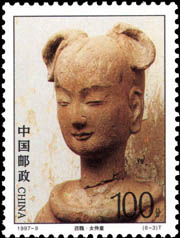
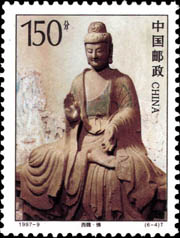
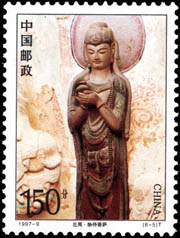
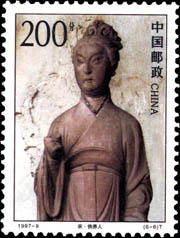
The third stamp of the 1988 definitive set R24 “Chinese Grotto Art” shows a Western Wei bodhisattva from Maijishan.

Banknotes and coins
The People’s Bank of China has issued the gold and silver coins “Chinese Grotto Art: Maijishan”.
Map
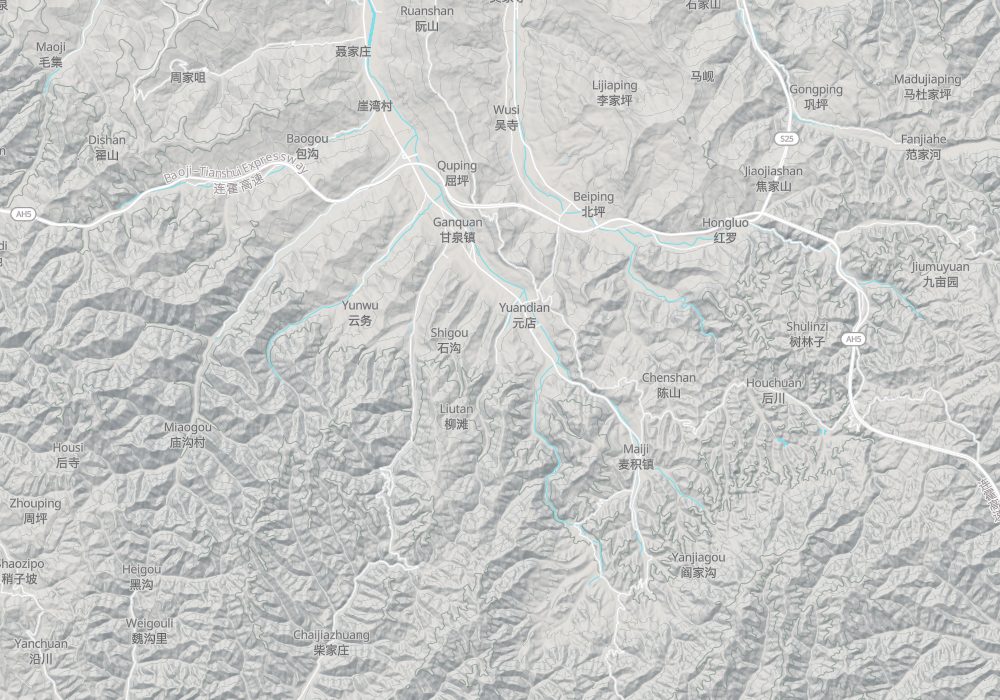
Photo credits: Maijishan: 颐园居 (CC BY-SA 4.0, Wikimedia Commons)
Nearby
| World Heritage | Silk Roads: the Routes Network of Chang'an-Tianshan Corridor 184km, Dafosi Grottoes 199km, Jiuzhaigou Valley 240km, Huanglong 271km |
| National parks | Guanshan Lianhuatai 101km, Mount Tiantai, Baoji 106km, Mount Kongtong 137km, White Dragon Lake 204km |
| AAAAA attractions | Liupan Mountain Red Army Long March Tourist Area 131km, Guan'e Gully Scenic Area 152km, Mount Taibai 165km, Famen Temple Buddhist Culture Scenic Area 177km |
| AAAA attractions | Yuquan Spring 28km, Suwan Cultural Tourism Area 29km, South Mountain 31km, Fuxi Temple 32km |
| Historic cities | Tianshui 30km |
| Historical sites | Maijishan Grottoes 6km, Fangmatan Tombs 12km |
| Nature reserves | Xiaolongshan National Nature Reserve 7km, Guanyinshan National Nature Reserve 95km, Liupanshan National Nature Reserve 143km |