 Park of China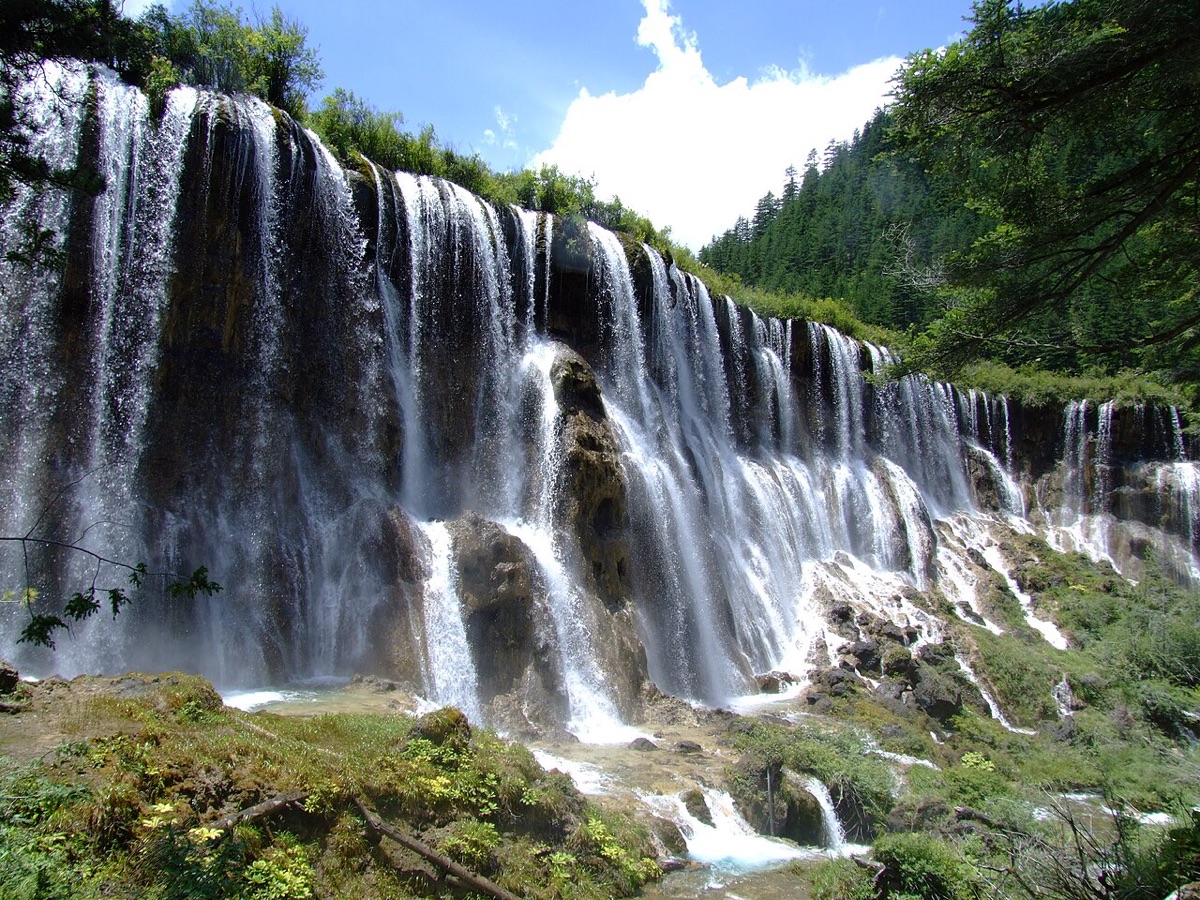
Overview
| Designation | UNESCO World Heritage (natural, 1992) AAAAA tourist attraction |
| Province | Sichuan |
| Location | Northern Sichuan |
| Mountains | Min Mountains |
| Latitude, longitude | 33.1, 103.9 Google Maps |
| Highlights | Multicoloured lakes, waterfalls, high mountains |
| Top sights | Nuorilang Waterfall |
| Wildlife | Giant panda |
| Highest point | 5,588 m |
| Nearby cities | Jiuzhaigou (Sichuan), Guangyuan, Chengdu, Lanzhou (Gansu) |
| Nearby sites | Huanglong 40km, Dujiangyan Irrigation System 235km, Maijishan Grottoes 240km, Mount Qingcheng 240km, Giant Panda National Park 251km Search nearby |
| Themes | Mountain, Snow Mountain, Valley, Waterfall, Lake, Stream, Forest, Wildlife, Stamp, Autumn colours, Ethnic cultures, Tibetan Buddhism, Hiking & climbing |
Jiuzhaigou
Jiuzhaigou (“Nine Village Valley”) lies in Jiuzhaigou County of the Aba Tibetan and Qiang Autonomous Prefecture in northern Sichuan and covers about 720 km². It is named after the nine Tibetan villages that stood in the valley: Heye, Panya, Yala, Jianpan, Heiguo, Shuzheng, Zechawa, Rexi and Guodu. The valley is dotted with brilliantly coloured lakes, groups of waterfalls and travertine shoals.
The main valley is Y-shaped and more than 50 km long; its three branches are the Rize, Shuzheng and Zechawa valleys, with six scenic zones: Shuzheng, Nuorilang, Jianyan, Long Lake, Zharu and Tianhai. The best-known sights are the Shuzheng lakes, Nuorilang Waterfall, Pearl Shoal Waterfall, Panda Lake Waterfall, the primeval forest, Five-Colour Pond and Long Lake.
More than half of the valley is primeval forest, nearly 30,000 hectares with over 2,000 plant species. It is home to 170 vertebrate and 141 bird species, 17 of them under national protection.
It was inscribed on the UNESCO World Heritage List in 1992, as a natural site.
Main sights
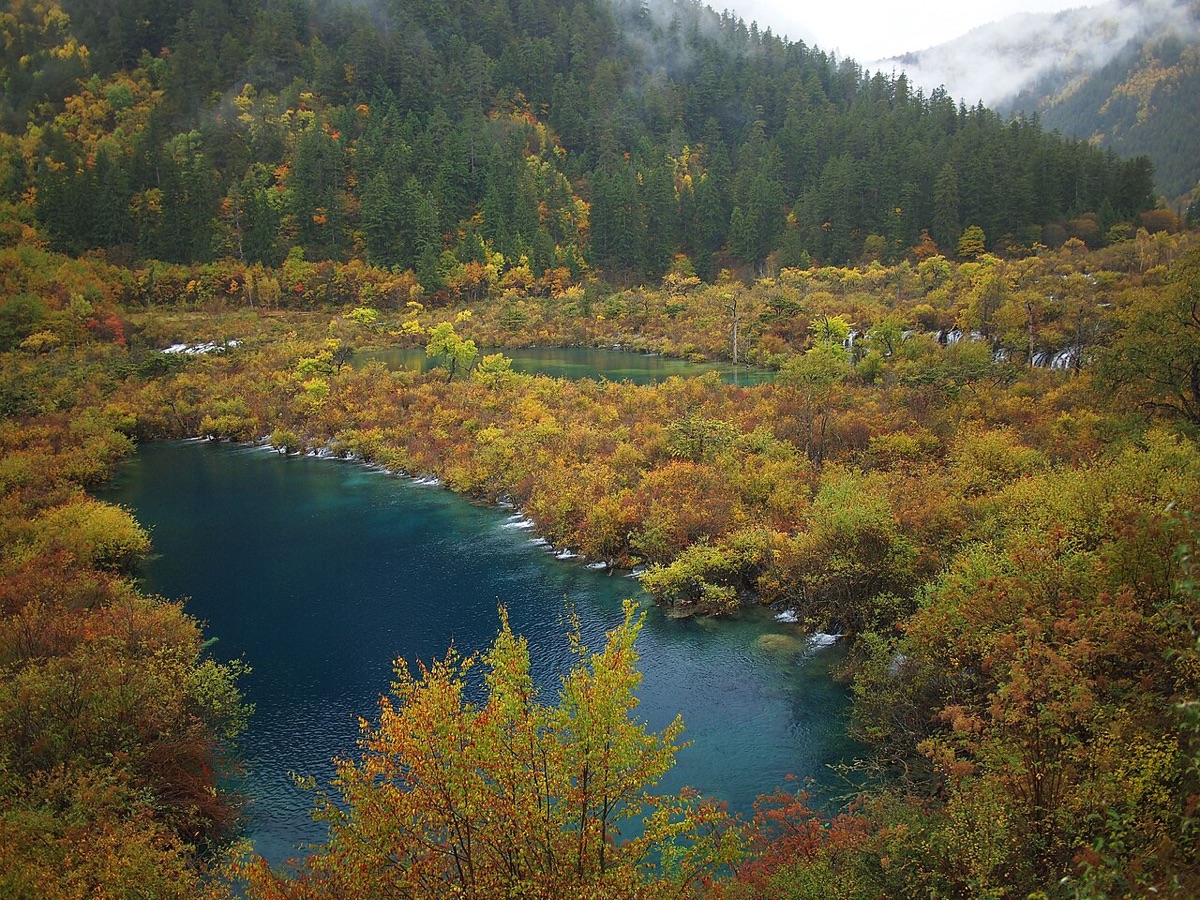
Shuzheng Lakes: in Shuzheng Gully, a flight of a dozen or so terraced lakes separated by travertine dams, each overflowing into the next in a series of small falls. Shuzheng village is one of the Tibetan villages in the valley.
Nuorilang Falls: at the head of Shuzheng Gully, about 300 m wide and among the widest travertine waterfalls in China. At high water they form a single white curtain. The Tibetan name is said to mean tall and majestic.
Mirror Lake: in the lower part of Rize Gully. When the surface is calm, the forest and mountains are clearly reflected.
Pearl Shoal Falls: in the middle of Rize Gully, where water spreads across a wide travertine shoal and then drops from its edge in a spray.
Five Flower Lake: in Rize Gully, with many colours in the water. Fallen trees on the bottom are coated in travertine and visible when the water is clear.
Panda Lake and Arrow Bamboo Lake: at the upper end of Rize Gully, deep blue and surrounded by old-growth forest. Panda Lake Falls lies downstream of Panda Lake.
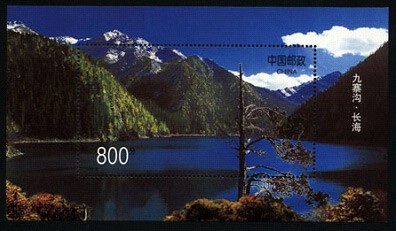
Long Lake: at the head of Zechawa Gully at about 3,100 m, the largest and deepest lake in the valley, long and narrow with snow peaks and forest around it.
Five Color Pond: in Zechawa Gully below Long Lake, small and deep, its water showing many colours from travertine and algae.
Five Color Pond, Huanglong: at the top of Huanglong Gully near the temple, the largest group of travertine pools in Huanglong, with water from yellow-green to blue in hundreds of pools of different sizes.
Huanglong Temple: a Taoist temple in the upper part of Huanglong Gully, originally with front, middle and rear temples, of which the rear temple at the head of the gully survives as the main one, next to the travertine pools of the gully.
Sleeping Dragon Lake: in Shuzheng Valley, about 20 m deep, with a calcareous dyke on the bottom shaped like a dragon lying in the water.
Long Lake has no surface outlet; it is fed by snowmelt and loses water mainly through seepage.
Seasonal Lakes: three lakes (upper, middle, lower) by the road in Zechawa Valley that fill and dry out over the year.
Geology and landscape
Most of the lakes and waterfalls in Jiuzhaigou and Huanglong are travertine landforms. Water flowing through limestone dissolves calcium carbonate, which settles out where the flow slows and carbon dioxide escapes, gradually building dams, shoals and waterfalls that hold back lakes.
The colour of the water depends on depth, the travertine on the bottom and the algae growing in it. The water is rich in calcium and very clear, so colours are sharp. Most of the valley's lakes, called haizi in Tibetan, lie between about 2,000 and 3,000 m.
Some of the lakes in the valley were formed when landslides or debris flows blocked the river. On 8 August 2017 a magnitude 7.0 earthquake struck Jiuzhaigou County, damaging the park and closing it, and changing some features. Repairs and reopening followed in stages.
The travertine pools of Huanglong run down a long gully, and the water changes colour from top to bottom with the travertine and microbial growth, one of the typical travertine landscapes of mainland China.
Travel tips
Getting there: Jiuzhai Huanglong Airport lies between the two areas; both the Jiuzhaigou entrance and Huanglong are over an hour's drive away. High-speed trains also run from Chengdu to Huanglong Jiuzhai station in Songpan, which is fairly close to Huanglong; the Jiuzhaigou entrance is about two hours on by road.
Booking: Jiuzhaigou requires advance booking under your real name, with a daily cap; book early in peak season.
Visiting Jiuzhaigou: inside the valley you can only use the park buses, getting on and off at each stop; boardwalks run along the lakes. Most visitors ride to the top of the Rize or Zechawa valley first and then work their way down, partly on foot, partly by bus.
Main sights at Jiuzhaigou: Long Lake and Five-Colour Pond in the Zechawa valley; Five-Flower Lake, Pearl Shoal, Panda Lake and Arrow Bamboo Lake in the Rize valley; the Shuzheng lakes and Nuorilang Falls in the Shuzheng valley.
Huanglong: the boardwalk from the entrance to the Five-Colour Pool is about 4 km and ends above 3,500 m. You can take the cable car up and walk down.
Time: a full day for Jiuzhaigou; half a day to a day for Huanglong.
Season: autumn, around October, has the best colours and the biggest crowds; summer is rainy, and after heavy storms parts of the park may close for a while; winter is quiet, and at Huanglong the cable car and other services may be suspended.
Where to stay: most hotels are in Zhangzha town near the Jiuzhaigou entrance; there are fewer near Huanglong.
Nearby: Kalong Valley, Muni Valley, Bipeng Valley and Gu’er Valley are also near the Jiuzhaigou–Huanglong area, if you have time.
Note: Huanglong is high, so walk slowly and watch for altitude sickness. On group tours, be aware of shopping and incense-burning stops.
Stamps
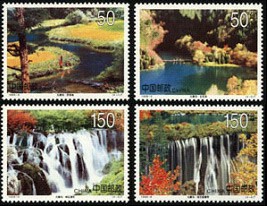
On 26 March 1998 China Post issued 1998-6T “Jiuzhaigou”, four stamps: Fangcao Lake (50 fen), Wuhua Lake (50 fen), Shuzheng Waterfall (150 fen) and Nuorilang Waterfall (150 fen), with a souvenir sheet 1998-6M of Long Lake (800 fen).
More photos
Map
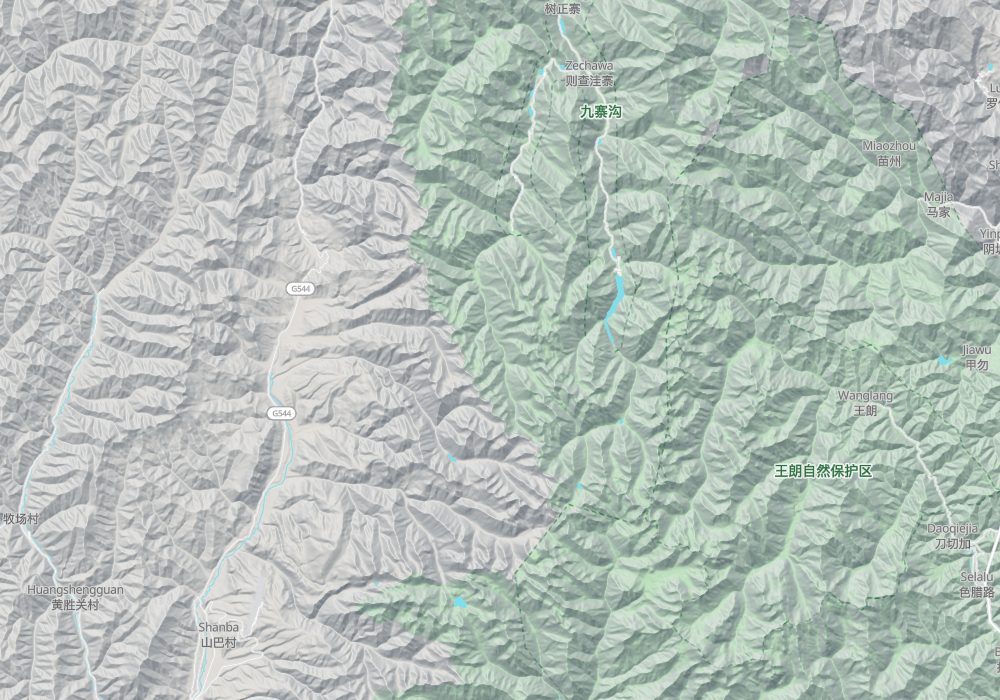
Photo credits: Nuorilang Waterfall, Jiuzhaigou: AlexHe34 (CC BY-SA 3.0, Wikimedia Commons); Shuzheng Lakes, Jiuzhaigou: rheins (CC BY 3.0, Wikimedia Commons)
Nearby
| World Heritage | Huanglong 40km, Dujiangyan Irrigation System 235km, Mount Siguniang and the Sichuan Giant Panda Sanctuaries 238km, Maijishan Grottoes 240km |
| National parks of China | Giant Panda National Park 251km |
| National parks | Jiuzhaigou–Huanglong Scenic Area 14km, White Dragon Lake 166km, Jianmen Pass and the Shu Road 179km, Mount Longmen 206km |
| AAAAA attractions | Guan'e Gully Scenic Area 109km, Beichuan Qiang City Tourist Area 151km, Wenchuan Special Tourist Area 182km |
| AAAA attractions | Chuanzhusi Town 45km |
| Nature reserves | Wanglang National Nature Reserve 24km, Baihe National Nature Reserve 32km, Baishuijiang National Nature Reserve 64km, Xuebaoding National Nature Reserve 67km |