 Park of China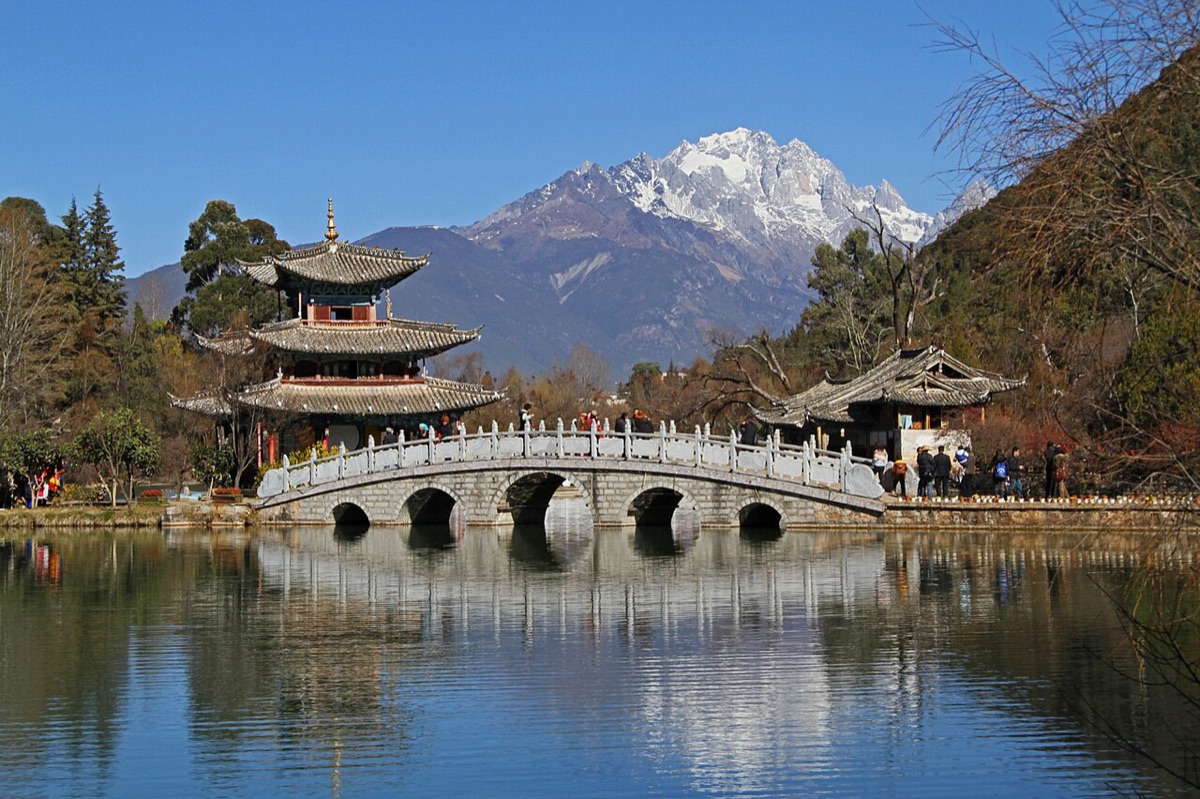
Overview
| Designation | UNESCO World Heritage (cultural, 1997) National Park of China (second batch) AAAAA tourist attraction |
| Province | Yunnan |
| Location | Lijiang and Ninglang counties, Yunnan |
| Mountains / Rivers and lakes | Yunling Mountains; Yangtze River |
| Latitude, longitude | 27.1, 100.2 Google Maps |
| Highlights | Snow mountain, old town, gorge, lake, matriarchal Mosuo culture |
| Top sights | Jade Dragon Snow Mountain, the Old Town of Lijiang, Tiger Leaping Gorge on the Jinsha River, Lugu Lake in Ninglang |
| Area | 777 km² |
| Highest point | 5,596 m |
| Nearby cities | Lijiang, Dali |
| Nearby sites | Three Parallel Rivers of Yunnan 36km, Dali Scenic Area 161km, Mount Luoji 224km, Tengchong Geothermal Area and Volcanoes 298km, Mount Gongga (Minya Konka) 319km Search nearby |
| Themes | Mountain, Snow Mountain, Peak, Long River, Canyon, Forest, Ancient City, Lake, Stamp, Cable Car, Glacier, Skiing, Ethnic cultures, Hiking & climbing, Alpine meadows |
Jade Dragon Snow Mountain
Jade Dragon Snow Mountain (Yulong Xueshan) in north-west Yunnan is the highest range of the Yunling Mountains and the southernmost mountain in the northern hemisphere with living glaciers. Its thirteen peaks all exceed 5,000 m; the main peak, Shanzidou, is 5,596 m, the second highest in Yunnan. The range runs 35 km north to south and about 20 km east to west; with snow on the summits all year and cloud about the slopes, from afar it looks like a jade dragon in flight, hence the name.
The Naxi people tell this story: Jade Dragon and Haba were twin brothers who lived by panning gold in the Jinsha River. One day a cruel demon king came from the north, seized the river and forbade panning. The brothers fought him with their swords; Haba, the younger, was beheaded, while Jade Dragon fought for three days and three nights, breaking thirteen swords before driving the demon away. Haba became the headless Haba Snow Mountain; Jade Dragon, holding his thirteen swords aloft day and night against the demon’s return, became the thirteen peaks, and the sweat of his battle became the Black Water and White Water rivers. The mountain is the outward symbol of the Naxi, and the hero of the legend their inner spirit; the Naxi protector god Sanduo is the mountain’s incarnation.
Shanzidou rises abruptly from the flat Lijiang basin, its ridge spread like a fan, like a warrior in silver helmet and jade armour. It is only about 25 km from the Old Town of Lijiang yet 3,200 m higher: eternal ice above, dense forest on the slopes and spring all year below, a rare “spring snow” landscape. The steep main peak was long unclimbed; a joint Chinese-American team first reached the summit in 2001.
Above 4,500 m are nineteen glaciers, with ice pinnacles and the “green snow” wonder; they are hanging and cirque glaciers, and the horns and comb-like arêtes between the cirques thrust skyward like swords, the basalt peaks cut into great pyramids. The sightseeing cable car runs from 3,365 m to 4,506 m, a length of 2,911 m. The ski ground on the north-east slope by the upper station is 1,000 m long and 600 m wide at 4,500 to 4,700 m; the mean temperature is 3.65 °C, the oxygen content 19.3% and the maximum wind 20 m/s.
The Nanzhao king Yimouxun, following Central Plains practice, named Yulong Snow Mountain the Northern Peak of his realm; in the early Yuan Kublai Khan, passing through Lijiang on his campaign against Dali, gave its deity a further title.
It is in the second batch of national parks of China (national scenic areas) named by the State Council in 1988.
Main sights
Glacier Park: the main cable car reaches the Glacier Park above 4,500 m, from where a boardwalk leads higher to a close view of the glacier and ice towers. The main peak, Shanzidou, stands behind.
Blue Moon Valley: a river valley at the foot of the mountain where the Baishui River is held back in a series of pools. The water is blue-green, with the snow peaks behind.
Spruce Meadow (Yunshanping): an alpine meadow on the slope, ringed by spruce forest. It is a common place to look across at the peaks, and a cable car goes up.
Yak Meadow (Maoniuping): a higher meadow where yaks are grazed in summer, also served by a cable car.
Ganhaizi: a meadow near the main entrance, and an open spot from which the whole range can be seen.
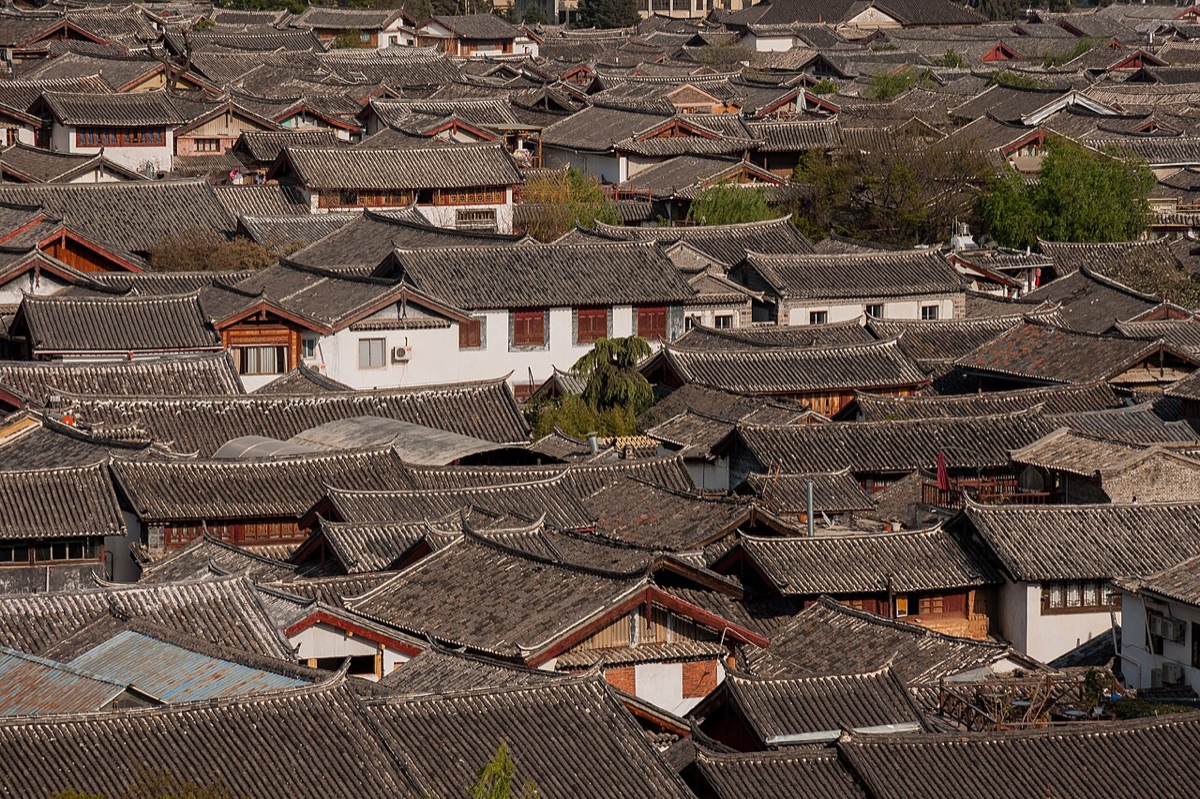
Old Town of Lijiang: also called Dayan, in the Lijiang basin. Streams run through the lanes, and the paved streets and Naxi houses are largely preserved. It was inscribed as a World Heritage Site in 1997, and Sifang Square is its central plaza.
Mu Residence: on the west side of the old town, the former seat of the hereditary Mu chieftains of the Naxi in the Ming and Qing periods. The present buildings are reconstructions, and the exhibits cover the chieftains' history.
Shuhe Old Town: northwest of the old town, an important market town on the Tea-Horse Road, smaller than Lijiang.
Baisha murals: in Baisha village on the southern foot of the mountain, Ming-dynasty murals that mix Buddhist, Daoist and Tibetan Buddhist themes.
Tiger Leaping Gorge: between Jade Dragon Snow Mountain and Haba Snow Mountain, where the Jinsha River is squeezed between the two ranges and drops fast.
Tiger Leaping Gorge has upper, middle and lower sections. At the upper section the river narrows to about 30 m around a boulder in midstream, from which, legend says, a tiger leapt across, giving the gorge its name.
History and culture
The Lijiang area is the main home of the Naxi people. Their Dongba culture takes its name from the priests, who write scriptures in a pictographic script still used today, sometimes called the living pictograph script.
Lijiang old town began to form around the end of the Song and the start of the Yuan and was the commercial centre of northwest Yunnan in the Ming and Qing. It has no city wall; a local explanation says the ruling family's name Mu, when enclosed by a wall, would make the character for 'trapped'. Water from the snow mountain is led into the lanes, giving the town its pattern of streams at every door.
A magnitude 7.0 earthquake struck in February 1996 and damaged the town. It was repaired to its old form and was inscribed as a World Heritage Site the next year.
Jade Dragon Snow Mountain is a sacred mountain for the Naxi. Their protector god Sanduo is said to be the mountain itself, and the Sanduo Festival on the eighth day of the second lunar month is a traditional festival. The old town, the mountain and the neighbouring Naxi, Bai, Tibetan and Mosuo communities together make up the varied culture of the area.
Travel tips
Getting there: fly to Lijiang Sanyi Airport, or take the train from Kunming or Dali to Lijiang station. The snow mountain scenic area is about 30 km north of Lijiang Old Town, reached by bus, tour coach or taxi. Inside the area, park buses link the sights.
Booking: the Glacier Park cable car has a daily limit and needs advance booking under your real name; in peak season it is often fully booked. Park entry and the cable car are booked separately, and you need both.
Glacier Park: the cable car rises to over 4,500 m, and a boardwalk climbs higher. Walk slowly at this altitude; people with heart or lung problems should not go up. The cable car stops in bad weather.
Other sights: Blue Moon Valley, Spruce Meadow (Yunshanping) and Yak Meadow (Maoniuping) are lower down; the two meadows each have a cable car.
Lijiang Old Town: in the city, seen on foot. It is crowded in the daytime and evening and quieter early in the morning. Shuhe old town, northwest of it, is smaller.
Tiger Leaping Gorge: north of Lijiang, on the Jinsha River; drive to Upper Tiger Leap to see the river. The high trail along the north side of the gorge is usually walked in two days.
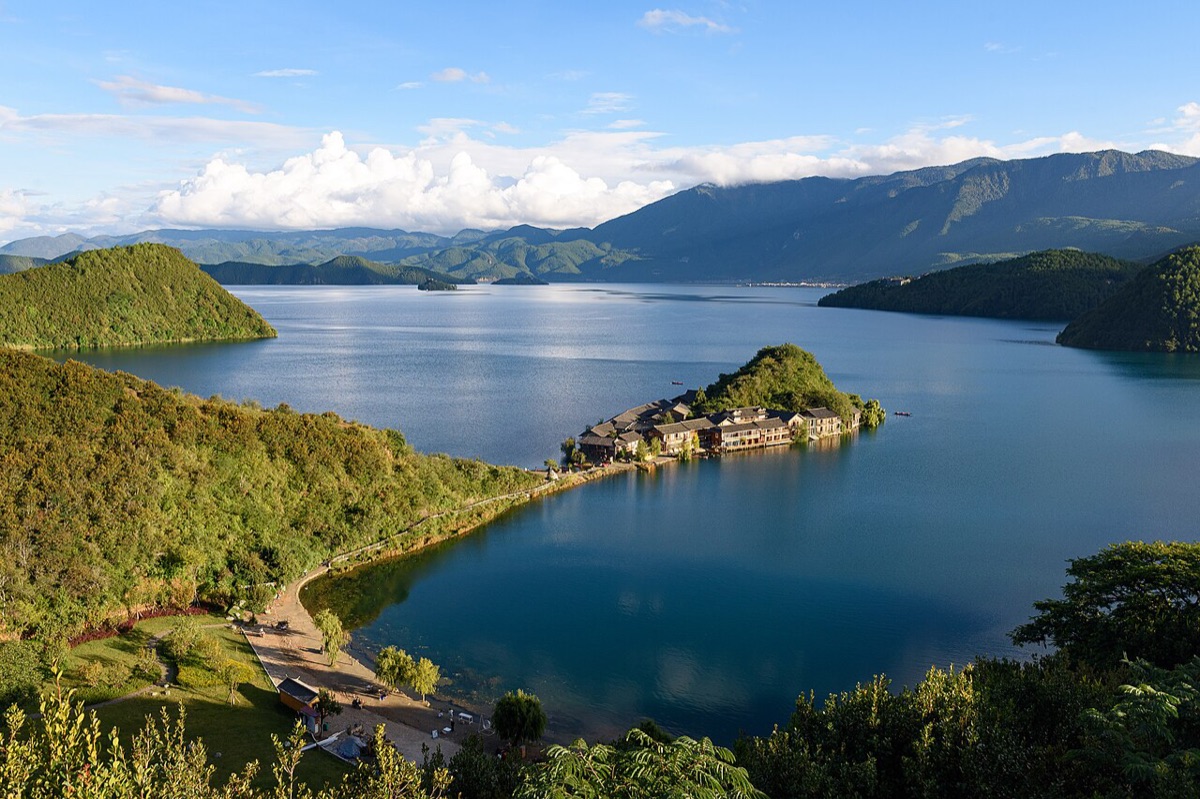
Lugu Lake: in Ninglang County, a long drive from Lijiang; plan two to three days for it on its own. There is an airport there, but flights are few.
Season: October to May has more clear days and better views of the mountain; June to September is the rainy season, when the summit is often in cloud and roads may be hit by landslides.
Time: one day for the snow mountain, one or two days for the old town, plus extra time for Tiger Leaping Gorge and Lugu Lake.
The Old Town of Lijiang
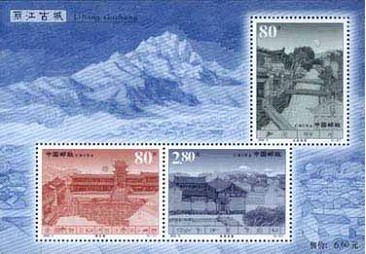
In 2002 China Post issued 2002-9T “The Old Town of Lijiang”, three stamps: Sifang Street, clear streams of the old town and Naxi houses, with a souvenir sheet 2002-9M.
More photos

Map

Photo credits: Tiger Leaping Gorge: CEphoto, Uwe Aranas (CC BY-SA 3.0, Wikimedia Commons); Jade Dragon Snow Mountain: Miltos Gikas (CC BY 2.0, Wikimedia Commons); Lugu Lake: N509FZ (CC BY-SA 4.0, Wikimedia Commons); Lijiang: CEphoto, Uwe Aranas (CC BY-SA 3.0, Wikimedia Commons)
Nearby
| World Heritage | Three Parallel Rivers of Yunnan 36km |
| National parks | Dali Scenic Area 161km, Qionghai Lake 226km |
| AAAAA attractions | Lijiang Old Town Scenic Area 31km, Potatso National Park, Shangri-La 77km, Daocheng Yading Scenic Area 147km, Three Pagodas of Chongsheng Temple Cultural Tourist Area 160km |
| AAAA attractions | Deqen Tiger Leaping Gorge Scenic Area 10km, Yushuizhai 17km, Dongba Pantheon Garden 17km, Dongba Valley 19km |
| UNESCO Global Geoparks | Dali-Cangshan UNESCO Global Geopark 168km |
| Historic cities | Lijiang 32km, Jianchuan County 73km |
| Historical sites | Jinsha River Rock Paintings 17km, Dabaoji Palace and Liuli Hall 22km, Murals of Dajue Palace 26km, Lijiang Puji Temple 28km |