 Park of China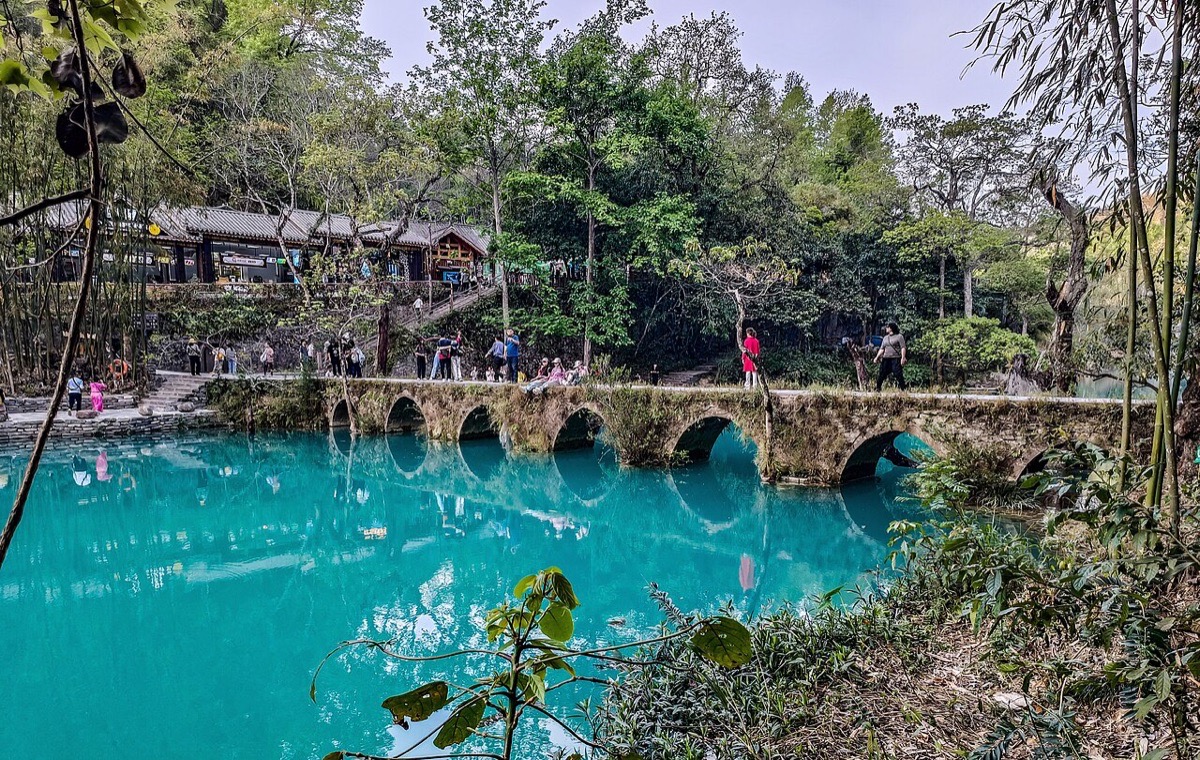
Overview
| Designation | UNESCO World Heritage (natural, 2007) National Park of China (third batch) |
| Province | Guizhou |
| Location | Libo County, southern Guizhou |
| Latitude, longitude | 25.3, 107.7 Google Maps |
| Nearby sites | Pingtang Scenic Area 75km, Liping Dong Villages 173km, Red Maple Lake 189km Search nearby |
| Nearby cities | Hechi (Guangxi) |
| Themes | River, Cave, Karst, Arch, Waterfall, Forest, Canyon |
About
The Libo Zhangjiang scenic area in Libo County, southern Guizhou, consists of the Little Seven-Arch and Mandarin Duck Lake area, the Big Seven-Arch and Di’e Palace area, the Shuichun River gorge and the Zhangjiang riverside. South China Karst, comprising Shilin in Yunnan, Libo in Guizhou and Wulong in Chongqing, was inscribed as a World Natural Heritage Site on 27 June 2007.
The Little Seven-Arch area is a karst forest growing in water, with more than ten rare tree species and over 70 cascades and waterfalls in a 2 km stretch of river. About 5 km away, the Immortals’ Cave of the Di’e Palace in the Big Seven-Arch area is more than 80 m high, with a natural bridge nearby.
Xiaoqikong takes its name from a seven-arched stone bridge over the Xiangshui River, built in the Daoguang reign of the Qing on the old road from southern Guizhou to Guangxi.
It was inscribed on the UNESCO World Heritage List in 2007 as part of “South China Karst”, as a natural site. It is in the third batch of national parks of China (national scenic areas) named by the State Council in 1994.
Travel tips
Getting there: Libo has an airport, and the Guiyang–Nanning high-speed line stops at Libo. From the county town, buses, tourist shuttles or taxis go to Xiaoqikong and Daqikong. Inside the scenic area, shuttle buses link the sights.
Xiaoqikong (Small Seven-Arch Bridge): the main area, with a chain of cascades, waterfalls and a 'forest in the water' along the Xiangshui River, plus Wolong Pool and Yuanyang (Mandarin Duck) Lake. It is seen on foot; the paths are mostly level but add up to several kilometres.
Daqikong (Big Seven-Arch Bridge): close to Xiaoqikong, with the old bridge, Di'e Cave, a natural bridge and a gorge. It has fewer visitors than Xiaoqikong.
Other sights: the Shuichun River gorge has rafting, depending on season and water levels; the Maolan reserve is primary karst forest with villages.
Time: Xiaoqikong takes most of a day; with Daqikong, allow one full day.
Season: from late spring to autumn the water is fuller; summer is rainy. Winter has less water but fewer people. Xiaoqikong is very crowded on public holidays.
Where to stay: in Libo county town or in the small town near the Xiaoqikong entrance.
Caution: stones and boardwalks by the water are slippery, especially in rain.
Stamps
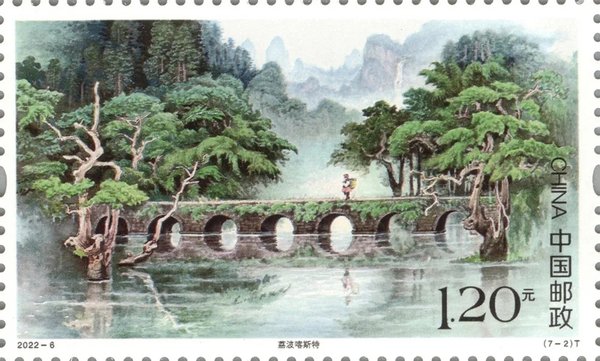
The second stamp of the 2022 set 2022-6 “World Natural Heritage – South China Karst” shows the Libo karst.
Map

Photo credits: Libo and the Zhangjiang River: FN-082 (CC BY-SA 4.0, Wikimedia Commons)
Nearby
| World Heritage | Huanjiang Karst 28km, Wuyang River 206km, Shibing Karst (Yuntai Mountain) 216km, Guilin Karst - Putao Fenling Karst Section 267km |
| National parks | Pingtang Scenic Area 75km, Rongjiang: Miao Mountains and Dong Waters 106km, Mount Doupeng and the Jian River, Duyun 129km, Liping Dong Villages 173km |
| AAAAA attractions | Qingyan Ancient Town Scenic Area 159km, Baise Uprising Memorial Park Scenic Area 186km |
| AAAA attractions | Zhenzhu Rock 58km |
| UNESCO Global Geoparks | Leye-Fengshan UNESCO Global Geopark 113km |
| National geoparks | Fengshan Karst National Geopark 113km, Luocheng National Geopark 115km, Dahua Qibainong National Geopark 122km, Baise Leye Dashiwei Tiankeng Group National Geopark 136km |
| Nature reserves | Mulun National Nature Reserve 26km, Maolan National Nature Reserve 37km, Jiuwanshan National Nature Reserve 85km, Leigongshan National Nature Reserve 135km |