A Brief History of ChinaChapter 2: Prehistory →
Chapter 1: Myths and Legends
Before writing, history is a chain of myths and legends. Legend says heaven and earth were at first a single chaos shaped like an egg, and Pangu was born inside it. After 18,000 years heaven and earth separated: what was light and clear rose to become heaven, what was heavy and murky sank to become earth. Pangu stood between them, holding them apart; each day heaven rose one zhang (about three meters), the earth grew one zhang thicker, and Pangu grew one zhang taller. When he died, his breath became wind and clouds, his voice thunder, his eyes the sun and moon, his blood the rivers, and his flesh the fields. This is the story of “Pangu separating heaven and earth.”
Then came Nüwa, who molded people from clay and melted stones to mend the sky; Fuxi, who drew the Eight Trigrams and taught people to make nets for fishing and hunting; and Shennong, who tasted hundreds of herbs and taught farming. There are also stories such as Gonggong striking Mount Buzhou in rage, Yi shooting down the ten suns, Chang’e flying to the moon and Cangjie inventing writing; Nüwa mending the sky and Yu taming the flood also appear in the Western Han Huainanzi. Most of these stories were written down only in the Warring States and Han periods; the Pangu story is the latest, first recorded in the Three Kingdoms period. They reflect how the ancients imagined the origin of the world and the dawn of civilization.
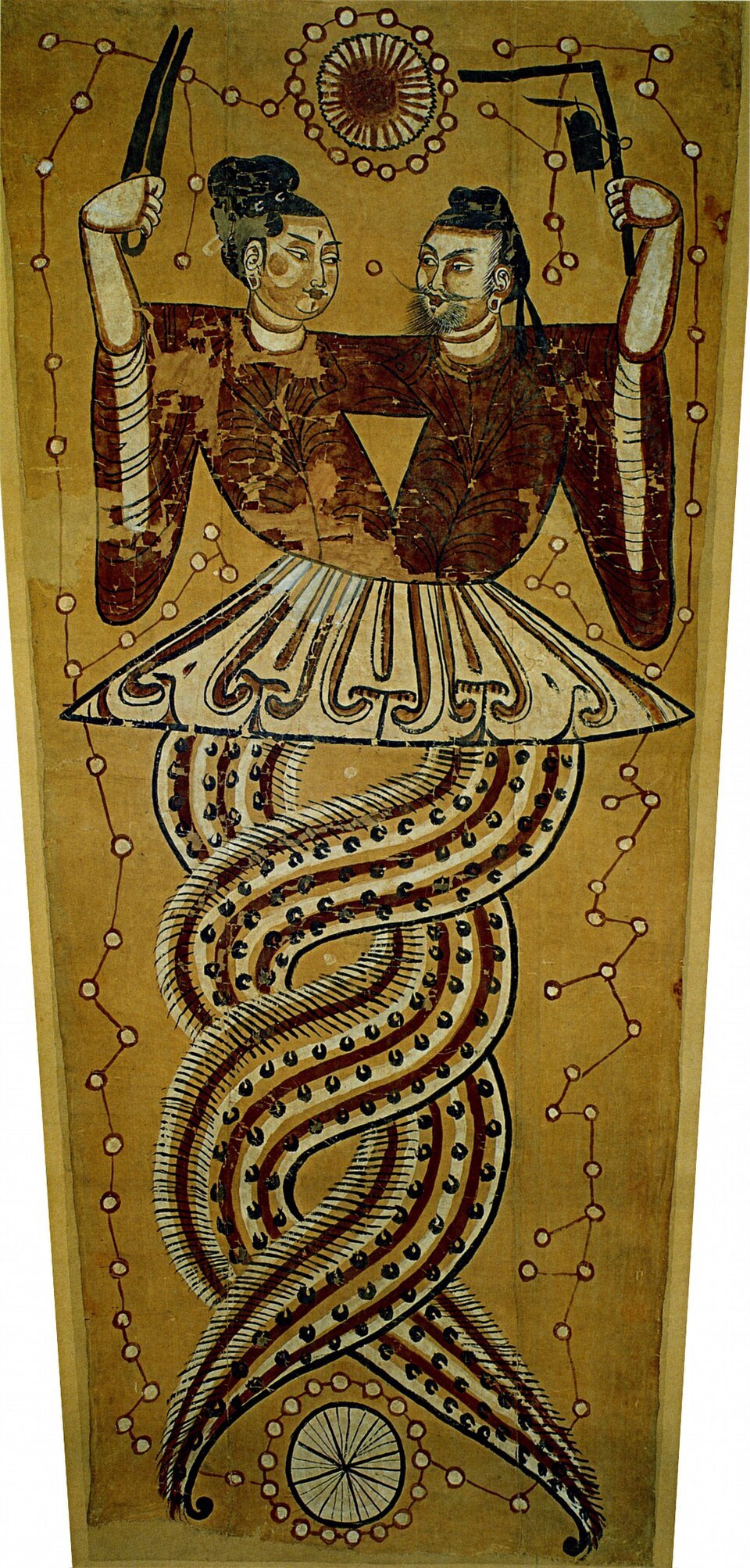
Accounts of the “Three Sovereigns and Five Emperors” vary. The Three Sovereigns are usually Fuxi, Nüwa (or Suiren) and Shennong; according to the “Annals of the Five Emperors” in the Shiji, the Five Emperors are the Yellow Emperor, Zhuanxu, Di Ku, Yao and Shun. Zhuanxu was the Yellow Emperor’s grandson; legend says he put gods and humans each in their own place and gave the worship of heaven and earth to dedicated officials, so that no longer could everyone commune with the spirits. Di Ku was the Yellow Emperor’s great-grandson and the father of Yao. Sima Qian placed the Yellow Emperor at the start of Chinese history: allied with the Yan Emperor, he defeated Chiyou at Zhuolu (the Battle of Zhuolu), and so later Chinese called themselves “descendants of Yan and Huang.” Sacrifices have been offered through the ages at the Mausoleum of the Yellow Emperor in Huangling County, Shaanxi.
Yao and Shun passed on the throne by “abdication” (shanrang), choosing the worthy rather than their sons. In Shun’s time floods spread across the land; Gun built dikes to block the water and failed after nine years. His son Yu instead cut channels to drain it, taming the flood over thirteen years and “passing his own door three times without going in.” After Yu died his son Qi succeeded him, and hereditary rule, “the realm as a family possession,” replaced abdication: this was the beginning of the Xia dynasty. The Mausoleum of Yu the Great stands at the foot of Mount Kuaiji in Shaoxing.
These legends cannot all be verified, but ancient cities, palaces and tombs found by archaeologists are gradually filling in this period.