 Park of China
Overview
| Province | Hubei |
| Location | Hubei |
| Latitude, longitude | 30.6, 114.3 Google Maps |
| Nearby sites | Mount Jigong 136km, Mount Jiugong 137km, Yueyang Tower 179km, Dongting Lake 193km, Mount Lu (Lushan) 197km Search nearby |
| Nearby cities | Nanjing, Hangzhou, Zhengzhou |
| Top sights | East Lake, Yellow Crane Tower |
| Themes | Big City, Long River, Ancient Building, Culture, Lake, Banknote, Stamp, Literary landmarks |
City sights
Wuhan Yangtze River Bridge
Yellow Crane Tower
The Wuhan Yangtze River Bridge was begun in September 1955 and opened on 15 October 1957, joining the three long-divided towns of Wuhan and linking the Beijing–Guangzhou railway across the river. A combined road and rail bridge, it is 1,670 m long, the main span 1,156 m on 8 piers and 9 arches, with 514 m of approaches and 35 m abutments, running from Qingchuan Pavilion and Turtle Hill to Lotus Lake, Snake Hill and the Yellow Crane Tower.
Yellow Crane Tower
The Yellow Crane Tower on Snake Hill in Wuchang is, with the Yueyang Tower in Hunan and the Tengwang Pavilion in Jiangxi, one of the three great towers south of the Yangtze. First built in 223 under the Wu kingdom, reputedly for military purposes, it was already a grand building by 765 in the Tang and became a famous sight visited by poets through the ages. Cui Hao’s poem “Yellow Crane Tower” is counted a masterpiece for all time: the immortal has flown off on his yellow crane, leaving only the tower and the drifting clouds, and the poet, looking over the river to Hanyang and Parrot Isle at dusk, longs for home.
The tower stood on Huanghe rock on Snake Hill and was built and destroyed again and again over 1,700 years; the last, the “Qing tower” of 1868, burned in 1884 and was not rebuilt for nearly a century.
Reconstruction began in October 1981 and finished in June 1985, modelled on the 1868 tower but larger: a reinforced-concrete frame imitating timber, five tiers of flying eaves, a pyramidal roof of golden glazed tiles, 51.4 m high, 30 m wide at the base and 18 m at the top, with murals, couplets and relics on each floor, and outside a bronze crane, the Shengxiang Pagoda, archways, galleries and pavilions.
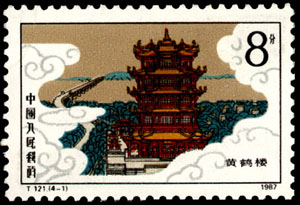
The first stamp of the 30 October 1987 set T121 “Famous Towers of China” shows the Yellow Crane Tower.
Banknotes
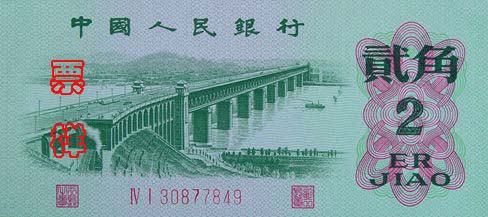
The 2-jiao note of the third series of renminbi (1964) shows the Wuhan Yangtze River Bridge.
Stamps
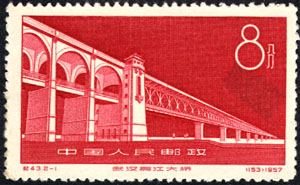
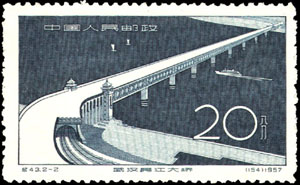
On 1 October 1957 China Post issued C43 “Wuhan Yangtze River Bridge”, two stamps.
Nearby
| World Heritage | Xianling Tomb of the Ming 173km, Mount Lu (Lushan) 197km |
| National parks | East Lake, Wuhan 14km, Lushui and the Red Cliff 106km, Mount Jiugong 136km, Mount Jigong 136km, Mount Dahong 159km, Huating Lake 182km |
| AAAAA attractions | Yellow Crane Tower Park 5km, East Lake Scenic Area 9km, Huangpi Mulan Culture and Ecology Tourist Area 56km, Three Kingdoms Red Cliff Battlefield Scenic Area 102km, Macheng Guifeng Mountain Scenic Area 105km, Tiantangzhai Tourist Area 153km |
| AAAA attractions | Wuhan Revolution Museum 4km, Wuhan Museum 5km, Huaxiang Tea Valley 6km, Wuchang Uprising Cultural Tourism Area (Xinhai Revolution Museum, Red Building, Uprising Gate) 6km, Wuhan Happy Valley 9km, Wuhan Garden Expo Park 9km |
| UNESCO Global Geoparks | Huanggang Dabieshan UNESCO Global Geopark 94km |
| National key parks | Wuhan Zhongshan Park 3km |
| Historical sites | Dazhimen Railway Station <1km, Site of the CCP Central Organs in Wuhan <1km, Site of the CCP Central Propaganda Department in Hankou 1km, Hankou Modern Building Complex 1km, Site of the Eighth Route Army Wuhan Office 2km, Tomb of the Martyrs of the Soviet Air Volunteer Group 2km |
| National geoparks | Dabieshan (Huanggang) National Geopark 134km |
| Nature reserves | Honghu Lake National Nature Reserve 124km, Liankangshan National Nature Reserve 127km, Dabieshan National Nature Reserve 134km |
| Historic villages | Dayuwan Village 49km |