
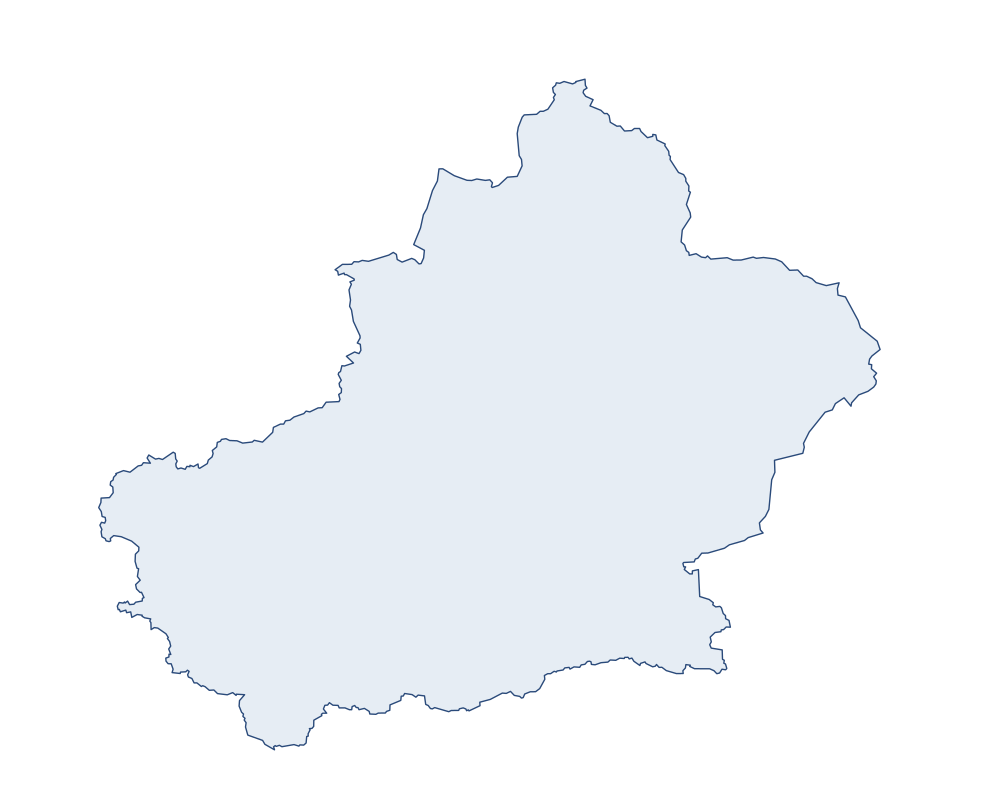
133 Major Historical and Cultural Sites Protected at the National Level in Xinjiang (batches 1–8, named by the State Council 1961–2019). Dots are coloured by category. See also Xinjiang and all provinces.
Liste:



Bezirk Aksu (18)
- Kizil Thousand-Buddha Caves (said to be cut in the 3rd century) 克孜尔千佛洞(传开凿于三世纪)Grotten und Steinschnitzereien · 1. Liste (1961)One of China's earlier Buddhist cave complexes, on the cliff on the north bank of the Weigan River valley; 236 numbered caves survive, 81 of them with murals, and it belongs to the culture of the ancient Kingdom of Kucha.
- Kumtura Thousand-Buddha Caves (said to be cut in the 3rd century) 库木吐喇千佛洞(传开凿于三世纪)Grotten und Steinschnitzereien · 1. Liste (1961)Part of the Kucha grottoes, extending about 3 kilometers along the cliffs of the Weigan River, with 112 surviving caves in various forms including central-pillar caves.
- Buddhistische Tempelstätte Subashi 苏巴什佛寺遗址Alte Fundstätten · 4. Liste (1996)Also called the Zhaohuoli Great Temple, a Buddhist monastery site of the Northern and Southern Dynasties to Tang, at the southern foot of the Quele Mountains.
- Tausend-Buddha-Höhlen von Simsim 森木塞姆千佛洞Grotten und Steinschnitzereien · 4. Liste (1996)Kucha-style cave group continuing from the Jin to the Song, the easternmost surviving Kucha grottoes.
- Signalturm Kizilgaha 克孜尔尕哈烽燧Alte Fundstätten · 5. Liste (2001)A Han dynasty beacon tower site near the Kizilgaha Grottoes, a relic of the beacon system the Han court operated in the Western Regions.
- Kizilgaha-Grotten 克孜尔尕哈石窟Grotten und Steinschnitzereien · 5. Liste (2001)Part of the Kucha grottoes, first built in the 5th century, with 54 caves surviving and the Kizilgaha beacon tower nearby.
- Stadtruine Tongusbasi 通古斯巴西城址Alte Fundstätten · 6. Liste (2006)The site of a military farming center under the Tang Anxi Protectorate.
- Alte Stadt Qiuci 龟兹故城Alte Fundstätten · 7. Liste (2013)Also called the Karadun Site, an ancient city of the Western Han to Song dynasties, identified as the former site of Yancheng of Qiuci in the Han and Yiluolu City in the Tang.
- Ruinen der alten Stadt Wushikate 乌什喀特古城遗址Alte Fundstätten · 7. Liste (2013)Also called Yuqikate Ancient City, meaning "triple city" in Uyghur; a site of the Han to Tang period.
- Buddhistische Tempelstätte Kesilertag 克斯勒塔格佛寺遗址Alte Fundstätten · 7. Liste (2013)Kucha-style Buddhist temple built against a mountain, consisting of a Buddha hall, monks' quarters and stupas, dating from about the Northern and Southern Dynasties to the Tang.
- Stadtruine Tangwang 唐王城遗址Alte Fundstätten · 7. Liste (2013)Ruinen einer alten Stadt der Tang-Zeit.
- Fundstätte Kuonaqilan 阔纳齐兰遗址Alte Fundstätten · 7. Liste (2013)Fundstätte der Qing-Zeit.
- Gräber an der Youyi-Straße in Kuqa 库车友谊路墓群Alte Gräber · 7. Liste (2013)More than ten ancient tombs of the Jin to Sixteen Kingdoms period, the only brick-chamber tomb group in Xinjiang.
- Mazar des Mulana Eshidin 默拉纳额什丁麻扎Alte Gräber · 7. Liste (2013)Mausoleum of Khoja Eshidin and his family, who introduced Islam to the Eastern Chagatai Khanate in the Ming period.
- Große Moschee von Kuqa 库车大寺Alte Bauwerke · 7. Liste (2013)Also called the Kuqa Jiaman Mosque, a Qing dynasty building and the main mosque of Kuqa.
- Fundstätten Ushi Tur und Xiahe Tur 乌什吐尔和夏合吐尔遗址Alte Fundstätten · 8. Liste (2019)Two ancient sites facing each other across the Weigan River, often treated as one; the main remains are buildings of the Wei and Jin to the Tang dynasty.
- Ruinen der alten Stadt Xiaoyangdakexiehaier 小央达克协海尔古城遗址Alte Fundstätten · 8. Liste (2019)Ruinen einer alten Stadt der Tang-Zeit.
- Inschrift des Liu Pingguo 刘平国刻石Grotten und Steinschnitzereien · 8. Liste (2019)An Eastern Han clerical-script cliff inscription recording how Liu Pingguo, Left General of Kucha, led men to cut the rock, build a pavilion and construct a pass.
Autonomer Bezirk Bayingolin der Mongolen (18)
- Ruinen der alten Stadt Loulan 楼兰故城遗址Alte Fundstätten · 3. Liste (1988)City site of the ancient Loulan kingdom of the Han and Jin periods, discovered by an explorer in 1900, an irregular square in plan, in the west of Lop Nur.
- Signaltürme am Kongque-Fluss 孔雀河烽燧群Alte Fundstätten · 5. Liste (2001)A group of Han dynasty beacon towers in the desert zone along the Kongque River, in Yuli County and Korla.
- Ruinen der alten Stadt südlich des Lop Nur 罗布泊南古城遗址Alte Fundstätten · 5. Liste (2001)Also called Haitou ancient city, an ancient city site of the Han to Jin, including the LK and LL cities and nearby residential sites, in the Lop Nur desert.
- Fundstätte Miran 米兰遗址Alte Fundstätten · 5. Liste (2001)A group of sites comprising remains of different periods, including Yixun city of the Shanshan kingdom, Han military farming and Tang garrison forts; winged angel figures in Greco-Roman style were found in the Buddhist temple murals.
- Stätte des buddhistischen Tempels Qigexing 七个星佛寺遗址Alte Fundstätten · 5. Liste (2001)A Buddhist site first built in the Jin, the largest Buddhist remains of the Yanqi state, which also retains pagodas, halls, grottoes and monks' quarters.
- Gräber von Chawuhu 察吾乎古墓群Alte Gräber · 5. Liste (2001)A group of tombs of the 10th to 5th century BC, in Hejing County.
- Gräber von Zaghunluq 扎滚鲁克古墓群Alte Gräber · 5. Liste (2001)A group of tombs of the Spring and Autumn and Warring States period, with square-framed tombs and family cluster burials, containing stone, pottery, wood, bronze and iron objects and wool and cotton textiles, about 2,700 years old.
- Gräber von Loulan 楼兰墓群Alte Gräber · 6. Liste (2006)Tomb groups from the Neolithic to the Jin related to the ancient state of Loulan.
- Alte Stadt und Gräber von Yingpan 营盘古城及古墓群Alte Fundstätten · 7. Liste (2013)Site of the Han to Jin periods centered on Yingpan Ancient City, including a temple, beacon towers and a public cemetery.
- Fundstätte Lancheng 兰城遗址Alte Fundstätten · 7. Liste (2013)Ruinen einer alten Stadt der Tang-Zeit.
- Gräberfeld Xiaohe 小河墓地Alte Gräber · 7. Liste (2013)Cemetery of the Xiaohe culture in the Lop Desert, dating to about 2000 to 1500 BC.
- Historischer Gebäudekomplex Gelber Tempel von Balguntai 巴仑台黄庙古建筑群Alte Bauwerke · 7. Liste (2013)Named "Yong'an Temple" in the Qing, a Gelug school Tibetan Buddhist monastery, called "Xiale Sumu Kulai" in Mongolian.
- Palast des Prinzen Manhan 满汗王府Stätten der neueren Geschichte · 7. Liste (2013)The former palace of the Torghut khan, completed in 1919; a palatial blue-gray brick-and-timber structure.
- Ehemalige Kommandozentrale für Kernwaffentests Hongshan 红山核武器试爆指挥中心旧址Stätten der neueren Geschichte · 7. Liste (2013)Formerly the PLA's National Defense Base 21, one of the locations of the headquarters and institutes of the "two bombs" test base.
- Ruinen der alten Stadt Zhuoerkute 卓尔库特古城遗址Alte Fundstätten · 8. Liste (2019)A Han-dynasty ancient city site, formerly called the Zhuoguotegin Ancient City.
- Ruinen der alten Stadt Bogedaqin 博格达沁古城遗址Alte Fundstätten · 8. Liste (2019)Ruinen einer alten Stadt der Han- bis Tang-Zeit.
- Ruinen der alten Stadt Kuonaxiehaier 阔纳协海尔古城遗址Alte Fundstätten · 8. Liste (2019)Ruinen einer alten Stadt von der Wei- und Jin- bis zur Tang-Zeit.
- Buddhistische Tempelstätte Huolashan 霍拉山佛寺遗址Alte Fundstätten · 8. Liste (2019)Stätte eines buddhistischen Tempels der Tang-Zeit.
Autonomer Bezirk Ili der Kasachen (18)
- Residenz des Generals von Ili 伊犁将军府Alte Bauwerke · 4. Liste (1996)Seat of the Qing Ili General, first built in the Qianlong years; the surviving remains were built in the Guangxu years.
- Alte Kupfermine Nulasai 奴拉赛铜矿遗址Alte Fundstätten · 5. Liste (2001)A Bronze Age copper mining and smelting site, with over ten shafts up to 20 m deep; radiocarbon dating puts it at about 2,500 years ago, and it has a mining area and a smelting area.
- Mazar des Tughluq Timur Khan 吐虎鲁克·铁木尔汗麻扎Alte Gräber · 5. Liste (2001)Also called the "Great Mazar", the mausoleum of Tughluq Timur Khan of the Yuan period.
- Shengyou-Tempel (Zhaosu) 昭苏圣佑庙Alte Bauwerke · 5. Liste (2001)A Tibetan Buddhist monastery, commonly called Lama Zhao in Chinese and Bogda Shagsum in Mongolian, a Qing dynasty building.
- Stele Commemorating the Pacification of the Dzungars 平定准噶尔勒铭碑Grotten und Steinschnitzereien · 5. Liste (2001)Also called the Gedeng Stele, with an inscription composed by the Qianlong Emperor recording the campaign pacifying the Dzungars, the only one of the four imperial steles Qianlong set up in the Western Regions to survive intact.
- Mazar des Sultans Uways Khan 速檀·歪思汗麻扎Alte Gräber · 6. Liste (2006)The tomb of Uways Khan of the Eastern Chagatai Khanate; the surviving building was rebuilt in 1876 in the traditional Chinese pavilion style.
- Jingyuan-Tempel 靖远寺Alte Bauwerke · 6. Liste (2006)Commonly called Lama Sumu, a Gelug-school Tibetan Buddhist temple and a religious building of the Xibe people.
- Site of the Political and Cultural Activity Center of the Three Districts Revolutionary Government 三区革命政府政治文化活动中心旧址Stätten der neueren Geschichte · 6. Liste (2006)The cultural activity center of the soldiers and civilians of Ili, Tacheng and Altay during the Three Districts Revolution, completed in 1949 and consisting of a reviewing stand, open-air theater and stage.
- Ruinen der alten Stadt Xiata 夏塔古城遗址Alte Fundstätten · 7. Liste (2013)Ruinen einer alten Stadt der Tang- bis Yuan-Zeit.
- Ruinen der neuen und alten Stadt Huiyuan 惠远新、老古城遗址Alte Fundstätten · 7. Liste (2013)Military and political center of Xinjiang in the Qing, first of the "Nine Cities of Ili", where the Ili General's Office and other government offices were based.
- Karun-Wachposten der Qing-Dynastie in Ili 伊犁清代卡伦遗址Alte Fundstätten · 7. Liste (2013)Frontier garrison sites of the Qing in the Ili region; "karun" means "sentry post" in Manchu and Xibe.
- Steinfigurengrab Xiaohongnahai 小洪纳海石人墓Alte Gräber · 7. Liste (2013)Stone figure tomb of the First Turkic Khaganate period; the figure is a round-carved reddish-brown granite warrior, possibly part of the mausoleum of the Western Turkic Nili Khagan.
- Minarett der Baitula-Moschee 拜吐拉清真寺宣礼塔Alte Bauwerke · 7. Liste (2013)The only surviving Qing dynasty individual building of the Jiefang South Road mosque in Yining, a four-story brick-and-wood structure in the style of a Central Plains drum tower.
- Glocken- und Trommelturm von Huiyuan 惠远钟鼓楼Alte Bauwerke · 7. Liste (2013)The bell and drum tower of the Qing dynasty new city of Huiyuan, covering 484 square meters, with three stories and triple eaves under a hip-and-gable roof, well preserved.
- Guandi-Tempel von Nadaqi Niru 纳达齐牛录关帝庙Alte Bauwerke · 7. Liste (2013)The Guandi Temple of the Qing dynasty Xibe camp of Nadaqi Niru.
- Große Shaanxi-Moschee in Yining 伊宁陕西大寺Alte Bauwerke · 7. Liste (2013)The largest mosque of the nine Qing dynasty cities of Ili and one of the earliest built in Ili.
- Former Site of the Three Districts Revolutionary Government 三区革命政府旧址Stätten der neueren Geschichte · 7. Liste (2013)Former site of the Three Districts Revolutionary Government, 1944-1949.
- Fundstätte am Schluchtausgang von Jirentai 吉仁台沟口遗址Alte Fundstätten · 8. Liste (2019)A large settlement site mainly of Bronze Age remains, composed of a residential area and high-platform remains, with a time span extending to the Sui and Tang.
Turpan (13)
- Alte Stadt Gaochang 高昌故城Alte Fundstätten · 1. Liste (1961)Site of an ancient central town of the Turpan Basin that lasted about a thousand years; the largest ancient city site preserved in Xinjiang, near the Flaming Mountains.
- Alte Stadt Yarkhoto 雅尔湖故城Alte Fundstätten · 1. Liste (1961)That is, the ancient city of Jiaohe, built on a plateau surrounded by two rivers; the largest and best-preserved city site built of rammed earth in the world.
- Tausend-Buddha-Höhlen von Bezeklik 柏孜克里克千佛洞Grotten und Steinschnitzereien · 2. Liste (1982)Buddhist cave temples of the Tang to Yuan period in Mutou Valley, the name meaning "place of beautiful decoration"; called Ningrong Cave Temple in the Tang, and part of the Gaochang grottoes.
- Sugong-Pagode 苏公塔Alte Bauwerke · 3. Liste (1988)Also called the Emin Pagoda, a brick pagoda of Islamic style built in the Qing by Emin Khoja, Prince of the Turpan Uyghurs, to commemorate his achievements.
- Gräber von Astana 阿斯塔那古墓群Alte Gräber · 3. Liste (1988)Tomb group from the Jin to the Tang, with burials in zones by family bounded by natural gravel, the common cemetery of the people of Gaochang.
- Fundstätte Taizangta 台藏塔遗址Alte Fundstätten · 5. Liste (2001)A single Buddhist temple site from the Tang to the Gaochang Uyghur period, the largest and fairly well-preserved temple site of its time in Xinjiang.
- Gräber von Yanghai 洋海墓群Alte Gräber · 6. Liste (2006)A cemetery on the Gobi at the southern foot of the Flaming Mountains, dating from the Bronze Age to the Tang, in three zones, with over a thousand tombs in one zone alone.
- Toyuq-Grotten 吐峪沟石窟Grotten und Steinschnitzereien · 6. Liste (2006)Begun around the 5th century and used until the 14th, with 157 surviving caves; the earliest and largest Buddhist cave temple in the Gaochang area.
- Unterirdisches Karez-Bewässerungssystem 坎尔井地下水利工程Stätten der neueren Geschichte · 6. Liste (2006)Turpan's traditional underground water system, which intercepts groundwater from the Tian Shan and carries it by covered channels to the center of the basin.
- Ruinen der alten Stadt Asa 阿萨古城遗址Alte Fundstätten · 7. Liste (2013)Ancient city site of the Tang to Song dynasties, also called Asa Xiehaier, made up of a larger and a smaller ancient city.
- Alte militärische Verteidigungsanlagen im Turpan-Becken 古代吐鲁番盆地军事防御遗址Alte Fundstätten · 7. Liste (2013)General name for military sites along the Han-Tang ancient Western Regions road in the Turpan Basin, 62 in all, including beacon towers, post stations, garrison forts and military farms.
- Ruinen der alten Stadt Liuzhong 柳中古城遗址Alte Fundstätten · 7. Liste (2013)Ancient city whose earliest surviving remains date from the Tang, in Lukqin Town, and which remained in use until the Qing.
- Bexihar-Grotten 伯西哈石窟Grotten und Steinschnitzereien · 7. Liste (2013)Buddhist grottoes of the Gaochang Uyghur period, ten caves in all, with murals in a Central Plains style and the rare Vimalakirti Sutra transformation scene.
Bezirk Hotan (12)
- Fundstätte Niya 尼雅遗址Alte Fundstätten · 4. Liste (1996)Archaeological site in the heart of the Taklamakan Desert in the lower reaches of the Niya River, generally believed to be the land of the Jingjue kingdom of the Western Regions in the Han.
- Alte Stadt Yuansha 圆沙古城Alte Fundstätten · 5. Liste (2001)Also called Yumulakkum ancient city, in the heart of the Taklamakan Desert, an ancient city site over 2,200 years old.
- Ruinen der alten Stadt Andir 安迪尔古城遗址Alte Fundstätten · 5. Liste (2001)Anciently called Tanglan city, a circular ancient city site of the Han and Jin about 200 m in diameter inside, known as the sister city of Niya.
- Buddhistische Tempelstätte Rawak 热瓦克佛寺遗址Alte Fundstätten · 5. Liste (2001)A Khotan Buddhist site of the Northern and Southern Dynasties in Gandharan architectural style; the name means "pavilions and towers".
- Gräber von Shanpula 山普拉古墓群Alte Gräber · 5. Liste (2001)A group of tombs from the Warring States to the Northern and Southern Dynasties, about 4 km long east to west, one of the largest and best-preserved tomb groups in the Hotan area.
- Fundstätte Dandan Oilik 丹丹乌里克遗址Alte Fundstätten · 6. Liste (2006)Anciently called Jiexie, an ancient site of the Northern and Southern Dynasties to the Tang, on the southern edge of the Taklamakan Desert.
- Festungsruine Mazartagh 麻扎塔格戍堡址Alte Fundstätten · 6. Liste (2006)A Tang garrison fort in Khotan guarding the post road, also used as a military base when Tubo controlled Khotan.
- Fundstätte Karadun 喀拉墩遗址Alte Fundstätten · 7. Liste (2013)Ancient site of the Han to Northern and Southern Dynasties period.
- Buddhistische Tempelstätten Damagou 达玛沟佛寺遗址Alte Fundstätten · 7. Liste (2013)Khotanese Buddhist remains consisting of three Topruk Dun temples; Temple No. 1 was first built in the 6th to 7th century.
- Etika-Moschee in Yutian 于田艾提卡清真寺Stätten der neueren Geschichte · 7. Liste (2013)Moschee aus der Republikzeit.
- Anwesen des Turdi Haji 吐尔迪·阿吉庄园Stätten der neueren Geschichte · 7. Liste (2013)Herrenhaus, 1915 fertiggestellt.
- Wachposten Saitula 赛图拉哨卡遗址Stätten der neueren Geschichte · 8. Liste (2019)Site of a border sentry post used from the late Qing until 1962, commonly called Akpos, at an altitude of about 3,800 meters.
Hami (12)
- Buddhistische Tempelstätte Baiyanggou 白杨沟佛寺遗址Alte Fundstätten · 5. Liste (2001)Stätte eines buddhistischen Tempels der Tang-Zeit.
- Alte Stadt Dahe 大河古城Alte Fundstätten · 5. Liste (2001)Also called Dahe Tang City, the largest and best-preserved Tang dynasty ancient city site in the Hami area.
- Gräber von Yanbulak 焉不拉克古墓群Alte Gräber · 5. Liste (2001)A cemetery of the Bronze Age to early Iron Age in the Hami Basin, dating to about 1100 to 500 BC, from which the Yanbulak culture takes its name.
- Gräber von Wubao 五堡墓群Alte Gräber · 6. Liste (2006)Gruppe bronzezeitlicher Gräber.
- Gräber der Hui-Fürsten von Hami 哈密回王墓Alte Gräber · 6. Liste (2006)The tomb complex of the Jasag Prince Heshuo Qinwang of Hami and members of the royal family, mainly the tomb of the seventh Hui prince.
- Fundstättengruppe Yuegongtai–Xiheigou 岳公台一西黑沟遗址群Alte Fundstätten · 7. Liste (2013)Site cluster of the Spring and Autumn to Warring States period.
- Fundstättengruppe Shirenzigou 石人子沟遗址群Alte Fundstätten · 7. Liste (2013)Large settlement site cluster of ancient nomadic peoples of the Han period.
- Signaltürme von Hami 哈密境内烽燧遗址Alte Fundstätten · 7. Liste (2013)Beacon tower sites of the Tang to Qing periods, spread across Hami, Barkol County and Yiwu County.
- Gräberfeld Baiqier 拜其尔墓地Alte Gräber · 7. Liste (2013)Bronzezeitlicher Friedhof.
- Ruinen der alten Stadt Lafuqueke 拉甫却克古城遗址Alte Fundstätten · 8. Liste (2019)Ruinen einer alten Stadt der Tang-Zeit.
- Ruinen der Altstadt von Barkol 巴里坤故城遗址Alte Fundstätten · 8. Liste (2019)Ruinen einer alten Stadt der Qing-Zeit.
- Inschriften von Huancaigou 焕彩沟石刻Grotten und Steinschnitzereien · 8. Liste (2019)Inscribed on three faces, with content from the Yonghe era of the Eastern Han, the Zhenguan era of the Tang and the Qianlong era of the Qing.
Bezirk Kashgar (10)
- Mazar des Afaq Khoja (Grab) 阿巴和加麻札(墓)Alte Gräber · 3. Liste (1988)Islamic family mausoleum, called "Abakh Khoja Mazar" in Uyghur, in the northeastern suburb of Kashgar, whose occupant is Ydayatulla.
- Tempelstätte Mor 莫尔寺遗址Alte Fundstätten · 5. Liste (2001)A Buddhist monastery site built in the 2nd to 3rd century, the best preserved of the architectural remains of the ancient Shule state, destroyed around the 10th century.
- Fundstätte Tokuzsarai 托库孜萨来遗址Alte Fundstätten · 5. Liste (2001)Also called the Tang King City, the site of Tang dynasty Weitou Prefecture city; in Uyghur "Tokuzsarai" means "nine stations".
- Ruinen der Steinstadt 石头城遗址Alte Fundstätten · 5. Liste (2001)An ancient city built on a hillside, covering about 100,000 square meters, with surviving Jin and Tang city remains, temples and Qing government offices, and walls with stone foundations.
- Id-Kah-Moschee 艾提尕尔清真寺Alte Bauwerke · 5. Liste (2001)The largest mosque in Xinjiang, first built in the Ming in the old city of Kashgar, one of the more influential mosques in Central Asia.
- Grab von Mahmud al-Kashgari 麻赫穆德·喀什噶里墓Alte Gräber · 6. Liste (2006)The tomb of Mahmud al-Kashgari, a scholar of the Karakhanid dynasty, on Opal Mountain.
- Königsgräber des Khanats Yarkand 叶尔羌汗国王陵Alte Gräber · 6. Liste (2006)Königsgräber des Khanats Yarkant aus der Ming-Zeit.
- Jiaman-Moschee in Shache 莎车加满清真寺Alte Bauwerke · 7. Liste (2013)The oldest and largest mosque in Shache, a Qing dynasty building.
- Ruinen der Prinzessinnenfestung 公主堡古城遗址Alte Fundstätten · 8. Liste (2019)Ruinen einer alten Stadt der Tang-Zeit.
- Gräberfeld Jirzankal 吉尔赞喀勒墓地Alte Gräber · 8. Liste (2019)Also called the Sun Cemetery, on the bank of the Tashkurgan River; an Eastern Zhou cemetery formed of black and white stone strips.
Autonomer Bezirk Changji der Hui (7)
- Ruinen der alten Stadt Beiting 北庭故城遗址Alte Fundstätten · 3. Liste (1988)Site of the seat of the Tang Beiting Protectorate, locally called Pochengzi and also known as Houbaozi Ancient City.
- Fundstätte Shichengzi 石城子遗址Alte Fundstätten · 7. Liste (2013)Eastern Han ancient city site, a Han-dynasty site in Xinjiang with accurate dating and well-preserved layout; excavated from 2014 to 2019 and named one of that year's Top Ten New Archaeological Discoveries in China.
- Ruinen der alten Stadt Tangchaodun 唐朝墩古城遗址Alte Fundstätten · 7. Liste (2013)Seat of Pulei County in the Tang dynasty, continuously used under the Gaochang Uyghurs, the Western Liao and the Mongol Yuan, and abandoned in the 15th century; covering about 160,000 square meters.
- Signaltürme im Bezirk Changji 昌吉州境内烽燧群Alte Fundstätten · 7. Liste (2013)Site cluster of 20 beacon towers, 5 post stations and 1 Tang-dynasty road, dating from the Tang to the Qing.
- Felsbilder von Kangjia Shimenzi 康家石门子岩雕刻画Grotten und Steinschnitzereien · 7. Liste (2013)Large-scale Bronze Age cliff carvings covering about 120 square meters, carved with more than 300 human and animal figures.
- Stätte der militärischen Landerschließung Xiaolizhuang 小李庄军垦旧址Stätten der neueren Geschichte · 7. Liste (2013)A complex of Corps division headquarters buildings of 1953 in Soviet collective-farm style, fairly well preserved.
- Ruinen der alten Stadt Manas 玛纳斯古城遗址Alte Fundstätten · 8. Liste (2019)Also called the Lounan Ancient City and commonly the Pochengzi; the highest-ranking city site in the west of Tingzhou in the Tang dynasty, covering about 290,000 square meters.
Urumqi (6)
- Alte Stadt Wulabo 乌拉泊古城Alte Fundstätten · 5. Liste (2001)The earliest and best-preserved ancient city site within Urumqi, dating from the Tang to the Yuan.
- Haupthalle der Großen Shaanxi-Moschee in Urumqi 乌鲁木齐陕西大寺大殿Alte Bauwerke · 7. Liste (2013)Bau aus der Qing-Zeit, die größte Hui-Moschee in Ürümqi.
- Former Site of the Eighth Route Army Office in Xinjiang 八路军驻新疆办事处旧址Stätten der neueren Geschichte · 7. Liste (2013)Location of the Eighth Route Army's office in Xinjiang during the War of Resistance against Japan; now a memorial museum.
- Volkstheater Xinjiang 新疆人民剧场Stätten der neueren Geschichte · 7. Liste (2013)A theater completed in 1956, combining Eurasian architectural styles with ethnic character.
- Konfuziustempel Urumqi 乌鲁木齐文庙Stätten der neueren Geschichte · 8. Liste (2019)Moved in 1922 from the Dihua Confucian Temple; the only Qing-style temple building in Xinjiang that is completely preserved.
- Ehemaliges Büro und Wohnheim von Mao Zemin 毛泽民办公室及宿舍旧址Stätten der neueren Geschichte · 8. Liste (2019)Where Mao Zemin lived and worked in Dihua in the 1940s; now part of a memorial museum.
Bezirk Altay (5)
- Gräber und Hirschsteine von Sanhaizi 三海子墓葬及鹿石Alte Gräber · 5. Liste (2001)A group of Bronze Age sites on the Altai watershed, made up of three valleys at about 2,700 m above sea level, with tombs and deer stones.
- Qiemuerqieke Stone Figures and Stone Coffin Tombs 切木尔切克石人及石棺墓群Alte Gräber · 5. Liste (2001)Stone figures and stone coffin tombs of the early Bronze Age, dating to about 2700 to 1800 BC, on the Gobi near Altay City.
- Alte Gräber von Kuokeke 阔科克古墓群Alte Gräber · 7. Liste (2013)Bronzezeitliche alte Gräbergruppe.
- Gräber im Landschaftsgebiet Groß-Kanas 大喀纳斯景区墓葬群Alte Gräber · 7. Liste (2013)Tomb group of the Bronze Age to the Iron Age, in the Kanas scenic area.
- Fundstätte Tongtian-Höhle 通天洞遗址Alte Fundstätten · 8. Liste (2019)The first Paleolithic cave site found in Xinjiang, with cultural remains continuing from the Paleolithic to the Bronze Age and early Iron Age.
Autonomer Bezirk Bortala der Mongolen (5)
- Steinfigurengräber von Arixiate 阿日夏特石人墓Alte Gräber · 6. Liste (2006)Gräber mit Steinfiguren aus der Sui- und Tang-Zeit.
- Ruinen der alten Stadt Dalete 达勒特古城遗址Alte Fundstätten · 7. Liste (2013)Known locally as Pochengzi; possibly the site of Boluo City of the Karakhanid to Eastern Chagatai Khanate period, abandoned in the 14th century.
- Alte Gräber am Sayram-See 赛里木湖古墓群Alte Gräber · 7. Liste (2013)Ancient tomb group of the Bronze Age and the Han to Tang period, around Sayram Lake.
- Arixiatekeke Stone Enclosures and Stone Mound Tombs 阿日夏特科克石围及石堆墓群Alte Gräber · 7. Liste (2013)Stone enclosures and stone mound tombs of the Spring and Autumn to Warring States period.
- Steinumfriedungsgräber und Felsbilder von Adunqiaolu 阿敦乔鲁石栅古墓群及岩画群Alte Gräber · 7. Liste (2013)Stone fence tomb group of the Spring and Autumn to Warring States period, with rock art.
Bezirk Tacheng (4)
- Rotes Gebäude von Tacheng 塔城红楼Stätten der neueren Geschichte · 6. Liste (2006)The best-preserved and largest Russian-style modern building in Xinjiang, completed in 1914 and named for its iron-red exterior walls.
- Altsteinzeitliche Fundstätte Luotuoshi 骆驼石旧石器遗址Alte Fundstätten · 7. Liste (2013)Late Paleolithic open-air stone tool workshop site, discovered in 2004 by Chinese, American and Russian scholars.
- Ruinen der alten Stadt Dorbon Oirat Sen 道尔本厄鲁特森木古城遗址Alte Fundstätten · 7. Liste (2013)Built around the 1640s in the late Ming; the Mongolian name means "Temple of the Four Oirats", and when completed it may have been the political, economic and religious center of the Dzungars.
- Minarette der Moscheen Hanake und Saitikamale 哈纳喀及赛提喀玛勒清真寺宣礼塔Alte Bauwerke · 7. Liste (2013)Minarett einer Moschee aus der Qing-Zeit in Tacheng.
Karamay (2)
- Erster Ölbrunnen Xinjiangs 新疆第一口油井Stätten der neueren Geschichte · 7. Liste (2013)The first oil well drilled in Xinjiang, in the late Qing; a symbol of the rise of Xinjiang's modern petroleum industry.
- Ölbrunnen Nr. 1 von Karamay 克拉玛依一号井Stätten der neueren Geschichte · 7. Liste (2013)Originally called Black Oil Mountain Well No. 1, the first well of the Karamay oilfield, which began producing oil in 1955.
Autonomer Bezirk Kizilsu der Kirgisen (1)
- Mazar des Abdul Ajem 艾比甫·艾洁木麻扎Alte Gräber · 6. Liste (2006)A Muslim mazar built in the late 19th century, in Upper Artux Town.
Shihezi (1)
- Stätten der militärischen Landerschließung in Shihezi 石河子军垦旧址Stätten der neueren Geschichte · 8. Liste (2019)Made up of three buildings: the former office building of the 22nd Corps organ built in 1952 (now the Corps Military Reclamation Museum), the Corps small auditorium, and the former offices and residences of Tao Zhiyue and Zhang Zhonghan.
Alar (1)
- Stätte der militärischen Landerschließung Yu'ergun 玉尔滚军垦旧址Stätten der neueren Geschichte · 8. Liste (2019)A military reclamation building group begun in 1971 and completed in 1973, including the Yu'ergun club, an open-air cinema and a clinic; clay-carved slogans such as 'Practice thrift and build the country with diligence' remain on the walls.