 Park of China
Overview
| Name | Jingzhou 荆州 |
| Web address | https://parkofchina.com/en/cityjingzhou.html |
| Province | Hubei |
| Location | Hubei |
| Latitude, longitude | 30.35, 112.19 Google Maps |
| Top sights | Jingzhou city wall, Jingzhou Museum, Jinancheng site, Guandi Temple |
About
Jingzhou, in south-central Hubei on the Jianghan Plain north of the Yangtze, was known in the past as Jiangling and is one of the first National Famous Historical and Cultural Cities. The old walled town of Jingzhou was the seat of Jiangling County and is now the centre of the city of Jingzhou. See also Cities of China.
About five kilometres north of the city, Jinancheng was Ying, capital of the state of Chu in the Spring and Autumn and Warring States periods, for more than four hundred years; the many Chu tombs around it have yielded lacquerware, silks and bamboo slips. In the Three Kingdoms period Jingzhou was fought over by Wei, Shu and Wu, and the famous stories of Liu Bei “borrowing” Jingzhou and Guan Yu losing it took place here.
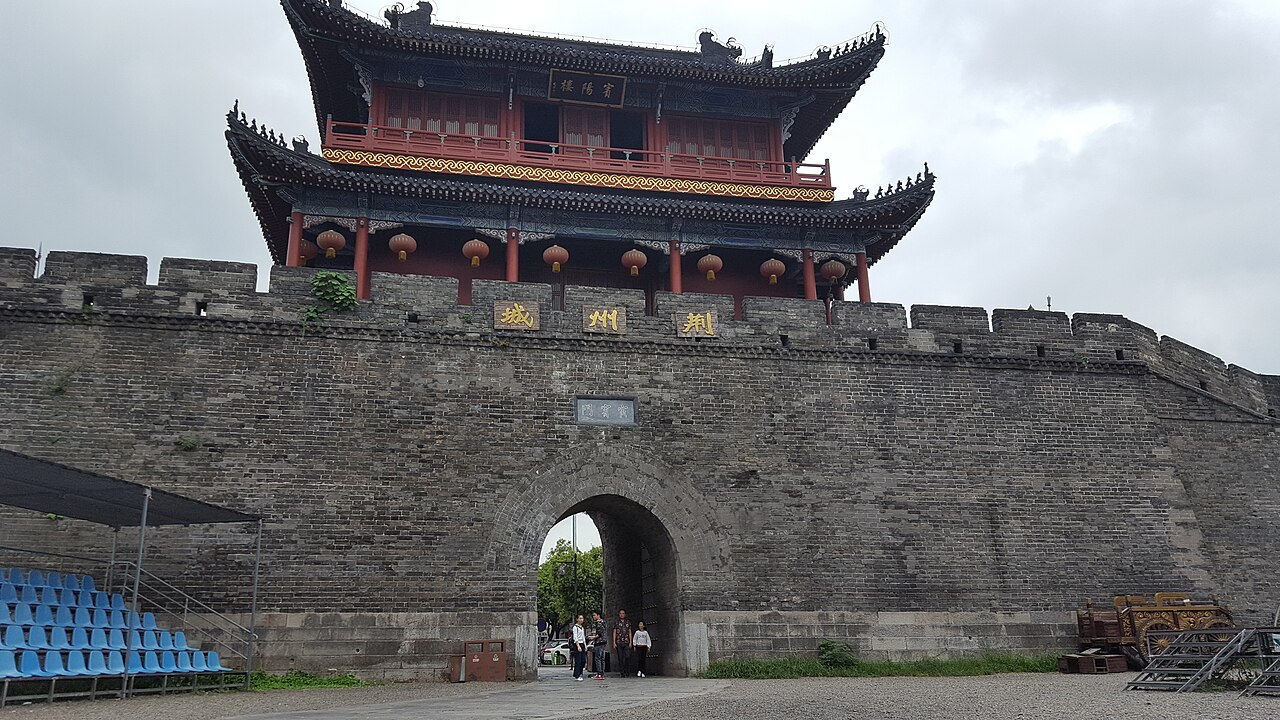
The Jingzhou city wall is a brick wall of the Ming and Qing, more than ten kilometres round, with most of its gates, barbicans and gate towers intact — one of the best-preserved city walls in southern China — and a moat around it. The Jingzhou Museum in the town holds finds from Chu and Han tombs and is known for its Warring States silks, lacquered woodwork and a preserved Western Han body.

Travel tips
Getting there: High-speed trains run to Jingzhou station; Jingzhou Shashi Airport is east of the city.
Sightseeing: The city wall can be walked or cycled round, and the Jingzhou Museum takes half a day. Yichang and the Three Gorges are to the west.
Photo credits: Binyang Tower, Jingzhou city wall: Fxqf (CC BY-SA 4.0, Wikimedia Commons); The moat outside the east gate of Jingzhou: Popolon (CC BY-SA 3.0, Wikimedia Commons)