Park of China
Overview
| Designation | US National Park |
| Location | Alaska, about 200 miles north of Anchorage |
| Latitude, longitude | 63.2, -150.8 Google Maps |
| Highlights | Highest peak in the US, snow mountains, glaciers, tundra, wildlife |
| Top sights | Denali, wildlife |
| Wildlife | Grizzly bears, Dall sheep, caribou, moose, wolves |
| Area | 6,029,000 acres |
| Highest point | 20,310 ft |
| Nearby cities | Anchorage |
| Nearby sites | Lake Clark National Park and Preserve 330km, Kenai Fjords National Park 380km, Wrangell–St. Elias National Park 433km, Gates of the Arctic National Park 525km, Katmai National Park and Preserve 570km Search nearby |
| Official website | http://www.nps.gov/dena/index.htm |
| Themes | Mountain, Snow Mountain, Famous Mountain, Peak, Glacier, Wildlife, Cliff, Forest, River, Stream, Valley, Glacial, Stamp, Night sky & aurora, Hiking & climbing, Scenic drives |
About
Denali National Park lies in the Alaska Range, about 200 miles north of Anchorage. It is the most visited national park in Alaska.
The Alaska Range runs 600 miles from east to west. Its highest peak, Denali (formerly Mount McKinley), is inside the park.
At 20,310 feet, Denali is the highest peak in North America.
Because the land around it is low, locals claim it has the greatest base-to-summit rise of any mountain in the world.
The park's main sights are snow mountains, tundra and wildlife. There are also glaciers, rivers, conifer forests and ponds.
Wildlife is plentiful. The main large mammals are grizzly bears, Dall sheep, caribou, moose and wolves.
An entry ticket is valid for one week.
With a national parks pass, entry is free.
Visitor map
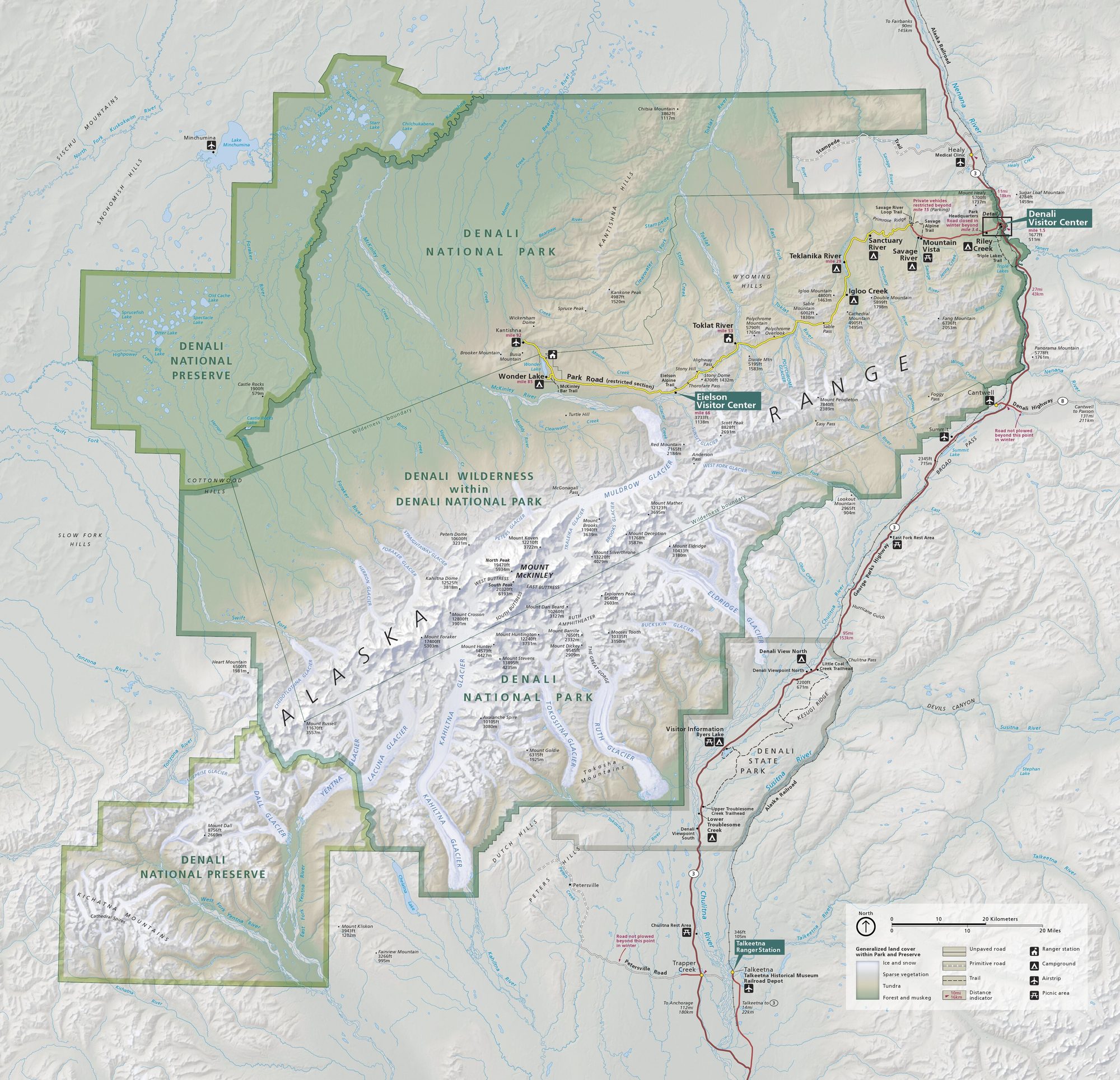
Main sights
Denali: the highest peak of the Alaska Range, at 20,310 ft the tallest mountain in North America. The park road follows its northern side, and on clear days the mountain can be seen near the entrance, around Savage River, and from Stony Hill Overlook, Eielson Visitor Center and Wonder Lake.
Park Entrance Area: the start of the road, with a visitor center, railroad depot, bus transfer point and campground. Several short trails begin nearby.
Savage River: at mile 15, the end of the road for private vehicles. The valley is wide, a short trail runs along the river, and Dall sheep and marmots are sometimes seen.
Teklanika River: at mile 29, where the road crosses a broad braided riverbed with bare gravel slopes and low shrubs on both sides.
Sable Pass: around mile 38, a core area for brown bears. Getting off the bus is restricted here to protect wildlife, and watching from the vehicle is the usual way to see animals.
Polychrome Pass: at mile 46, where the road winds along a high slope. Volcanic rock on the opposite hillsides shows red, orange and yellow tones, with a braided river valley below.
Toklat River: at mile 53, another braided river with a wide gravel bed where grizzly bears and caribou are often seen.
Eielson Visitor Center: at mile 66, set among glaciers, scree and tundra. On clear days Denali is seen at close range, and the view is one of the widest along the road.
Wonder Lake: at mile 85, the largest lake near the road and the closest to the mountain, which stands to the south. On calm clear days it is reflected in the water. There is a campground at the lake.
Kantishna: the end of the road at mile 92, a former gold-mining district. A few private lodges remain, and relics of the mining period are left in the valleys.
Geology and landscape
The Alaska Range is an arc of mountains raised where the Pacific Plate pushes beneath the North American Plate. The rock around Denali is mainly granite, and the mountain rises about 18,000 ft from lowlands near 2,000 ft on its north side, which is part of why it looks so tall.
The Denali Fault runs along the north side of the park, and its valley guides the park road. On 3 November 2002 a magnitude 7.9 earthquake struck on this fault, one of the largest recorded in interior Alaska.
Glaciers descend from the mountain on all sides. Kahiltna Glacier, on the south side, is about 70 km long and is the main starting point for climbing expeditions. Meltwater carrying fine rock flour runs into the valleys and forms the broad braided rivers seen along the road.
Permafrost in the park is discontinuous. Where it thaws in summer the ground sinks and spruce trees lean, forming so-called drunken forest. Tundra covers the higher slopes, and above the tree line the views are open, which is why distant animals are easy to spot from the bus.
Travel tips
Getting there: the nearest big city is Anchorage, with Fairbanks also within reach. The drive from Anchorage takes four to five hours; the Alaska Railroad runs trains to the park entrance, and there are summer coaches.
Park road: the only road is 92 miles long, and private vehicles may drive only the first 15 miles; beyond that you ride the park bus or a tour bus, and you can get off and on along the way.
Buses: there are several kinds of bus; those that go far take many hours; Seats are scarce in peak season, so book ahead.
Wildlife: grizzly bears, caribou, moose, Dall sheep and wolves sometimes appear beside the road, and drivers stop for them; do not approach.
The mountain: Denali, formerly Mount McKinley, is often hidden by cloud. Flightseeing trips, mostly from Talkeetna, go close to the summit.
On foot: there are several trails near the entrance; most of the park has none, and you may leave the bus at stops and walk cross-country.
Time: allow at least two days, one for the bus and one for trails or a flight.
Season: summer is short, and buses typically run from late May to mid-September, with very long days. In winter the road and facilities are mostly closed, but aurora and skiing are possible.
Where to stay: towns outside the entrance have hotels and the park has campgrounds, which should be booked early in season; a few private lodges lie deeper in the park.
Caution: mosquitoes are numerous in summer, and almost no food is sold in the park, so carry food and water on the bus.
Park road and buses
A single road runs into the heart of the park from the entrance in the east, along the north side of the Alaska Range. It is 92 miles long, and private cars may use only the first 15 miles from the entrance.
To see the interior of the park you must ride a park bus.
In peak season, book bus tickets in advance.
Past Mile 15 the road is gravel, and some mountain stretches are rather hair-raising.
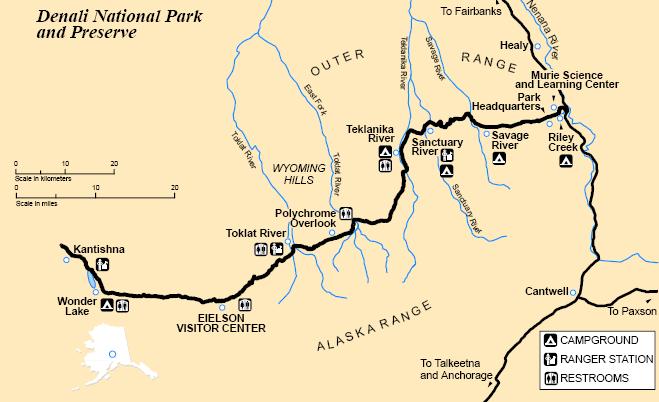
Bus stops and mileage:
Entrance: Mile 0
Savage River: Mile 15
Teklanika River: Mile 29
Polychrome Overlook: Mile 47
Toklat River: Mile 53
Wonder Lake: Mile 85
Kantishna: Mile 92
The road from the entrance to Savage River at Mile 15 is paved and needs no ticket. Private cars may drive it, and the park also runs a free shuttle on this stretch.
On clear days you can see Denali from about Mile 9 to Mile 11.
Suggested itinerary
Day one: ride the park bus to Wonder Lake at Mile 85 and back. Allowing time for wildlife watching and breaks, the trip takes about 11 hours.
Day two: take a small sightseeing plane over Denali.
With more time, visit the park's Visitor Center and Wilderness Access Center and watch the excellent short film about Denali. You can also hike the trails near the park entrance.
With still more time, watch a sled dog demonstration.
Half-day trip: ride the bus to Polychrome Overlook or Toklat River.
Getting there
By car: the park entrance is at Mile 236 of Highway 3 (the George Parks Highway). The small towns of Healy and Cantwell are nearby.
Highway 8 (the Denali Highway): you can reach the park from the east on Highway 8. Most of it is gravel, and speeds are usually limited to 30 mph.
By train: the Alaska Railroad has a station at the park entrance.
By air: there are small airstrips at Healy, Cantwell and Kantishna, deep in the park.
Where to stay
Denali Backcountry Lodge
There are many hotels near the park entrance.
Park map
Flightseeing
Small-plane tours of the park and Denali leave from near the park entrance or from the Talkeetna airport south of the park.
Flights last about 1 to 2 hours.
Some planes land on glaciers inside the park.
The main flightseeing companies at Denali are:
K2 Aviation
Talkeetna Air Taxi
Talkeetna Aero Services
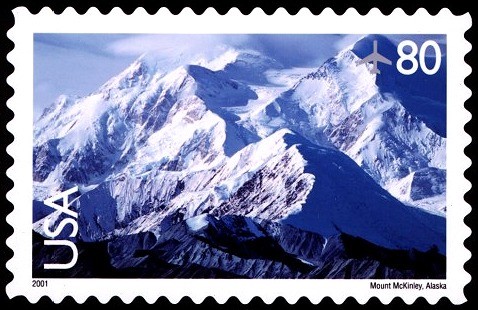
Stamps
Tips
In peak season, book hotels and bus tickets in advance.
Mountain weather changes fast. The chance of seeing Denali is only about 25%.
Do not approach or feed wildlife in the park.
No food is sold inside the park. Bring your own food and drink on the bus.
Besides the park buses there are also tour buses. They provide food and commentary, but cost more.
Bus drivers have no duty to give commentary, but most do. Riders usually tip.
Going into the park, sit on the left side of the bus.
Since most of the road is gravel, the back of the bus is bumpy.
Alaska's mosquitoes are fierce, and worst of all at Wonder Lake. Bring insect repellent.
Alaska summer days have up to 21 hours of daylight, so you can start early and stay out late.
Map